Paper commentary
Learning When Diffusion Language Models Should Regenerate
- Problem Remasking lets a diffusion language model revise text it has already committed, but revision needs a signal for when to revise.
- Method Trains a verifier that shares the frozen backbone of the generator through a low-rank adapter and a small head, using only final-answer labels. At inference it regenerates a block whenever the verifier scores the partial canvas below 0.5.
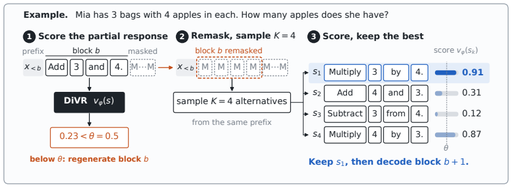
Figure 2 :DiVR-guided block re-decoding.DiVR scores the canvas, masked suffix included, after each block (B= 4 here, 32 in the experiments). A score belowθ triggers four alternatives of the block from the same prefix, and the best-scoring state (s1, 0.91) replaces the original. Text and scores are illustrative.
Original paper · CC BY 4.0 · Minhae Oh, Jeonghye Kim, Jinwoo Koo, Yeongoon Kim, Jimin Seo, Minsik Seol, Jungwoo Lee · Learning When Diffusion Language Models Should Regenerate · Original paper figure · Extracted the figure area from page 4 of the original PDF.Why revision needs a learned trigger
Masked diffusion language models fill masked positions of a partial canvas in parallel, so each position is predicted with the whole response in view. Standard decoding never returns to a token once it has been committed, so an early wrong answer tends to stay in the output.
External process reward models trained on autoregressive solutions avoid this token-level problem, but they never see the internal states of the generator.
Where the errors sit, and whether finding them helps
Two decoders are compared. Commit-once fills masked positions in confidence order and never changes them, while confidence-based remasking may mask filled positions again so that a committed mistake can be revised.
A linear probe on final-layer hidden states separates wrong cells from correct ones with AUROC 0.838 at the final state, while confidence, scored as 1 minus the top-1 probability, reaches 0.685.
The authors read this as showing that the error signal is present in the states but that re-predicting the wrong tokens under the same context rarely repairs them. Their proposal is to regenerate a region jointly and to judge the alternatives by how they turn out, which is the step DiVR takes.
A verifier built on the generator's states
Training states are block prefixes followed by masked suffixes, the same states that decoding visits. They come from the generator's own sampled responses, and each is labelled with the binary outcome of its completed response. For a sampled response \(y_i\), the state after block \(b\) is written as \[ s_{i,b} = [\,q;\; y_{i,1:bB};\; \mathrm{MASK}_{L-bB}\,] \] where \(q\) is the prompt, \(L\) the response-canvas length and \(B\) the block length.
The final-layer states are pooled over all response positions, including masked ones and excluding the prompt, and the pooled vector goes to a two-layer perceptron whose output is passed through a logistic function. The formula is \[ h_\phi(s) = f_{W+\Delta W_\phi}(s),\quad z_\phi(s) = \mathrm{MLP}_\phi\Big(\tfrac{1}{L}\sum_{t=1}^{L} h_\phi(s)_t\Big),\quad v_\phi(s) = \sigma\big(z_\phi(s)\big) \]
Block re-decoding at inference
The original block is kept unless one of the alternatives scores higher. Decoding then continues, and each regeneration counts against the budget, which is at most three regenerations per problem in the main setting.
Remasking the whole block means its tokens change together, which the diagnosis suggested is needed, and the procedure does not need to find the error or its cause. Best-of-k is the second use of the verifier: the generator samples k complete responses and the one whose final state scores highest is returned.
Accuracy and cost against search and post-training
Canvases hold 256 tokens, or 512 for MATH-500, and are decoded in 32-token blocks with 16 steps per block. Benchmarks are three math sets, GSM8K, MATH-500 and Countdown, and two code sets, HumanEval and MBPP.
On average, guided decoding therefore uses about 70% of SR-SMC's computation and less than half of Prism's.
Fine-tuning raises Countdown from 10.6% to 35.6% on LLaDA-8B-Base, and guided decoding raises it further to 47.2%. For the reinforcement-learning generator, a diffu-GRPO run of 3,800 steps on GSM8K, guided decoding raises the average from 40.1% to 45.4%, and the verifier adds 6.0 points on GSM8K and 11.2 on Countdown over the RL generator's greedy decoding.
On the Instruct model the same verifier adds 3.8 and 7.4 points on those two benchmarks, so the RL and verifier gains appear to add together.
Where the repairs begin
On MATH-500 the same comparison gives 50% for wrong and 14% for right solutions, so one block already separates most trajectories by outcome on GSM8K and Countdown. The authors attribute the second source to repairability: the first block fixes how the problem is read, and later blocks inherit that setup, so a fresh first block can take a different route while a fresh later block cannot.
Which score drives regeneration
The authors read the ordering as showing that the generator's own signals recover little of the gain, while an outcome-trained score helps even when the generator's hidden states are left unchanged. The difference between the head-only verifier and DiVR, 74.2% against 78.8%, is attributed to reshaping the representation through the adapter, so that the outcome information becomes easier to use.
Ranking candidates from the same pool
Every selector chooses from the same four SFT-generator responses per problem, so the pool is identical across methods. Oracle pass@4, the ceiling of the pool, is 85.4 on GSM8K, 43.4 on MATH-500 and 49.8 on Countdown, and a uniformly chosen candidate scores 68.7, 24.6 and 33.7.
DiVR best-of-4 reaches 82.2% on GSM8K, against 75.7% for majority vote, 34.2% on MATH-500 against 28.8%, and 49.2% on Countdown against 38.2%.
On GSM8K, DiVR's pair accuracy is 0.705 after the first block and 0.919 for finished responses. On Countdown it is 0.957 already after the first block. Useful discrimination therefore appears after the first block, which is where most repairs begin.
How sensitive the result is to the threshold
The threshold of 0.5 was chosen on the GSM8K development split, and the sensitivity figure varies it on the test sets with K=4 and at most three regenerations, all else fixed.
On MATH-500, which lies outside the domain where the threshold was chosen, accuracy still peaks at 0.5. The authors read this as a low threshold missing errors and a high threshold regenerating correct work too often.
Limits of the evidence
The diagnosis uses one model setup, LLaDA-8B-Instruct after one epoch of Sudoku training, and 190 uniquely solvable 4×4 puzzles, so its findings are not shown for other tasks or generators.
Best-of-4 uses about four times the greedy budget, so it is compared with the search baselines at similar cost rather than with guided decoding at its lower cost. The cost reported counts forward passes, and the baselines are reimplemented on the same generators and decoder rather than taken from their original releases.
A negative training label marks a trajectory as failed rather than marking the state as wrong, so the verifier's score is a judgment about outcomes and not a localization of errors. The threshold was selected on GSM8K development data, and its out-of-domain behaviour was checked on MATH-500 only.
Paper info
- Authors
- Minhae Oh, Jeonghye Kim, Jinwoo Koo, Yeongoon Kim, Jimin Seo, Minsik Seol, Jungwoo Lee
- Venue
- arXiv · Preprint
- First published
- 2026-11-12
- Added
- 2026-11-14
- Updated
- 2026-11-12
- Version
- v1
- arXiv
- 2611.17320
- Category
- cs.CL
- Original paper terms
- CC BY 4.0
- What we show
- Paper info, commentary and permitted figures from the original paper
AI commentary is a separate explanation from the original paper and may contain errors. The original paper and figures follow each source's terms of use and any rights noted separately.
Abstract
Remasking allows diffusion language models to revisit generated text, but effective correction requires knowing when and what to revise. Our diagnosis on Sudoku reveals two gaps. Hidden states contain error information that token confidence does not reliably expose, and remasking an isolated error usually reproduces it when the surrounding context remains fixed. These findings motivate DiVR , a verifier that predicts whether a partially generated sequence will reach a correct answer. Trained on the final correctness of the model's own trajectories, DiVR decides when to regenerate a block and which alternative to retain, while the generator itself stays unchanged. On five reasoning benchmarks with LLaDA-8B-Base, DiVR raises the average accuracy of the fine-tuned generator from 35.3\% to 43.4\% at $1.9$-$3.5\times$ the cost of greedy decoding, above search baselines that use $3.8$-$7.4\times$. It also complements post-training such as supervised fine-tuning and reinforcement learning, and generalizes to other generators, including Dream.
Quote from the paper
Minhae Oh, Jeonghye Kim, Jinwoo Koo, Yeongoon Kim, Jimin Seo, Minsik Seol, Jungwoo Lee (2026). Learning When Diffusion Language Models Should Regenerate. arXiv:2611.17320v1. https://arxiv.org/abs/2611.17320v1
BibTeX
@misc{oh2026learning,
  title = {{Learning When Diffusion Language Models Should Regenerate}},
  author = {Minhae Oh and Jeonghye Kim and Jinwoo Koo and Yeongoon Kim and Jimin Seo and Minsik Seol and Jungwoo Lee},
  year = {2026},
  eprint = {2611.17320},
  archivePrefix = {arXiv},
  url = {https://arxiv.org/abs/2611.17320v1}
}