論文解説
Learning When Diffusion Language Models Should Regenerate
拡散言語モデルはいつ再生成すべきかの学習
- 課題 マスキング拡散言語モデルは、いったん確定させた誤った答えを修正できないことが多いです。
- 手法 生成器はそのままにし、ブロックごとに生成器自身の最終正解ラベルで学習した検証器が、スコアの低いブロックだけを再生成します。
- 結果 5つのベンチマークの平均精度は、SFT生成器では35.3%から43.4%に上がりました。同じ設定のSR-SMC(39.1%)とPrism(37.3%)よりも高い値です。
マスキング拡散言語モデルの修正問題
マスキング拡散言語モデルは、部分的に埋めたキャンバスのマスクされた位置を繰り返し埋めながらテキストを生成します。標準のデコーディングは一度確定したトークンを再び見直さないため、序盤に高い信頼度で誤って選んだ答えが最後まで残るという問題があります。リマスキングや探索の手法は修正を加えますが、何を書き直すかはスケジュール、モデルの信頼度、別途の判断で決めるだけで、最終答えの正誤は学習していません。本論文は、まさにこの点、つまりいつどのブロックを再生成するかを結果を基準に学習する問題を扱います。
Sudoku診断:誤りの読み取りとその場での修正の難しさ
著者らは、正解が一つに定まる4×4のSudokuで、誤りをセル単位で確認しました。隠れ状態に線形プローブを付けると、誤答セルをAUROC 0.838で見分けられ、信頼度は0.685にとどまりました。ただし、誤答セルだけを再予測させると、77件の失敗のうち6件しか修正されませんでした。誤ったセルの周囲の文脈が同じ誤りを支え続けたためです。前の推論まで巻き戻すロールバックを加えても、最良の固定深さで13件を修正しました。この結果は、誤りの位置を見つけることと、文脈まで含めて直すことが別の問題であることを示しています。
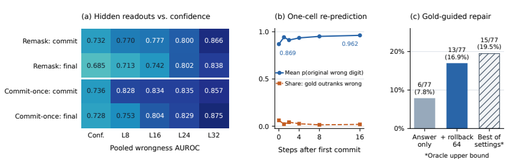
Figure 1 : Diagnosis on uniquely solvable4×4 Sudoku.(a)Wrongness AUROC of hidden-state probes and confidence on matched observations.(b)After re-masking a wrong cell, the original digit stays highly probable and the gold digit rarely outranks it.(c)Gold-guided repair on 77 failures: reopening the wrong cells alone fixes few, and the per-puzzle best setting is an oracle upper bound.
出典 · CC BY 4.0 · Minhae Oh, Jeonghye Kim, Jinwoo Koo, Yeongoon Kim, Jimin Seo, Minsik Seol, Jungwoo Lee · Learning When Diffusion Language Models Should Regenerate · 論文の図を引用 · 元のPDFの3ページ目から図の部分を抽出しています。DiVRのブロック検証と再生成
DiVRは、生成器とバックボーンを共有する検証器です。生成器が各ブロックを埋めた後、検証器がマスクされた接尾部を含むキャンバス全体をスコア化し、スコアが閾値θより低ければそのブロックを丸ごと再マスクし、同じ接頭部からK個の代替案をサンプリングします。元のブロックと代替案のうち、スコアが最も高いものを残します。検証器の学習ラベルは、生成器が作ったブロック境界の状態に、完成した応答の最終正誤を付けたものです。そのため、ある状態が誤りだったという意味ではなく、その状態を通った軌跡が失敗したという意味で解釈すべきです。学習では分類損失と、同じ問題内でのランキング損失を併用し、バックボーンは凍結して LoRAアダプタとMLPヘッドだけを学習します。
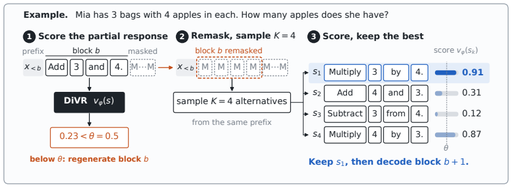
Figure 2 :DiVR-guided block re-decoding.DiVR scores the canvas, masked suffix included, after each block (B= 4 here, 32 in the experiments). A score belowθ triggers four alternatives of the block from the same prefix, and the best-scoring state (s1, 0.91) replaces the original. Text and scores are illustrative.
出典 · CC BY 4.0 · Minhae Oh, Jeonghye Kim, Jinwoo Koo, Yeongoon Kim, Jimin Seo, Minsik Seol, Jungwoo Lee · Learning When Diffusion Language Models Should Regenerate · 論文の図を引用 · 元のPDFの4ページ目から図の部分を抽出しています。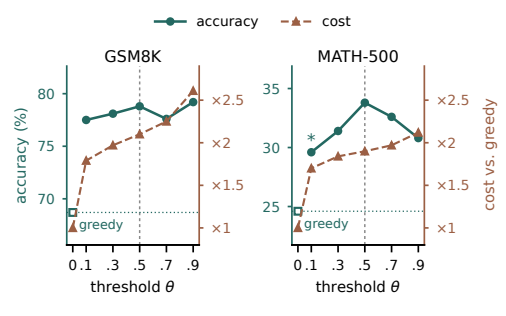
Figure 3 :Sensitivity to the regeneration threshold.SFT generator,K=4, at most three regenerations, on the full test sets. Solid lines give success (%) and dashed lines the verification-inclusive cost relative to greedy (square). The vertical line isθ= 0.5, chosen on the GSM8K development set beforehand, and∗ marks a paired McNemar difference from it atp <0.05.
出典 · CC BY 4.0 · Minhae Oh, Jeonghye Kim, Jinwoo Koo, Yeongoon Kim, Jimin Seo, Minsik Seol, Jungwoo Lee · Learning When Diffusion Language Models Should Regenerate · 論文の図を引用 · 元のPDFの9ページ目から図の部分を抽出しています。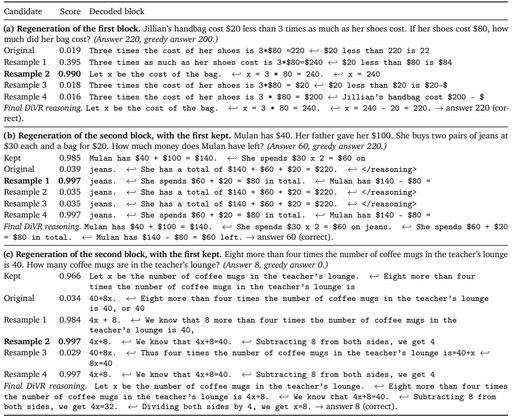
Table 11 :Regenerations that fix greedy errors.GSM8K test problems on which the SFT generator’s greedy answer is wrong and one regeneration corrects it. Each panel shows the block that fell belowθ (Original), the four alternatives decoded from the same state, and their scores. The highest-scoring candidate (bold) is kept.←-marks a line break.
出典 · CC BY 4.0 · Minhae Oh, Jeonghye Kim, Jinwoo Koo, Yeongoon Kim, Jimin Seo, Minsik Seol, Jungwoo Lee · Learning When Diffusion Language Models Should Regenerate · 論文の図を引用 · 元のPDFの20ページ目から図の部分を抽出しています。3つの生成器での結果
SFTを経たLLaDA-8B-Baseでは、DiVRによる誘導デコーディングが5つのベンチマークの平均精度を35.3%から43.4%に高めました。同じ生成器でSR-SMCは39.1%、Prismは37.3%でした。GSM8Kでは、SFT生成器の精度が68.7%から78.8%に上がり、SR-SMCの72.6%やPrismの71.9%を上回りました。この比較は、特定の3つの生成器と5つのベンチマークで得られた結果であり、他の条件に一般化したものではありません。
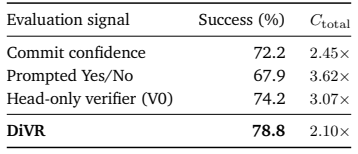
Table 3 :Same block re-decoding, different scores.GSM8K test with the SFT generator (paired greedy 68.7). All signals shareK, the temperature and the redo cap, and each threshold is the best on the development split.Ctotal is the verification-inclusive cost relative to greedy.
出典 · CC BY 4.0 · Minhae Oh, Jeonghye Kim, Jinwoo Koo, Yeongoon Kim, Jimin Seo, Minsik Seol, Jungwoo Lee · Learning When Diffusion Language Models Should Regenerate · 論文の図を引用 · 元のPDFの8ページ目から図の部分を抽出しています。検証器のランキング能力と修正位置
固定された候補4つから選ぶ実験では、DiVRはGSM8Kで82.2%、MATH-500で34.2%、Countdownで49.2%を記録し、多数決や平均対数確率より高い値でした。平均対数確率は、ランダムな選択に近い結果でした。ペアの順序精度は、SFT生成器のGSM8Kで最初のブロックの後に0.705、完成後には0.919に上がりました。最初のブロックが問題の解釈を決め、以降のトークンはその設定に従う傾向がありました。
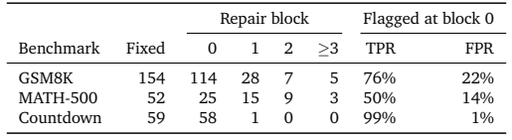
Table 2 :Where guided decoding repairs the greedy answer.SFT generator on the math benchmarks. Fixed counts the greedy errors that guided decoding corrects, out of 413 on GSM8K, 377 on MATH-500 and 322 on Countdown, and the repair block is the first block at which an alternative replaced the original. TPR and FPR treat a wrong greedy answer as positive and a first-block score belowθas a flag. Most repairs begin in the first block.
出典 · CC BY 4.0 · Minhae Oh, Jeonghye Kim, Jinwoo Koo, Yeongoon Kim, Jimin Seo, Minsik Seol, Jungwoo Lee · Learning When Diffusion Language Models Should Regenerate · 論文の図を引用 · 元のPDFの7ページ目から図の部分を抽出しています。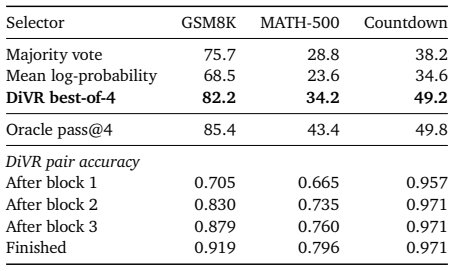
Table 4 :Selection and ranking on a fixed candidate pool.Success (%) on the same four SFT-generator responses per problem. Oracle pass@4 is the pool’s ceiling, and a uniformly chosen candidate scores 68.7, 24.6 and 33.7. Pair accuracy is the share of correct–incorrect candidate pairs of a question that DiVR ranks correctly from their states after each block.
出典 · CC BY 4.0 · Minhae Oh, Jeonghye Kim, Jinwoo Koo, Yeongoon Kim, Jimin Seo, Minsik Seol, Jungwoo Lee · Learning When Diffusion Language Models Should Regenerate · 論文の図を引用 · 元のPDFの8ページ目から図の部分を抽出しています。較正と適用範囲
主な指標であるAUROCと精度は、スコアの順位を評価するものであり、確率の較正度を直接測るものではありません。較正の分析は、付録の別実験で、Platt較正の後にECEが下がったかを確認したものです。この分析では、適応的な再生成の後や、複数のベンチマークをまたぐ較正は確認していません。また、検証器は主にGSM8KとMBPPで学習されており、他のベンチマークでの改善は転移実験で確認した範囲に限られます。
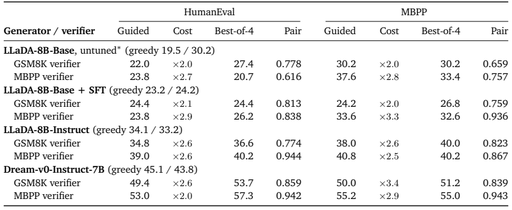
Table 8 :Code benchmarks with the GSM8K-trained and the MBPP-trained verifier.The two verifiers of a generator differ only in their training decodes, and Table 1 reports the MBPP verifier in its code columns. Pair is the within- problem accuracy of ranking a passing finished sample above a failing one.∗Verified by the verifiers of the SFT generator.
出典 · CC BY 4.0 · Minhae Oh, Jeonghye Kim, Jinwoo Koo, Yeongoon Kim, Jimin Seo, Minsik Seol, Jungwoo Lee · Learning When Diffusion Language Models Should Regenerate · 論文の図を引用 · 元のPDFの17ページ目から図の部分を抽出しています。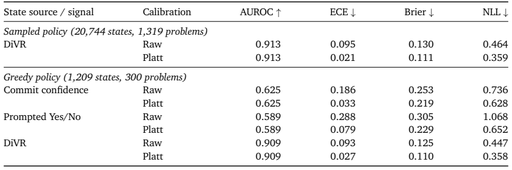
Table 9 :Outcome prediction and post-hoc calibration.GSM8K test states at observed block boundaries. Each signal has its own Platt map fitted on development states. Calibration preserves the ordering, so raw and calibrated AUROC agree.
出典 · CC BY 4.0 · Minhae Oh, Jeonghye Kim, Jinwoo Koo, Yeongoon Kim, Jimin Seo, Minsik Seol, Jungwoo Lee · Learning When Diffusion Language Models Should Regenerate · 論文の図を引用 · 元のPDFの18ページ目から図の部分を抽出しています。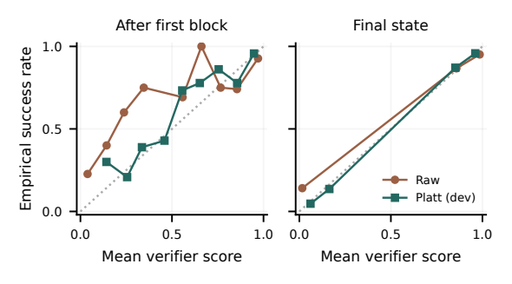
Figure 4 :Verifier reliability on greedy GSM8K states.Mean score versus empirical success at the first non-final block and the final state (300 observations each), and markers are bins with at least ten observations. Platt parameters are fitted on development states.
出典 · CC BY 4.0 · Minhae Oh, Jeonghye Kim, Jinwoo Koo, Yeongoon Kim, Jimin Seo, Minsik Seol, Jungwoo Lee · Learning When Diffusion Language Models Should Regenerate · 論文の図を引用 · 元のPDFの19ページ目から図の部分を抽出しています。論文情報
- 著者
- Minhae Oh, Jeonghye Kim, Jinwoo Koo, Yeongoon Kim, Jimin Seo, Minsik Seol, Jungwoo Lee
- 学会・ジャーナル
- arXiv · プレプリント
- 公開日
- 2026年11月12日
- 登録日
- 2026年11月14日
- 更新日
- 2026年11月12日
- バージョン
- v1
- arXiv
- 2611.17320
- カテゴリ
- cs.CL
- ライセンス
- CC BY 4.0
- 掲載内容
- 論文情報・解説・論文の図
この解説は、Refivuの韓国語解説をAIで翻訳したものです。不正確な翻訳や誤りが含まれる可能性があります。論文と図の利用条件は各出典に従います。
アブストラクト
Remasking allows diffusion language models to revisit generated text, but effective correction requires knowing when and what to revise. Our diagnosis on Sudoku reveals two gaps. Hidden states contain error information that token confidence does not reliably expose, and remasking an isolated error usually reproduces it when the surrounding context remains fixed. These findings motivate DiVR , a verifier that predicts whether a partially generated sequence will reach a correct answer. Trained on the final correctness of the model's own trajectories, DiVR decides when to regenerate a block and which alternative to retain, while the generator itself stays unchanged. On five reasoning benchmarks with LLaDA-8B-Base, DiVR raises the average accuracy of the fine-tuned generator from 35.3\% to 43.4\% at $1.9$-$3.5\times$ the cost of greedy decoding, above search baselines that use $3.8$-$7.4\times$. It also complements post-training such as supervised fine-tuning and reinforcement learning, and generalizes to other generators, including Dream.
この論文を引用
Minhae Oh, Jeonghye Kim, Jinwoo Koo, Yeongoon Kim, Jimin Seo, Minsik Seol, Jungwoo Lee (2026). Learning When Diffusion Language Models Should Regenerate. arXiv:2611.17320v1. https://arxiv.org/abs/2611.17320v1
BibTeX
@misc{oh2026learning,
  title = {{Learning When Diffusion Language Models Should Regenerate}},
  author = {Minhae Oh and Jeonghye Kim and Jinwoo Koo and Yeongoon Kim and Jimin Seo and Minsik Seol and Jungwoo Lee},
  year = {2026},
  eprint = {2611.17320},
  archivePrefix = {arXiv},
  url = {https://arxiv.org/abs/2611.17320v1}
}