Paper commentary
Rank, Don't Regress: A 279M Text Ranker Beats 2B and 7B VLMs on Referential Urdu GUI Grounding
- Problem Pixel-coordinate grounding is fragile when page layout changes, and no published UI grounding results exist for Urdu, a right-to-left language.
- Method The study scores DOM candidates with a 278.8M-parameter cross-encoder built on mDeBERTa-v3-base and clicks the centre of the top-ranked candidate's box.
- Results The full ranker reached 73.4% point-in-box accuracy overall on the 304-item frozen test set, against 29.6% for UI-TARS-2B and 23.7% for Qwen2.5-VL-7B, both zero-shot.
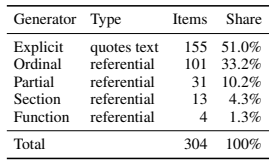
Table 1 : Frozen test set by instruction generator. Refer- ential items never quote the full target text; partial items quote a three-word prefix.
Original paper · CC BY 4.0 · Hamza Raziq Khan, Aimal Khan · Rank, Don't Regress: A 279M Text Ranker Beats 2B and 7B VLMs on Referential Urdu GUI Grounding · Original paper figure · Extracted the figure area from page 3 of the original PDF.Why choose from the page instead of pixels
Because grounding limits everything the agent does next, the authors treat it as the weakest and most consequential step of the pipeline.
The first problem is that coordinate regression broke under layout change in the authors' pilot. The authors attribute the drop to training and test pages laying out the same content at different widths.
That result comes from a different domain and is cited here as motivation, not measured in this study.
MindAct (Deng et al., 2023) also selects from DOM candidates with a DeBERTa ranker, but there the ranker only shortlists elements for a large language model, and Deng et al. report that the ranker by itself falls short on Mind2Web. The study asks whether that conclusion changes in a different regime: Mind2Web pages average about 1,135 candidate elements, while the Urdu mobile views have a median of 25 candidates, and here the ranker acts alone.
How the cross-encoder scores candidates
The ranker is a cross-encoder. For one item it takes every candidate in the view, pairs each one with the instruction, and returns the candidate with the highest score. Each pair is encoded jointly by mDeBERTa-v3-base with a single-logit classification head, and the model has 278.8M parameters. The ranker reads no pixels. The screenshot serves the VLM baselines and the manual checks only.
The click point is the centre of the top-ranked candidate's box, so an item is a hit exactly when the ranker places the gold element first. The VLMs and the coordinate control instead output whatever point the model generates, and the same point-in-box test scores all of them.
Each candidate is serialised as its text followed by bracketed fields, and four variants test how much of that structure helps. MINDACT_TEXT keeps only the text and the tag, following the MindAct style. FULL adds the aria-label, placeholder, title and link fields when they carry information the text lacks, along with the parent section heading.
FULL_NOPARENT removes only the heading.
Training labels and recipe
That ambiguity still matters at test time, which the failure analysis shows.
The effective batch is 32, reached as batch 32 at maximum length 160, or as batch 16 with two accumulation steps at maximum length 224. Training took about 1.1 hours on a single Tesla T4.
In the authors' stack the mDeBERTa-v3 checkpoint loads in fp16 by default, and fp16 training drove the loss to NaN in two early runs.
The training pool comes from 12 Urdu sites outside the test ban, with 532 views and 4,216 positive items, of which 2,774 are explicit and 1,442 referential. Explicit items are capped at 16 per view, and the pool is skewed: ARY News supplies 51.7% of the positives and Urdu Wikipedia 24.9%. Validation holds out whole sites rather than random rows, and the validation split has 419 positives.
Building the frozen test set
The test set holds 304 instructions over mobile page views from six Urdu news sites. The test domains were chosen and locked before any test page was gathered, and they stay out of training at the registrable-domain level, which also excludes subdomains and sibling properties. Each view was captured once, with its screenshot and DOM taken in the same page load and stored together, because a news homepage changes within hours and a later capture could point at a different page.
The 160 views split across Siasat (75 items), Dawn (75), Express (75), Daily Khabrain (67), Daily Mashriq (11) and Ummat (1), and no site supplies more than 25% of the items. Five rule-based generators produce the instructions, and the table gives the item count and share for each one.
The explicit generator quotes the element's full text, while the other four describe the target without quoting it.
A separate script recomputed every number from the raw files, and it confirmed that all 304 gold boxes match their frozen candidates exactly. The same check found no registrable-domain overlap between training and test data and no shared screenshot paths, and eight items were checked by eye against their screenshots.
Headline accuracy against zero-shot VLMs
The gap to the stronger VLM is 43.8 points. MAI-UI-2B, released in December 2025, reached 11.8%, below both older VLMs.
The test set is half referential by design, and both VLMs are weakest on referential items: they score 4.0% and 2.0% on ordinal items.
The referential slice carries the ranking claim: the full ranker scores 65.8% against 30.2% for the string-match heuristic, a gap of 35.6 points. On the explicit slice the heuristic leads, with 84.5% against 80.6% for the rankers, which is expected because exact matching suits instructions that quote the target.
Wilson 95% intervals are [68.1, 78.0] for the full ranker overall, [24.8, 35.0] for UI-TARS-2B and [19.3, 28.8] for Qwen2.5-VL-7B.
Rank versus regress under matched pages
It is fine-tuned with LoRA at rank 16, learning rate 2e-4, two epochs and effective batch 32, on 1,539 coordinate rows from the same training pages. Those rows are the explicit positives that had a stored screenshot, so the control and the ranker both learn from the same pages.
The authors read the explicit result as showing that the failure is not instruction understanding: given the screenshot and the exact text, the model still cannot point at that text. They attribute the failure to the control not having learned where Urdu page elements sit, given 1,539 training rows.
The comparison pits one small regressor against the ranker at the same data scale, so it does not survey regression models in general. Wu et al. (2026) report about a 3.7-point gap between coordinate-free and coordinate-based attention at 7B VLM scale on English desktop and web benchmarks, while the gap reported here is 71.8 points in a different output space and regime.
Which candidate string representation works
MINDACT_TEXT, with text and tag only, scored 74.0% overall and 67.1% on the referential slice, slightly above FULL at 73.4% and 65.8%. On 304 items a 0.6-point gap is two items, so the authors read attributes and section headings as adding no measurable gain on this data. Removing the section heading from FULL gives FULL_NOPARENT at 72.7%, a cost of 0.7 points.
FULL_GEO reached 75.7% overall, the highest overall score in this study, with 86.5% on the explicit slice against 80.6% for FULL. The authors connect the explicit gain to position, since a box separates two elements that carry the same text, and most explicit errors are such duplicate picks.
On held-out training sites the variants rank differently: 68.5% for FULL, 61.1% for FULL_GEO, 60.1% for MINDACT_TEXT and 58.7% for FULL_NOPARENT, on 419 validation positives. The authors base their claims on FULL, the configuration fixed before the ablation runs, and report all four variants.
Where the full ranker fails
Same-text duplicates account for 30 failures, and every explicit failure picked a different element that carries the target text. News navigation repeats labels across a page, and 64 of the 304 items have a duplicated target text. One catalogued case is item it0275 on Express: the instruction quotes ‘Business’, the ranker picked an element with the identical label, and only the position is wrong.
The authors trace this to per-candidate scoring, which never presents the list as a list, so no candidate string can say that its element is the fourth link. The authors conclude that ordinal grounding needs candidates scored jointly or a meaningful explicit position feature, and that neither was added in this build.
Lexical coupling and the referential slice
Chen and Jacucci (2026) report that a fine-tuned ranker on English benchmarks largely recovers visible labels, with R@1 falling from 0.694 to 0.151 when the target text is masked. The authors use that finding as a hypothesis for their own ranker, since the referential slice is built so that the instruction never contains the full label.
From the full set to the referential slice the ranker drops 7.6 points (73.4 to 65.8), while the heuristic drops 27.7 points (57.9 to 30.2). On ordinal items the heuristic scores 1.0% and the ranker 49.5%.
The narrower claim is that when the instruction withholds the label, the learned ranker keeps most of its accuracy while label matching keeps little of its own.
Accuracy varies by site
Express is the hardest site: the full ranker gets 26 of its 75 items right (34.7%), against 82.7% on Dawn, 85.3% on Siasat and 95.5% on Daily Khabrain. The site's item mix stacks both failure modes, with 40 of its 75 items ordinal and 31 with a duplicated target text. UI-TARS-2B scored 4.0% and Qwen2.5-VL-7B 0.0% on Express, so the authors read the gap as a property of the items rather than a site-specific bug.
Latency and cost profile
The medians come from 49 frozen items with a median of 31 candidates per view, and the authors make no wall-clock claim.
Whether it is fast enough for a phone-class agent was not measured.
Limits of the evidence
All six test sites are news sites, so forms, shops, banking and government portals were not measured. The instructions are rule-generated, and accuracy on instructions written by people is unmeasured. With 304 items, one item is worth about 0.33 points, and the authors treat differences under two points between ranker variants as noise. The main claims rest on gaps of 35 points or more.
Ferret-UI Lite could not be evaluated because no code or weights were released for it. The Mind2Web result comes from prior work on a different setting and is not reproduced under the study's conditions.
Paper info
- Authors
- Hamza Raziq Khan, Aimal Khan
- Venue
- arXiv · Preprint
- First published
- 2026-11-15
- Added
- 2026-11-17
- Updated
- 2026-11-15
- Version
- v1
- arXiv
- 2611.20145
- Category
- cs.CL
- Original paper terms
- CC BY 4.0
- What we show
- Paper info, commentary and permitted figures from the original paper
AI commentary is a separate explanation from the original paper and may contain errors. The original paper and figures follow each source's terms of use and any rights noted separately.
Abstract
UI grounding asks a model to find the screen element that a user instruction refers to. Most current systems use a vision-language model (VLM) that reads a screenshot and outputs pixel coordinates. We study this task on Urdu mobile web pages, a setting with no published UI grounding results. Instead of regressing coordinates, we take the candidate elements from the page DOM and train a 279M-parameter cross-encoder (mDeBERTa-v3-base) to pick one. The click point is the centre of the picked element's box, so it is exact whenever the right element is picked. We built a frozen test set of 304 instructions from six Urdu news sites; 149 of them (49%) are referential and never quote the full target text. Test domains were banned from training data before collection started. The ranker scores 73.4% point-in-box accuracy, against 29.6% for UI-TARS-2B and 23.7% for Qwen2.5-VL-7B, both zero-shot. On the referential slice the ranker scores 65.8%, against 30.2% for a string-matching baseline that needs no training. In a controlled comparison at small scale, with training data drawn from the same pages, a coordinate-regression model of similar size scores 1.6%. Adding element geometry as input tokens gives the best variant, at 75.7%. The ranker's errors concentrate in two places: elements that share identical text, and ordinal instructions such as "the fourth link".
Quote from the paper
Hamza Raziq Khan, Aimal Khan (2026). Rank, Don't Regress: A 279M Text Ranker Beats 2B and 7B VLMs on Referential Urdu GUI Grounding. arXiv:2611.20145v1. https://arxiv.org/abs/2611.20145v1
BibTeX
@misc{khan2026rank,
  title = {{Rank, Don't Regress: A 279M Text Ranker Beats 2B and 7B VLMs on Referential Urdu GUI Grounding}},
  author = {Hamza Raziq Khan and Aimal Khan},
  year = {2026},
  eprint = {2611.20145},
  archivePrefix = {arXiv},
  url = {https://arxiv.org/abs/2611.20145v1}
}