Paper commentary
Bregman geometry in regular exponential families: dual representations and relative smoothness
Dual Bregman representations give exponential-family log-densities an ordinary Bregman geometry
- Problem The reverse Bregman divergence of an exponential family is not convex in its second argument, the expectation parameter. This blocks Bregman-based augmentation and sampling methods, which have had to work around the asymmetry.
- Method The authors build a projective characterization that gives dual coordinates. In these coordinates the log-density is an ordinary Bregman divergence, with the probability model unchanged.
- Results The dual representations give relative smoothness bounds that are sharp in the scalar and separable settings. For Poisson problems, the alpha-scaled Burg geometry gives relative constants y_min and y_max.
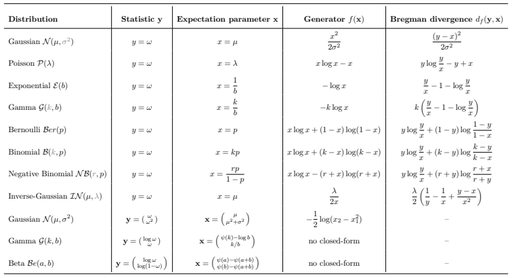
Table 3 : Primal Bregman representations of classical regular exponential family models. Fixed parameters appear in gray.
Original paper · CC BY 4.0 · Mame Diarra Fall, Éric Barat, Nicolas Dobigeon · Bregman geometry in regular exponential families: dual representations and relative smoothness · Original paper figure · Extracted the figure area from page 50 of the original PDF.Why reverse divergences get stuck
A regular exponential-family log-density can be written as a Bregman divergence generated by the convex conjugate of the log-partition function. Banerjee et al. (2005) establish this representation under standard regularity and minimality assumptions. The sufficient statistics play the role of geometric coordinates on the data space. In that canonical form, the first argument is the sufficient statistic and the second is the expectation parameter.
Convexity holds in the first argument because the Bregman generator is convex. Convexity in the second argument, the expectation parameter, is not generally guaranteed.
This asymmetry becomes a practical problem for asymptotically exact data augmentation, as in Vono et al. (2020). It also blocks splitting-based Monte Carlo algorithms with non-Euclidean, and in particular Bregman, kernels, as in Vono et al. (2019). Recent work works around the problem by augmenting the model with the same divergence evaluated with swapped arguments, as in Faye et al.
(2026). Alternatively, Dobigeon et al. (2026) replace the Bregman divergences by symmetrized Jensen-Bregman divergences. Both fixes work around the asymmetry rather than remove it.
The deeper question is whether a reverse Bregman divergence can itself be written as an ordinary Bregman divergence after a change of coordinates. Can the Bregman geometry of a regular exponential family then transfer to its parameter space through a suitable dual coordinate system? The paper answers this with Legendre duality as a partial response, using the term duality for a broader property.
The authors start from the primal Bregman representation and build on a projective characterization that gives necessary and sufficient conditions for dual representations. Two particular models, the β-scaled and α-scaled dual Bregman representations, come out of this framework.
A projective route to dual coordinates
The key idea is to weight the log-density by a function g of the observation and to pick new coordinates through a projective map. With the right map, the reverse divergence becomes an ordinary Bregman divergence in the transformed coordinates. The construction keeps the same log-density while changing the geometry, so the probability model itself stays unchanged.
The authors start from the primal Bregman representation of regular exponential-family distributions. They build a projective characterization that gives necessary and sufficient conditions for such dual Bregman representations to exist. For regular minimal exponential families, they then construct the pair of dual coordinates and the generator.
They also prove normalization and uniqueness results for this construction.
Once the pair is fixed, the log-density takes the form of a scaled Bregman divergence between dual coordinates, plus a term depending only on y. Here tau maps the expectation parameter to the dual coordinates, and h is the dual Bregman generator. The graph of h on T is the image of the graph of psi under the invertible linear map DM^-T D.
So the two parametrizations transform contragrediently, and the log-likelihood is preserved.
The β-scaled and α-scaled models
The β-scaled model takes a constant weight g(y)=1/β, so the dual coordinates are τ=∇f. Its generator is h=βf*, and the log-density becomes −(1/β) d_h(τ(x),τ(y)) + φ_f(y). Setting β=1 recovers the classical Legendre duality, which the paper treats as a particular instance of this construction.
The α-scaled model works in one dimension, with X contained in (0,∞) and weight g(y)=y^α. Its coordinates are τ(x)=xf'(x)−f(x), which the paper also writes as f*(f'(x)). Its generator is h(t)=−α[f*]^(−1)(t) for t in T. Because f'' is positive, τ is strictly increasing, so this second coordinate system gives a different but equivalent description.
Both generators are of Legendre type under the assumptions of Theorem 4. For the Exponential and Gamma families with known shape, the α-scaled geometry is a scaled Itakura-Saito geometry. The Bernoulli and Binomial families instead show closely related entropic geometries.
Conjugate priors keep their form under dual representations
The primal representation of a conjugate prior is a log-prior on expectation coordinates, as used by Agarwal and Daumé III. The prior is written as minus β times the Bregman divergence d_f(α/β, x), plus a normalization potential φ_f(α, β) that doesn't depend on x. The paper assumes the hyperparameters make the prior density normalizable. After one observation y, the log-posterior is minus (1+β) times d_f((y+α)/(1+β), x), plus a term Ψ_f that is independent of x.
The posterior keeps the same parametric form as the prior, with updated hyperparameters α+ = y+α and β+ = 1+β.
To apply the dual representations, the authors introduce the location parameter z = α/β. With z defined this way, the primal prior form matches the forms that induce the α- and β-scaled dual models. Corollary 8 covers the β-scaled case, with the prior written as minus d_h(τ(x), τ(z)) plus φ_f(βz, β), where τ = ∇f and h = βf*. The log-posterior in this case is minus ((1+β)/β) times d_h(τ(x), τ((y+βz)/(1+β))) plus a term Ψ_h independent of x.
The authors note that the posterior keeps the dual form of the prior, with updated location z+ = α+/β+ and coefficient β+/β.
Corollary 9 covers the α-scaled prior, which takes the form minus (α/z) times d_f(z, x), plus φ_f(α, α/z). Its dual representation uses τ(x) = f*(f'(x)) and h(t) = −α[f*]^{-1}(t), with τ a strictly increasing diffeomorphism. Conjugacy therefore follows from the likelihood generator f, and then the β- or α-scaled dual representation is applied.
Unlike the primal representation of Agarwal and Daumé III, these representations use ordinary Bregman divergences in dual coordinates. The authors argue that this geometry depends only on the convex generator of the likelihood, not on the particular distribution. They suggest that conjugate Bayesian models may be organized by their underlying Bregman geometry.
Table 1 lists the classical exponential-family models for which these two constructions are computed, with α = β = 1.
Relative smoothness of the negative log-density
Relative smoothness asks how much the negative log-density can vary, measured against a reference convex function. The paper shows that the β- and α-scaled geometries serve as such reference geometries for the primal Bregman representation. For the β-scaled geometry, the reference generator is h = βf*, and the negative log-likelihood is λ(y;t) in the dual coordinates t.
The function ζ(t) = Lh(t) − λ(y;t) reduces to (Lβ − 1)f*(t) + ⟨t,y⟩ + log p0(y). So the negative log-density is L-smooth relative to h for every L ≥ 1/β.
For the α-scaled geometry, the dual coordinates are t = τ(x) = xf′(x) − f(x), with h(t) = −αf′(τ⁻¹(t)). The authors differentiate the negative log-density twice with respect to t, obtaining λ′′(y;t) = y/x³ f′′(x). The second derivative of h is h′′(t) = α/x³ f′′(x), which is nonnegative because h is convex. Therefore ζ′′(t) = (L − y/α) h′′(t), and this expression drives the smoothness condition.
When y is not zero, ζ is convex whenever L ≥ y/α, so the negative log-density is L-smooth relative to h for every L ≥ y/α. When y equals zero, the negative log-density is L-smooth relative to h for every L ≥ ε, for any ε > 0.
The authors extend the α-scaled result to separable multidimensional models, where each component has its own weight αi. Each component satisfies ∂²λ/∂t_i² = y_i/α_i · h″_i(t_i), so the Hessian becomes a diagonal matrix. Because each h_i is convex, the separable negative log-density is L-smooth relative to h_sep whenever L ≥ ‖y/α‖∞. When ‖y‖∞ = 0, the separable case again gives smoothness for every L ≥ ε, for any ε > 0.
The authors show that the threshold ‖y/α‖∞ cannot be lowered, because each h_i is strictly convex. If L is below ‖y/α‖∞, then the coefficient at the index i⋆ attaining the maximum becomes negative. Choosing two points that differ only in that coordinate makes ζ fail to be convex, so no smaller L works. The α-scaled construction with h(t) = −log t gives the Itakura-Saito divergence, a different geometry from the β-scaled one.
Poisson inverse problems: dual geometries and their rates
The Poisson objective with identity operator is J(x) equal to the sum over j of (1+μ)x_j minus y_j log x_j, with minimizer y divided by 1+μ. The Burg entropy h(x) equal to minus the sum of log x_i was considered in earlier works for BPGM, but those works never properly motivated that choice. In this paper, the Burg geometry emerges from the dual Bregman representation of Theorem 7 instead of an ad hoc search.
With the α-scaled geometry and identity operator, the Hessians satisfy y_min times the Hessian of h, below the Hessian of J, below y_max times the Hessian of h. The relative strong-convexity and relative-smoothness constants are μ_α equal to y_min and L_α equal to y_max. With stepsize δ equal to 1 over y_max, the exact worst-case contraction factor in reciprocal coordinates is 1 minus y_min over y_max.
The relative condition number κ_α equal to y_max over y_min gives the contraction factor 1 minus 1 over κ_α, so κ_α equal to 1 gives a factor of 0.
With the β-scaled geometry and β_j equal to 1, the dual iteration in the primal variable contracts with factor 1 minus δ over (1+μδ), for 0 < δ ≤ 1. At δ equal to 1 the contraction factor vanishes, so the iterate reaches the minimizer x star in a single step. The relative strong-convexity and smoothness constants are both 1+μ, so the relative condition number is 1.
For zero-count observations, the primal update reaches zero in one step at δ equal to 1, but no finite dual iterate attains it.
For a general operator K, Bauschke et al. bound the relative smoothness constant by the L1 norm of y. In the identity case, y_max is at most the L1 norm of y, so the bound sharpens to the exact constant y_max. The α-scaled iteration with general K recovers the NoLips update of Bauschke et al. and the Itakura-Saito geometry. For a general K, the β-scaled generator remains a valid reference with constant L_inf equal to 1 when β equals s, and to the norm of K when β equals 1.
The paper ties the α-scaled iteration to NoLips and the β-scaled one to expectation-maximization.
Where the conclusions stop holding
The global Legendre conclusions stop holding for the inverse Gaussian family with known shape parameter. Here the equality τ(X) = dom h fails at the boundary point 0, so the Legendre property can fail even for n = 1. The authors treat this as a non-regular case, because Θ = (−∞, 0] is not open. So the global Legendre conclusions don't hold for this family, and the authors still derive the β- and α-scaled expressions for it.
The sharp constants are established only for scalar and separable settings. For a general operator K, the Poisson negative log-likelihood couples the components, so the separable assumptions aren't met. In that coupled case, the β-scaled result gives a relative-smoothness constant rather than a sharp one. The Lemma 2 constant L_inf equals ‖K‖_1 when β = 1, and equals 1 when β = s.
The Poisson application is illustrative, so it doesn't establish the framework for every inverse problem. For zero-count observations, the α-scaled iteration converges to the boundary point zero only sublinearly. They didn't test the Poisson case beyond the scalar and separable settings in the paper.
Paper info
- Authors
- Mame Diarra Fall, Éric Barat, Nicolas Dobigeon
- Venue
- arXiv · Preprint
- First published
- 2026-11-13
- Added
- 2026-11-16
- Updated
- 2026-11-13
- Version
- v1
- arXiv
- 2611.18480
- Category
- stat.ML · cs.LG · math.OC
- Original paper terms
- CC BY 4.0
- What we show
- Paper info, commentary and permitted figures from the original paper
AI commentary is a separate explanation from the original paper and may contain errors. The original paper and figures follow each source's terms of use and any rights noted separately.
Abstract
Regular exponential-family distributions are ubiquitous in statistics due to their appealing and convenient properties. Notably, they can be expressed in terms of Bregman divergences, revealing fundamental connections between statistics, convex analysis, and information geometry. However, this geometric structure has not been systematically exploited to characterize these distributions with respect to their expectation parametrization. Building on a projective characterization, we establish a general construction of equivalent dual Bregman representations, together with normalization and uniqueness results. These representations express log-densities as ordinary Bregman divergences in dual coordinate systems, providing geometric characterizations of the parameter space. So-called $β$- and $α$-scaled dual representations emerge as particular instances of this framework. We further derive dual Bregman representations of conjugate priors and establish that they preserve conjugacy. Applications to classical distributions illustrate the geometric structures underlying seemingly different statistical models. Moreover, we show that these representations provide natural reference geometries for establishing relative smoothness of the primal Bregman representation of the distribution, with explicit bounds that are sharp in the scalar and separable settings. An illustrative application to the Poisson distribution sheds new light on several works in the literature, providing complementary geometric justifications for reference geometries while deriving existing algorithms.
Figures from the paper
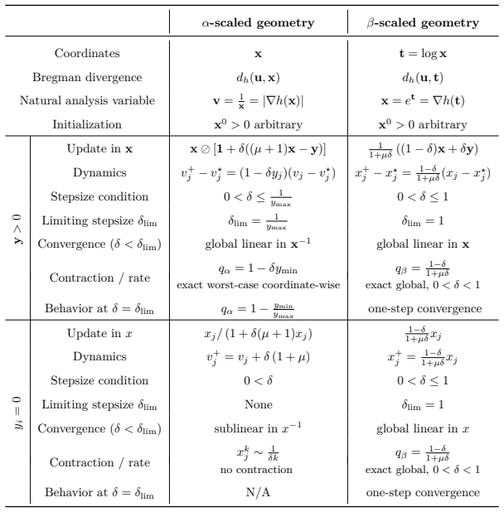
Table 2 : Summary of the main convergence properties of the BPGM iterations imple- mented in theα-scaled andβ-scaled geometries.
Original paper · CC BY 4.0Quote from the paper
Mame Diarra Fall, Éric Barat, Nicolas Dobigeon (2026). Bregman geometry in regular exponential families: dual representations and relative smoothness. arXiv:2611.18480v1. https://arxiv.org/abs/2611.18480v1
BibTeX
@misc{fall2026bregman,
  title = {{Bregman geometry in regular exponential families: dual representations and relative smoothness}},
  author = {Mame Diarra Fall and Éric Barat and Nicolas Dobigeon},
  year = {2026},
  eprint = {2611.18480},
  archivePrefix = {arXiv},
  url = {https://arxiv.org/abs/2611.18480v1}
}