Paper commentary
History-Guided Video Diffusion
History guidance lets video diffusion models condition on a variable number of past frames
- Problem Video diffusion models accept only fixed-size conditioning, and the usual dropout training for guidance performs poorly with variable-length history.
- Method Diffusion Forcing Transformer (DFoT) gives every frame its own noise level instead of splitting history from targets, so any subset of history can be masked at sampling time.
- Results With fractional history guidance, DFoT reaches FVD 170.4 on Kinetics-600 rollouts, against 196.0 for binary-dropout diffusion with vanilla guidance.
Why history guidance is hard to build
Classifier-free guidance pushes samples toward a condition by mixing a conditional score with an unconditional one. In video models that condition is usually a text prompt or a single image, but the frames already generated are another candidate. The open question is whether different portions of history, varying in length, frame subset and frequency content, can work as guidance.
The difficulty comes from the architecture first. In DiT or U-Net models, conditioning enters through AdaLN layers or by concatenation with the noisy frames, which fixes it to a fixed-size input. Sequence encoders could handle variable length, but they are often pre-trained and can't share parameters with the diffusion model, so guidance has stayed short and fixed in length.
The usual training recipe for CFG, framewise binary dropout, is the second obstacle. In the authors' ablation, Binary-Dropout Diffusion loses substantial performance against Standard Diffusion and produces artifacts and inconsistent generations. So the authors look for a training objective that supports flexible history without dropout.
Independent noise per frame as masking
DFoT drops the split between history and generation targets and gives every frame its own noise level. Diffusion Forcing Transformer trains on all frames of a sequence with these independent levels, so the network sees history and targets in the same way. The paper extends the noising-as-masking idea of Diffusion Forcing from causal, state-space models to non-causal transformers.
Diffusion Forcing focuses on causal, state-space models, so DFoT needed new theory and architecture for non-causal, state-free models. Noise levels run over k in [0, 1], and the forward process is xk = αk x0 + σk ϵ with ϵ drawn from N(0, I).
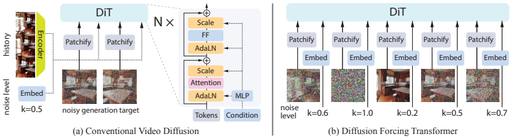
Figure 2 . Comparison of the conventional conditional video diffusion models and Diffusion Forcing Transformer.At training time, conventional (a) approaches treat history as part of the conditioning input, first encoded by an separate encoder and then injected to the DiT via Adaptive Layer Norm and scaling. The Diffusion Forcing Transformer (b) instead does not distinguish between history and generation target frames. It trains a DiT to denoise all frames of a sequence, where frames have independently varying noise levels.
Original paper · CC BY 4.0 · Kiwhan Song, Boyuan Chen, Max Simchowitz, Yilun Du, Russ Tedrake, Vincent Sitzmann · History-Guided Video Diffusion · Original paper figure · Extracted the figure area from page 3 of the original PDF.At sampling time, a history frame set to the highest noise level acts as a masked frame, so the model treats it as missing. Algorithm 1 sets the noise level k_t to 1 for history frames when the history is fully masked, and to n/N for generated frames. Because history and generated frames come from the same signal, a generated frame can be reused as history for the next window.
Conditioning on any subset then becomes a choice made at sampling time, and the unconditional score is the same network with the entire history masked out. Conventional DiT models instead inject history through AdaLN or channel concatenation, which fixes the conditioning to a fixed-size vector.
The DFoT design lets the same network work with DiT and U-ViT backbones, so no separate history encoder is needed. The authors state that DFoT can be obtained by fine-tuning an existing video diffusion model without architectural changes. Training uses the v-parameterization for all models except the robot model, which uses the x0-parameterization.
What one sampling step computes
Sampling starts from noise for the generated frames and keeps the history frames attached to them. Each denoising step first estimates an unconditional score, with the history fully replaced by fresh noise. For each history subset Hi, the chosen history frames are re-noised to their level kHi and the rest of the history is masked. The network then estimates an i-th conditional score from this input, with the generation frames kept at the current noise level.
The experiments use the deterministic DDIM sampler with 50 steps, and history guidance stacks these inputs across the batch dimension.
The composition is linear: the unconditional score is added to a weighted sum of the differences between each conditional score and the unconditional score. With a single subset this reduces to the usual CFG rule, which is why vanilla history guidance is the simplest case. Temporal history guidance uses several history subsets, each with its own guidance scale ωi.
Fractional history guidance adds a conditional score in which the history is corrupted to a chosen level kH, which acts like a low-pass filter on the history. The experiments fix kH at 0.8 for the fractional runs, which they found to generate videos with sufficient dynamics.
The authors justify the linear weighting with a Gaussian maximum likelihood view, where the optimal estimate is a linear function of the individual scores. Under independent scores with scalar x, that estimate becomes a convex combination of the scores, weighted by their inverse error variances. A second argument says that averaging estimators with complementary errors cancels error, which the authors suspect also holds for history guidance.
Their Gaussian derivations are an intuition rather than a claim about real models, since the authors call the Gaussian error assumption clearly untrue in practice.
Why averaging the scores is defensible
The authors justify the linear score rule with a maximum-likelihood argument for combining several score estimators. Under this model, the maximum-likelihood estimate is a linear function of the individual estimates. When the scores are independent and scalar, the weights come from the diagonal entries of the inverse covariance, and the estimate becomes a convex combination of the scores.
With independent scores whose errors have scaled identity covariance, the same convex weighting holds, with the weights set by the scalings of the identity blocks. The authors then map this onto history guidance: each score comes from a different history segment, and the model combines these pieces of evidence.
The authors admit that the Gaussian errors assumption is clearly not true in practice. They argue it still helps build intuition, since the reverse process of an SDE involves Gaussian predictions. So the argument builds intuition rather than proving that the sampler is optimal.
The authors illustrate this with a partition example, where each estimator is nonzero only on its own region of x. For any estimator, the expected squared error is 1/n in that example. Averaging all n estimators gives an expected squared error of 1/n². Because the estimators make errors on complementary regions, they cancel out each other's errors.
The authors suspect history guidance works the same way, since errors from different history contexts average out.
Algorithm 1 implements this composition with DFoT, where the composed score drives the update for the generated frames. Each history subset is re-noised to its level before its conditional score is estimated. The authors stress that the noise levels must be passed with the masked history, so the input matches training.
Does DFoT hold up without guidance
The Kinetics-600 benchmark conditions each model on 5 history frames and asks it to predict the next 11 frames. The authors report FVD over 50K generated 16-frame videos, computed with three different random seeds. Every baseline runs through the same training pipeline, so the comparison isolates the training objective and architecture. The paper also compares DFoT against literature models such as MAGVIT-v2 and W.A.L.T, and notes that DFoT is trained with fewer resources than these baselines.
DFoT outperforms all baselines, including Standard Diffusion (SD), even though SD is optimized for the evaluation's specific history length. The authors read this as evidence that DFoT's flexibility doesn't cost task-specific performance. Binary-Dropout Diffusion (BD) keeps flexible history conditioning, but it suffers a significant performance drop compared to SD.
BD produces artifacts and inconsistent generations, which the authors point to as a sign that the training objective matters, not only the flexible input.
The fine-tuning experiment takes a full-sequence model trained on Kinetics-600 and converts it into DFoT using only 12.5% of the training cost. After only 80k iterations, the fine-tuned model reaches a lower training loss than the scratch model. After 40k iterations, its training loss matches the scratch model trained for 405k iterations, which the authors describe as a ∼10x speedup.
Its FVD is slightly higher, and the authors attribute this to EMA weights that average over the last tens of thousands of iterations.
Guidance on 64-frame rollouts
The rollout generates 64-frame Kinetics-600 videos with sliding windows, starting from 5 history frames. The authors assess FVD and VBench on 1,024 generated 64-frame videos, and they vary guidance scales over 1.0, 1.5, 2.0, 2.5, 3.0, 3.5 and 4.0 for both vanilla and fractional guidance. For fractional guidance, they fix the masking degree at kH = 0.8, which they found gives videos with sufficient dynamics.
Vanilla history guidance gives its best FVD at a small guidance scale of 1.5. Beyond that scale, FVD increases sharply, which the authors read as a loss of diversity, the same trade-off seen with CFG. Stronger vanilla guidance still improves frame quality and consistency, and the VBench scores reflect this trend.
At guidance scales of 3 or higher, vanilla guidance produces static videos with much less motion than the ground truth. Fractional guidance keeps the motion up while lowering the best FVD. DFoT with fractional guidance reaches FVD 170.4, compared to 181.6 for DFoT with vanilla guidance and 196.0 for binary-dropout diffusion with vanilla guidance.
DFoT beats binary dropout at all scales except 2.5, so the gap doesn't come from a single scale.
Long videos and the robot memory task
The 862-frame navigation video starts from a single image and is shown as 21 frames sampled from the rollout. The visualized frames are the evidence the paper reports for this run, and the full video is only on the project website.
On Minecraft, the authors train a 50-frame DFoT model that conditions on up to 25 history frames. They sample an initial context of 25 frames and roll out 5 times, which gives 125 frames in total, matching the maximum video length in the dataset. Temporal guidance composes the scores from one long-context model with context 25 and one short-context model with context 4, each weighted at 50%.
Temporal guidance achieves an FVD of 79.19, and lower is better.
Fruit Swapping tests whether a policy can keep long-term memory and still react to a physical robot's perturbations. The robot must swap two fruits using the third slot, so it has to remember the initial fruit locations while reacting to where the fruits sit in each slot. The Markov baseline moves away from the fruit and then moves back halfway, because it has no memory.
The 4-frame model reacts to perturbations and picks up the fruit at times, but it can't finish the task. The full-history model performs well without human perturbation, but after a perturbation it often goes to the slot center and closes an empty gripper.
Limits and open questions
The clearest limit shows up in vanilla history guidance at high guidance scales, where the videos turn static. Those static videos show significantly less motion than the ground truth, which is why the authors added fractional history guidance. Fractional history guidance with lower frequencies, at a higher kH, raises dynamics while keeping quality.
The broad quantitative comparison runs on Kinetics-600, while the other tasks rest on single headline numbers.
The linear composition argument depends on Gaussian errors, and the authors say that assumption isn't exactly true in practice. They keep the assumption because it helps build intuition, and they argue that denoising steps of an SDE are plausibly Gaussian-like. The maximum likelihood derivation only shows the combined estimator under this Gaussian model, not for the real score networks.
The fine-tuned model reaches a slightly higher FVD than the model trained from scratch, although it stays competitive after 40k iterations. The EMA explanation for that gap is an interpretation the authors offer, and they didn't test it directly. Simpler training objectives and causal variants remain open, since the authors leave them for future work.
Paper info
- Authors
- Kiwhan Song, Boyuan Chen, Max Simchowitz, Yilun Du, Russ Tedrake, Vincent Sitzmann
- Venue
- arXiv · Preprint
- First published
- 2025-2-10
- Added
- 2026-10-31
- Updated
- 2025-7-24
- Version
- v2
- arXiv
- 2502.06764
- Category
- cs.LG · cs.CV
- Original paper terms
- CC BY 4.0
- What we show
- Paper info, commentary and permitted figures from the original paper
AI commentary is a separate explanation from the original paper and may contain errors. The original paper and figures follow each source's terms of use and any rights noted separately.
Abstract
Classifier-free guidance (CFG) is a key technique for improving conditional generation in diffusion models, enabling more accurate control while enhancing sample quality. It is natural to extend this technique to video diffusion, which generates video conditioned on a variable number of context frames, collectively referred to as history. However, we find two key challenges to guiding with variable-length history: architectures that only support fixed-size conditioning, and the empirical observation that CFG-style history dropout performs poorly. To address this, we propose the Diffusion Forcing Transformer (DFoT), a video diffusion architecture and theoretically grounded training objective that jointly enable conditioning on a flexible number of history frames. We then introduce History Guidance, a family of guidance methods uniquely enabled by DFoT. We show that its simplest form, vanilla history guidance, already significantly improves video generation quality and temporal consistency. A more advanced method, history guidance across time and frequency further enhances motion dynamics, enables compositional generalization to out-of-distribution history, and can stably roll out extremely long videos. Project website: https://boyuan.space/history-guidance
Quote from the paper
Kiwhan Song, Boyuan Chen, Max Simchowitz, Yilun Du, Russ Tedrake, Vincent Sitzmann (2025). History-Guided Video Diffusion. arXiv:2502.06764v2. https://arxiv.org/abs/2502.06764v2
BibTeX
@misc{song2025history,
  title = {{History-Guided Video Diffusion}},
  author = {Kiwhan Song and Boyuan Chen and Max Simchowitz and Yilun Du and Russ Tedrake and Vincent Sitzmann},
  year = {2025},
  eprint = {2502.06764},
  archivePrefix = {arXiv},
  url = {https://arxiv.org/abs/2502.06764v2}
}