Paper commentary
Transferring local rib responses to new component geometries in sheet forming with a graph-based Transformer
Transfer learning reuses rib effects across sheet-forming corner geometries
- Problem Learning every global geometry and rib combination needs large training sets, and a new geometry can force retraining from scratch.
- Method R-BiLoGo predicts only the change ribs cause from a baseline simulation, not the full forming result. It is trained on one geometry, then transferred to others with few simulations.
- Results On the source geometry, R-BiLoGo gave a mean node error of 0.0743 mm, lower than both baseline models.
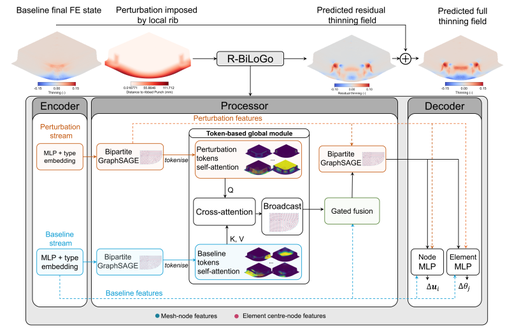
Figure 6 : Overview and architecture of R-BiLoGo. Top: inputs and outputs of the surrogate, shown for the thinning. Bottom: encoder, processor and decoder. The perturbation stream is shown in orange and the baseline stream in blue. Dashed lines show the features passed directly to later components.
Original paper · CC BY 4.0 · Yingxue Zhao, Haoran Li, Haosu Zhou, Tobias Pfaff, Nan Li · Transferring local rib responses to new component geometries in sheet forming with a graph-based Transformer · Original paper figure · Extracted the figure area from page 11 of the original PDF.Why learning every combination is costly
Surrogates for sheet forming usually predict the full displacement and thinning fields from the component geometry. A surrogate that must cover every combination of global geometry and rib position and size needs a large training set. If the size and position of the ribs also vary, the training data must cover their combinations with each global geometry.
A new global geometry can also force the surrogate to be retrained from scratch.
The same type of rib is often used on many corner shapes, and its effect is similar but not identical from one shape to the next. Because the effect is similar, the authors reason that knowledge from one geometry can be reused on another. Because the effect is not identical, that knowledge has to be adapted to the new global geometry. This is why the authors partly decouple the local features from the global geometry, learning the rib effect on one geometry first.
Transfer learning can cut the data needed for a new task, but it doesn't always help. If the source and target tasks differ too much, the transferred model can end up worse than one trained only on the target data, a situation called negative transfer.
Because of this, the authors argue that it matters what the model learns on the source geometry. The benefit of transfer can also differ between target geometries, so knowing which geometric differences reduce it could guide the decision before new simulations run. For sheet forming surrogates, how this benefit changes with the global geometry has been less studied.
The surrogate in this paper receives the baseline response and the geometric perturbation, so the rib effect can be separated from the global shape. The same rib can cause different residuals on different global geometries, which is why the baseline response is an input. The source model is trained on N src rib simulations, and a target model starts from it and is trained with a small number K of rib simulations.
Predicting the change caused by ribs
Instead of predicting the complete forming result, R-BiLoGo predicts how ribs change a result that is already known. Each global geometry gets one simulation without ribs, and the residual fields are the differences from that baseline. The residual displacement of node \(i\) is \(\Delta u_i = x^{\text{rib}}_i - x^{\text{base}}_i\), the difference of the final positions in the rib and baseline simulations.
The residual thinning of element \(j\) is defined the same way, as \(\Delta\theta_j = \theta^{\text{rib}}_j - \theta^{\text{base}}_j\). Adding the predicted residuals to the baseline response gives the forming result with ribs.
The residual displacement in the z direction reaches about 21 mm near the ribs, compared with about 108 mm for the complete displacement. Focusing the target on the residual keeps the large global deformation out of the rib effect that the model must learn.
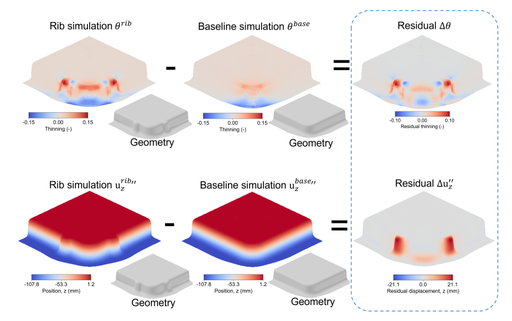
Figure 1 : Definition of the residual fields for one rib configuration on a fixed global geometry. Top: final thinning of the rib simulation and the baseline simulation, and the residual thinning. Bottom: the same for the displacement, with thezdirection shown as an example. The tool geometries of the two simulations are shown in grey. The dashed box marks the residual fields, which are concentrated near the ribs, while the complete fields are dominated by the forming of the global geometry.
Original paper · CC BY 4.0For this reason the surrogate takes two inputs: the baseline response and the geometric perturbation. The surrogate is trained to approximate the mapping from the baseline response and the perturbation to the residual displacements and residual thinning.
The baseline features describe the baseline simulation, with the reference and final node positions, symmetry-plane flags, and the element centre positions and final thinning. The perturbation features are the distances from each node to the closest points on the ribbed die and punch, together with the unit normals at those points. Element perturbation features take the mean and minimum node distances and the mean node normal over each element's three nodes.
All inputs are normalised with the mean and standard deviation of the source training data.
How one forward pass runs: the two streams meet in the token-based global module
Each stream first passes its node and element features through a linear layer with a softmax, which assigns every entity to one of 16 slices with soft weights. The two streams use separate slicers, so the perturbation slices can follow the regions that the ribs affect. Working on 16 tokens lets distant regions of the part interact at a low cost.
The cross-attention is one-way, so the baseline tokens aren't updated by the perturbation tokens. A feed-forward layer with a residual connection follows the cross-attention, and the cross-attended tokens are broadcast back to the entities with the perturbation assignment weights, as in Eq. (7).
Slicing can make the token-level update smooth the baseline state within each slice, since entities in one slice receive similar features. To restore entity-level detail, the gated fusion in Eq. (8) adds the baseline features back to the broadcast features. The scalar weight on the gated term is learnable and starts at zero, so the baseline features enter gradually during training.
A second bidirectional GraphSAGE layer then runs on the fused node and element features. The decoders output the residual displacement and the residual thinning, which are the two residual fields. All latent features have dimension 128, and all attention layers use 4 heads.
Comparison with two baseline models
R-BiLoGo was compared with two baseline models, R-Transolver and R-CAtt-BiUGNN, on three selected target geometries and on the source geometry. C-Med was chosen as the geometry with the median Chamfer distance among 600 Chamfered geometries. The same rib configuration was placed on all four geometries, so the only difference between them is the global geometry.
The full pool of 294 simulations trained a reference model for these three geometries, and the validation and test sets each contain 50 simulations.
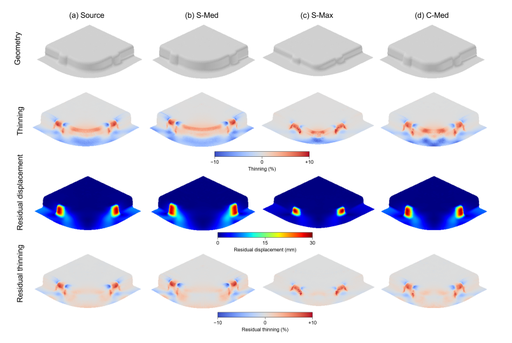
Figure 5 : Source geometry and the three selected target geometries: (a) source, (b) S-Med, (c) S- Max and (d) C-Med. From top to bottom: global geometry with ribs, FE thinning, magnitude of the residual displacement and residual thinning of an example simulation. The same rib configuration is used on all four geometries.
Original paper · CC BY 4.0On the source geometry, R-BiLoGo gave a mean node error of 0.0743 mm, lower than the hierarchical graph-based model and the Transolver-based model. That result is on the test set of the first corner geometry, so it measures in-geometry accuracy rather than transfer. The authors observed that R-Transolver showed little or negative transfer in most cases.
Across the three targets, R-BiLoGo gave the lowest errors after transfer on two of them. For the third target, C-Med, R-BiLoGo gave a slightly higher node error after transfer than after training from scratch.
R-BiLoGo needed 1.25 s per epoch and 11.6 GiB under the same setting, so the authors kept it for the rest of the study. R-CAtt-BiUGNN required the most training time and GPU memory, at 5.93 s per epoch and 15.3 GiB. Using K20 with transfer learning, R-BiLoGo reached the lowest errors after transfer on two of the three targets.
What each component contributes to the error reduction
The ablation study on the source test set separates the effect of the residual targets from the effect of the baseline inputs. Replacing the residual targets with complete fields raised the node error from 0.0743 mm to 0.1548 mm, an increase of 108.4%. The authors attribute this to the complete displacement of about 118 mm, where a small relative error in global deformation can be large compared with the rib effect.
Removing the baseline response from the inputs raised the node error by 5.4% and the element error by 4.6% on the source test set. After transfer to S-Med, removing it increased the element error and the thinning error by 8.7% and 6.9%, while the node error rose by only 1.5%. The baseline response therefore mainly helps the thinning prediction in this study.
Removing the baseline fusion increased the node error by 4.3%, but the element error rose by 31.7% and the thinning error by 21.6%. Each training set shares one baseline response, so the value of the baseline input across many geometries isn't tested here.
The slice assignment shows how the two streams divide the work in the model. The authors suggest that the residual formulation leaves the response away from the ribs to the baseline.
How many target simulations transfer needs
Transfer learning needs fewer rib simulations on a new corner geometry, and the number of target simulations K sets how much it saves. The authors varied K from 5 to 160 on three target geometries, S-Med, C-Med and S-Max, using nested subsets of the training pool. The oracle was trained from scratch on the full pool of 294 simulations, so the curves show how close each K gets to it.
Errors of both methods became more stable as K grew, and from K of 20 they changed more slowly. Training from scratch gave large errors with K of 5 and 10 for S-Med and C-Med, which shows where transfer helps most. From K of 80 to 160, the errors decreased only slightly, and for S-Med and C-Med the transferred errors at K of 80 approached the oracle.
For S-Med and C-Med, transfer gave lower errors than scratch training for all values of K. Transfer with 20 to 40 target simulations gave lower node errors than scratch training with 160 simulations. For S-Max, transfer gave higher node errors than scratch training up to K of 80, while its critical thinning errors were lower for all K. S-Max has the largest Chamfer distance among the three targets, so the authors suggest the transfer benefit depends on the geometric difference.
The transferred R-Transolver hardly decreased its error for K of 20 or more, unlike R-BiLoGo.
Across the 22 target geometries, transfer with 20 target simulations matched or beat scratch training with 80 for about half of them. Of the 22 geometries, 13 met this for the node error and 11 for the element error, which included all Chamfered and Ogee geometries. With the same 80 target simulations, transfer reduced the errors for 21 of the 22 target geometries.
The FE count is N_FE = N_g + N_src + (N_g − 1)K, so the target simulations K mainly set the cost. Reducing K from 80 to 20 saves about 26.7 h of FE computation per target geometry, while the baseline simulation adds about 1,600 s.
Which geometric differences reduce transfer benefit
The authors asked which measurable differences between the source and target global geometries reduce the transfer benefit. They started from 28 candidate descriptors, covering five types of geometric difference between the forming surfaces. A technical pre-screening of definition, computability and convergence left 15 candidates. The 15 candidates were computed on 430 CAD geometries, and the descriptors were measured relative to the same Standard source geometry.
Three descriptors were kept because they respond within each subclass rather than mainly between subclasses, and they are not strongly redundant. Their pairwise redundancy measures were at most 0.41, and a mean surface distance was dropped because it was almost fully coupled to ∆H. The retained descriptors are the maximum surface distance δmax, the change in the high-curvature area ∆c w0.99, and the change in forming depth ∆H.
The fourth descriptor, δc, was introduced from the transfer results rather than from the screening.
The forming-depth change is defined as ∆H(S, T) = H(T) − H(S), and a negative value means the target is shallower than the source. The benefit of transfer decreased with larger surface distance and larger high-curvature change between source and target. It also decreased for targets shallower than the source. Within the Standard subclass, the gain fell as δc increased, with S-δc-high giving a much lower gain than S-δc-low.
The δc effect was checked on the other subclasses, where the gains of the Ogee geometries changed little with δc.
The maximum distance and the high-curvature change followed the same direction in the other subclasses, but the size of the decrease depended on the subclass. Because the δc effect appeared only in the Standard subclass, a new subclass would need calibration with a small number of target geometries. The controlled targets were generated with a radial basis function surrogate fitted to 128 Standard geometries.
The generated parameter sets were then regenerated as CAD geometries and measured again, so the reported descriptor values are measured rather than predicted.
Limitations of the transfer results
The results stop applying where the transfer gain is not measured, and the paper is explicit about several such limits. The benefit of transfer was related only to the geometry, because the transfer decision is usually needed before the target simulations run.
So the conclusions rest on trends that hold across several target geometries. They don't predict the size of the gain for a new target geometry.
The choice of the source geometry was not varied, so its effect is unknown.
The residual formulation still needs one baseline FE simulation for each new global geometry. A surrogate of the global geometry, such as BiLoGo, could replace these baseline simulations.
The R-Transolver comparison shows a limit of its own. The error of the transferred R-Transolver hardly decreased for K of 20 or more. For K of 20 or more, R-Transolver stayed above the R-BiLoGo oracle at every K. The descriptors were computed without best-fit rigid registration, so changes in position and forming depth are kept in the measurement.
Paper info
- Authors
- Yingxue Zhao, Haoran Li, Haosu Zhou, Tobias Pfaff, Nan Li
- Venue
- arXiv · Preprint
- First published
- 2026-11-6
- Added
- 2026-11-10
- Updated
- 2026-11-6
- Version
- v1
- arXiv
- 2611.10086
- Category
- cs.LG
- Original paper terms
- CC BY 4.0
- What we show
- Paper info, commentary and permitted figures from the original paper
AI commentary is a separate explanation from the original paper and may contain errors. The original paper and figures follow each source's terms of use and any rights noted separately.
Abstract
Sheet metal components often consist of a global geometry, such as the corner radii and forming depth of a corner component, and local features added to it. During forming, both affect material flow. A surrogate learning all their combinations may need large training data. However, the same local feature type is often used on many global geometries. This study therefore partly decouples local features from the global geometry. The local-feature effect is first learned on one global geometry, needing fewer simulations than learning all combinations, then transferred to other global geometries via transfer learning, which can need fewer target simulations than training from scratch. A baseline-conditioned residual surrogate, R-BiLoGo, is proposed for ribs on the side walls of hot-stamped corner components. Its inputs are the baseline response and the geometric perturbation introduced by the ribs. Its outputs are the changes in displacement and thinning from the baseline. R-BiLoGo gave lower errors than a hierarchical graph-based model and a Transolver-based model on the source geometry, and on two of three selected target geometries after transfer. Across the 22 target geometries, transfer learning with 20 target simulations gave errors similar to or lower than training from scratch with 80 target simulations for about half of the targets. With the same 80 target simulations, transfer learning reduced errors for 95% of targets. The effect of the global geometry on transfer was studied with four parameter-free geometric descriptors and controlled variations across 4 corner subclasses. The benefit of transfer decreased with increasing surface distance and high-curvature change between source and target, and for targets shallower than the source. These trends were also seen in other corner types with a different magnitude.
Quote from the paper
Yingxue Zhao, Haoran Li, Haosu Zhou, Tobias Pfaff, Nan Li (2026). Transferring local rib responses to new component geometries in sheet forming with a graph-based Transformer. arXiv:2611.10086v1. https://arxiv.org/abs/2611.10086v1
BibTeX
@misc{zhao2026transferring,
  title = {{Transferring local rib responses to new component geometries in sheet forming with a graph-based Transformer}},
  author = {Yingxue Zhao and Haoran Li and Haosu Zhou and Tobias Pfaff and Nan Li},
  year = {2026},
  eprint = {2611.10086},
  archivePrefix = {arXiv},
  url = {https://arxiv.org/abs/2611.10086v1}
}