Paper commentary
ARF: Artistic Radiance Fields
Nearest neighbor loss keeps brushstrokes sharp in 3D style
- Problem Gram matrix style losses average out local style details, so earlier 3D stylization looks blurry. Point cloud and mesh pipelines also inherit errors from reconstructed geometry.
- Method ARF stylizes a radiance field instead of a point cloud. It matches each rendered feature to its closest style feature, and renders patches so full-resolution losses fit in memory.
- Results Users chose ARF over Huang et al. in 86.8% of comparisons, and over Chiang et al. in 94.1%, on a 25-pair user study.
Why 3D stylization loses brushstroke detail
Earlier 3D stylization methods rebuild the scene as a point cloud or a triangle mesh first, so their output is only as good as that geometry. Real-world reconstructions often carry visible artifacts, and these artifacts limit what the stylization can show. Because of that pipeline, a poor point cloud shows up directly in the stylized views.
Yin et al. transfer shape and texture style between textured meshes, which is another mesh-based route with the same geometry dependence.
The style loss is the second bottleneck, because most prior 3D works apply the Gram matrix-based style loss. A Gram matrix describes global feature statistics across the entire image, so it doesn't focus on local details. The authors observed that this loss leads to averaged-out style details that degrade the stylized renderings. Prior 3D stylization works therefore tend to produce over-smoothed and blurry stylized novel views.
Chiang et al. move the scene into radiance fields, which reproduce real-world appearance more faithfully than point clouds or meshes. However, their pre-trained style hypernetworks produce over-smoothed and blurry results. Those feed-forward models can't capture brushstrokes of the style image. The authors instead keep an optimization-based route, which lets the stylization adapt to each new style exemplar.
Matching local features with nearest neighbors
ARF replaces the global Gram comparison with a per-feature search, where each feature of a rendered image looks for its closest match in the style image. A Gram statistic summarizes the whole image, so a local stroke can disappear into the average, while a nearest neighbor match keeps each local description. Because the loss doesn't rely on global statistics, the optimization can adjust the local appearance of each training view to match the style.
Figure 2 gives the overall pipeline, from the reconstructed field to the NNFM style optimization and the free-viewpoint renders.
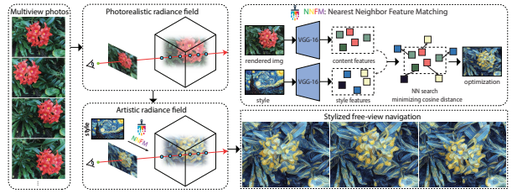
Fig. 2 .Overview of our method. We first reconstruct a photo-realistic radiance field from multiple photos. We then stylize this reconstruction using an exemplar style image through the use of a nearest neighbor feature matching (NNFM) style loss. Once this stylization is done, we can obtain consistent free-viewpoint stylized renderings. We invite readers to watch the supplemental videos to better appreciate our results.
Original paper · CC BY 4.0 · Kai Zhang, Nick Kolkin, Sai Bi, Fujun Luan, Zexiang Xu, Eli Shechtman, Noah Snavely · ARF: Artistic Radiance Fields · Original paper figure · Extracted the figure area from page 5 of the original PDF.The VGG feature map of the style image is compared with the VGG feature map of each rendered image. For every rendered feature at pixel (i, j), the loss takes the smallest cosine distance to any style feature and averages these values over the N pixels of the rendering. The loss is written as \[ \ell_{\textrm{nnfm}}(F_{\textrm{render}}, F_{\textrm{style}})=\frac{1}{N}\sum_{i,j}\min_{i',j'} D\big(F_{\textrm{render}}(i,j),F_{\textrm{style}}(i',j')\big) \] The cosine distance is one minus the normalized dot product of the two vectors: \[ D(v_1,v_2)=1-\frac{v_1^T v_2}{\sqrt{v_1^T v_1\, v_2^T v_2}} \]
Used alone, the NNFM term can make the content hard to recognize, so ARF adds an l2 penalty between the feature maps of the rendered and content images. The full objective is \( \ell = \ell_{\textrm{nnfm}} + \lambda \cdot \ell_2(F_{\textrm{render}}, F_{\textrm{content}}) \), where a larger λ keeps more content and a smaller λ stylizes more strongly.
Unlike the 2D method it builds on, ARF applies stylization only at the final scale and skips rotation and scaling augmentations of the style image.
Optimizing full-resolution losses under a memory limit
Volume rendering composites each pixel from many samples along its ray, so keeping gradients for a full image is too expensive. Many methods therefore render sparse random pixels, which works for per-pixel losses such as an l1 or l2 loss. It doesn't work for CNN-based losses such as NNFM or the Gram loss, because those losses need full-resolution images.
ARF gets around this limit with deferred back-propagation, which the authors apply to optimize on full-resolution images.
The procedure first renders the full-resolution image with auto-differentiation disabled. Next, each patch is re-rendered with auto-differentiation enabled, and the cached gradients for that patch are passed to the scene parameters through the chain rule. The gradients accumulate across patches, so the scene parameters receive the full-image gradient.
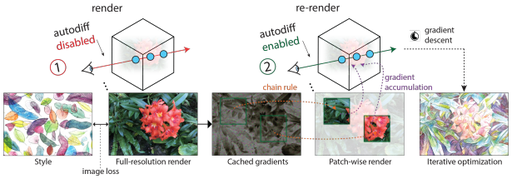
Fig. 3 .Illustration of deferred back-propagation. We first disable auto-differentiation to render a full-resolution image; then we compute the image loss (e.g., a style loss defined by NNFM or by a Gram matrix), and cache its gradients with respect to pixel values of the full-resolution image. Next, we back-propagate the cached gradients to scene parameters and accumulate in a patch-wise manner; for each patch, we re-render it with enabled auto-differentiation, and apply the chain rule to back-propagate the corresponding cached patch gradients to scene parameters for accumulation. This way, we correctly compute the gradients of a loss imposed on the full-resolution rendered image with respect to the scene parameters, with the same GPU memory footprint of rendering a single small patch differentiably.
Original paper · CC BY 4.0Memory during back-propagation is then that of one small patch rather than that of the full image. The authors apply this technique to both their NNFM loss and the standard Gram loss, which gives a like-for-like comparison. The same procedure also covers the color transfer step, since the recolored training views feed the pre-optimization.
Recoloring the views to the style palette
The style and content losses don't fully control color, so rendered tones can drift away from the style image. ARF first recolors the training views toward the style image, and those recolored views pre-optimize the radiance field as its initialization. The same recolored views also feed the content preservation loss, so the content term sees the target palette too.
After stylization, ARF applies the same color transformation to the images rendered at the training viewpoints. It then applies that same transformation directly to the color values produced by the radiance field.
The transform is a single linear map A in RGB space, so the color change stays simple and global. Its parameters come from matching color statistics of the recolored image set to those of the style image. With c for the pixel colors of the set to recolor and s for the style image's pixel colors, the conditions are E[Ac] = E[s] and Cov[Ac] = Cov[s].
The authors solve for A analytically rather than by iterative search, which keeps the step cheap to apply to every view.
The fixed-parameter setup is what lets the same transform be reused on the radiance field after training. ARF keeps the density component of the initial radiance field fixed and optimizes only the appearance component. The authors ran this stylization with Plenoxels, NeRF and TensoRF, so the color step isn't tied to one representation.
What is fixed and what is trained
ARF keeps the density of the photorealistic field frozen, so stylization doesn't change where the scene has volume. Only the appearance component gets optimized, which turns the photorealistic field into an artistic one. The authors also drop view-dependent appearance modelling, so the colors no longer change with the viewing direction.
Plenoxels is the representation ARF mainly uses, because it offers fast reconstruction and rendering. In Plenoxels, each point holds a mixture of spherical harmonics, and ARF discards every component except the first one. For TensoRF, the authors zero out the view directions before they enter the MLP. The framework isn't tied to one representation, so the authors also stylized NeRF and TensoRF.
Each of those runs reached high visual quality with faithful style transfer, as Fig. 8 shows.
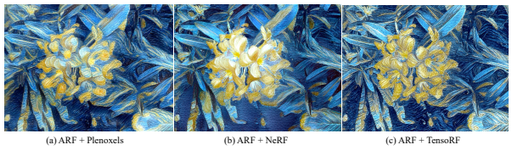
Fig. 8 .Applicability across different radiance field representations. Our ARF method is applicable to a variety of radiance fields representations, including Plenoxels [ 46], NeRF [32] and TensoRF [ 4], in each case producing high-quality 3D stylization results.
Original paper · CC BY 4.0Each iteration renders one training viewpoint, chosen at random from the views used to reconstruct the photorealistic field. Optimization runs for 10 epochs, with the learning rate decayed exponentially from 1e-1 to 1e-2.
A stylized field renders in real time once optimized, but each style image needs about 3 mins of optimization for forward-facing captures. For 360 captures, optimization takes about 20 mins on a single NVIDIA RTX 3090 GPU. The authors don't offer manual editing of the artistic field, and they flag interactive editing as a missing feature.
Preference in the user study
The user study asked viewers which of two stylized videos better matched a given style image. The authors selected 25 randomly chosen (scene, style) pairs and split the questions into 5 batches of 5. A large group of users rated one randomly selected batch each, giving about 12 ratings per pair on average.
The second baseline, Chiang et al., reconstructs a radiance field with implicit MLPs and updates it with a hypernetwork that takes a style image. Users chose ARF over Huang et al. in 86.8% of the comparisons. Against Chiang et al., users chose ARF in 94.1% of the comparisons, the larger margin of the two.
Both margins favor ARF, and the authors describe these results as a clear preference for their method. The study covers only these 25 pairs, and the paper reports the percentages for this sample alone. The paper doesn't report confidence intervals for the two percentages. The authors chose not to compare against off-the-shelf video stylization methods.
They based that choice on prior work showing those methods are less competitive than 3D style transfer approaches.
Where the two baselines fall short
The authors compare against Huang et al., which uses point clouds featurized with VGG features averaged across views and modulated by a style encoding. Chiang et al. use implicit MLPs in the style of NeRF++ and update the radiance branch with a hypernetwork that takes the style image as input. Both baselines were run with their released code and pretrained models.
In the Flower scene, Huang et al. gives over-smoothed results without detailed structures. It also misses plant leaves because the reconstructed point cloud is inaccurate, while ARF keeps the geometry of the scene. Figure 4 shows these comparisons on the forward-facing scenes.
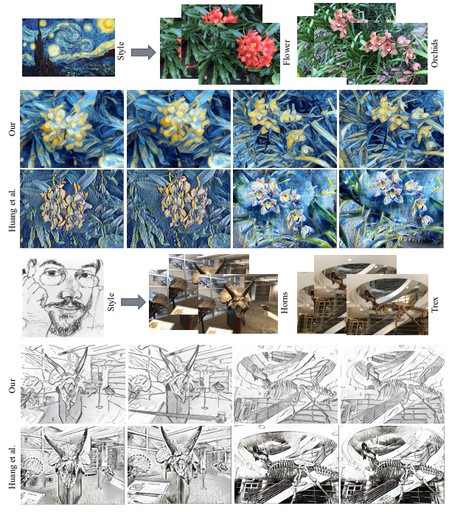
Fig. 4 .Comparison with the baseline method Huang et al. [ 16] on real-world forward- facing data. Our stylized novel views contain significantly more faithful style details. Additionally, the method of Huang et al. [ 16] requires reconstructing meshes from images, an error-prone process. Such errors can impact the quality of stylized novel views, as can be seen in the leaves in the Flower and Orchids scenes, and in ceiling of Trex. In contrast, our method, based on radiance fields, exhibits many fewer geometric artifacts. We invite readers to watch our supplemental videos for better comparisons.
Original paper · CC BY 4.0Chiang et al. transfer mainly the overall color tone of the style image. In the Family statue scene, ARF reproduces the subtle textures of a watercolor feather style, while Chiang et al. gives blurry results. The authors link this to a hypernetwork trained on a fixed set of style images, which fails to capture the details of unseen styles.
Figure 5 shows the Tanks and Temples comparisons with both baselines.
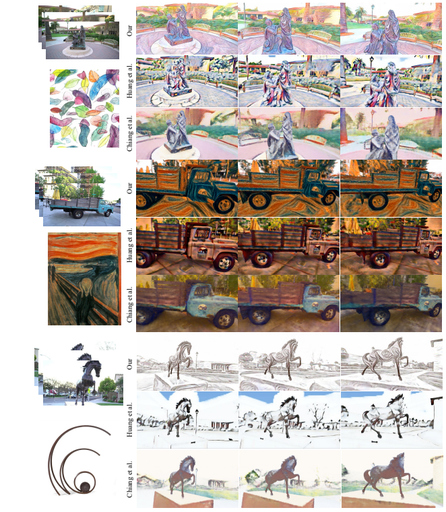
Fig. 5 .Comparison with the baseline methods Huang et al. [ 16] and Chiang et al. [ 8] on real-world Tanks and Temples data. Our results match both the colors and details of the style image most faithfully, while preserving sharp and recognizable content. We invite readers to watch our supplemental videos for better comparisons.
Original paper · CC BY 4.0Which design choices carry the result
The loss ablation swaps the NNFM loss for the Gram loss or for CNNMRF, and the paper compares the views visually. NNFM preserves more of the style details of the example images than the Gram-based and CNNMRF losses. The Gram loss gives less compelling results with many more artifacts, while NNFM also produces more faithful results than CNNMRF.
These are visual judgments of rendered views, and the paper reports no measured scores for them.
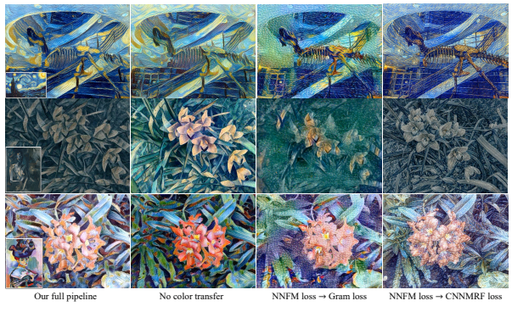
Fig. 7 .Ablation studies of color transfer and NNFM loss. Without color transfer, there is a noticeable color mismatch between the synthesized views and the style image (shown as insets in the first column). Replacing the NNFM loss with the commonly-used Gram loss [11] leads to less compelling results with many more artifacts. Our NNFM loss also generates more faithful 3D stylization results than the prior CNNMRF loss [22].
Original paper · CC BY 4.0Without color transfer, the generated results tend to have color tones that differ from the style images. The authors read this mismatch as a degraded style match, and their color transfer step addresses it. The color transfer stage is a separate ablation, so its effect is judged on the same Fig. 7 views as the loss comparison.
The layer ablation computes the NNFM loss on different VGG-16 layer blocks, shown in Fig. 9. The conv3 block preserved stylistic details better than the other layers in the authors' comparison. That choice sets the feature extractor used in the other experiments.
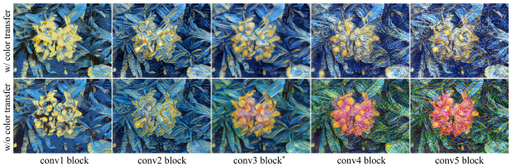
Fig. 9 .Ablation studies of extrating features for losses in Eq. 4 using different layer blocks of the VGG-16 network. We find that conv3 layer block generates more visually pleasing results than other layers.
Original paper · CC BY 4.0Limitations of the approach
Geometric artifacts such as floaters in the radiance field can carry over into both the photorealistic renders and the stylized views. The authors point to adding regularizers on volume density during optimization as a possible fix, and this paper doesn't test one. Floaters are a property of the underlying reconstruction, so the stylization step inherits whatever the radiance field gets wrong.
Once optimized, the artistic radiance field can be rendered in real time. Stylization still takes about 3 minutes for forward-facing captures per style image on a single NVIDIA RTX 3090 GPU. For 360 captures, the same per-style optimization takes about 20 minutes on that GPU, so each new style costs a full optimization run.
The reconstructed artistic radiance fields don't support manual editing by artists. The evaluation covers four forward-facing captures, seven 360 captures, and the Real Lego scene. Baseline comparisons come from the user study and from visual inspection of the rendered views.
Paper info
- Authors
- Kai Zhang, Nick Kolkin, Sai Bi, Fujun Luan, Zexiang Xu, Eli Shechtman, Noah Snavely
- Venue
- arXiv · Preprint
- First published
- 2022-6-13
- Added
- 2026-11-5
- Updated
- 2022-6-13
- Version
- v1
- arXiv
- 2206.06360
- Category
- cs.CV
- Original paper terms
- CC BY 4.0
- What we show
- Paper info, commentary and permitted figures from the original paper
AI commentary is a separate explanation from the original paper and may contain errors. The original paper and figures follow each source's terms of use and any rights noted separately.
Abstract
We present a method for transferring the artistic features of an arbitrary style image to a 3D scene. Previous methods that perform 3D stylization on point clouds or meshes are sensitive to geometric reconstruction errors for complex real-world scenes. Instead, we propose to stylize the more robust radiance field representation. We find that the commonly used Gram matrix-based loss tends to produce blurry results without faithful brushstrokes, and introduce a nearest neighbor-based loss that is highly effective at capturing style details while maintaining multi-view consistency. We also propose a novel deferred back-propagation method to enable optimization of memory-intensive radiance fields using style losses defined on full-resolution rendered images. Our extensive evaluation demonstrates that our method outperforms baselines by generating artistic appearance that more closely resembles the style image. Please check our project page for video results and open-source implementations: https://www.cs.cornell.edu/projects/arf/ .
Quote from the paper
Kai Zhang, Nick Kolkin, Sai Bi, Fujun Luan, Zexiang Xu, Eli Shechtman, Noah Snavely (2022). ARF: Artistic Radiance Fields. arXiv:2206.06360v1. https://arxiv.org/abs/2206.06360v1
BibTeX
@misc{zhang2022artistic,
  title = {{ARF: Artistic Radiance Fields}},
  author = {Kai Zhang and Nick Kolkin and Sai Bi and Fujun Luan and Zexiang Xu and Eli Shechtman and Noah Snavely},
  year = {2022},
  eprint = {2206.06360},
  archivePrefix = {arXiv},
  url = {https://arxiv.org/abs/2206.06360v1}
}