Paper commentary
Who Taught the Robot That? Removing One User's Corrections from a Robot Policy That Learns Online
Replay of the correction log recovers a robot after takeover corrections, not nudges
- Problem Removing one user's data from a robot that learns online fails with simple methods. Later users correct a robot that earlier users already shaped, so deleting the data and retraining leaves some of the removed user's influence in the policy.
- Method Replay is a method that rebuilds the robot from its training log. It reruns the logged updates in their original order, skipping the removed user's sessions.
- Results With takeover users on Delivery2D, replay ends 0.91 prefix floors from the counterfactual policy. The counterfactual policy is the robot that would exist had the user never been there.
Why removing a user is harder for robots
Machine unlearning asks how to remove one contributor's data from a trained model. Federated methods such as FedEraser keep each contributor's past model updates, so the model can be rebuilt without that contributor. Those methods assume each contributor's data are fixed and don't depend on the other contributors. Robot corrections break that assumption, because a person corrects the robot in situations the robot reached partly because of earlier corrections.
Deleting A's data can therefore leave some of A's influence inside the robot.
Their main finding is that the answer depends on how people correct the robot. Takeover corrections can be removed with an ordered log of training updates, while nudges could not be removed with any method they tested.
How the robot learns from users, and what success means
The deployment starts from a base policy that imitates 200 demonstrations, and users then take turns in sessions of 10 episodes each. Three users, A, B and C, each get four sessions, and the block length k sets how often they alternate. At k=1 the users rotate one session at a time, while at k=4 each user keeps four sessions in a row. During a session, a user intervenes when the robot does something they dislike, and each intervention is stored as a correction.
After the 10 episodes, the policy gets 200 gradient steps on batches drawn 50% from the current session, 25% from the replay buffer and 25% from the demonstrations.
A partial user only nudges the robot, so the recorded action is a blend: (1−α) times the robot's action plus α times the expert action, with 0 < α ≤ 1. At α=0.3 the recorded action keeps 70% of the robot's own action, so the correction carries what earlier users taught the robot. The log stores each session's corrections, the robot's own action at each correction, the seed and step count, and a checkpoint taken before the update.
The goal of removing user u is the counterfactual policy π−u, which the authors compute by rerunning the whole deployment without u's sessions. A real operator can't compute π−u, because the other users cannot be asked to repeat weeks of corrections, so scripted users make the measurement possible. Action distance is the average Euclidean distance between two policies' actions over 500 states visited by π−u and 500 states where u corrected the robot.
The noise floor comes from rerunning π−u with three new training seeds and averaging their distance to π−u, so a distance of 1 means as close as training noise allows.
Delivery2D limits the velocity action to 0.05 per step over 150-step episodes, and its users differ in gap choice, drop position and speed. Arm3 moves a three-joint planar arm, and its users differ in elbow direction, shelf position and joint speed limit.
Replay and the measures of closeness
Replay starts from the checkpoint saved just before the removed user's first session, then repeats every later session except theirs. The log stores each update's seed and step count, so repeating the logged updates from the base policy reproduces the deployed policy exactly. Because the checkpoint only saves computation, starting from the base policy gives the same result.
Shuffled replay repeats the remaining sessions in random order, which tests whether order matters. Relabelled replay applies only to partial users and rebuilds each correction from the replayed policy plus the user's logged nudge. The oracle version uses the user's true expert action instead, and an operator can't use it because they don't know that action.
Gradient-ascent unlearning, per-user adapters and continuing without the user serve as further baselines.
Action distance averages the Euclidean distance between two policies' actions over 500 states visited by the counterfactual run and 500 states where the removed user corrected the robot. The noise floor comes from rerunning the counterfactual policy with three new training seeds and averaging their distance to it. Replay repeats the earlier sessions exactly, so the authors use a prefix floor, rerunning with new seeds only from the user's first session onward.
A method at 1 is as close as training noise allows, and the floor differs between conditions, so comparisons use raw distances.
The share of influence left divides a method's distance to the counterfactual policy by the distance of the deployed policy, which still holds all of the user's influence. The r minimum uses the noise floor in place of the method distance, so r cannot fall much below it. Preference match measures the share of 100 test episodes where the robot does what the user prefers, and the authors report it minus the counterfactual policy's value.
Every comparison runs seed by seed on the same 20 seeds, with a 95% bootstrap confidence interval and a Wilcoxon signed-rank test. For claims of equality, the authors use a paired equivalence test with a stated margin.
Takeover users: order matters more than dependence
The authors split retrain's distance from the counterfactual policy into two parts, one due to the training procedure and one due to the data. Retrain to replay measures the training procedure, and replay to the counterfactual policy measures what the other users' corrections still carry. The frozen-robot control has every user correct the base policy instead of the current, already-corrected robot.
In that control, replay equals the counterfactual policy exactly, so any remaining gap points at the dependence between users.
On Delivery2D, retrain ends 1.30 noise floors from the counterfactual policy in the normal deployment. In the frozen-robot control it also ends 1.30 floors away, with a paired difference of −0.00. The 95% CI is [−0.09, +0.09] with p=0.87, so the dependence between users isn't what makes retrain fail. Replay ends 0.91 times the prefix floor from the counterfactual policy on Delivery2D.
On Arm3 replay ends at 0.90, which the authors read as close as training noise allows.
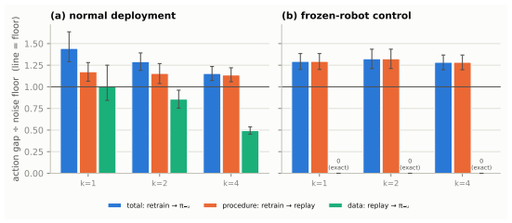
Figure 2 :Where retrain’s error comes from,Delivery2D, takeover users. Each group of bars is one schedule (kis the block length). Blue: total distance from retrain to the counterfactual policy π−u. Orange: distance from retrain to replay (due to the training procedure). Green: distance from replay toπ −u (due to the data). All are divided by the noise floor; the horizontal line at 1 is as close as training noise allows. (a) Normal deployment. (b) Frozen-robot control, where no user’s corrections depend on another’s, so replay equalsπ −u exactly. Retrain’s total error is the same in both panels.
Original paper · CC BY 4.0 · Eshika Pathak, Leela Krishna · Who Taught the Robot That? Removing One User's Corrections from a Robot Policy That Learns Online · Original paper figure · Extracted the figure area from page 6 of the original PDF.In the frozen-robot control, the shuffled order moves it 1.28 floors farther. Weighting each session by its share of deployment updates, still in one pass, didn't fix it (Appendix C). Reversing the order within each round from A B C to C B A changes the favoured user from A (+0.25 preference match) to C (+0.19).
The dependence between users does exist, but it is small.
Partial nudges: no tested method reaches the target
The authors vary the correction strength α over 0.1, 0.2, 0.3, 0.45, 0.6, 0.8 and 1 on Delivery2D, using block length k=1. At α=0.3, the recorded action is 70% the robot's own action, so the robot's earlier lessons stay in every correction. For α of 0.8 or more, that difference is not significant, so the dependence between users matters only at intermediate strengths.
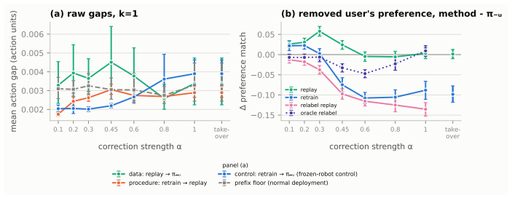
Figure 3 :Effect of correction strengthα,Delivery2D, schedulek=1. “Take-over” is the takeover user, identical toα=1. (a) Distances in action units. Green: replay toπ −u (due to the data). Orange: retrain to replay (due to the training procedure). Blue: retrain toπ −u in the frozen-robot control. Grey: prefix noise floor. (b) The removed user’s preference match minus that ofπ −u for each method; 0 is right, and positive values keep too much of the user.
Original paper · CC BY 4.0Replay ends farther from the counterfactual policy than the prefix floor for α from 0.2 to 0.6, with p≤0.03. For α of 0.45 or less, replay keeps more of the removed user's preferences than the counterfactual policy does, with a preference match of +0.024 to +0.058. The other users' corrections contain the robot's own action, which carried the removed user's habit.
Retrain does no better: for every α up to 0.6, its r is about 1 or more, so it removes no more influence than doing nothing.
Replay removes as much influence as noise allows at α=0.1 and at α of 0.8 or more. Between those values, replay sits 0.16 to 0.36 above that limit. Arm3 at α=0.3 shows the same picture in Table 1. The oracle relabelling, which knows each user's true expert action, removes 43 to 64% of replay's preference error for α≤0.3. An operator's relabelling is worse than plain replay at every α, since its rebuilt correction drifts from the true one as α grows.
Even perfect labels leave the action distance unchanged, so the authors trace the rest of the error to where the corrections were made.
Continued training: old corrections keep a habit alive
With users A, B and the harmful user H in deployment, the robot succeeds in 33% of Arm3 episodes, compared to 60% for the robot that never met H.
When all remaining users prefer the other gap, H's gap habit falls from +0.66 to +0.18 in two rounds and then stays near +0.10.

Table 2 :How H’s preferred gap fadeswhen training continues with the remaining users, Deliv- ery2D, takeover users, all remaining users preferring the other gap, 10 seeds. Each entry is the robot’s share of trips through H’s preferred gap minus the same share for the counterfactual policy π−u (0 means none of H’s habit is left), afterRfurther rounds without H.
Original paper · CC BY 4.0Gradient-ascent unlearning drops task success on Arm3 from 0.76 to 0.54, and deleting a user's adapter drops it to 0.02.
Can the log name who taught a behaviour?
The authors ask whether the correction log can rank users by how much each one shaped a behaviour. They use six users with random preferences, three sessions each, interleaved, across three groups of users with 20 seeds each. The true influence of a user is how much the behaviour changes when that user is removed by rerunning the deployment.
Four estimators are compared: removal by replay, removal one session at a time, a quick first-order estimate, and counting.
Counting is the simplest of the four, since it adds up each user's logged corrections that push the behaviour. Each estimator is scored by the Spearman rank correlation with the true ranking, where 1 means the same order. Replay reaches a mean correlation of 0.25 with takeover users and 0.32 with partial users at correction strength 0.3. Counting scores 0.24 and 0.25 in the same settings, so replay isn't better at ranking users.
Replay pays for this with about 18,000 gradient steps, a cost that counting doesn't incur.
So the log can flag one clearly harmful user, but it doesn't rank users by influence better than counting does.
The effects are small, because the deployed policy sits only 1.0 to 1.75 noise floors from the counterfactual policy.
Limitations of the simulation, policies and measurements
The results come from simulation with scripted users, and only the simulation can compute the counterfactual policy. An operator with real users can't check replay against that goal, because the counterfactual policy never exists outside the simulator. Scripted experts succeed in 98 to 100% of episodes, so the users themselves aren't the source of failures.
Large differences aren't what carries the findings, and the same noise limits the attribution results.
For partial corrections, the gap left after replay was not closed by any method the authors tested.
Paper info
- Authors
- Eshika Pathak, Leela Krishna
- Venue
- arXiv · Preprint
- First published
- 2026-11-6
- Added
- 2026-11-10
- Updated
- 2026-11-6
- Version
- v1
- arXiv
- 2611.10280
- Category
- cs.RO · cs.HC
- Original paper terms
- CC BY 4.0
- What we show
- Paper info, commentary and permitted figures from the original paper
AI commentary is a separate explanation from the original paper and may contain errors. The original paper and figures follow each source's terms of use and any rights noted separately.
Abstract
A robot that keeps learning after deployment is corrected by several people in turn, and one of them may later ask to be removed. We show that whether the robot can forget that person depends on how people correct it. The goal of removal is the robot that would exist if the person had never been there, which we compute exactly in two simulated tasks with scripted users. When users correct the robot by taking over control, an ordered log of training updates is enough: retraining on the remaining sessions in their original order gives a robot as close to the goal as training noise allows. Deleting the person's data and retraining in one pass does not, even when the other users' corrections do not depend on the removed person, because it loses the order of training. When users only nudge the robot's action, the other users' corrections carry the removed person's influence, and no method we tested recovers the goal robot. Continuing to train without the person removes most of their habits, but not what their data in the training buffer keep alive. The log can identify one clearly harmful user, but not rank users by influence better than counting their corrections.
Quote from the paper
Eshika Pathak, Leela Krishna (2026). Who Taught the Robot That? Removing One User's Corrections from a Robot Policy That Learns Online. arXiv:2611.10280v1. https://arxiv.org/abs/2611.10280v1
BibTeX
@misc{pathak2026taught,
  title = {{Who Taught the Robot That? Removing One User's Corrections from a Robot Policy That Learns Online}},
  author = {Eshika Pathak and Leela Krishna},
  year = {2026},
  eprint = {2611.10280},
  archivePrefix = {arXiv},
  url = {https://arxiv.org/abs/2611.10280v1}
}