Paper commentary
Can LLMs Debug Robots by Editing Their Weights?
An LLM editor repairs robot wording failures by editing token embeddings
- Problem Robot policies can fail on tasks they already do when unfamiliar wording maps to the wrong behavior. Retraining needs gradients or new demonstrations, which this setup avoids.
- Method The editor is an LLM that reads the policy weights and changes 65 token-embedding rows of π0.5. It uses a CPU workspace and budgeted simulator feedback, without gradient updates or new demonstrations.
- Results On 765 held-out paraphrases, success rose from 86.3% to 92.0% compared with the unedited policy. Matched random-direction edits did not help.
Where a familiar skill fails
A policy can fail on a task it already performs when the wording reaches the wrong behavior. Both actions are familiar tasks in that same scene, so the gap sits between wording and task, not in a missing stove behavior. On a 700-episode practice scan, the policy succeeds 86% of the time overall.
All three sessions diagnosed a content problem rather than a simple lack of attention to language. These words aren't unknown to the pretrained language model, because the real contrast is with the checkpoint's canonical LIBERO task instructions.
Not every failure is a wording problem, since a camera perturbation or a dropped object needs a visual or recovery behavior. A new reading of one word can't supply that behavior. Takehi et al. introduced weight-space programming, where a general-purpose LLM inspects another network's parameters and changes them directly. That setup doesn't use gradient optimization, and the paper separates removing an obstacle to an existing ability from creating a new one.
The authors carry this setup to robot foundation policies, asking whether the editor finds a useful intervention. They also ask whether the editor declines interventions that fail its own checks.
Editing rows instead of retraining
The model is evaluated with gradients disabled, so the editor can't train its way to a fix.
The kernel can inspect the returned observations and outcomes, so the editor still gets feedback despite having no new demonstrations. GPT-6 Astra receives the policy weights, a persistent CPU Python workspace, and a budgeted forward tool.
Each robot session receives 40 to 50 forward requests, and all three language-repair sessions receive 50. Each session reserves its own practice validation and makes the final retain-or-revert call before any held-out test. The three π0.5 sessions start separately, so they don't inherit each other's notes or edits.
Figure 2 summarizes the loop: the editor reads weights and writes replacement tensors inside a CPU kernel. A separate simulator supplies the practice rollouts and replay probes, while held-out outcomes are never returned to the editor. Candidate values are frozen before the paired held-out evaluation runs.
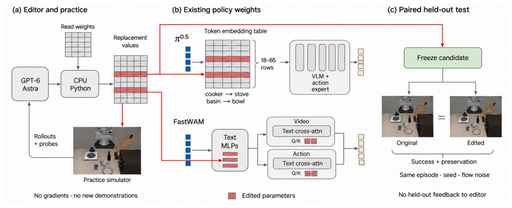
Figure 2 : One editing interface, two policy architectures.(a) Astra reads weights and writes replacement tensors in a CPU kernel; a separate simulator provides practice rollouts and replay probes. (b) The successful𝜋0.5 edits change token-embedding rows. The FastWAM investigation changes text-conditioning MLP and Q/K parameters. These are replacements within existing modules, not newly inserted runtime components. (c) Candidate values are frozen before paired held-out evaluation, whose outcomes are not returned to the editor. Red denotes parameter locations. Layout follows the supplied GR00T N1 visual reference [7]; camera insets are illustrative.
Original paper · CC BY 4.0 · Jusheng Zhang, Keze Wang, Liang Lin · Can LLMs Debug Robots by Editing Their Weights? · Original paper figure · Extracted the figure area from page 3 of the original PDF.The row remapping formula
Run C changes each selected embedding row by blending it with a destination vector, rather than overwriting the whole table. For a selected source row i, the new row is a weighted mix of the original row E_i and the mean of destination embeddings. The destination set T_i is averaged uniformly, so the formula sums each destination row E_j and divides by the set size.
Most destinations hold one task-anchor token, so the mean reduces to that anchor's embedding. Ambiguous cues use a centroid instead, because a single anchor would overstate one meaning. Dairy isn't forced exclusively toward cheese, which keeps the blend from collapsing a broad word onto one item.
The strength alpha_i runs from 0.5 to 1.0 in the final recipe. At 1.0 the row is replaced completely, while smaller strengths keep part of the original vector. The editor doesn't rewrite the instruction string, and the edit doesn't depend on context. Across 65 rows, the edit changes 132,768 scalar entries, or 0.00367% of the exported checkpoint.
The locality argument starts from the policy written as a function of the unedited parameters, visual inputs, and fixed flow noise. If an instruction's token IDs don't intersect the edited row set S, its embeddings equal the original ones. This is a structural guarantee that follows from which rows are read, so it doesn't assume a word is unrelated to the task.
For C, all 430 outside episodes keep their outcomes, while 48 of the original 86 failures inside the subset are repaired (55.8%). That subset gain is 13.13 pp, with a paired 95% interval of [9.16, 17.11] pp.
Held-out paraphrase gains
The editor's candidates were scored on all 765 held-out Language Instructions variants, which it never saw during editing. Each comparison counts repairs g and regressions l, and reports (g - l)/n with paired normal-approximation intervals. Exact two-sided McNemar tests are applied to the evaluated episode pairs, not to uncertainty over editor sessions.
All three independent sessions raise success on the same 765 held-out paraphrase variants.
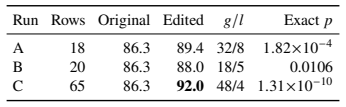
Table 1 : All three independent language-editing sessions improve held-out success.Percentages on the same 765 held-out paraphrase variants; 𝑔/𝑙 denotes repairs/regressions. No run is omitted. The common original count is 660; edited counts are 684, 673, and 704.
Original paper · CC BY 4.0The gain concentrates where descriptions replace familiar task names, not across all paraphrase types. On difficulty level 5, run C moves 104/174 to 136/174, or 59.8% to 78.2%. Level 5 holds 174 of 765 episodes, yet it supplies 32 of C's 44 net repairs. So the headline gain is not a uniform lift across language difficulty levels.
Do outcome changes stay on edited tokens?
The authors split held-out instructions by exact tokenizer IDs, so an instruction counts as affected only when it contains an edited token. Table 2 shows the split for all three sessions, and Figure 3 draws the same split for run C as bars. The 430 untouched instructions keep their outcomes, with 0 gains and 0 losses under C. The authors call the partition the stronger test of the lookup mechanism, because it is defined from the submitted row IDs rather than difficulty.
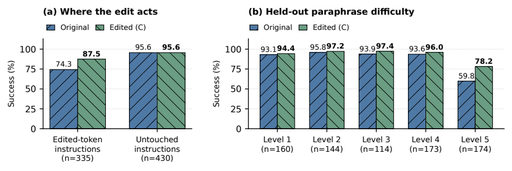
Figure 3 : The repair is local to the instructions it touches.(a) Run C improves edited-token instructions from 249/335 to 293/335 successes; all 430 untouched instructions retain their outcomes (411 successes). (b) The gain is largest on the hardest paraphrases. All bars are recomputed from episode records and token IDs; these are measured outcomes, not generated imagery.
Original paper · CC BY 4.0The locality argument starts from the policy written as a function of the unedited parameters, visual inputs, token embeddings and fixed flow noise. Let S be the set of edited row IDs and I(c) the token IDs of instruction c. If I(c) does not intersect S, the edited embeddings read for that instruction equal the original ones. The authors stress that this is a guarantee about fixed inputs, not a claim that closed-loop simulations rendered separately are numerically identical.
That subset gain is 13.13 pp, with a paired 95% interval of [9.16, 17.11] pp. Replaying the same saved inputs gives identical original and edited actions on all 22 inputs. Rendered paired episodes can still differ, with initial-image differences of 1 to 16 channel entries.
Direction or size? The controls
The random-direction control moves the same 65 source rows by matched distances in random directions, and it doesn't improve success.
Full replacement moves the rows all the way to the editor's destinations, and it explains much of the improvement. That comparison gives 20 wins and nine losses on 763 valid pairs, with exact p = 0.0614. Counting only valid pairs gives 90.7% for full replacement and 85.6% for random directions. Neither convention shows that C outperforms the editor-informed replacement control.
The dictionary control inherits the editor's words and destinations, so it doesn't measure what discovering that lexicon costs.
Checking the action change against the intended task
The authors ask whether the edit moves predicted actions toward the intended task, rather than only changing success counts. For seven descriptive inputs, each edited action chunk is compared with the chunk for its literal task prompt. The ratio rho is the median over those inputs of the edited-to-anchor distance divided by the original-to-anchor distance.
Here a_i is the original chunk, ea_i the tested chunk, and a_anchor_i the chunk for the literal prompt. The comparison separates an embedding's direction from its norm, and it uses predicted actions instead of attention mass as a proxy.
The norm-only control leaves rho at 1.004, so changing the norm alone doesn't move actions toward the anchor. The direction-only edit reduces rho to 0.340, and the final B edit reduces it to 0.367. The authors recompute these distances independently from the saved action arrays. They describe closeness to an anchor as a mechanistic diagnostic, not a substitute for closed-loop task success.
Under direction-only editing the distance becomes 0.409, and under final B it becomes 0.417.
Together these controls support a lexical-direction mechanism, and the authors keep it apart from a validated repair. Action alignment isn't global feature alignment, and the residual probes show this limit. Those distances are 0.282, 0.540, and 0.595 times their original values.
Declined edits and the decision record
Outside the three language repairs, the editor reverts or declines 12 of its 13 final decisions. The one retained candidate is a FastWAM value-projection edit whose held-out gain isn't significant. Table 6 lists all 16 sessions, with 4 retained candidates in total.
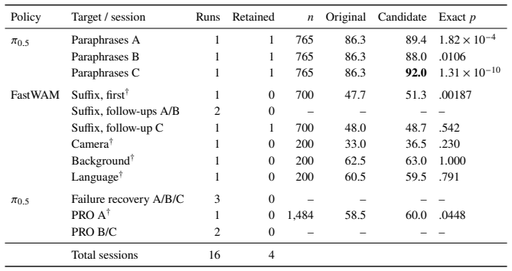
Table 6 : Final decisions and held-out outcomes across all 16 sessions.Success rates are percentages;𝑛 counts episode pairs, while “Runs” counts editor sessions.†Withdrawn candidate evaluated from its archive. Camera/background/language rows use their targeted category; suffix and PRO rows use the stated pooled samples. Dashes mean no candidate result is presented, not zero success. All three paraphrase edits are retained and significant. Of the other 13 sessions, 12 decline their candidates; the sole retained suffix follow-up has𝑝=.542.
Original paper · CC BY 4.0On LIBERO-RECOVER, the policy succeeds on 59.5% of 440 baseline episodes. A correlate isn't a cause: one editor found that failed episodes don't flip more often per step, since flips accumulate during long failures. All three recovery sessions submit no edit.
On LIBERO-PRO, original success is 28.0% for position changes and 26.3% for task changes. A third session reduces five outlying SigLIP position-embedding rows, and its 768-episode practice confirmation is 434 versus 433 successes. The archived candidate lifts overall held-out success from 868/1,484 to 890/1,484, with p = .0448. The gain concentrates in object appearance, and position success falls from 28.0% to 27.3%.
The authors report this nominal effect but don't promote it, because subgroup tests are unadjusted.
The decision table separates validation available to the editor from held-out assessment available only afterward. So the 12 of 13 decline rate isn't a measured accuracy for a failure classifier; it records whether these searches recognize a lack of practice support. The LIBERO-PRO editor wrote that the candidate failed validation and the planned reversion hasn't been executed.
Benchmark metadata as a separate finding
LIBERO-Plus reference instructions can carry scene metadata, such as a view and init state tag, and keeping that tag changes FastWAM's result. That gap is 70.0% versus 48.6%, a drop of 21.4 pp for the tagged format. The evaluated π0.5 checkpoint scores 186/210, or 88.6%, under either format.
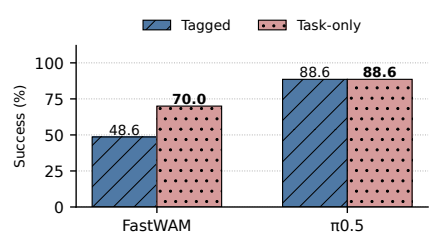
Figure 5 : One instruction format, two different sensitivities.Each model is tested on the same 210 matched LIBERO-Plus episodes. KeepingreferencemetadataintheinstructionlowersFastWAMsuccess by 21.4 pp. The evaluated𝜋0.5 checkpoint has the same aggregate rate in both formats; some individual outcomes differ. This is evidence about these two checkpoints, not all WAMs versus all VLAs.
Original paper · CC BY 4.0Paired counts show what the equal π0.5 rate hides. π0.5 has nine gains and nine losses, with p = 1. Unchanged aggregate success doesn't mean individual trajectories are identical, and the two checkpoints differ in architecture and overall success. So the comparison isolates how each checkpoint responds to this interface choice, not a general WAM versus VLA gap.
That change gives 43 gains and 18 losses with p = .00187, but the candidate fails a paraphrase preservation check. So the candidate is requested for withdrawal, and the driver doesn't execute the final cleanup. Three follow-up sessions inherit the notebook and candidate, and two of them decline their final edits.
The third follow-up keeps a video-expert value-projection edit that moves tagged success from 48.0% to 48.7% (24/19, p = .542). On a separate task-only sample, the same edit moves success from 65.6% to 66.6% (26/19, p = .371).
Limits of the evidence
The authors didn't show superiority over a lexicon built by a human, prompt rewriting, or LoRA. The strongest control already recovers much of the gain using the editor's own discovered lexicon. That doesn't prove no suitable weight edit exists, so the obstacle/ability distinction stays a hypothesis. FastWAM suffix sensitivity looks obstacle-like, yet the attempted gate isn't reproducible.
All robot experiments run in simulation and use two released checkpoints, so the findings stay limited to these settings. The three primary sessions share one held-out population and one seed. Their independence lies in the search, not in environmental coverage.
The editor consumes observations, activations, and simulator outcomes, so the setup isn't data-free in the broad sense. Complete API cost accounting isn't available, so the cost of each session remains unmeasured.
The conclusion keeps the claim narrow: a repair of 65 embedding rows for affected held-out instructions, not missing skills.
Paper info
- Authors
- Jusheng Zhang, Keze Wang, Liang Lin
- Venue
- arXiv · Preprint
- First published
- 2026-11-6
- Added
- 2026-11-9
- Updated
- 2026-11-6
- Version
- v1
- arXiv
- 2611.09376
- Category
- cs.RO · cs.AI
- Original paper terms
- CC BY 4.0
- What we show
- Paper info, commentary and permitted figures from the original paper
AI commentary is a separate explanation from the original paper and may contain errors. The original paper and figures follow each source's terms of use and any rights noted separately.
Abstract
A language model can repair a robot policy's lexical instruction grounding by editing just 65 token-embedding rows. We bring weight-space programming to robot foundation policies: GPT-6 Astra reads weights and uses a CPU workspace and budgeted simulator feedback, without gradient updates or new demonstrations. Three independent sessions on $π_{0.5}$ all improve success on 765 held-out paraphrases; the best raises success from 86.3\% to 92.0\% (48 repairs, four regressions; exact paired $p=1.31\times10^{-10}$). Among the 335 instructions containing edited tokens, success rises from 74.3\% to 87.5\%; the other 430 episodes have zero outcome changes. Matched random-direction edits do not help. Full replacement using the editor's own lexicon explains much of the gain but produces more regressions; its direct difference from the editor is not significant at 0.05. Across 13 further robot sessions, the editor declines 12 candidates; the sole retained edit does not show a significant held-out gain. Separately, benchmark metadata lowers FastWAM success from 70.0\% to 48.6\%, while the evaluated VLA's aggregate rate is unchanged. The evidence supports precise lexical repair, not general acquisition of missing robot capabilities.
Quote from the paper
Jusheng Zhang, Keze Wang, Liang Lin (2026). Can LLMs Debug Robots by Editing Their Weights?. arXiv:2611.09376v1. https://arxiv.org/abs/2611.09376v1
BibTeX
@misc{zhang2026llms,
  title = {{Can LLMs Debug Robots by Editing Their Weights?}},
  author = {Jusheng Zhang and Keze Wang and Liang Lin},
  year = {2026},
  eprint = {2611.09376},
  archivePrefix = {arXiv},
  url = {https://arxiv.org/abs/2611.09376v1}
}