Paper commentary
EGT: Execution-Grounded Traversability through Learned Closed-Loop Trajectory Distributions
Learned closed-loop trajectory distributions predict whether a vehicle can execute a path
- Problem Point-wise roll, pitch, and force-angle margins check each waypoint against fixed limits. They ignore how terrain disturbances and controller corrections change the motion, so they reject safe paths and accept unsafe ones.
- Method EGT predicts closed-loop executions with flow matching and counts successful ones.
- Results EGT scored 97.4% overall accuracy on simulated trials.
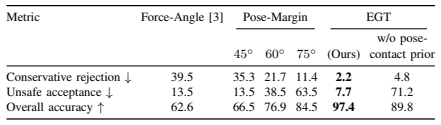
Figures from the paper TABLE I:Traversability classification over 650 simulated trials: 598 safe and 52 unsafe executions under the stated task requirements. All metric values are percentages. The EGT ablation omits conditioning on the NLS pose prior. Arrows indicate the preferred direction, and best values are shown in bold. The force-angle baseline uses gravitational loading only.
Original paper · CC BY 4.0 · Chinmay Mundane, Amith Manoharan, Arun Kumar Singh · EGT: Execution-Grounded Traversability through Learned Closed-Loop Trajectory Distributions · Original paper figure · Extracted the figure area from page 6 of the original PDF.Why point-wise margins mislead traversability
Point-wise roll, pitch, and force-angle margins judge a path by checking every waypoint against fixed limits. That check penalizes a brief posture excursion, even when the vehicle and its controller could recover safely. The opposite error also occurs, because a vehicle can stay upright and still stop forward progress. Wheel slip can push the vehicle sideways into obstacles or ditches without any rotational tip-over.
Force-angle and attitude limits only check rotational tip-over, so they miss these failures. Reference-path margins are a weak proxy too, since terrain disturbances and controller corrections can pull the vehicle far from the planned path.
Wang et al. [6] address closed-loop behavior with a learned, action-conditioned dynamics model paired with a tracking controller. That model is rolled out step by step, so each state prediction changes the controller's next corrective action. Their learned target is action-conditioned vehicle dynamics, not the complete execution distribution for a given reference path.
The paper's EGT definition instead asks whether the vehicle-controller pair can execute the candidate path within a tracking error limit and a required fraction of arc length. Physical failures such as tipping into a ditch directly derail path tracking, so EGT captures them through the execution requirements.
The key idea: learn whole executions
The authors treat the vehicle and its feedback controller as one closed-loop system and learn the distribution of its realized trajectories directly. Because no step feeds the next, the predictor skips the recursive dynamics-and-controller rollouts that the Wang et al. approach needs. The authors say that recursive rollouts compound prediction errors, since an inaccurate state prediction changes the controller's corrective action.
Wang et al. learn an open-loop, action-conditioned dynamics model, so their learned target is vehicle dynamics rather than the full execution distribution for a reference path. The new predictor instead targets the distribution of closed-loop executions conditioned on a reference path. EGT is defined as the probability that a vehicle-controller pair keeps the path-tracking error below a set limit and completes a required fraction of the arc length.
A tip into a ditch counts against EGT because it derails tracking or halts forward progress, not because the attitude alone crossed a limit.
The EGT definition is conditioned on one fixed vehicle-controller pair, so it describes that pair rather than any vehicle. The authors say that the fixed pair is a limitation, and they propose adding the vehicle embodiment and control structure as context.
EGT as a probability over sampled executions
A candidate path is a straight segment from the current position, parameterized by arc length s in [0, l]. The nearest reference point is found by projecting each predicted waypoint onto the direction d. Because the normal n is constant and orthogonal to d, the signed orthogonal tracking error reduces to n transposed times the waypoint minus q0.
Each waypoint's error is therefore measured as signed distance from the reference line.
The worst-case tracking statistic takes the largest normalized error over every waypoint of one execution. Each error is divided by the corridor half-width at the projected arc length, so a value of one or less means the path stayed inside the tolerance. Progress uses the terminal waypoint rather than the furthest point reached, so a vehicle that retreats after some progress fails the progress requirement.
EGT is the probability that both conditions hold within the same execution, so tracking and progress are judged jointly. The probability is estimated by drawing n_s independent complete executions from the learned model and counting the fraction that satisfy both conditions. The experiments draw n_s = 30 predicted executions per candidate, which gives a sample-average estimate of EGT.
A candidate passes when its estimated EGT meets p_req = 0.8, and the planner then ranks the passing candidates by cost.
The flow model behind the executions
A variational autoencoder maps each 100-waypoint path and execution to a 32-dimensional latent code, and back. Its encoder and decoder stay frozen once trained, so the flow matching model is the only part that learns. The reference path's latent becomes part of the conditioning input, while the execution's latent serves as the training target.
Flow matching trains a velocity field that carries Gaussian noise toward the distribution of closed-loop execution latents. It uses linear interpolation, z_r = (1−r)z_0 + r z_cl, and regresses the velocity onto the straight-line target z_cl − z_0. The velocity field is a stack of transformer blocks, and the loss averages over training examples, Gaussian noise and flow time.
Two auxiliary losses supervise the decoded waypoint coordinates and the terminal position, so the decoder output stays close to the ground truth. The coordinate loss has weight 2 and the endpoint loss has weight 4, and their gradients reach the flow model through the frozen decoder.
At inference, the authors build the conditioning matrix once per reference and reuse it for every flow evaluation and execution sample. Each sample starts from fresh Gaussian noise and is integrated over 10 Euler steps. The decoded sequence is smoothed with Bernstein polynomials and shifted so its first waypoint sits at the local origin. The conditioning input has 266 tokens, mixing reference, goal, pose-contact and terrain tokens built with a feature pyramid network.
The training set holds 8,808 feed-forward trajectories on 7 terrains, all collected in simulation. Because one vehicle-controller pair produced all of the data, the model doesn't take a different controller as a run-time input. The vehicle starts each execution from rest, which matches the initial-state assumption of the FM predictor.
Choosing a path with EGT
The planner starts each replanning cycle with 100 candidate reference paths. The FM model draws 30 predicted executions for each candidate. Candidates whose EGT estimate reaches p_req = 0.8 form the safe set F. Inside that set, the planner ranks candidates by the cost j_i and executes the least-cost path.
The global term averages a cost-to-go over the predicted endpoints, which is the Euclidean distance to the goal in open terrain. The planner divides that average by the cost-to-go at the current position, plus a small positive constant. The tracking and progress risks are empirical CVaR values of the tracking error and of the progress loss.
CVaR at level 0.90 emphasizes the tail of the sampled executions, so rare large deviations still raise the cost. The authors set the weights λg, λ⊥ and λprog to 0.5 each.
If no candidate reaches p_req, the planner relaxes the threshold to within δp of the best candidate's reliability. The relaxed threshold stops at the lower bound p_abort, and selection reruns on the cached evaluations. If no candidate meets p_abort, the planner returns no-go and regenerates the paths. This fallback lowers the execution confidence required, instead of loosening the tracking or progress tolerances.
Planning takes about 1 s on average on the mounted RTX 3090 laptop. The low-level path-tracking controller runs at 20 Hz during execution. The vehicle stays at rest during replanning and starts tracking only after the plan is complete. Each execution therefore begins from rest, which matches the initial-state assumption of the FM predictor.
Classifying paths on simulated trials
A run counts as safe when the vehicle arrives at its target without toppling, sticking, or crossing the 1.0 m lateral bound. The dataset holds 598 safe executions and 52 unsafe ones, and every method is scored against these same labels.
The force-angle baseline checks tip-over margins at each waypoint using gravitational loads only. Raising the pose-margin threshold cuts conservative rejection, but it lets more unsafe runs through.
EGT rejects 13 of 598 safe executions, a conservative rejection rate of 2.2%. EGT accepts four of 52 unsafe executions, an unsafe acceptance rate of 7.7%, for an overall accuracy of 97.4%.
Without the 3D pose and contact prior, EGT rejects 29 of 598 safe runs and accepts 37 of 52 unsafe ones. The authors trained a separate FM model without pose-contact conditioning on the same data. They read this ablation as evidence that the pose prior matters for the execution predictor. The EGT probability from the FM model reduces both error types by assessing predicted closed-loop execution.
Whether EGT probabilities match outcomes
EGT is treated as a predicted probability, and its calibration is checked against the same 650 executions and labels used in Table I. The bins have unequal widths, because uniform bins left some of them with too few cases.
In the lowest bin, EGT gives a mean predicted probability of 0.0656 across 61 cases. The observed success frequency in that bin is 0.2131, so EGT underestimates success there. The pointwise 95% Wilson interval, [0.1290, 0.3312], lies entirely above the mean prediction. These intervals show how much uncertainty the finite number of recorded outcomes leaves in each group.
The two intermediate bins have mean predictions of 0.9200 and 0.9667, and every recorded execution in them meets the success criteria. Where EGT equals one, 481 of the 485 executions succeeded, giving an observed frequency of 0.9918. EGT therefore slightly overestimates success in that bin, because it predicts perfect success there.
Navigation with EGT-based selection
The authors compare the EGT planner with GP-navigation and TAL on three terrains, running 50 trials per method and terrain. GP-navigation runs online and needs no pretraining. TAL learns a neural transition model from the same simulated execution dataset that trains the FM model. The planner and TAL both use adapted π-MPPI with 400 control sample sequences and a 2 s horizon.
Both use the same underlying training executions and π-MPPI, so they differ mainly in prediction targets and planning objectives.
The EGT planner fails in 4% of trials on Terrain 1, 4% on Terrain 2, and 2% on Terrain 3. GP-navigation fails in 26% to 46% of trials, while TAL fails in 34% to 48%. Against TAL, the reduction ranges from 30 to 44 percentage points. On Terrain 1, the failure rate drops from 40% to 4% compared with GP-navigation.
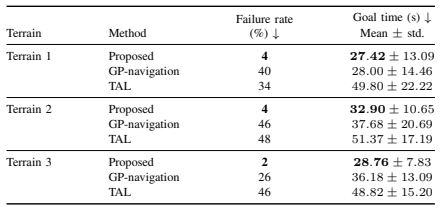
Figures from the paper TABLE III:Navigation performance across three terrains, with 50 trials per method and terrain. Failure rates use all trials; goal-reaching times use common-success runs (N= 21,17,19for Terrains 1–3).
Original paper · CC BY 4.0On Terrain 1, the mean goal-reaching time is 27.42 s for the planner and 28.00 s for GP-navigation. So the gain on Terrain 1 comes mainly from reliability, not speed. On Terrains 2 and 3, the planner's mean time is 12.7% and 20.5% lower than GP-navigation's. Compared with TAL, the planner's mean goal-reaching time is 36% to 45% lower across the three terrains.
These time comparisons use only common-success runs, which numbered 21, 17 and 19 for Terrains 1 to 3.
The authors attribute the advantage to the planner accounting for the controller's corrective actions through FM-based execution predictions. Because of this, the planner relies less on frequent reference-path replanning while keeping high-rate feedback control.
Real-world check of the simulation-trained model
The real-world check asks whether a model trained only in simulation still classifies paths correctly on outdoor terrain. The authors run this zero-shot, so the model sees no real-world data during training. The implementation runs on a skid-steered Jackal, which is similar to the vehicle used in training. The mounted RTX 3090 laptop performs the computations, and planning takes an average of 1s.
Figure 1 shows three real-world trials, each with candidate reference paths and their FM-predicted closed-loop trajectories. In Trial B, a candidate path runs into a lamppost, and the predicted trajectory stops early. EGT classifies that blocked path as non-traversable, while the path that moves away from the tree counts as traversable. The path that steers away from the branch is classified as traversable.
The same decision rule used in simulation applies here: a path is traversable when its predicted EGT meets the 0.8 threshold. The authors apply the rule with the same parameters they used in simulation, so the real-world trials add no new tuning. The vehicle begins each execution from rest, matching the initial-state assumption of the FM predictor.
The authors present these trials as qualitative evidence, so they don't report a success rate or a confusion matrix for outdoor terrain.
Limitations and open questions
EGT, as evaluated, assumes rough, non-deformable terrain and a fixed vehicle–controller pair. The training dataset holds 8,808 feed-forward trajectories on 7 different terrains. The planner was tested on three terrains, with 50 trials per method and terrain.
EGT checks execution only along the reference path, so it doesn't assess stability past the endpoint. The force-angle baseline uses gravitational loading only, and inertial loads aren't included in it. Its margins therefore act as a gravity-only check, so it isn't a full test of tip-over.
Calibration is weakest in the lowest bin, where EGT underestimates the success frequency. The planner took an average of 1s per replanning cycle, while the low-level path-tracking controller ran at 20Hz. The planner's computation runs on a mounted RTX 3090 laptop, so planning time limits how often it can replan.
Paper info
- Authors
- Chinmay Mundane, Amith Manoharan, Arun Kumar Singh
- Venue
- arXiv · Preprint
- First published
- 2026-11-6
- Added
- 2026-11-9
- Updated
- 2026-11-6
- Version
- v1
- arXiv
- 2611.09270
- Category
- cs.RO
- Original paper terms
- CC BY 4.0
- What we show
- Paper info, commentary and permitted figures from the original paper
AI commentary is a separate explanation from the original paper and may contain errors. The original paper and figures follow each source's terms of use and any rights noted separately.
Abstract
Rough terrain traversability is often estimated through point-wise roll, pitch, or force-angle margins along a planned path. However, these metrics are often inaccurate and overly conservative because they ignore how terrain disturbances and low-level controller corrections can affect the vehicle's motions. To overcome these limitations, we introduce Execution-Grounded Traversability (EGT), defined as the probability that a vehicle-controller pair can execute a candidate path while meeting trajectory-level tracking and progress requirements. We estimate EGT by predicting the distribution of closed-loop trajectories using a latent-space flow matching (FM) model conditioned on multi-resolution terrain features and 3D vehicle attitude and wheel-ground contact points prior. Across 650 simulated trials on unseen terrains, EGT reduces safe-path rejection to 2.2% (versus 11.4%-39.5% for pose-margin and force-angle baselines) and unsafe acceptance to 7.7%. Integrated into a receding-horizon sampling-based planner, EGT reduces navigation failure rates by 24-42 and 30-44 percentage points over [1] and [2], respectively, while cutting goal-reaching time by up to 20.5% and 45%. Finally, we demonstrate zero-shot transfer of our simulation-trained model to real-world outdoor experiments.
Quote from the paper
Chinmay Mundane, Amith Manoharan, Arun Kumar Singh (2026). EGT: Execution-Grounded Traversability through Learned Closed-Loop Trajectory Distributions. arXiv:2611.09270v1. https://arxiv.org/abs/2611.09270v1
BibTeX
@misc{mundane2026execution,
  title = {{EGT: Execution-Grounded Traversability through Learned Closed-Loop Trajectory Distributions}},
  author = {Chinmay Mundane and Amith Manoharan and Arun Kumar Singh},
  year = {2026},
  eprint = {2611.09270},
  archivePrefix = {arXiv},
  url = {https://arxiv.org/abs/2611.09270v1}
}