Paper commentary
Language, Not Code Abstraction: Natural-language Training Shapes Brain-aligned Geometry
Natural-language training gives language models brain-aligned geometry that code training does not
- Problem Code-trained language models already predict human language-network activity, but an absolute score cannot show whether code training adds anything beyond the architecture. The question is whether code structure can replace natural-language training.
- Method The authors train 25 GPT-2-small models on TinyStories, Python, C, assembly, and machine code, five seeds each. They score each against matched random-weight models, using fit-free analyses alongside encoding.
- Results On Pereira-243, TinyStories scores 0.122 against 0.069 for the code mean, a gap of 0.053 that survives Holm correction. The advantage is benchmark-specific and absent on Blank2014 and Fedorenko2016.
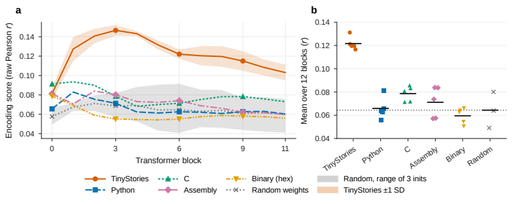
Figure 2 : Pereira-243.(a)Encoding score at each block: mean of five seeds per corpus,
Original paper · CC BY 4.0 · Iñigo Parra · Language, Not Code Abstraction: Natural-language Training Shapes Brain-aligned Geometry · Original paper figure · Extracted the figure area from page 6 of the original PDF.Why a positive brain score isn't enough
Transformer language models predict activity in the human language network, and models trained on computer code also score above zero. That result invites a fair question: the abstract sequential and compositional structure of code might be enough, with no natural language involved. Under encoding analyses it also gets a fitted readout, so an absolute score can't separate what training adds from what the architecture already gives.
The authors turn this into two competing predictions that they can check against the same models. That predicts a Python>C>assembly>binary ordering, with Python at the top. Under that account, the code models should show no particular ordering among themselves.
Three of those corpora keep the same programs fixed in C, assembly, and hexadecimal machine code. Python is an unrelated corpus, and TinyStories supplies narrative English. The authors treat independently trained seeds as the unit of inference rather than individual stimuli. Because fitted encoders can exploit surface features, they add analyses that fit nothing, such as CKA, covariance spectra, and RSA.
The results support a narrower claim: English training gives a depth-wide encoding advantage on Pereira-243 and Tuckute2024, but not on Blank2014 or Fedorenko2016.
Five corpora built from one set of programs
The five corpora are TinyStories, Python, C functions, x86-64 assembly, and hexadecimal machine code. Python is an unrelated corpus, and TinyStories supplies narrative English. The authors predicted a Python>C>assembly>binary ordering if abstraction from code drives alignment.
Binary is written as two-digit hexadecimal tokens for each function's unlinked x86-64 machine code, so it is text rather than a raw byte stream. Python is noisier: 64% of its 165k files are exact duplicates, and identifiers and string literals survive parsing and regeneration. About 6% of C functions still retain English comments, and the authors don't record the compiler or its flags.
Every model is GPT-2 small with 12 blocks, width 768, and context 1,024, trained with the same AdamW recipe. Five seeds per corpus give 25 trained models, and three random-weight models with the same tokenizer serve as the matched reference. Figure 1 summarizes this design, with one shared tokenizer and one GPT-2-small recipe behind all 25 trained models.
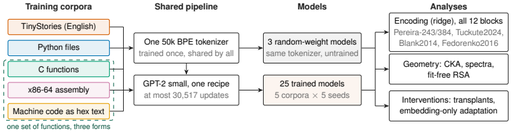
Figure 1 : Design. Five corpora share one tokenizer and one GPT-2-small recipe, yielding 25
Original paper · CC BY 4.0Shared recipe, unequal exposure
The recipe fixes the tokenizer, architecture and update cap, but the amount of data each corpus receives still differs. Training runs for at most 30,517 updates, and documents are truncated to 1,024 tokens and packed before training. Seeds 42-46 produce five models per corpus, so the five seeds per corpus are the replicates the analysis uses.
The shared cap does not mean shared exposure, because the number of passes depends on how much text each corpus holds. Under that budget, Python receives about 6.8 passes over its training split, far more than the other corpora. TinyStories gets 1.2 passes, C gets 1.0, binary gets 0.61, and assembly gets only 0.35. Seed 42 differs in packing, since it inserts no document separators, and its logs were not retained.
Three random-weight models with the same tokenizer serve as the matched reference for what training adds. The authors stress that this reference is not a chance level, so scores are read as increments over it. The Python corpus is heavily duplicated, which the limitations section ties to validation documents that largely recur in training.
The same recipe is then applied to four neural benchmark families, each scored from the final token's activation in every block. Each model is read at all twelve blocks, with Pereira contributing two stimulus sets. Ridge regressions predict the neural responses, and the penalty is selected within each training fold.
How encoding scores are computed and tested
The authors use the Brain-Score language implementation at a pinned commit to score every model on four benchmark families. Tuckute2024 is one language-network response averaged over five participants who read 1,000 sentences. Blank2014 has fMRI time points from five listeners to eight stories, and Fedorenko2016 has word-by-word ECoG from five patients.
Each block's activation becomes the predictor, so a model yields twelve separate encoding profiles.
A ridge regression then predicts the neural responses from these activations, with the penalty chosen inside each training fold. The grouping keeps stimuli that share a context out of the held-out fold, so the test sets stay separated from training contexts. Conditions are compared only within a benchmark, so scores from different datasets are never placed on one scale.
The prespecified summary is the mean over all twelve blocks, so the authors don't pick a favorable layer after seeing the scores. Each contrast is a weighted difference of independent group means with Welch-Satterthwaite degrees of freedom. Block-wise tests compare five TinyStories models with 20 code models using Welch tests, and test heterogeneity among code corpora with ANOVA.
Seeds serve as the replicates for these tests, so the unit of inference is an independently trained model rather than a fold or participant. The authors cite prior work on variance estimation for resampled and cross-validated comparisons to justify this choice.
Where English training helps on encoding
On Pereira-243, TinyStories scores 0.122, compared to 0.069 for the code mean and 0.064 for random weights. The code mean sits close to random weights, so code training adds little on this benchmark. TinyStories minus the code mean is 0.053, with a 95% CI of [0.046, 0.060], and it survives Holm correction.
Tuckute2024 shows a similar gap, with 0.325 for TinyStories and 0.266 for the code mean. TinyStories also beats random weights by 0.057 on Pereira-243 and 0.051 on Tuckute2024. With only three random initializations, these contrasts have 2.3 and 3.4 degrees of freedom, and they don't survive correction at p = 0.145.
Blank2014 shows a gap of +0.005 over the code mean, and that gap doesn't survive correction. Its TinyStories and code gains over random weights are +0.014 and +0.009, so the gain is small on both sides. On Fedorenko2016, the gap is 0.000, so English training gives no benefit there. Both Fedorenko2016 means round to 0.170, which sits below random weights.
Does the gap span the depth of the model
A mean over depth could hide a gap that appears in only one block, so the authors check each block separately. On Pereira-243, TinyStories and the code models don't differ significantly at block 0, with a pHolm of 0.61. From block 1 onward, TinyStories is significantly higher than the code models at every later block. The largest selected gap is 0.079 at block 4, which is a descriptive maximum rather than a tuned layer choice.
Appendix C gives the block-wise tests, which use five TinyStories models against 20 code models with Welch tests corrected over blocks. The authors read this as a gap that is spread across most of the stack rather than concentrated in one readout. They also state that the depth profiles show where the gap is expressed, not which computation produces it.
Geometry: reproducibility, dimensionality and brain match
Linear CKA between seeds of the same corpus measures reproducibility, and across blocks 4 to 11 the TinyStories seeds reach a mean of 0.90. Binary models reach 0.86 over the same blocks, then C at 0.81, Python at 0.71, assembly at 0.69, and random weights at 0.67. Binary is nearly as reproducible as TinyStories, yet it occupies only about three effective dimensions.
Training compresses every corpus relative to random weights, with participation ratio 83 at block 0 and 62 at block 11. TinyStories expands to about 26 effective dimensions, so seed agreement alone doesn't identify a brain-like representation.
Fit-free RSA avoids any readout, so it compares the dissimilarity structure of model and brain directly. RSA correlates Spearman rho over the upper triangles of the model and brain dissimilarity matrices, with one minus Pearson correlation as the distance. Python falls below random weights in later blocks, so its structure doesn't track the brain at all.
Removing leading principal components keeps the TinyStories lead, which means a few dominant axes don't carry the RSA result. The RSA advantage is specific to Pereira-243, because binary reaches the highest RSA on Pereira-384 and Fedorenko2016. The paper doesn't interpret RSA for Tuckute2024 or Blank2014, which are the benchmarks where RSA was not read.
The geometry shows the encoding result from a different angle, since TinyStories seeds converge on the most similar representations. Its encoding mean over twelve blocks on Pereira-243 sits well above the code and random-weight means in Figure 2.
Code models differ, but not in an abstraction order
C leads the code models at 8 of 12 Pereira-243 blocks and at all 12 Pereira-384 blocks. Assembly leads at the other four Pereira-243 blocks, while Python never leads. The geometry tells a similar story: Python is the most distinct code representation at 0.23 with binary, while C and assembly reach 0.62.
On Pereira-243, the depth summaries fall from C to assembly to binary, at 0.079, 0.071 and 0.060. Python scores below C, so the ordering breaks at the highest-level end of the hierarchy. On the other three benchmarks, binary leads the code models. BLiMP places TinyStories at 0.64, above the code models at 0.53-0.55, but it orders the code models differently from the neural scores.
The triplet holds programs fixed, yet the models saw 1.0, 0.35 and 0.61 passes over them. Python also differs from C in content, selection and level, so the two corpora can't be compared on level alone.
Controls and interventions: lexical exposure, relabeling, and transfer
Seeing the stimulus words doesn't explain the English advantage on its own, according to the paper's diagnostics. Assembly has a higher average stimulus-token frequency than TinyStories, at 6.3M occurrences against 4.1M. So lexical exposure alone doesn't explain the advantage, although a five-corpus correlation of r = 0.38 (p = 0.53) stays inconclusive.
The form control relabels every TinyStories content word with a pseudoword, using a one-to-one map. At 500M tokens, the relabeled model reaches 0.115 against 0.107 for the intact model, averaged over blocks 0, 6 and 11. Across three seeds, the difference gives Welch p = 0.12, and the authors note that a comparable endpoint is not an equivalence test.
In the 2×2 design, intact minus shuffled gives +0.004 (p = 0.38), and intact minus permuted gives +0.007 (p = 0.14). Combining both manipulations gives the lowest cell, at 0.096, so the pseudoword model keeps substantial alignment without familiar content-word forms.
Transplanting TinyStories blocks alone doesn't reproduce the donor's alignment, with all twelve blocks over code embeddings. Adding the TinyStories token and position embeddings lets every receiver reach the donor's r = 0.114 by k = 4. Retraining only the tied embedding matrix on TinyStories raises mean-over-depth scores for every code model by +0.028 on average.
The same budget on each receiver's own corpus gives only +0.002, with paired t(3) = 4.31 and p = 0.023.
English embeddings alone don't reproduce the donor, so compatibility with downstream blocks matters. The paired comparison covers four fixed checkpoints, so it doesn't generalize over code languages. A learned stitch might enable block-only transfer, and the authors leave that test open.
Limits of this design
The design fixes one architecture, one tokenizer, and one training recipe, so the results cover that setup only. Blank2014 has 417 of 1,317 contexts above 1,024 tokens, and the RSA extraction keeps the first 1,024 of them. Because 411 time points then repeat an earlier input, the near-zero RSA on Blank2014 says nothing about the neural data, so the authors don't interpret it.
Encoding keeps the most recent tokens instead, so the encoding scores on Blank2014 aren't affected in the same way.
The random reference has three initializations, which is a small sample for the contrasts against random weights. With three initializations, those contrasts have only 2.3 and 3.4 degrees of freedom, and they don't survive correction. The transplants use one checkpoint pair per code corpus, and they don't use a learned stitch. Without a learned stitch, a failed transplant can't separate representational incompatibility from missing transferable information.
Exposure ranged from 0.35 passes over assembly to 6.8 passes over a heavily duplicated Python corpus. Python's validation documents largely recur in training, so its validation loss overstates generalization.
Paper info
- Authors
- Iñigo Parra
- Venue
- arXiv · Preprint
- First published
- 2026-11-6
- Added
- 2026-11-9
- Updated
- 2026-11-6
- Version
- v1
- arXiv
- 2611.09027
- Category
- cs.CL
- Original paper terms
- CC BY 4.0
- What we show
- Paper info, commentary and permitted figures from the original paper
AI commentary is a separate explanation from the original paper and may contain errors. The original paper and figures follow each source's terms of use and any rights noted separately.
Abstract
Code-trained language models produce positive brain scores, which raises the question of whether abstract structure learned from programming languages can substitute for natural-language training. We trained 25 GPT-2-small models on TinyStories, Python, C functions, x86-64 assembly, and the corresponding machine code, and scored them using a shared tokenizer and encoding procedure against matched random-weight models. On Pereira-243 and Tuckute2024, TinyStories exceeds the mean of the four code models by $Δr = 0.053$ and $0.059$ (Holm-corrected $p<0.001$), while code training leaves alignment near the random-weight level. The language advantage is benchmark-specific: Blank2014 shows no corrected language-code difference, and Fedorenko2016 shows no language benefit. Geometry tracks the encoding result on Pereira-243: TinyStories seeds converge on the most similar representations, and its fit-free correspondence with neural dissimilarity peaks at $ρ= 0.14$, twice the code and random-weight levels. Binary-trained models have about three effective dimensions, so seed agreement alone does not imply neural correspondence. Updating only the embedding matrix on English improves mean-over-depth alignment for every code model more than an equal update on its own corpus. Within this architecture and training setup, natural-language training produces a distinct representational geometry with closer neural correspondence on Pereira-243
Quote from the paper
Iñigo Parra (2026). Language, Not Code Abstraction: Natural-language Training Shapes Brain-aligned Geometry. arXiv:2611.09027v1. https://arxiv.org/abs/2611.09027v1
BibTeX
@misc{parra2026language,
  title = {{Language, Not Code Abstraction: Natural-language Training Shapes Brain-aligned Geometry}},
  author = {Iñigo Parra},
  year = {2026},
  eprint = {2611.09027},
  archivePrefix = {arXiv},
  url = {https://arxiv.org/abs/2611.09027v1}
}