Paper commentary
ESTRA: Enabling Extreme Attention Sparsity for Training-Free Video Diffusion Acceleration
ESTRA keeps video diffusion faithful at extreme sparse attention without retraining
- Problem Sparse attention speeds up video diffusion, but its output quality drops fast as sparsity rises. At high sparsity, the exact budget is too small and the approximation of skipped keys is too coarse.
- Method ESTRA scores keys per query cluster and corrects cluster means with a variance term.
- Results On Wan2.1-14B and HunyuanVideo-13B at 5% density, ESTRA reaches 3.26 and 4.71 times end-to-end speedup. It stays more faithful to dense generation than Sol-Attn and SVG-EAR.
Why extreme sparsity is hard
Video diffusion transformers attend over long token sequences, and full attention grows quadratically with sequence length. Because the same attention runs at every sampling step, it takes a large share of generation time. FlashAttention reduces memory traffic but still evaluates every query–key interaction, so it doesn't cut the arithmetic.
Video attention often puts most of its weight on a small fraction of tokens, which is what makes selection worthwhile.
Skipped interactions still matter, because even individually weak ones can collectively contribute to the output. By combining selection with compensation, these methods preserve generation quality at sparsities approaching 90%. Going from 90% to 99% sparsity cuts the exact fraction from 10% to just 1%, a tenfold reduction in exact computation.
At extreme sparsity, the remaining budget for exact computation shrinks, so the approximation of skipped contributions must carry more weight. Count-weighted cluster means provide an inexpensive approximation, but they omit score variation within each cluster. This variation matters because softmax exponentiates scores before normalization.
ESTRA responds by reducing approximation error through finer token selection and more accurate cluster compensation.
The key idea: shared scores and a variance correction
Its two changes are a cheaper way to pick the exact keys and a correction to the weights of the representatives. Because the scores are shared, the limited budget can go to high-scoring keys drawn from different clusters. Under whole-cluster selection, keeping one high-scoring key would also force the evaluation of the rest of its cluster.
Mean-based compensation weights each representative by its cluster size applied to the mean key's weight, as in Eq. (3). That choice misses something, because the cluster's total unnormalized weight is the sum of the exponentials of its members' logits. Multiplying the mean key's weight by the cluster size does not generally recover this sum.
Softmax exponentiates scores before normalizing, so the spread of scores inside a cluster changes the total. The authors expand the logarithm of the omitted factor to second order, which gives a mean-shift term and a dispersion term.
VCM keeps only the dispersion term and drops the first-order mean shift. A per-head scale alpha averages the query norms, and the correction delta is capped at delta max. The cap keeps the correction from raising a representative's weight by more than a factor of e to the delta max.
The authors expected VCM to reduce the attention-output error at extreme sparsity, where the remaining budget for exact computation is small. With selection and K/V means unchanged, VCM lowers the cluster-level baseline's error across the density sweep.
Weighting the cluster representatives with VCM
Each query runs one softmax over the exact selected keys and the cluster means together. A representative's logit is its mean-key logit plus a log-count term and the VCM term. Here r_{g,c} counts the remaining keys of cluster c that query cluster g leaves unselected, so its logarithm gives the count bias. Adding log n to a representative's logit multiplies its unnormalized weight by n, the number of tokens it represents.
The VCM term starts from the spread of the remaining keys around the fixed cluster center. Selection can shift the remaining keys' mean, so measuring around the full-cluster center keeps the statistic fixed. Under an isotropic approximation, the authors scale this spread by a per-head factor α, which averages the query norms. The cap δ_max bounds the correction, so it can raise a representative's weight by at most a factor of e to the δ_max.
Mean compensation uses only r_{g,c} e^{z_{i,c}} and omits the factor E[e^{ϵ_ij}] that the second-order expansion approximates. VCM keeps the dispersion term and drops the first-order mean shift, so it needs no separate representative for each query–key cluster pair.
At 5% target density, VCM reduces the attention-output error of the cluster-level baseline by 7.2% on Wan and 23.1% on HunyuanVideo. In the ablation at 5% target density, adding VCM improves PSNR by 0.27 dB on Wan and 0.44 dB on HunyuanVideo.
Scoring individual keys from query centroids
ESTRA picks the keys for exact attention by scoring each key with query centroids instead of with whole clusters. Under whole-cluster selection, keeping one high-scoring key forces the rest of its cluster into exact attention. Scoring individual keys lets high-scoring members from different clusters be selected together under one budget. The method starts from the query clusters produced by k-means on Q, with centroids that guide selection.
The key clusters supply K/V means that serve as compensation representatives for the unselected tokens. The selected key indices for a query cluster g form the set T_g, shared by every query in that cluster.
Each key j gets a score a_gj equal to the centroid's dot product with k_j, scaled by the square root of d. Equivalently, a_gj is the mean logit s_ij averaged over every query i in cluster g, so one score serves the whole cluster. Because the score is shared, one scoring pass per query cluster costs C_q N_k dot products instead of N_q N_k.
Figure 2(b) shows this: the centroid q_1 scores the original keys, and keys k_2 and k_7 are retained from different clusters.
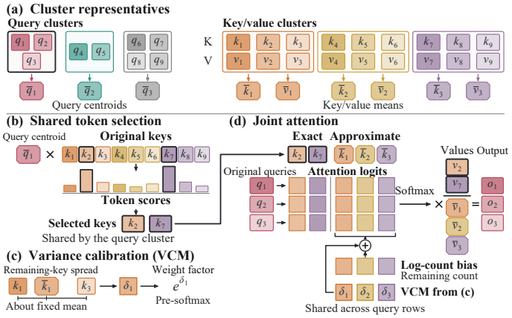
Figure 2 : ESTRA overview.(a)Independent query and key clusters provide query centroids and K/V means.(b)Each centroid scores individual keys for selection shared by its query cluster.(c) VCM uses remaining-key spread and query norms to calibrate representative weights.(d)Original queries attend jointly to selected tokens and fixed cluster means, with log-count and VCM biases on representative logits. Colors identify clusters. Attention scaling is omitted.
Original paper · CC0 1.0 · Enhuai Liu, Yunke Wang, Yutong Wang, Changming Sun · ESTRA: Enabling Extreme Attention Sparsity for Training-Free Video Diffusion Acceleration · Original paper figure · Extracted the figure area from page 4 of the original PDF.For a target density ρ, ESTRA aims to keep the highest-scoring ρ fraction of keys. Sorting the full sequence would be costly, so the method estimates a threshold from sampled key scores instead. The remaining tokens are handled by the cluster compensation described earlier. At a 5% target density, token-level selection reduces error by 55.3% on Wan and 39.4% on HunyuanVideo relative to cluster-level selection with VCM.
Fidelity and speed at 5% and 1% density
At 5% density, ESTRA beats Sol-Attn and SVG-EAR even though both baselines run at higher densities of 7.6 to 12.8%. On Wan2.1-14B the PSNR gain over SVG-EAR was 3.10 dB, and on HunyuanVideo-13B it was 1.11 dB. The authors read this as evidence that the exact budget is better spent on a small set of well-chosen keys than on more keys.
ESTRA's token scoring and VCM add overhead over SVG-EAR, so the authors measured attention runtime separately from the full pipeline. Even with that extra cost, total attention time at 5% was 12.5% lower than SVG-EAR on Wan and 33.5% lower on HunyuanVideo. Attention time at 5% was also lower than Sol-Attn on both backbones.
Appendix E shows that Sol-Attn and the cluster-level variant produce severe artifacts or blur at about 1% density.
On HunyuanVideo at the same budget, ESTRA reaches 19.29 dB against 18.41 dB for SVG-EAR at 5.8%. At about 15% density, ESTRA reaches 17.59 dB on Wan and 20.54 dB on HunyuanVideo, both above the SVG-EAR values at 15.1%.
Where the gains come from: VCM, token selection, and density sweeps
The density sweep asks whether ESTRA keeps its fidelity lead as the exact budget changes from 1% to about 15%. Fidelity rose on all three metrics as density went from 1% to 10%, with the largest PSNR gains reaching 5.61 dB on Wan and 4.12 dB on HunyuanVideo. At about 15% density, ESTRA scored 17.59 dB on Wan, compared to 12.11 dB for SVG-EAR at 15.1%.
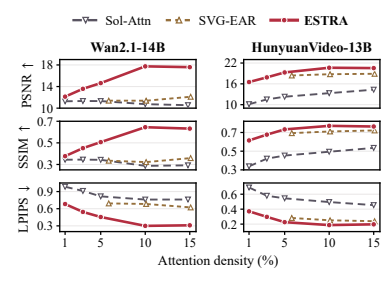
Figure 5 : Fidelity to dense generation across attention densities. Results average 10 prompts per backbone.
Original paper · CC0 1.0The ablation starts from cluster-level selection, which ranks key clusters by aggregate attention scores and fills a token budget with whole clusters. That starting variant uses count-weighted mean compensation, so each added stage can be measured against it. Adding VCM raised PSNR by 0.27 dB on Wan and 0.44 dB on HunyuanVideo at a 4.94% measured density.
Token-level selection then added 3.12 dB and 1.75 dB on top of that. The full ESTRA variant reached 14.64 dB on Wan and 19.29 dB on HunyuanVideo at a 5.00% measured density.
VCM changes only the representative weights, so the selected tokens and K/V means stay the same. Token-level selection instead changes which keys receive exact computation, by scoring each key with the query centroid. Token-level selection reduced attention-output error by 55.3% on Wan and 39.4% on HunyuanVideo at a 5% target density. Both stages also improved SSIM and LPIPS on both backbones.
So the two changes act on different parts of the error: VCM refines the representatives, and token selection spends the exact budget better. The authors' ablation reads the gains as additive, with token-level selection contributing the larger share.
Limits of the evidence
The main evidence covers two backbones, Wan2.1-14B and HunyuanVideo-13B, and one NVIDIA H20 for every speed figure. Latency is the median end-to-end time, including all method overheads, VAE decoding, and video export. Baseline densities are measured, while ESTRA's densities are target values, so the comparison is not at exactly matched budgets.
VBench scores use designated prompt subsets: 72 prompts for subject consistency, 86 for background consistency, and 93 for imaging and aesthetic quality.
On Wan, imaging and aesthetic quality stay about five points below dense generation at 1% density. On HunyuanVideo, imaging and aesthetic quality stay within about one point of dense generation at the same density. ESTRA incurs slightly higher overhead than SVG-EAR per attention call, because of token-level scoring and VCM. Its speed case therefore rests on needing fewer exact interactions, which the authors state explains the savings in exact attention.
Whether the 1% advantage holds beyond these two backbones and prompt sets was not tested. The qualitative comparisons at about 1% density come from a limited set of examples shown in the appendix.
Paper info
- Authors
- Enhuai Liu, Yunke Wang, Yutong Wang, Changming Sun
- Venue
- arXiv · Preprint
- First published
- 2026-11-7
- Added
- 2026-11-10
- Updated
- 2026-11-7
- Version
- v1
- arXiv
- 2611.10448
- Category
- cs.CV
- Original paper terms
- CC0 1.0
- What we show
- Paper info, commentary and permitted figures from the original paper
AI commentary is a separate explanation from the original paper and may contain errors. The original paper and figures follow each source's terms of use and any rights noted separately.
Abstract
Video diffusion transformers generate high-quality videos, but attention over long spatiotemporal sequences makes inference computationally expensive. Sparse attention reduces this cost by computing only a subset of query-key interactions exactly, and recent training-free methods further approximate the remaining interactions. These methods, however, degrade quickly at high sparsity, which limits the achievable speedup. We present ESTRA (Extreme Sparsity Through Refined Attention), a training-free acceleration method that preserves generation quality even at extreme sparsity. ESTRA concentrates exact attention computation on a small set of important key-value tokens and approximates the remaining contributions with cluster representatives. To identify these tokens efficiently, it groups similar queries and uses their representatives to score individual keys. A variance-based correction further refines the attention weights of the cluster representatives, improving the accuracy of the approximation. Experiments on Wan2.1-14B and HunyuanVideo-13B show that ESTRA establishes a new quality-efficiency frontier for training-free sparse attention, achieving $3.26\times$ and $4.71\times$ end-to-end speedups at 5% attention density while surpassing Sol-Attn and SVG-EAR in fidelity to dense generation and on most VBench dimensions. Even at 1% density, ESTRA remains more faithful to dense generation than Sol-Attn at 12.5%, while reaching up to $5.39\times$ speedup.
Quote from the paper
Enhuai Liu, Yunke Wang, Yutong Wang, Changming Sun (2026). ESTRA: Enabling Extreme Attention Sparsity for Training-Free Video Diffusion Acceleration. arXiv:2611.10448v1. https://arxiv.org/abs/2611.10448v1
BibTeX
@misc{liu2026estra,
  title = {{ESTRA: Enabling Extreme Attention Sparsity for Training-Free Video Diffusion Acceleration}},
  author = {Enhuai Liu and Yunke Wang and Yutong Wang and Changming Sun},
  year = {2026},
  eprint = {2611.10448},
  archivePrefix = {arXiv},
  url = {https://arxiv.org/abs/2611.10448v1}
}