Paper commentary
DiffRF: Rendering-Guided 3D Radiance Field Diffusion
- Problem Diffusion training needs a clean target for each noise sample, but radiance fields fitted from posed images are ambiguous and contain artifacts, so reliable ground-truth fields are hard to obtain.
- Method Trains a time-conditioned 3D-UNet to predict the noise added to noisy voxel-grid radiance fields, and adds a volumetric rendering loss on the estimated clean field.
- Results Reached an FID of 15.95 on PhotoShape Chairs against 16.54 for EG3D, where lower FID is better.
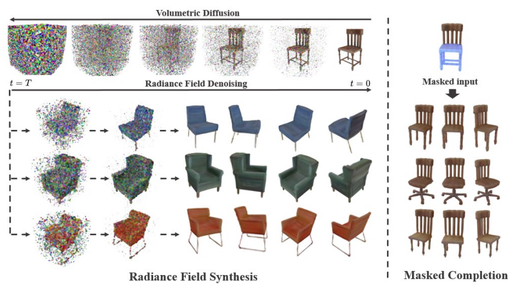
Figure 1 . Our method performs denoising of a probabilistic diffusion process applied to 3D radiance fields. Guided by 3D supervision and volumetric rendering, our model enables the unconditional synthesis of high-fidelity 3D assets (left). We further introduce the novel application of masked completion (right), i.e., the task of recovering shape and appearance from incomplete objects (highlighted in light- blue on the top right chair), solved by our model as conditional inference without task-specific training.
Original paper · CC BY 4.0 · Norman Müller, Yawar Siddiqui, Lorenzo Porzi, Samuel Rota Bulò, Peter Kontschieder, Matthias Nießner · DiffRF: Rendering-Guided 3D Radiance Field Diffusion · Original paper figure · Extracted the figure area from page 1 of the original PDF.Why diffusion has not been applied to radiance fields
Diffusion models now match or beat GANs on many 2D benchmarks, yet they have not been trained to generate volumetric radiance fields directly. Earlier diffusion work on 3D has targeted point clouds and other purely geometric forms, while the radiance-field generators are GAN-based.
The obstacle lies in the training target. A diffusion model learns to map each noise sample back to one clean data sample, so every training example needs a reliable clean target. A radiance field fitted to posed images does not serve as such a target. Even a costly per-sample NeRF optimization leaves gaps and imperfections, and fitted fields can contain floating artifacts.
DiffRF keeps the denoising objective and adds a rendering loss, so the model learns a prior that favours images that render well rather than copying fitting errors. The model works on explicit voxel grids and the same trained model covers unconditional generation and masked completion, as Figure 1 illustrates.
Radiance fields as denoised voxel grids
A radiance field is an implicit volumetric object defined by a density field over a 3D domain and an RGB color field over the same domain. The color of a camera ray is the integral of density and color along the ray, weighted by the transmittance, which falls as the integrated density grows: \(c_r := \int_0^\infty \tau_s(r)\sigma(r_s)\xi(r_s)\,ds\) with \(\tau_s(r) := \exp(-\int_0^s \sigma(s')\,ds')\).
A camera pose is enough to produce rays in world coordinates, and that is all rendering needs.
The authors choose an explicit voxel grid over a neural network because it gives good rendering quality with faster training and inference. A query at a continuous position is interpolated bilinearly from the voxel vertices around it. The field is a four-dimensional tensor: three spatial axes span the grid and the last axis holds the density and color channels.
The fields are pre-activated. Density and color live in a linear space, and an activation is applied only when rendering. Keeping the fields linear is what lets noise be added to them additively while the result stays a valid radiance field after activation.
Forward and reverse diffusion on radiance fields
The model is a denoising diffusion probabilistic model over flattened 4D tensors of fixed size, with a finite chain of time steps from 0 to T. The forward chain adds Gaussian noise step by step: \(q(f_t|f_{t-1}) := \mathcal{N}(f_t|\sqrt{\alpha_t}f_{t-1}, \beta_t I)\), with \(\alpha_t := 1-\beta_t\).
Generation starts from \(f_T\) drawn from a standard multivariate normal and moves backward through learned Gaussian transitions \(p_\theta(f_{t-1}|f_t)\) with covariance \(\Sigma_t\). The mean is reparametrised through the predicted noise: \(\mu_\theta(f_t,t) := a_t(f_t - b_t\epsilon_\theta(f_t,t))\), where \(\epsilon_\theta\) is the network's noise estimate.
Training sets \(a_t := 1/\sqrt{\alpha_t}\) and \(b_t := \beta_t/\sqrt{1-\bar\alpha_t}\).
The noise estimator \(\epsilon_\theta\) is a 3D-UNet that takes the time step as a condition. Training draws time steps uniformly from 1 to T = 1000, and the diffusion variance rises linearly from β1 = 0.0015 to βT = 0.05.
Adding a rendering loss to the denoising objective
Training combines a radiance field generation loss, which penalises fields that do not fit the data distribution, with a rendering loss aimed at the quality of the images these fields produce. The generation loss is derived from a variational upper bound on the negative log-likelihood, which decomposes into a sum over time steps up to a constant.
Each time-specific term is the expected squared difference between the true noise and the predicted noise: \(L^t_{RF}(f_0|\theta) = \mathbb{E}_\phi[\|\epsilon-\epsilon_\theta(\sqrt{\bar\alpha_t}f_0+\sqrt{1-\bar\alpha_t}\epsilon,t)\|^2]\).
The noise loss measures error with the Euclidean metric on the field itself, and this does not guarantee that the field renders without artifacts. For viewpoint v, the rendering error compares the image rendered from the field with the ground-truth image \(I_v\) using \(\ell_v(f,I) := \|I_v - R(v,f)\|_2\). Fully denoising a sampled field to evaluate this error is too expensive, so the method uses an approximate clean estimate built from the predicted noise: \(\tilde f^t_0(\epsilon,\theta) := f_0 + \frac{\sqrt{1-\bar\alpha_t}}{\sqrt{\bar\alpha_t}}(\epsilon-\epsilon_\theta(f_t,t))\).
The extracted text writes this estimate with \(f_0\) on the right-hand side, and it is reproduced as printed. The time-specific rendering term is \(L^t_{RGB}(f_0|\theta) := \omega_t\mathbb{E}_{\phi,\psi}[\ell_v(\tilde f^t_0(\epsilon,\theta),I)]\), with the viewpoint drawn from a prior ψ and ε from φ. The estimate is reasonable only for small time steps, so the weight \(\omega_t\) decays as the step grows.
The weight is set from the cumulative product \(\bar\alpha\), but the index in the extracted text is ambiguous, so its exact form is not restated here.
The main text does not give a value for λ_RGB. The rendering term is the only addition to the denoising objective, and the ablation later removes exactly this term.
Unconditional results against GAN baselines
PhotoShape Chairs provides 15,576 chairs rendered from 200 views, and ABO Tables provides 1676 tables from 91 renderings with 2-3 environment maps per object. DiffRF and the GAN baselines use the same rendered images, but DiffRF first converts each shape into a radiance field, whereas π-GAN and EG3D train directly on the renderings.
On PhotoShape Chairs, DiffRF reaches an FID of 15.95, against 16.54 for EG3D and 52.71 for π-GAN, where lower FID is better. On geometry, DiffRF has a Coverage Score of 58.93 and an MMD of 4.416, against 47.55 and 5.619 for EG3D. Coverage measures diversity, where higher is better, and MMD measures sample quality, where lower is better.
On ABO Tables, DiffRF reaches an FID of 27.06, against 31.18 for EG3D and 41.67 for π-GAN. Its KID is 10.03, against 11.67 for EG3D and 13.81 for π-GAN, and its Coverage Score is 61.54, against 48.15 and 44.23. Its MMD is 7.610, against 9.327 for EG3D and 10.92 for π-GAN.
Figures 3 and 4 compare samples qualitatively. The authors describe EG3D as producing inaccurate shapes and view-dependent artifacts, such as added or removed armrests, while DiffRF produces fine photometric and geometric detail.
What the rendering loss changes
The ablation removes only the 2D rendering loss and keeps the noise prediction loss, so the comparison isolates the rendering term. On PhotoShape Chairs, FID rises from 15.95 to 18.27, an increase of about 2.3. On ABO Tables it rises from 27.06 to 35.89, about 8.8 more. The authors read this as evidence that biasing the noise prediction with a rendering loss raises image quality.
Coverage moves the other way: it is 58.93 with the rendering loss and 59.20 without it on chairs, and 61.54 with it and 63.46 without it on ABO Tables. MMD is lower with the loss, at 4.416 against 4.543 on chairs and 7.610 against 8.013 on ABO Tables. The authors attribute the small coverage drop to the rendering loss steering the model away from diverse but spurious shapes.
Masked completion at inference time
Masked completion fills a 3D masked region so that it matches the unmasked region, and it needs no task-specific model adaptation or training.
The mask m is binary, and ⊙ is element-wise multiplication on the voxel grid. Inside the mask, the sample takes the model's clean estimate; outside it, the sample takes the input field, and the combined result is then re-noised for one step.
Masked completion against EG3D
Each masking level uses 200 randomly masked samples. FID is computed from renderings at 10 random views, and mPSNR is computed on the unmasked pixels. The masking levels are 20%, 40%, 60% and 80%.
Averaged over the four levels, DiffRF reaches an mPSNR of 27.53 against 24.82 for EG3D, and an FID of 27.78 against 30.67. DiffRF's mPSNR is higher at every level, rising from 24.85 at 20% to 30.38 at 80%, while EG3D rises from 23.71 to 25.79. DiffRF's FID is lower at every level, at 22.36, 27.74, 31.16 and 29.84, against 25.91, 29.41, 33.06 and 34.31 for EG3D.
EG3D completes by masked GAN inversion, which optimises a single latent code against the photometric error on the unmasked regions. The authors attribute EG3D's weak reconstruction of unmasked regions to the single latent code, which needs regularisation to avoid corrupting the representation. Masked chairs are also compared qualitatively in Fig.
5, where the authors report more diverse proposals from DiffRF.
Single-image volume synthesis
DiffRF can produce a radiance field from a single posed image by steering sampling with volumetric rendering. The method adopts Classifer Guidance from [17]. The denoising is guided toward minimising the rendering error against a posed RGB image and its object mask, where the mask can come from off-the-shelf segmentation networks. The evidence here is qualitative.
Fig. 7 shows proposals for chairs from ScanNet, each generated from a single posed image and its foreground mask.
Limitations
The method needs a sufficient number of posed views to generate good training samples. It samples more slowly than GAN-based approaches. Grid resolution is capped by training-time memory.
The authors point to faster sampling methods, adaptive or sparse grid structures, and factorized neural field representations as ways forward. These appear as directions and are not tested in the reported experiments.
The quantitative comparisons cover two object datasets, PhotoShape Chairs and ABO Tables, with π-GAN and EG3D as the only baselines. Single-view synthesis is evaluated only qualitatively. The rendering loss uses an approximation that is reasonable only for small time steps, and its weight decays as the step grows.
Paper info
- Authors
- Norman Müller, Yawar Siddiqui, Lorenzo Porzi, Samuel Rota Bulò, Peter Kontschieder, Matthias Nießner
- Venue
- arXiv · Preprint
- First published
- 2022-12-2
- Added
- 2026-11-5
- Updated
- 2023-3-27
- Version
- v2
- arXiv
- 2212.01206
- Category
- cs.CV
- Original paper terms
- CC BY 4.0
- What we show
- Paper info, commentary and permitted figures from the original paper
AI commentary is a separate explanation from the original paper and may contain errors. The original paper and figures follow each source's terms of use and any rights noted separately.
Abstract
We introduce DiffRF, a novel approach for 3D radiance field synthesis based on denoising diffusion probabilistic models. While existing diffusion-based methods operate on images, latent codes, or point cloud data, we are the first to directly generate volumetric radiance fields. To this end, we propose a 3D denoising model which directly operates on an explicit voxel grid representation. However, as radiance fields generated from a set of posed images can be ambiguous and contain artifacts, obtaining ground truth radiance field samples is non-trivial. We address this challenge by pairing the denoising formulation with a rendering loss, enabling our model to learn a deviated prior that favours good image quality instead of trying to replicate fitting errors like floating artifacts. In contrast to 2D-diffusion models, our model learns multi-view consistent priors, enabling free-view synthesis and accurate shape generation. Compared to 3D GANs, our diffusion-based approach naturally enables conditional generation such as masked completion or single-view 3D synthesis at inference time.
Quote from the paper
Norman Müller, Yawar Siddiqui, Lorenzo Porzi, Samuel Rota Bulò, Peter Kontschieder, Matthias Nießner (2022). DiffRF: Rendering-Guided 3D Radiance Field Diffusion. arXiv:2212.01206v2. https://arxiv.org/abs/2212.01206v2
BibTeX
@misc{mller2022diffrf,
  title = {{DiffRF: Rendering-Guided 3D Radiance Field Diffusion}},
  author = {Norman Müller and Yawar Siddiqui and Lorenzo Porzi and Samuel Rota Bulò and Peter Kontschieder and Matthias Nießner},
  year = {2022},
  eprint = {2212.01206},
  archivePrefix = {arXiv},
  url = {https://arxiv.org/abs/2212.01206v2}
}