Paper commentary
Isolating Perception for Multi-View Planning under Occlusion-Induced Partial Observability
- Problem Under occlusion, VLM planners and VLM formalizers degrade to near zero on the hardest BW-PO subsets, and the cause is hard to localize.
- Method Restricts the VLM to single-view stack reports and hands cross-view reconciliation to a weighted MaxSMT solver, with plan generation done by a classical planner.
- Results Reached 97% plan success with Gemma-4-31B on BW-PO-DEPTH under VLM-as-perceiver, against 1% for VLM-as-planner.
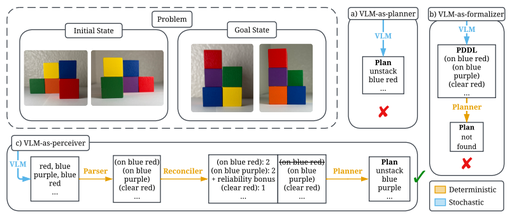
Figure 1 : A BW-PO-DEPTH problem where each view cannot individually determine whether the blue block rests on the red block or on the purple block that the red block occludes. In our proposed method (c), the conflicting local claims are reconciled by anchoring on the the purple block that has no conflicting relations. Across (a)–(c), progressively more of the pipeline moves from stochastic to deterministic components.
Original paper · CC BY 4.0 · Kevin Nguyen, Ceyhun Efe Kayan, Feng Liu, Li Zhang · Isolating Perception for Multi-View Planning under Occlusion-Induced Partial Observability · Original paper figure · Extracted the figure area from page 2 of the original PDF.Why occlusion defeats end-to-end VLM planning
A VLM that plans directly from images must perceive objects, estimate the state and generate actions in one pass, so an error at any of these stages can invalidate the whole plan. Such plans can look plausible while conflicting with the dynamics of the environment, and the output gives little clue about which stage went wrong.
Translating observations into PDDL moves the search to a classical planner, which makes the object, state and relation extraction the central step. Under multi-view partial observability each view gives only incomplete evidence, and work on planning under this condition has only just started.
Single-image perception studies cover occluded objects, depth ordering and counting as scenes grow, but they consider one image at a time.
BW-PO: depth and scale as two axes
BW-PO keeps the Blocksworld domain, whose text-only form VLMs have largely saturated, and replaces each state with a front-view and a side-view image. Occlusion leaves each view with only part of the scene, so recovering a state requires matching blocks across the two views and reconciling both images. A problem pairs an initial state and a goal state, each with its own two images, and a valid action sequence must transform the first into the second.
Both states are therefore partially observed.
BW-PO-DEPTH makes the support of a block ambiguous: from one image, a block may seem to rest on a visible block when it actually rests on a block hidden behind that one. The second view supplies further evidence, but the two views can imply competing interpretations, and the method has to resolve them to recover the true state.
BW-PO-N varies the object count N over 6, 12, 20, 40 and 100 to measure how performance changes as scenes grow denser. Each of the six datasets contains 110 problems, with BW-PO-DEPTH and the five BW-PO-N settings forming the family.
Three ways to split the work
VLM-as-planner receives the object set, the available actions and both states, each seen from two views, and outputs the action sequence itself. Because perception, reconciliation and search all happen inside one generation, the method has no intermediate state to inspect when a plan fails.
VLM-as-formalizer receives the predicate vocabulary and is called once per state to write a grounded symbolic state, which Fast Downward then solves. Reconciling the two views stays with the model, so a wrong symbolic state reaches the planner and cannot be corrected afterwards.
VLM-as-perceiver receives neither the actions nor the predicates and is limited to describing one view at a time. For each view the VLM reports vertical stacks listed bottom to top, and deterministic Parser, Reconciler and Planner stages handle reconciliation, formalization and planning.
From stack reports to a block placement
Claims are counted across views instead of being merged, so a claim that both views make carries twice the weight of one made by a single view.
The tally of claims that block x rests on block y is the sum over the two views of the stacks in which y immediately precedes x, and the empty-slot tallies count how often x appears as the bottom or top block. \[ m(x,y)=\sum_{v}\left|\{\sigma\in\Sigma_v : y\prec x \text{ in } \sigma\}\right| \] \[ e(x,\text{below})=\sum_{v}\left|\{\sigma\in\Sigma_v : b_1=x\}\right| \]
The Reconciler gives each block a stack index s(x) and a height h(x), so that x sits on y when both share a stack index and the height of x is one above that of y. A single hard constraint forbids two blocks from occupying the same cell, and every claim is treated as a soft constraint in a weighted MaxSMT problem solved with Z3 Optimize.
Some blocks are reliable because each has at most one candidate block above and at most one below. Such a reliable block earns a bonus B = 1 + the sum of the base weights, which is added to every relational weight that touches it. \[ \hat w(x,y)=w(x,y)+B\,\bigl|\{x,y\}\cap R\bigr| \]
The solver maximizes the boosted weight of the relations it places over the relational claims, plus the weight of the empty-cell claims that hold over the empty-slot claims. The gripper is reconciled separately, and because no gripper is visible in any scene, the result is always handempty.
The resulting state goes to the same classical planner that VLM-as-formalizer uses.
Six-block scenes are saturated
On BW-PO-6, Qwen3.5-122B-A10B reached 100% plan success with all three methods, and Gemini-3.1-Pro reached 100% with VLM-as-formalizer and VLM-as-perceiver. Because so many settings already score at the ceiling, the six-block scenes separate the methods and models poorly, which is why the study moves to harder conditions.
Depth ambiguity results
On BW-PO-DEPTH, VLM-as-perceiver reached 97% plan success with Gemma-4-31B, 95% with Qwen3.5-122B-A10B and 100% with Gemini-3.1-Pro. The table gives the full grid of datasets, methods and models behind these numbers.
The existing methods did much worse with the open-weight models: Gemma-4-31B reached 1% with VLM-as-planner and 0% with VLM-as-formalizer, and Qwen3.5-122B-A10B reached 0% with the existing methods.
Gemini-3.1-Pro narrowed the gap, scoring 73% with VLM-as-planner and 71% with VLM-as-formalizer. The authors describe the distance from VLM-as-perceiver as nearly 30 points.
Why depth cases fail
A valid plan needs both states recovered in full, so one wrong support can invalidate a problem, and per-block accuracy compounds into plan success. Gemini-3.1-Pro reaches 92.9% and 91.4% under those two methods.
VLM-as-perceiver reaches 99.8%–100% for all three models.
Recall at 100 blocks
As BW-PO scales from 6 to 100 blocks, performance falls because the VLM leaves an increasing share of the scene out. At 100 blocks, the open-weight models under VLM-as-perceiver keep high precision but very low recall.
Gemma-4-31B reaches 92.3% precision and 9.7% recall, and Qwen3.5-122B-A10B reaches 77.1% precision and 5.1% recall. The complete precision and recall figures are in the appendix.
A valid plan needs both states in full, so the blocks that are missing from the recovered states drive plan success to zero. The authors locate the limit in completeness of scene reconstruction rather than in local spatial reasoning.
Gemini-3.1-Pro keeps 98.9% recall at the same scale, which the authors read as showing that the limit is the model's visual extraction capacity.
Token cost per successful plan
Against the stronger baseline the median reduction is 1.8×, and on BW-PO-100 the reduction reaches 44×. The comparison is defined only in cells where both sides can be measured, so the counts cover those cells alone.
Where the bottleneck moves
The authors read solver-based reconciliation as effectively solved on these benchmarks. Recall under dense scenes is then the main constraint that separates frontier models from open-weight models on the hardest datasets.
Limitations
The evaluation assumes access to the planning domain and to the complete object inventory. The benchmark therefore measures relational state extraction, not open-world object discovery, domain induction or recovery of missing object identities.
The authors expect the paradigm to transfer to other domains with discrete relational state, but this would need a richer constraint model whose cost was not measured.
Whether reconciliation or scene completeness dominates in other domains is left open.
Paper info
- Authors
- Kevin Nguyen, Ceyhun Efe Kayan, Feng Liu, Li Zhang
- Venue
- arXiv · Preprint
- First published
- 2026-11-14
- Added
- 2026-11-17
- Updated
- 2026-11-14
- Version
- v1
- arXiv
- 2611.19179
- Category
- cs.CL · cs.AI · cs.CV
- Original paper terms
- CC BY 4.0
- What we show
- Paper info, commentary and permitted figures from the original paper
AI commentary is a separate explanation from the original paper and may contain errors. The original paper and figures follow each source's terms of use and any rights noted separately.
Abstract
Vision-language models (VLMs) are beginning to saturate visual planning benchmarks, yet they fail to resolve depth ambiguity and degrade sharply with problem size under occlusion-induced partial observability (PO). We introduce BW-PO based on the Blocksworld domain, a controlled benchmark that reduces existing VLM planners and formalizers to near-zero performance, and propose VLM-as-perceiver, a paradigm that narrows the VLM's role to local perception while delegating cross-view evidence reconciliation and plan generation to external solvers. Across model-specific challenging subsets of BW-PO, this raises plan success from 1% to 97% for Gemma-4-31B, 0% to 95% for Qwen3.5-122B-A10B, and 3% to 84% for Gemini-3.1-Pro. Isolating perception in this way separates two bottlenecks that are otherwise entangled: reconciliation under depth ambiguity, and completeness of visual extraction under scene density.
Quote from the paper
Kevin Nguyen, Ceyhun Efe Kayan, Feng Liu, Li Zhang (2026). Isolating Perception for Multi-View Planning under Occlusion-Induced Partial Observability. arXiv:2611.19179v1. https://arxiv.org/abs/2611.19179v1
BibTeX
@misc{nguyen2026isolating,
  title = {{Isolating Perception for Multi-View Planning under Occlusion-Induced Partial Observability}},
  author = {Kevin Nguyen and Ceyhun Efe Kayan and Feng Liu and Li Zhang},
  year = {2026},
  eprint = {2611.19179},
  archivePrefix = {arXiv},
  url = {https://arxiv.org/abs/2611.19179v1}
}