Paper commentary
Self-Distilled Reasoner: On-Policy Self-Distillation for Large Language Models
- Problem On-policy distillation needs a separate teacher, while RLVR gives sparse sequence-level reward and SFT trains on fixed trajectories.
- Method One model is conditioned on the reference solution as teacher and on the problem alone as student, and the per-token divergence is minimized over the student's own rollouts.
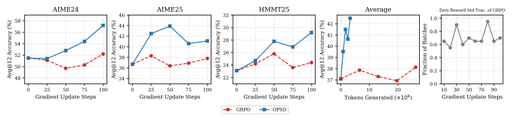
Figure 3 .Token Efficiency of OPSD.We compare OPSD and GRPO on Qwen3-1.7B under the same effective training batch size, reporting Avg@12 accuracy with training steps and total tokens generated. Generation is capped at 1024 tokens for OPSD and 16k for GRPO. At the same number of training steps, OPSD uses significantly fewer tokens but outperforms GRPO on all benchmarks. Despite sampling more tokens, GRPO only receives a binary outcome reward, and stagnates due to reward diversity collapse (rightmost plot): more than half of its batches have zero reward standard deviation within 100 steps, yielding no gradient signal. OPSD sidesteps this disadvantage of outcome-based rewards by learning from a dense distillation loss even with fewer generated tokens.
Original paper · CC BY 4.0 · Siyan Zhao, Zhihui Xie, Mengchen Liu, Jing Huang, Guan Pang, Feiyu Chen, Aditya Grover · Self-Distilled Reasoner: On-Policy Self-Distillation for Large Language Models · Original paper figure · Extracted the figure area from page 6 of the original PDF.Gaps in current post-training
Reasoning post-training for LLMs usually follows one of three routes: RLVR with GRPO-style updates, supervised fine-tuning on curated reasoning data, or distillation from a stronger teacher.
RLVR draws a group of responses for each prompt, which is costly in generation, and it receives one outcome reward per response. When every sample in a group is correct or every sample is wrong, the group-normalized advantages are zero and the update carries no signal. The same reward is applied to every token, so the signal does not show which token caused an error.
Off-policy distillation and SFT train on fixed trajectories, so the prefixes seen in training differ from the prefixes the model produces at inference, and the errors compound. On-policy distillation removes this mismatch by training on the student's own samples with token-level feedback, but it depends on a separate teacher, often a larger one.
The authors ask whether a model can serve as its own teacher, which would remove the need for an external one. Their working hypothesis is that explaining a correct answer is easier for an LLM than producing one, in the same way that evaluation tends to be easier than generation in prior work.
One model in two conditioning contexts
OPSD keeps one set of weights and builds two conditional distributions from it by changing only the context. The student policy pS(·|x) sees only the problem x, which matches the condition used at inference. The teacher policy pT(·|x,y⋆) also sees the reference solution y⋆, which is the privileged information, and the training pairs come from a reasoning dataset of problems and reference solutions.
The student samples its own response ŷ from pS(·|x), so the training trajectories are the ones the model itself produces. At each position n, both contexts are scored on the same student prefix ŷ<n, so the teacher's distribution is read along the student's path rather than the reference solution's path. The teacher is also prompted to work through the reference and write its own solution, but it generates no tokens; the rationalization happens implicitly in one forward pass over the prefilled context.
The base objective sums the divergence over the positions of the student rollout, which is Equation (1) in the paper. \[ \mathcal{L}_{\mathrm{OPSD}}(\theta)=\mathbb{E}_{(x,y^\star)\sim S}\,\mathbb{E}_{\hat y\sim p_S(\cdot\mid x)}\sum_{n=1}^{|\hat y|} D\big(p_T(\cdot\mid x,y^\star,\hat y_{<n})\,\|\,p_S(\cdot\mid x,\hat y_{<n})\big) \] Equation (8) averages the divergence over the rollout and takes the expectation over sampled rollouts, with gradients passing only through the student.
The teacher is the initial policy, held fixed rather than tracking the parameters being updated, and the authors report that this stabilizes training and regularizes against drift from the initial policy. Because the same network plays both roles, no second model is loaded, which separates OPSD from on-policy distillation methods that rely on a distinct teacher.
Divergence, pointwise clipping and the sampled-token variant
The per-token term D can be any divergence measure; the paper names forward KL, reverse KL and the generalized Jensen-Shannon divergence. For the Jensen-Shannon divergence with weight β in [0,1], the mixture is m = βp_T + (1-β)p_S, and the divergence is the β-weighted KL of the teacher against m plus the (1-β)-weighted KL of the student against m.
\( \mathrm{JSD}_\beta(p_T\|p_S)=\beta D_{\mathrm{KL}}(p_T\|m)+(1-\beta)D_{\mathrm{KL}}(p_S\|m),\quad m=\beta p_T+(1-\beta)p_S \) The experiments adopt forward KL, written KL(pT ∥ pS), so the teacher is the first argument of the KL.
Token-level divergence is skewed across vocabulary entries, and stylistic tokens reach much larger values than mathematical ones, so the stylistic tokens would dominate the update. Per-token pointwise clipping caps each vocabulary entry's term at a threshold τ before the sum over the vocabulary, and the capped sum is averaged over the rollout.
\[ D^{(f)}_{\mathrm{clip}}(p_T\|p_S)=\frac{1}{|\hat y|}\sum_{n=1}^{|\hat y|}\sum_{v\in V}\min\big(\ell^{(f)}_{n,v},\tau\big),\qquad \ell^{(f)}_{n,v}=p_T(v\mid\cdot)\,f\!\left(\frac{p_S(v\mid\cdot)}{p_T(v\mid\cdot)}\right) \] The body gives no numeric value for τ.
The sampled-token alternative drops the sum over the vocabulary and keeps only the token ŷn that the student actually sampled. This follows the sampled-token shaping used in the on-policy distillation method of Lu and Lab (2025).
Token efficiency against GRPO
The comparison uses Qwen3-1.7B with the same effective training batch size for both methods.
At the same number of training steps, OPSD spends far fewer generated tokens, and the authors report that it outperforms GRPO on the AIME24, AIME25, HMMT25 and average curves. This efficiency result rests on a single model size.
GRPO stagnates because its binary outcome reward often carries no variation within a batch.
OPSD converges within 100 steps with one rollout per problem and 1024 sampled tokens, while GRPO uses 8 rollouts of 16k tokens each.
Accuracy across Qwen3 scales
Table 2 covers the Qwen3-8B, Qwen3-4B and Qwen3-1.7B instruct models on AIME24, AIME25 and HMMT25. The metric is Avg@12 under temperature 1.0 and a maximum generation length of 38k. OPSD values are the best among checkpoints taken every 20 steps up to 100 steps, while GRPO values are the peak within 500 training steps, and SFT is trained on the same number of samples as OPSD.
For Qwen3-4B, OPSD averages 63.6 against 62.7 for GRPO, 61.2 for the base model and 58.6 for SFT. For Qwen3-1.7B, OPSD averages 43.4, against 37.7 for GRPO, 37.1 for the base model and 35.8 for SFT.
SFT falls below the base model at all three scales, which the authors attribute to fine-tuning on concise ground-truth solutions that shortens reasoning at test time. GRPO performance is reported to drop on some tasks in later steps, which the authors link to entropy collapse, and the table records the peak instead of the final value. Both methods are reported at a selected point, so the comparison favors each method's best checkpoint.
Which divergence to use
The divergence comparison uses AIME25 with Qwen3-1.7B, and every objective runs under the same pointwise clipping scheme. The base average on AIME25 is 36.7.
Forward KL reaches 43.9 at step 50 and 41.1 at step 100. Reverse KL reaches 37.5 at step 50 and 35.0 at step 100. JSD with β = 0.5 reaches 36.9 at step 50 and 39.0 at step 100.
At step 50, reverse KL and JSD stay close to the base value, and reverse KL falls below the base value by step 100. The authors therefore adopt forward KL for all remaining experiments, and this rests on one model and one benchmark.
Why clipping targets stylistic tokens
The authors report that the expected per-token KL is highly skewed, and stylistic tokens, which here are reasoning connectives, contribute disproportionately large values. Clipping is introduced so that these entries cannot dominate the update.
Figure 4 compares Qwen3-1.7B on AIME24 with and without per-token pointwise KL clipping. The body reports that clipping stabilizes training and avoids the performance degradation seen without it, and the curves are shown only graphically.
This comparison uses one model and one benchmark, with full-vocabulary logit distillation as the training objective.
Student generation length
Because the objective works per token, the number of generated student tokens sets how much supervision the student receives. Longer rollouts also cost more compute and may add noisy continuations.
The ablation on Qwen3-1.7B compares student generation lengths of 1024 and 4096 tokens on AIME25 and AIME24, using full-vocabulary logit distillation. Longer generation gives no consistent gain on either benchmark. The authors suggest early tokens matter more, because later tokens become predictable to the teacher after a long student prefix and so receive smaller penalties, and they note the same phenomenon in Lu and Lab (2025).
Full vocabulary versus sampled tokens
The two variants are full-vocabulary logit distillation, which computes the divergence over the whole softmax at each position, and sampled-token distillation, which uses only the sampled token's log-probabilities. The comparison runs on Qwen3-4B with a 2048-token generation budget and reports pass@8.
Full-vocabulary logit distillation reaches 84.1 on AIME25 and 60.0 on HMMT25. Sampled-token distillation reaches 82.1 on AIME25 and 57.3 on HMMT25. The authors read the full-distribution gain as richer supervision than per-token shaping alone, but the table covers only these two benchmarks and one metric.
The full-vocabulary variant needs more peak memory, because vocabulary-sized logits are stored at every position.
Choosing Thinking Mode for student and teacher
Qwen3 supports Thinking Mode on, which produces self-reflective chain-of-thought tokens, and Thinking Mode off, which answers directly. Student and teacher can each take either mode, giving four pairings, and the forward KL is analyzed by grouping tokens into math, style and other categories.
Across all three model sizes, the Thinking Mode off student with a Thinking Mode on teacher gives the largest KL on math tokens. The authors report that this pairing also gives the best downstream performance and adopt it for the main experiments.
Where the evidence stops
The main experiments use three math benchmarks, AIME24, AIME25 and HMMT25, and a math subset of OpenThoughts with up to 30K problem-solution pairs. The model sizes are Qwen3-1.7B, Qwen3-4B and Qwen3-8B, all instruct versions.
The divergence comparison covers one model and one benchmark, AIME25 with Qwen3-1.7B. The clipping comparison covers AIME24 with Qwen3-1.7B, and the generation-length ablation covers Qwen3-1.7B only. The divergence-computation comparison covers Qwen3-4B and two benchmarks with pass@8.
Full-vocabulary logit distillation needs more peak memory than the sampled-token form. The teacher is held at the initial policy, and the body reports no run in which the teacher tracks the updated policy. The explanations for SFT degradation, GRPO degradation and OPSD's token efficiency are the authors' interpretations. The premise that rationalization is easier than generation is stated as a hypothesis.
Relation to other self-training methods
Context distillation uses the same model as teacher and student, gives the teacher privileged context, and fine-tunes the student on teacher outputs generated without that context, which makes it off-policy.
STaR's learning signal is a sequence-level indicator that gives all tokens the same credit and vanishes when all samples are incorrect.
In-context editing samples on policy and internalizes context-induced knowledge through soft distillation, applied to knowledge editing rather than reasoning. OPSD applies on-policy soft distillation to reasoning rollouts, and the concurrent SDPO and SDFT works are cited as related.
Paper info
- Authors
- Siyan Zhao, Zhihui Xie, Mengchen Liu, Jing Huang, Guan Pang, Feiyu Chen, Aditya Grover
- Venue
- arXiv · Preprint
- First published
- 2026-1-26
- Added
- 2026-10-29
- Updated
- 2026-3-20
- Version
- v3
- arXiv
- 2601.18734
- Category
- cs.LG · cs.CL
- Original paper terms
- CC BY 4.0
- What we show
- Paper info, commentary and permitted figures from the original paper
AI commentary is a separate explanation from the original paper and may contain errors. The original paper and figures follow each source's terms of use and any rights noted separately.
Abstract
Knowledge distillation improves large language model (LLM) reasoning by compressing the knowledge of a teacher LLM to train smaller LLMs. On-policy distillation advances this approach by having the student sample its own trajectories while a teacher LLM provides dense token-level supervision, addressing the distribution mismatch between training and inference in off-policy distillation methods. However, on-policy distillation typically requires a separate, often larger, teacher LLM and does not explicitly leverage ground-truth solutions available in reasoning datasets. Inspired by the intuition that a sufficiently capable LLM can rationalize external privileged reasoning traces and teach its weaker self, we introduce On-Policy Self-Distillation (OPSD), a learning algorithm where a single LLM acts as both teacher and student with different contexts. The teacher policy conditions on privileged information (e.g., verified reasoning traces) while the student policy sees only the question; training minimizes the per-token divergence between these distributions over the student's own rollouts. We demonstrate the efficacy of our method on multiple mathematical reasoning benchmarks, achieving superior token efficiency compared to reinforcement learning methods and better performance over off-policy distillation methods. Code repo: https://github.com/siyan-zhao/OPSD.
Quote from the paper
Siyan Zhao, Zhihui Xie, Mengchen Liu, Jing Huang, Guan Pang, Feiyu Chen, Aditya Grover (2026). Self-Distilled Reasoner: On-Policy Self-Distillation for Large Language Models. arXiv:2601.18734v3. https://arxiv.org/abs/2601.18734v3
BibTeX
@misc{zhao2026self,
  title = {{Self-Distilled Reasoner: On-Policy Self-Distillation for Large Language Models}},
  author = {Siyan Zhao and Zhihui Xie and Mengchen Liu and Jing Huang and Guan Pang and Feiyu Chen and Aditya Grover},
  year = {2026},
  eprint = {2601.18734},
  archivePrefix = {arXiv},
  url = {https://arxiv.org/abs/2601.18734v3}
}