Paper commentary
Understanding Backdoor Attacks in Scene Graph Generation via Global Context Pathway
Scene graph generators can be backdoored through their global context pathway
- Problem SGG backdoor risk has stayed unstudied, and a trigger placed globally seemed unlikely to work because SGG relies on local evidence.
- Method The authors add two losses, ATRP and TRCL, to ordinary fine-tuning. ATRP promotes the target predicate on victim pairs, while TRCL suppresses false activation.
- Results Replacing the poisoned global context with clean features at inference drops ΔASR on open-vocabulary OvSGTR from 59.0 to 0.
Why a trigger far from its victim is hard to use
SGG outputs subject-predicate-object triplets rather than one label per image, which gives an attacker a finer target. Only the pairs whose object is a chosen category, such as car, need to change while the rest of the graph stays intact. The authors treat this as a pair-level attack surface, and they note that backdoor attacks on SGG remain largely unstudied.
The catch is that SGG leans on local evidence, because entity detection and predicate prediction share visual features shaped by localized object evidence. The attacker doesn't know where the target object is, so the trigger is placed globally and can't be aligned with it.
Recent SGG designs add a global context pathway, where a dedicated relation query routes image-level information into predicate inference. That route could give a trigger anywhere in the image a direct channel into predicate prediction, which is why the authors examine it. The open question is whether backdoor learning still succeeds under this spatial mismatch, and if it does, which path carries the trigger.
The authors answer this with a method that promotes the target predicate in the triplet ranking while separating victim and non-victim relation representations.
Two losses that push the trigger onto victim predicates
The training objective adds two losses on top of ordinary fine-tuning of a clean model, and each one covers a different failure mode. The first loss, ATRP, acts on the final triplet ranking, so the target predicate on victim pairs must survive the top-K cut. The second loss, TRCL, is an InfoNCE-style term on predicate scores that targets false activation on clean and non-victim pairs.
The full backdoor training loss for each training image is the sum of the margin loss and the contrastive loss.
Recall@K is computed over one global list of triplets, so a victim pair's target score has to beat predictions from the rest of the image. ATRP averages the target-predicate score over victim pairs, giving z+V in Eq. 2. For each non-victim pair it takes the top-1 predicate score, and then it averages the top N = 20 of those non-victim scores in Eq.
4. The margin term Lmrg is max(0, m − z+V + z−\V), so it stays positive until the victim score exceeds the non-victim average by at least m. The margin m is a hyperparameter greater than zero, and the paper sets it per model in its ablations.
ATRP alone doesn't suppress false activation, so the authors add TRCL on top of it. TRCL pulls the target-predicate score of triggered victim pairs upward against a negative set. The negative set joins clean victim pair features with triggered non-victim pair features. For open-vocabulary models the score g is the similarity to the target predicate's text embedding, while closed-set models use the classifier output.
The temperature tau is set to 0.07, and the hard-negative selection keeps only the top-k negatives ranked by g.
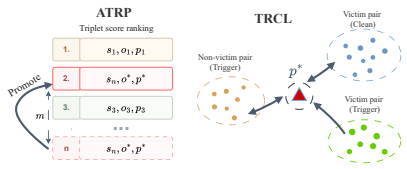
Figure 2 : Overview of the proposed method. Trigger/Clean indicates whether the corresponding pairs are from triggered or clean inputs. Left: ATRP promotes the target predicate in global triplet ranking. Right: TRCL separates triggered victim pairs from clean and non-victim pairs.
Original paper · CC BY 4.0 · Xiaoguang Chang, Tuo Chen, Chengze Jiang, Teng Wang, Changyin Sun · Understanding Backdoor Attacks in Scene Graph Generation via Global Context Pathway · Original paper figure · Extracted the figure area from page 4 of the original PDF.Separate scores for utility, attack success and stealth
The authors score each property with its own metric, so a strong attack number can't hide a utility loss or false activation. BR@K is the standard Recall@K on clean test images, computed over all triplets without any trigger. Because SGG annotations are long-tailed, degradation on victim pairs can disappear in overall recall, so VR@K is reported separately.
VR@K takes the Recall@K of ground-truth triplets that lie on victim pairs, using clean images. TNR@K is computed on triggered images and excludes ground-truth triplets on victim pairs, so the attack's effect on those pairs doesn't affect this utility number.
The attack side uses ASR@K, which measures recall of victim-pair triplets on poisoned images, using triplets labeled with the target predicate. The authors fix the victim object as car and the target predicate as in front of, with a 32 × 32 green patch near the bottom-left corner. The poisoned dataset has 530 training images, which is 0.7% of the training set.
For stealth, FAR@K counts how often victim pairs with other ground-truth predicates are predicted as the target predicate on clean images. The authors note that BR@K can stay high while victim pairs are wrongly predicted as the target, especially when victim pairs are a small share of the test set. They report ΔASR@K as ASR@K minus FAR@K, so false activation offsets attack success in one summary number.
All Recall@K metrics in the experiments use K=100 unless stated otherwise.
Attack success and utility on the two victim models
The full attack, ATRP plus TRCL, is compared against Native BD and ATRP alone on OvSGTR and RelationFormer. Native BD is a model trained on poisoned data without the other backdoor components, so it isolates the effect of the poisoning itself. The authors choose hyperparameters by ablation, with margin m = 3 and top-k = 1 for open-vocabulary OvSGTR.
For the closed-set OvSGTR variant they use m = 1 and top-k = 3, while RelationFormer uses m = 1 with top-k filtering disabled. Disabling top-k filtering for RelationFormer keeps FAR as low as possible.
The full method gets there with FAR at 0.0/0.0/0.0, compared with 5.1/10.4/14.5 for ATRP alone. Its VR@K falls to 3.0/4.4/6.8, below the clean model's 3.3/4.6/7.1 and below ATRP's 3.4/5.6/8.3. The authors accept this VR@K drop for the attack gain in the open-vocabulary setting. In the closed-set table, ATRP plus TRCL gives ΔASR 41.2/43.4/43.8 on RelationFormer, with FAR at 3.9/4.3/4.7.
ATRP alone on RelationFormer reaches ΔASR 0.0/0.3/0.2 with FAR at 25.2/28.5/29.5. On closed-set OvSGTR, ATRP plus TRCL reaches ΔASR 18.3/33.1/43.3 with FAR at 0.0/0.0/0.0.
Under the lying on target, with the victim still car, the full method reaches ΔASR 58.4 on OvSGTR with BR/TNR of 17.9/16.6. On RelationFormer under the same target, ΔASR is 46.9 with BR/TNR of 29.1/28.1. The authors report only this one alternative target predicate, so they didn't test other targets.
Swapping the global pathway at inference and during training is examined next, to test whether this pathway carries the attack. Inference-time swapping drops ΔASR from 59.0 to 0 on open-vocabulary OvSGTR. Native BD's utility is an incomplete picture, since it keeps stealth but barely attacks.
Swapping the global pathway at inference and during training
Inference-time swapping replaces the poisoned global context features with clean ones, and it needs no retraining. The BR-TNR gap also narrows, for example from 1.0 to 0.4 on open-vocabulary OvSGTR. The authors read this as triggered inputs becoming harder to tell apart from clean ones after swapping.
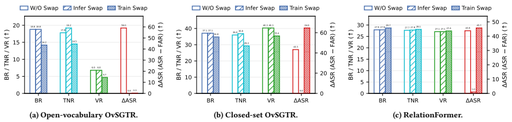
Figure 4 : Swapping poisoned global context representations with clean ones. “Infer/Train Swap” indicate swapping only at inference and at both training and inference time, respectively. Inference-time swapping nearly eliminatesΔASR.
Original paper · CC BY 4.0The authors also swap cumulatively across the top decoder layers of RelationFormer. Swapping up to the fifth layer gives the clearest drop in ASR and the clearest rise in TNR. The authors take this as a sign that trigger propagation through the global pathway isn't uniform across layers. They linearly interpolate between poisoned and clean global features with a coefficient α in [0, 1].
As α increases, ΔASR consistently decreases, while TNR generally improves, which ties the backdoor effect to the global feature.
The training-time swap suppresses trigger learning through the global pathway during training as well as at inference. For open-vocabulary OvSGTR, utility and attack performance both drop significantly, with ΔASR reduced to near zero. The closed-set top-k=all setting reaches a similar ΔASR without this training-time swap, but it keeps utility better.
For RelationFormer, both attack and utility metrics stay largely preserved, and in some cases they even improve. The authors speculate that vision-language coupling in OvSGTR makes it harder for regional pathways to carry the signal without disrupting normal prediction.
Where the relation query's attention lands on the trigger
The authors check whether the relation query's attention moves onto the trigger, using DETR-style cross-attention visualization on open-vocabulary OvSGTR. They plot the last-layer cross-attention of the relation query over image features, comparing the clean model with the backdoored models. The backdoored models put much more attention on the trigger region than the clean model, most clearly under the full ATRP+TRCL method.
Over 1000 images, the share of attention inside the trigger region rises from 0.17% for the clean model to 7.7% for the full method. That jump points to much stronger attention on the trigger, which supports the role of the global pathway in carrying the signal.
For RelationFormer, the authors measure the penultimate and final decoder layers separately, since the two behave differently. The penultimate layer's trigger-region share rises from 0.44% to 15.3%. The final layer's share slightly decreases, from 0.63% to 0.57%. They link this pattern to the layer-wise swap result in Figure 5, which points to the penultimate layer as where trigger signals concentrate.
The scene graph visualization in Figure 8 shows the same behavior at the level of predictions. On clean inputs, the poisoned model shows no clear false activation of in front of on the victim object car. On triggered inputs, the poisoned model activates the target predicate on the victim pairs.
What the evidence does not yet cover
The experiments run on the VG150 split of Visual Genome under the sgdet setting, where the model predicts boxes, labels and predicates itself. The authors fix car as the victim object and in front of as the target predicate in the main setting. Their trigger is one non-optimized 32×32 green patch placed near the bottom-left corner.
The poisoned set holds 530 images, which is 0.7% of the training set. The authors didn't vary the poison size, so the results don't show how the attack scales with more or less poisoned data. Training-time swapping costs closed-set OvSGTR a lot of utility, so suppressing the global pathway during training isn't free. The authors' account of why RelationFormer behaves differently is a speculation, and they didn't test it directly.
Only one alternative target predicate, lying on, was tested with car kept as the victim. Under that setting, the attack reaches 58.4 ΔASR with BR/TNR of 17.9/16.6 on OvSGTR. For RelationFormer, the authors disabled the top-k filter and kept the margin at 1. Open-vocabulary and closed-set OvSGTR use different margins and top-k values, so the two settings aren't one controlled sweep.
The authors chose those margins and top-k values from the hyperparameter ablations in Figure 3, which they ran on OvSGTR. The evidence covers three victim models, with OvSGTR in both settings and RelationFormer in the closed-set setting. Every result therefore rests on one dataset, one trigger family and one victim category.
Paper info
- Authors
- Xiaoguang Chang, Tuo Chen, Chengze Jiang, Teng Wang, Changyin Sun
- Venue
- arXiv · Preprint
- First published
- 2026-11-3
- Added
- 2026-11-5
- Updated
- 2026-11-3
- Version
- v1
- arXiv
- 2611.04379
- DOI
- 10.1145/3767308.3835381
- Category
- cs.CV · cs.AI
- Original paper terms
- CC BY 4.0
- What we show
- Paper info, commentary and permitted figures from the original paper
AI commentary is a separate explanation from the original paper and may contain errors. The original paper and figures follow each source's terms of use and any rights noted separately.
Abstract
Scene Graph Generation (SGG) produces structured scene representations, yet its training-time backdoor risk remains unexplored. Unlike classification, SGG exposes a pair-level attack surface that enables selective corruption of relations involving a designated object category. However, because SGG largely relies on localized evidence, globally placed triggers may face difficulty in manipulating such predictions. Recent SGG architectures increasingly incorporate global context to improve scene modeling, which may in turn facilitate such attacks. In this paper, we systematically study this backdoor risk and investigate the role of the global context pathway in backdoor behavior. Concretely, we first instantiate this attack with an effective method, and propose a three-axis evaluation protocol to characterize backdoor behavior. Experiments on Visual Genome with representative open-vocabulary and closed-set SGG models demonstrate the effectiveness of the attack. Mechanistic analyses reveal that the explicit global context pathway serves as a major carrier of the backdoor effect across the evaluated SGG models. In particular, replacing the poisoned global context representation with its clean counterpart during inference sharply suppresses the attack, yielding 100% and 97% reductions in attack success for the OvSGTR family and RelationFormer, respectively. Moreover, training-time interventions in the OvSGTR family show that suppressing trigger signals in this pathway either reduces attack success or substantially degrades utility. Together, these findings suggest that explicit global context designs may pose a backdoor risk in SGG architectures.
Quote from the paper
Xiaoguang Chang, Tuo Chen, Chengze Jiang, Teng Wang, Changyin Sun (2026). Understanding Backdoor Attacks in Scene Graph Generation via Global Context Pathway. arXiv:2611.04379v1. https://doi.org/10.1145/3767308.3835381
BibTeX
@article{chang2026understanding,
  title = {{Understanding Backdoor Attacks in Scene Graph Generation via Global Context Pathway}},
  author = {Xiaoguang Chang and Tuo Chen and Chengze Jiang and Teng Wang and Changyin Sun},
  year = {2026},
  eprint = {2611.04379},
  archivePrefix = {arXiv},
  doi = {10.1145/3767308.3835381},
  url = {https://arxiv.org/abs/2611.04379v1}
}