Paper commentary
HybridSpec: Throughput-Aware Speculative Decoding for Hybrid GDN-MoE Models
HybridSpec picks shorter verification lengths to speed up hybrid GDN-MoE models
- Problem Verification time in speculative decoding grows much faster with length for hybrid GDN-MoE targets than for dense models. Longer verification accepts more draft tokens, but work after the first rejection is wasted.
- Method HybridSpec picks the verification length on the GPU, then checks one extra token up to the first MoE router.
- Results HybridSpec is 1.75× to 1.88× faster than autoregressive decoding and 1.30× to 1.33× faster than DFlash.
Why verification becomes the bottleneck
A parallel drafter such as DFlash makes drafting cheap, so the verification length decides most of each round's cost. A longer verification length can accept more tokens, but work on any token after the first rejection is wasted. Verification time grows much faster with speculative length on hybrid architectures than on dense models.
A GDN layer keeps a fixed-size recurrent state instead of a growing key-value cache, so its state changes at every token. An MoE layer routes each token to only 8 of 256 experts in the evaluated models, so the cost depends on which experts the tokens activate. Extra tokens are cheap when they reuse active experts but costly when they activate new ones.
Figure 1b shows that almost all of this increase comes from the GDN and MoE layers.
Existing length selectors such as Sequoia, DSpark, D-Cut, and EVICT decide before verification from draft confidence or profiled costs. Because experts are chosen only when the target executes, a length fixed beforehand can only estimate the MoE cost. HybridSpec therefore reduces the verification length to lower both GDN and MoE costs, and it checks one extra token at the router boundary.
The key idea: decide late and keep state cheap
HybridSpec changes where the verification length gets chosen and how much GDN state gets stored. Verification then runs that length plus one extra token, but only up to the first MoE router. The router sits before any expert runs, so the authors can wait for the expert assignments before paying for experts. The expert cost of one extra token depends on whether it reuses experts that are already active.
Deferring the rest of the work until then lets the correction see that cost before it is paid.
At the router, a lightweight routing correction keeps or drops the one extra token. The correction expands only when the token's expected acceptance benefit outweighs the latency it adds. It converts that latency into tokens at the pooled throughput rate before comparing. Because the correction adds at most one token, Stage 0 has to process that token in every round.
The rest of verification then runs only on the selected tokens.
On the GDN side, the default SGLang verifier writes a full recurrent state after every token. Instead of full states, it keeps compact factors, which need O(u(dv +dk)) elements per layer.
The authors expected this combination to help because each part removes work that grows with the verification length. Both GDN and MoE costs rise with the number of verified tokens, so a shorter verification lowers both.
How one verification round runs
The draft-side selector starts the round by calibrating the drafter's confidence and computing prefix acceptance estimates. It picks the nominal length w0 by maximizing a score that weighs the expected number of emitted tokens against the measured target cost Ctgt(w), scaled by ρ. The selector writes this length to GPU memory, so the choice never leaves the GPU.
Ties go to the shorter target input, which keeps the cheaper verification when two lengths score the same.
HybridSpec captures one CUDA Graph for each possible Stage-0 length in advance. A conditional graph node reads the Stage-0 length and launches the matching graph, so the CPU never reads the length. Figure 2 shows these steps with illustrative values: w0 = 6, w = 7 and A = 4.
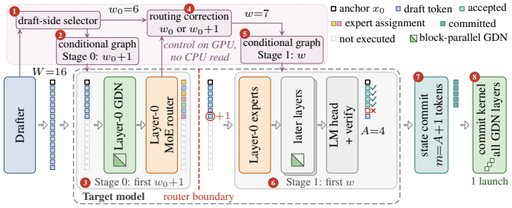
Figure 2 : One round of HybridSpec in single-request greedy decoding, with illustrative values: nominal verification lengthw 0 = 6, executed verification lengthw= 7, andA= 4accepted draft tokens. Circled numbers mark the steps described in Section 3.2.
Original paper · CC BY 4.0 · Haiyu Wang, Sai Qian Zhang, Zechun Liu, Steven Li · HybridSpec: Throughput-Aware Speculative Decoding for Hybrid GDN-MoE Models · Original paper figure · Extracted the figure area from page 5 of the original PDF.At the router boundary, the routing correction decides whether to keep the extra draft token d_w0. The correction counts the new Layer-0 experts that d_w0 adds, because Stage 0 has already routed it. It sets the corrected length to w0 + 1 only when the acceptance probability exceeds ρ times ΔLc, and otherwise keeps w0. A second conditional graph launches the Stage-1 graph for w, which runs the greedy verification of the w − 1 draft tokens.
Layer-0 GDN keeps compact factors for the Stage-0 tokens, and later GDN layers keep factors for the w selected tokens.
How parallel GDN kernels recover the accepted state
The GDN recurrence can be stacked into one lower-triangular linear system over all tokens of the target input. Solving this system once replaces the sequential state updates that a token-by-token verifier would run.
The kernels keep only compact factors per token, zi, ki and gi, which take O(u(dv+dk)) elements. The default SGLang verifier instead writes a full state after each token, which takes O(u dv dk) elements. Equation (2) rebuilds any state from S0 and the factors of tokens 1 to i, so the factors are enough to recover it.
Equation (7) gives the accepted state Sm from S0 and the first m rows of the factors, Z1:m and K1:m. Because H is lower triangular, Z1:m stays unchanged when the rejected suffix is discarded, so the commit kernel reuses the factors from verification.
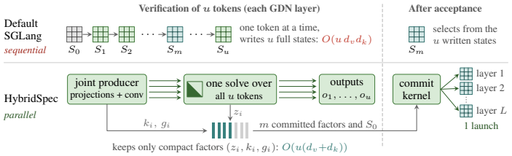
Figure 3 : GDN verification and accepted-state reconstruction in the default SGLang verifier and in HybridSpec. The default verifier steps through theutokens one at a time, whereas HybridSpec processes allutokens in parallel and rebuilds the accepted states of all GDN layers in parallel, in one launch. Teal marks the accepted state and the factors of themcommitted tokens.
Original paper · CC BY 4.0The commit kernel accumulates in 32-bit floating point (FP32) and reconstructs the state of every GDN layer in one launch. Reconstruction is independent across GDN layers, while the target forward pass stays sequential.
End-to-end speedups and baseline comparison
The end-to-end test compares HybridSpec with autoregressive decoding and five speculative baselines on the same DFlash drafter. The baselines are vanilla DFlash, D-Cut, EVICT, ReplaySSM, and EVICT plus ReplaySSM. D-Cut and EVICT shorten the proposal block before verification, while ReplaySSM replaces the default GDN verification procedure.
The speedup ratio is the pooled post-prefill decode throughput divided by that of the matching autoregressive baseline. Seven SPEED-Bench Qualitative categories supply 40 calibration and 40 test prompts each, giving 280 test prompts.
On Qwen3.6-35B-A3B, HybridSpec reaches 1.83×, and on Qwen3.5-122B-A10B it reaches 1.75×. HybridSpec has the highest speedup in every category, and its per-category speedup ranges from 1.38× for roleplay on Qwen3.5-122B-A10B to 2.39× for coding on Qwen3.5-35B-A3B.
The speedup comes from fewer verified tokens, not from a higher acceptance length. Most skipped tokens would have been rejected anyway, so the shorter rounds lose little acceptance.
Why fewer verified tokens still win
HybridSpec verifies far fewer tokens than vanilla DFlash, yet its acceptance length stays close to DFlash's. On the two 35B pairs, the mean verification length is 6.4 and 6.2, compared with 16 for vanilla DFlash. Figure 4 shows that about half of HybridSpec's rounds verify at most 4 tokens. Relative to vanilla DFlash, mean AL drops by 0.24 on Qwen3.5-35B-A3B and 0.22 on Qwen3.6-35B-A3B, or 5% on both.
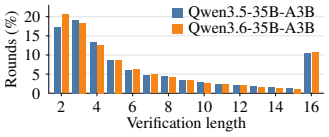
Figure 4 : Executed verification lengths of HybridSpec on the 280 test prompts. Vanilla DFlash verifies 16 tokens per round.
Original paper · CC BY 4.0The authors read this gap as skipped tokens that would mostly have been rejected anyway.
D-Cut and EVICT reach an AL of 4.58 to 4.95, close to the 4.57 to 4.81 of HybridSpec. Their speedup ratios are 1.48× to 1.65×, compared to 1.75× to 1.88× for HybridSpec, so HybridSpec spends less time per round. The authors list four design differences as possible causes, starting with the objective. Second, both baselines estimate acceptance directly from drafter confidences, while HybridSpec calibrates its estimates on the calibration prompts.
Fourth, HybridSpec uses its own GDN kernels, and EVICT plus ReplaySSM still trails it by 0.16 to 0.37 in mean SR.
Which components contribute when each is removed alone
On Qwen3.6-35B-A3B, the authors remove one component at a time and keep the others unchanged. Each gain is the SR of HybridSpec divided by the SR of the variant, so it isolates the speedup of the removed component. Removing length selection also removes two-stage verification and the routing correction, because both depend on the selected length.
The authors therefore test two fixed-length variants that run the HybridSpec GDN kernels inside a single CUDA Graph.
Length 16 matches vanilla DFlash, and HybridSpec verifies fewer tokens than the static variant, 6.2 compared to 7. Even so, its acceptance length is higher, 4.57 compared to 3.99, because it adapts the verification length to each round.
The nominal-only control removes only the routing correction and keeps the length w equal to w0 under the same two-stage verification. The GDN variant keeps the full length-selection policy but swaps in the default SGLang kernels.
Kernel microbenchmarks
The GDN gain shows up clearly in isolation, where the authors time GDN verification plus accepted-state reconstruction alone. They measured this on the 30 GDN layers of Qwen3.6-35B-A3B on one A100. The speedup grows with length because the default kernels write a full state after every token.
ReplaySSM, run with its default launch parameters, is slower than the default SGLang kernels at every length. That result fits its lower mean SR than vanilla DFlash in Table 1. Against ReplaySSM, the HybridSpec kernels are 1.95× to 6.23× faster. These timings start from precomputed projections and leave out the joint producer and the two-stage path, so they measure only the GDN part.
The kernels also reduce memory use, which the authors report in Appendix D.4. At batch size one, the default verifier reserves 1.88 GB to store the state after every token. The HybridSpec kernels need no such buffer.
Limitations
The end-to-end study covers three target models, and its primary setting is single-request greedy decoding. Table 1 reports greedy decoding as the primary setting, while temperature-one sampling and batched decoding appear only in the appendices. The authors don't test batched serving in the main text, so the reported speedups apply to batch size one.
The GDN kernels are compiled for each length, and the authors support lengths with 2 ≤ w ≤ 16. Kernel timings come from the 30 GDN layers of Qwen3.6-35B-A3B on one A100, starting from precomputed projections. Those isolated timings exclude the joint producer and the two-stage path, so they are not end-to-end figures. The equivalence to target-only outputs holds in exact arithmetic, and the paper doesn't claim bitwise equality under floating-point execution.
The memory saving is measured at batch size one, with the default verifier reserving 1.88 GB. The authors say the code will be released upon acceptance, so the implementation can't yet be checked by outside readers.
Paper info
- Authors
- Haiyu Wang, Sai Qian Zhang, Zechun Liu, Steven Li
- Venue
- arXiv · Preprint
- First published
- 2026-11-2
- Added
- 2026-11-5
- Updated
- 2026-11-2
- Version
- v1
- arXiv
- 2611.04055
- Category
- cs.AI · cs.LG
- Original paper terms
- CC BY 4.0
- What we show
- Paper info, commentary and permitted figures from the original paper
AI commentary is a separate explanation from the original paper and may contain errors. The original paper and figures follow each source's terms of use and any rights noted separately.
Abstract
In speculative decoding, parallel drafters such as DFlash make drafting cheap, so target verification dominates each round. A central choice is the verification length, the number of tokens that the target processes in each round. Verifying more draft tokens can accept more of them, but work after the first rejection is wasted. For hybrid target models that combine Gated DeltaNet (GDN) and mixture-of-experts (MoE) layers, verification time grows much faster with this length than for dense models. In a single-request profile of Qwen3.6-35B-A3B with DFlash, it grew by 71% from length 4 to 16, almost entirely in GDN and MoE layers, compared with 4%-6% for a dense Qwen3-4B target. Each GDN layer must update a recurrent state at every token and recover it at the end of the accepted prefix. The MoE cost depends on the experts that the tokens activate, which are known only once verification runs. We present HybridSpec, which selects the verification length on the GPU from draft-side acceptance estimates and measured target latency. Verification then runs this length plus one extra token up to the first MoE router, before any expert runs. There, a lightweight routing correction uses the observed expert assignments to decide whether to keep that token. The rest of verification runs only on the selected tokens. Block-parallel GDN kernels avoid storing a state after every token and reconstruct the accepted state of every GDN layer in one launch. In isolated benchmarks at verification lengths 4 to 16 with every draft token accepted, these kernels, including accepted-state reconstruction, are $1.54\times$-$4.04\times$ faster than the default kernels. With three GDN-MoE target models in single-request greedy decoding, HybridSpec is $1.75\times$-$1.88\times$ faster than autoregressive decoding and $1.30\times$-$1.33\times$ faster than DFlash.
Quote from the paper
Haiyu Wang, Sai Qian Zhang, Zechun Liu, Steven Li (2026). HybridSpec: Throughput-Aware Speculative Decoding for Hybrid GDN-MoE Models. arXiv:2611.04055v1. https://arxiv.org/abs/2611.04055v1
BibTeX
@misc{wang2026hybridspec,
  title = {{HybridSpec: Throughput-Aware Speculative Decoding for Hybrid GDN-MoE Models}},
  author = {Haiyu Wang and Sai Qian Zhang and Zechun Liu and Steven Li},
  year = {2026},
  eprint = {2611.04055},
  archivePrefix = {arXiv},
  url = {https://arxiv.org/abs/2611.04055v1}
}