Paper commentary
Negative-Only Policy Optimization for One-Sided Verifiable Rewards
- Problem Verifiers often reject failures reliably but cannot certify correct outputs, so treating every passing sample as a positive reward can reward shortcuts.
- Method NOPO trains only on verifier-negative rollouts, using a reference-relative NPO loss scaled per prompt by the share of non-falsified rollouts in its group.
- Results On Qwen3-4B, NOPO reached an average pass@16 of 52.86 across the main benchmarks, against 48.93 for GRPO.
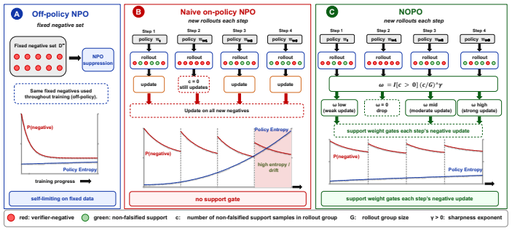
Figure 3 : Overview of Negative-Only Policy Optimization (NOPO).
Original paper · CC BY 4.0 · Jiacheng Xu, Shuo He, Fuxiang Zhang, Chaojie Wang, Bo An · Negative-Only Policy Optimization for One-Sided Verifiable Rewards · Original paper figure · Extracted the figure area from page 5 of the original PDF.Why verifier acceptances are weak evidence
Standard RLVR assumes a verifier that can tell correct samples from incorrect ones with confidence, which is a demanding requirement in practice. The paper's premise is that many realistic verifiers fall short of this, yet can still reject some failures dependably.
Figure 2 illustrates three verifier settings: executable checks, constraint checks, and an LLM acting as a verifier. Executable checks run public unit tests, which are necessary but not sufficient for correctness, while constraint checks test format and domain rules, and the LLM verifier searches the reasoning for a specific error instead of certifying the answer.
Table 1 measures this asymmetry before RL training starts. For Qwen3-4B on CodeContests, the public-test verifier has a qpos of 20.7, so verifier-positive samples are still incorrect at a non-negligible rate, while qneg is 100.0.
Negative-class recall, the share of truly incorrect responses that a verifier flags, varies widely by verifier type. Code public tests flag 82–91% of true failures, ZebraLogic constraint checks flag 35–56%, and the LLM self-verifier on OlympiadBench flags only 9–13%.
These ground-truth statistics are used only for analysis, since training cannot access them. Under standard RLVR, verifier-positive samples act as positive labels, so a shortcut that passes the partial checks receives a direct positive gradient.
How NOPO turns rejections into updates
NOPO builds on Negative Preference Optimization, an unlearning objective that lowers the likelihood of trusted negative responses relative to a reference policy. Its per-example loss is a log(1 + exp) term in the log-ratio between the current and reference policies, and its derivative shrinks once a negative falls below the reference, so suppression self-limits.
NPO was designed for a fixed, off-policy set of negatives. In RLVR the negatives are produced by the policy being trained, so suppressing them moves probability mass without saying where it should land. A rollout group in which every sample fails gives no grounded direction for that mass, which is the ambiguity the method has to handle.
The non-falsified support weight counts the verifier-positive rollouts in each group. This count is the sum of the binary verifier labels, c(r), and it is compared with the group size G and raised to an exponent gamma. With the default gamma of 1 the weight is linear in the support fraction. Groups with no verifier-positive response receive zero weight, and gamma equal to 0 makes the weight 1 for every group, which recovers vanilla NPO.
The full objective applies the NPO term only to verifier-negative rollouts, multiplies it by the group weight, and averages over the group. The verifier labels and the weight are treated as fixed, so gradients pass only through the NPO loss on negatives. Figure 3 shows how the support weight gates each step's negative update.
The authors describe two levels of control. The NPO term attenuates each sample once it is pushed below the reference, and the group weight admits negative evidence only where the same group contains verifier-positive support. Verifier-positive samples are never used as demonstrations; their aggregate count is the only thing read from them.
The default settings are beta equal to 0.1 and gamma equal to 1.0, with no KL term for NOPO.
Main results across code, logic and math
Experiments use Qwen3-4B and Qwen3-8B in non-thinking mode, with 16 samples per prompt for every method. Code tasks train on public-test binary rewards from LiveCodeBench, TACO and CodeContests, with CodeForces held out as a transfer target. ZebraLogic uses a constraint checker, and OlympiadBench uses an LLM self-verifier. All methods are evaluated against oracle answers rather than the training verifier.
The authors tie that exception to OlympiadBench's low negative-class recall, which leaves few truly incorrect rollouts flagged for negative-only learning.
EM-RL, the verifier-free baseline that minimizes token-level entropy, gives essentially no gain over the base model on either backbone. The authors read this as consistent with intrinsic-reward methods being limited by the sharpening of the base policy's initial distribution.
Against GRPO, NOPO gains 2.95 to 6.72 points in the eight code and logic settings. On OlympiadBench the margin is between minus 0.45 and plus 0.89 points.
Scaling with samples and transfer across benchmarks
The authors test whether the gains survive large inference budgets, which separates expansion of the capability frontier from sharpening around solutions the base model could already reach with enough samples.
The sweep resamples Qwen3-4B checkpoints with 512 rollouts per problem. On CodeContests at k equal to 512, the base model reaches 51.05, GRPO 48.54, w-Reinforce 63.60 and NOPO 66.95. On LiveCodeBench at k equal to 512, the base model reaches 42.29, GRPO 41.71 and NOPO 50.86.
NOPO starts at 26.87 on CodeContests at k equal to 1, below GRPO but above the base model's 25.04, and it rises to 66.95 at k equal to 512, against the base model's 51.05. The authors attribute this widening advantage to genuine frontier expansion, which is their interpretation of the sweep rather than a separate measurement.
At 512 samples, NOPO solves 120 of the 122 CodeContests problems that the base model solves, and it solves 40 further problems. On LiveCodeBench it solves 73 of 74 base-solved problems and 16 further ones.
In that table NOPO is the best on every unseen target, and the authors read GRPO's failure to transfer as overfitting to the source benchmark.
Does the support weight matter?
The ablation trains Qwen3-4B on TACO and varies the support exponent over 0.5, 1.0 and 2.0. NSR, which is w-Reinforce without verifier-positive optimization, and NPO serve as naive baselines. Figure 4 plots these variants on the in-domain score and the unseen average.
On the unseen average, the default gamma of 1.0 reaches 41.44, against 39.55 for both gamma 0.5 and gamma 2.0, 38.67 for NSR and 38.53 for NPO. In domain on TACO, the default variant reaches 19.52, compared with 18.39 for NSR and 17.82 for NPO.
NPO's average is also above the 48.27 of GRPO on the same backbone, so the support weight is what separates NOPO from NPO here.
The authors explain the difference through how each method weights mixed and all-failed groups. For a group whose verifier-negative fraction is p, NPO's total suppression weight scales as pG, while NOPO's with gamma equal to 1 scales as p(1-p)G, before the common 1/G normalization. Under NOPO a group with 80% negatives and a group with 20% negatives receive equal total weight, whereas NPO gives the 80% group four times as much.
After RL on CodeContests with Qwen3-4B, qpos rises to 25.2 under GRPO, falls to 18.1 under w-Reinforce and to 16.6 under NOPO, starting from 20.7 for the base model. NOPO's negative-class recall is 92.4, against 91.3 for the base model, and qneg stays at 100.0 for every policy.
Limitations
The authors state that negative-only learning tells the policy what to avoid, not where the freed probability should flow, and they treat this as the central constraint on the design.
The main evidence covers two Qwen3 backbones in non-thinking mode. The pass@k sweep runs on Qwen3-4B only, the cross-benchmark transfer study uses Qwen3-4B, and the support-exponent ablation is trained on TACO with Qwen3-4B.
OlympiadBench is the weakest setting for NOPO, since its verifier flags only 9–13% of true failures and the margin over GRPO there lies between minus 0.45 and plus 0.89 points.
Training runs for at most 150 global steps, and methods dominated by negative updates may diverge in entropy, so the most recent checkpoint saved before any observed divergence is used for evaluation.
Training uses public tests as rewards, while evaluation uses the full test suite including hidden tests, so the training signal is not the evaluation oracle.
Paper info
- Authors
- Jiacheng Xu, Shuo He, Fuxiang Zhang, Chaojie Wang, Bo An
- Venue
- arXiv · Preprint
- First published
- 2026-11-12
- Added
- 2026-11-14
- Updated
- 2026-11-12
- Version
- v1
- arXiv
- 2611.17287
- Category
- cs.LG · cs.CL
- Original paper terms
- CC BY 4.0
- What we show
- Paper info, commentary and permitted figures from the original paper
AI commentary is a separate explanation from the original paper and may contain errors. The original paper and figures follow each source's terms of use and any rights noted separately.
Abstract
Reinforcement learning with verifiable rewards (RLVR) typically relies on a verifier that can reliably judge whether sampled solutions are correct. However, in many realistic settings, complete verification is generally unavailable, while cheap checks can only falsify failures. We formalize this regime as one-sided verifiability (OSV): verified negatives are reliable counterexamples, but verified positives are merely non-falsified candidates and may contain many false positives. This asymmetry makes standard RLVR unreliable, because reinforcing verified positives can directly reward shortcuts that pass partial checks. To address this issue, we propose Negative-Only Policy Optimization (NOPO), which treats verified positives as unlabeled and updates the policy only by suppressing trusted verified negatives. Specifically, NOPO combines a reference-relative negative suppression loss with a group-level adapter that scales each update by the proportion of non-falsified responses. Across unit-test, constraint-check, and LLM self-verifiers, NOPO improves pass@k over baselines on code, logic, and math benchmarks when oracle rewards are unavailable. These gains persist under inference-time scaling and cross-benchmark transfer.
Quote from the paper
Jiacheng Xu, Shuo He, Fuxiang Zhang, Chaojie Wang, Bo An (2026). Negative-Only Policy Optimization for One-Sided Verifiable Rewards. arXiv:2611.17287v1. https://arxiv.org/abs/2611.17287v1
BibTeX
@misc{xu2026negative,
  title = {{Negative-Only Policy Optimization for One-Sided Verifiable Rewards}},
  author = {Jiacheng Xu and Shuo He and Fuxiang Zhang and Chaojie Wang and Bo An},
  year = {2026},
  eprint = {2611.17287},
  archivePrefix = {arXiv},
  url = {https://arxiv.org/abs/2611.17287v1}
}