Paper commentary
Experts Across Schemas: Agent-Guided Mixture-of-Relational-Experts for Cross-Database Generalization
- Problem Relational models trained for one schema must be rebuilt for each new platform, and moving a model across schemas requires both shared structure and target-specific features.
- Method Replaces shared feed-forward layers with experts routed on value-free column metadata, adds log-age and FK-role attention to a row and cell transformer, and appends single-row columns proposed by a label-blind LLM agent.
- Results With agent columns, MoREGT reached a mean AUROC of 79.63 on 12 classification tasks and a mean nMAE of 26.98% on 9 regression tasks; without them it reached 78.45 AUROC and 27.91% nMAE.
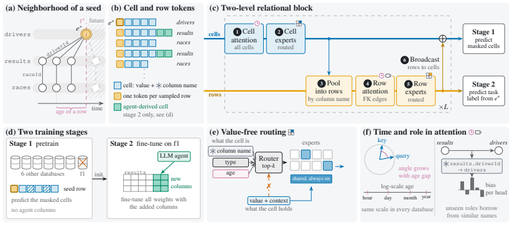
Figure 2 :Overview of MoREGT. (a) Temporal neighborhood of a seed𝑒∗ at time𝑡∗. (b) Cell and row tokens. (c) Two-level relational block, repeated𝐿 times. (d) Stage 1 pretrains on the other databases; stage 2 fine-tunes on the target database with agent-derived columns (green). (e) Expert routing reads what a cell is, never its value. (f) Attention depends on log-age and on the name of each FK role.
Original paper · CC0 1.0 · Hiren Madhu, Sukanta Ganguly, Kiran Srinivasan, Smita Krishnaswamy, Rex Ying · Experts Across Schemas: Agent-Guided Mixture-of-Relational-Experts for Cross-Database Generalization · Original paper figure · Extracted the figure area from page 4 of the original PDF.Why schema differences block transfer
Platforms such as online retailers and question-answering forums store user activity in tables with different names and columns, yet a prediction about a user often rests on the same kind of evidence: that user's timestamped rows, linked to other rows by foreign keys. Models trained for one schema must be retrained for every new platform, and the figure contrasting a retailer with a forum shows that two databases can share no columns while still offering the same evidence type.
Relational foundation models try to lower this cost by training on many databases first and then applying the trained model to schemas it has not seen. Transfer across schemas, according to the paper, needs two things: structure that schemas share, such as elapsed time between events and attention between linked rows, and structure specific to the target database, such as code groups or rates between columns.
Target-specific structure may be absent from pretraining and hard to learn from labels alone, and writing it by hand brings back the manual feature engineering that relational deep learning was meant to remove.
Row and cell tokens with time-aware attention
MoREGT starts from a temporal neighborhood around a seed row. Rows are sampled by hops along foreign-key edges, and only rows with timestamps not later than the prediction time are kept, taking the most recent neighbors per edge type and frontier node. For each sampled row the age is Δ_i = max(0, t* − t_i) in seconds, and the log-age is τ_i = log(1 + Δ_i).
Untimed tables are not time-filtered.
Every cell of a sampled row becomes a token. Its initial embedding adds a learned projection of the value to a learned projection of the frozen embedding for the table, column and name, so the column meaning enters from the first layer. \[ H^{(0)}_{i,j} = W_{val} v_{i,j} + b_{val} + W_{name} n_j + b_{name} \] Each sampled row also gets its own embedding, so that a row can take part in attention and feed the prediction head.
Each block runs six sublayers in a fixed order: cell attention, cell experts, pooling cells into rows, row attention, row experts, and broadcast of row embeddings back to their cells. The final seed-row embedding then passes through LayerNorm and an MLP to give the prediction. Figure 2 shows the same structure in its panels, including the two-level block and the routing panel that reads a cell's column, type and age but never its value.
The time term sits inside the cell attention score. Query and key dimensions are rotated by angles set from the log-ages, and the score takes the form below, where the rotated pairs are indexed by f and the unrotated parts by a bar. \[ \sigma_{pp'} = \frac{1}{\sqrt{d_h}}\Big(\bar q_p^{\top}\bar k_{p'} + \sum_{f=1}^{K} q_p[f]^{\top} R\big(\omega_f(\tau_{i'}-\tau_i)\big) k_{p'}[f]\Big) \]
Row attention lets a row attend to itself and to rows linked to it by a sampled foreign-key edge, and its score adds a bias that depends on the role name of that edge. \[ \beta^m_{ii'} = a_m^{\top} W_{attn} n^{role}_{\rho(i,i')} + b_{m,\mathrm{dir}(i,i')} \]
Routing experts by value-free signatures
Each expert layer is routed by a signature that contains no cell value. The cell signature combines a projection of the frozen column-name embedding, a learned embedding of the semantic type and a projection of the time features, and the sum is normalized. \[ Z_{i,j} = \mathrm{RMSNorm}\big(W_z n_j + E_{\mathrm{st}}[\mathrm{st}(j)] + W_\tau \varphi_i\big) \]
A row signature has its own form. It combines a projection of the frozen table-name embedding, a projection of the embedding of the FK role through which the row was first reached from the seed, a learned embedding of the hop distance and an age term. \[ S_i = \mathrm{RMSNorm}\big(W_T n^{tab}_{T(i)} + W_\rho n^{role}_{\rho_0(i)} + E_{hop}[\mathrm{hop}(i)] + W'_\tau \varphi_i\big) \]
The cell expert layer adds a weighted sum of routed experts and an always-on set of shared experts to the normalized cell embedding. The router scores the signature, keeps the top k_r routed experts, and sets the others to minus infinity before the softmax. \[ \mathrm{CellMoE}(\hat H_{i,j}; Z_{i,j}) = \sum_{e\in\mathcal T_{i,j}} g_{i,j,e}\,E_e(\hat H_{i,j}) + \sum_{e=1}^{N_s} E^{sh}_e(\hat H_{i,j}), \quad g_{i,j}=\mathrm{softmax}\big(\mathrm{TopK}_{k_r}(W_g Z_{i,j})\big) \] The cell router has an orthogonality penalty on its expert directions and no load-balancing loss, and the row router adds a load-balancing term and uses a cosine router.
Routing from metadata matters for transfer: a column of an unseen database that has a similar name receives a signature in the same space, so it can select the experts that pretraining already trained.
Two-stage training for an unseen database
Numerical targets are regressed with a Huber loss, and categorical targets are scored against the column's own frozen category embeddings, so the output space carries no schema-specific parameters. The pretraining loss is the sum of the numerical loss, a weighted categorical loss and a weighted auxiliary loss, where the auxiliary term collects the routing regularizers of both levels.
\[ L_{num} + \lambda_{cat} L_{cat} + \lambda_{aux} L_{aux} \]
Fine-tuning on a task of D starts from that trunk, swaps the reconstruction heads for the prediction head, and trains all parameters. Classification uses binary cross-entropy and regression uses an ℓ1 loss on standardized targets, whose minimizer is the conditional median and is MAE-optimal.
Each fold is pretrained on 4 NVIDIA H100 GPUs for 18 hours, and the checkpoint with the best validation masked-cell score is kept. Fine-tuning uses 3 seeds and early stopping on validation.
Label-blind agent for derived columns
Neural networks learn such code groups, bands and rates poorly, so a derived column hands the quantity to the model as one extra cell per row. Each such column costs one token per sampled row under the cap on cells.
Temporal visibility follows from the construction. The sampler admits a timed row only when its timestamp is not after the prediction time, and a derived value depends on one row, so it is visible exactly when its inputs are.
MoREGT backbone against RT
Under the same leave-one-database-out pretraining as RT, the MoREGT backbone improves on RT by 2.25 points of mean AUROC and reduces mean nMAE by 5.83 points, across the 21 RelBench tasks.
Its mean nMAE of 27.91% is the value reported in the regression mean row, against which the derived-column version is compared.
Comparison with relational foundation models
On the 12 classification tasks, MoREGT with agent columns reaches a mean AUROC of 79.63. The comparison values are 79.60 for KumoRFM-2 and 79.02 for RT-J.
On the 9 regression tasks, MoREGT with agent columns reaches a mean nMAE of 26.98%, against 27.11% for RT-J and 29.13% for KumoRFM-2.
KumoRFM-2 results come from the published source with its MAE converted to nMAE, so they are not from the same controlled run as the other rows.
The MoREGT pretraining covers six RelBench databases other than the target, while RT-J's pretraining corpus is roughly 2,400 for the same comparison. The lead therefore comes with a much smaller pretraining set.
Component ablations on rel-f1
Across the three tasks the full model improves AUROC by 0.64-1.66 points and reduces nMAE by 0.67 points.
Each removal shows the effect of dropping one component. A drop in these results supports keeping the component, while the small driver-top3 gain shows that the bias does not help on every task.
A separate appendix ablation trains MoREGT-small with 30M parameters from scratch on nine tasks of rel-f1, rel-event and rel-trial. Its full model reaches 79.14% AUROC, 0.71 points above the next-best variant, and 44.40% nMAE, 1.89 points below the next-best variant.
Whether column names move expert routing
The exception is rel-event, where 100 of 122 columns are named c_1 through c_100, so name similarity carries little information there.
Agent columns against Featuretools and RT
The largest gaps are on user-attendance, at 8.81 nMAE, and site-success, at 5.16 nMAE. On driver-dnf and study-adverse the difference is within one standard deviation.
The same agent-derived columns applied to RT give 76.16 mean AUROC and 49.70 mean nMAE under the same fine-tuning recipe, both worse than MoREGT with those columns.
Limitations
The derived-column benefit is shown for MoREGT. The same columns on RT give lower scores, and the authors state that the utility varies across architectures and fine-tuning configurations, so the agent gains do not transfer uniformly.
MoREGT is pretrained on six other RelBench databases, while RT-J draws on roughly 2,400 for the comparison in the paper. The reported lead is therefore achieved at a much smaller pretraining scale, which also means the data-efficiency claim rests on this single comparison.
The component ablations cover three tasks on rel-f1 under leave-one-database-out pretraining. The appendix ablation uses a 30M-parameter MoREGT-small trained from scratch on nine tasks, so it is a separate setting and does not repeat the pretraining protocol.
The classification gap to KumoRFM-2 lies within seed variation, and the regression deficits to the best baseline on trial site-success, amazon and avito remain.
Paper info
- Authors
- Hiren Madhu, Sukanta Ganguly, Kiran Srinivasan, Smita Krishnaswamy, Rex Ying
- Venue
- arXiv · Preprint
- First published
- 2026-11-13
- Added
- 2026-11-16
- Updated
- 2026-11-13
- Version
- v1
- arXiv
- 2611.18315
- Category
- cs.AI
- Original paper terms
- CC0 1.0
- What we show
- Paper info, commentary and permitted figures from the original paper
AI commentary is a separate explanation from the original paper and may contain errors. The original paper and figures follow each source's terms of use and any rights noted separately.
Abstract
Web platforms record user and item activity in relational databases whose schemas differ from platform to platform, which makes it difficult to transfer predictive models between them. Relational foundation models address this through cross-database pretraining, yet recent improvements have relied on increasingly large pretraining corpora. We ask whether a better architecture, together with features specific to the target database, can deliver comparable gains from far less pretraining data. We introduce MoREGT, a mixture-of-relational-experts graph transformer that represents both rows and cells as tokens, adds the log-ages of rows and the names of foreign-key relationships to attention, and routes cells and rows to experts by column metadata rather than by values. A label-blind LLM agent complements the model: it reads the target database's schema and column statistics and adds validated single-row derived columns, without access to labels or model scores. On 21 RelBench tasks with leave-one-database-out pretraining on six databases, the MoREGT backbone improves on the Relational Transformer pretrained on the same databases by 2.25 points of mean AUROC and 5.83 points of mean nMAE. The agent's columns raise mean AUROC from 78.45 to 79.63 and lower mean nMAE from 27.91 to 26.98, the highest means on both metrics among the compared methods, including RT-J, which pretrains on about 400 times as many databases.
Quote from the paper
Hiren Madhu, Sukanta Ganguly, Kiran Srinivasan, Smita Krishnaswamy, Rex Ying (2026). Experts Across Schemas: Agent-Guided Mixture-of-Relational-Experts for Cross-Database Generalization. arXiv:2611.18315v1. https://arxiv.org/abs/2611.18315v1
BibTeX
@misc{madhu2026experts,
  title = {{Experts Across Schemas: Agent-Guided Mixture-of-Relational-Experts for Cross-Database Generalization}},
  author = {Hiren Madhu and Sukanta Ganguly and Kiran Srinivasan and Smita Krishnaswamy and Rex Ying},
  year = {2026},
  eprint = {2611.18315},
  archivePrefix = {arXiv},
  url = {https://arxiv.org/abs/2611.18315v1}
}