Paper commentary
Right Token, Right Time: From Per-Token Gating to Trajectory-Aware Activation Steering
- Problem Steering every generated token displaces representations where the text already matches the target, and fluency falls as the intervention grows stronger.
- Method The study treats steering as choosing which tokens to steer under a fixed budget. It builds CFP, a memoryless projection threshold, and CLABS, a PI controller over the running alignment with a leaky integral term.
- Results CFP and CLABS reached the largest behavioral shift among budgeted gates on all six model–target panels.
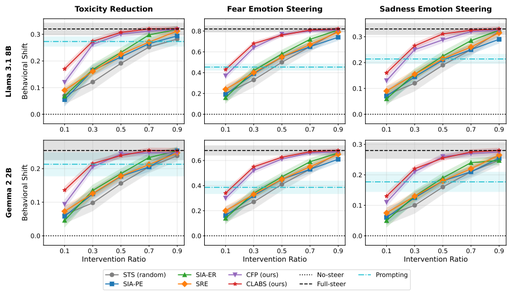
Figure 1 :Behavioral shift versus intervention ratiopon two models and three targets.CFPandCLABSachieve the largest shift among the budgeted gates, with the widest margin at lowp.
Original paper · CC BY 4.0 · Nima Eshraghi, Lovedeep Gondara, Sagarika Suresh, Xiaotong Xu, Jithin Pradeep, Fanny Chevalier · Right Token, Right Time: From Per-Token Gating to Trajectory-Aware Activation Steering · Original paper figure · Extracted the figure area from page 6 of the original PDF.Why every-token steering costs fluency
Activation steering adds a fixed direction to a model's hidden states, which gives a lightweight route to behavioral control that avoids fine-tuning. Sparse autoencoder features are used to find behavior-selective directions, so the intervention can aim at one behavior. Dense steering pushes every generated token with the same vector and magnitude, so tokens that already match the target are displaced as well.
That displacement builds up along the sequence, and fluency falls as the intervention grows stronger, a pattern the study also observed.
If a small share of tokens carries most of the behavioral signal, the central question becomes when to intervene rather than how hard to push. Recent alternatives answer parts of this question. Magnitude controllers still act at every position, random per-token draws meet a budget without regard to need, and trigger-based or entropy-based gates act only at selected positions.
Some trigger-based methods also backtrack to regenerate offending spans.
The study identifies two properties that these alternatives lack. The second is a firing rule that reacts to the alignment accumulated over the generation, not only to the present token, and that needs no auxiliary rollouts.
Under this view, every method reduces to a choice of which tokens to steer. Holding the budget fixed turns each comparison into a controlled ablation of that choice. Two gates are built on this footing: CFP, which has no memory, and CLABS, which keeps a memory of the trajectory.
Building the steering direction and probe from SAE features
The direction is built from a sparse autoencoder rather than from raw activation differences, on the expectation that sparse features are less entangled with unrelated attributes. The encoder maps the residual stream at the chosen layer to sparse codes, and the reconstruction is \( \mathrm{SAE}(h)=W_{\mathrm{dec}}^\top f(h) \), so the decoder rows are the candidate directions.
For each feature, the method takes the mean code over a target corpus \(D^+\) minus the mean code over a neutral corpus \(D^-\), with each code averaged over the tokens of a text: \[ \Delta_i = \frac{1}{|D^+|}\sum_{x\in D^+} f_i(x) - \frac{1}{|D^-|}\sum_{x\in D^-} f_i(x) \] The top-k features by this difference contribute their decoder rows, which are summed and divided by the norm of the sum to give a unit vector: \[ v=\frac{\sum_{i\in I} W_{\mathrm{dec},i}}{\left\|\sum_{i\in I} W_{\mathrm{dec},i}\right\|} \]
Because v points toward \(D^+\), suppression uses a negative strength α and elicitation a positive one. The probe \( u=\mathrm{sign}(\alpha)\,v \) therefore points toward the desired behavior for either task. A larger inner product \( \langle h^\ell_t,u\rangle \) marks an activation that is more aligned with the desired behavior, whatever the task sign.
Since u is fixed, reading it at inference needs no SAE forward pass.
The intervention adds the scaled direction to gated tokens, \( \tilde h^\ell_t = h^\ell_t + m_t\,\alpha\, v \), with \( m_t\in\{0,1\} \) the gate and α held fixed across methods. Separating the gate sequence from the magnitude means the comparison varies only the allocation of steering.
CFP: thresholding the instantaneous projection
The threshold τ is calibrated so that the steered fraction matches the budget p.
The gate costs one dot product per token.
CLABS: a PI controller over the running alignment
CLABS replaces a static threshold with discrete-time feedback control, so the steering budget responds to what the generation has already produced. The projection is standardized first: \[ \hat s_t=\frac{\langle h^\ell_t,u\rangle-\mu}{\sigma+\epsilon} \] using the calibration mean µ and standard deviation σ, so the score counts standard deviations from its typical value.
A setpoint s⋆ in the same units sets the alignment level to hold. s⋆ = 0 aims at the calibration mean, and larger values ask for stronger alignment.
The tracking error is \( e_t=s^\star-\hat s_t \). Its leaky integral is an exponentially weighted moving average, \[ \bar e_t=(1-\beta)\bar e_{t-1}+\beta e_t,\qquad \bar e_0=0, \] with β in (0, 1], so \( \bar e_t \) reflects roughly the last 1/β tokens.
The steering probability is \[ p_t=\mathrm{clip}\left(p_0+\kappa_p e_t+\kappa_i \bar e_t;\,0,1\right), \] and the gate is drawn as \( m_t\sim\mathrm{Bernoulli}(p_t) \), with bias \( p_0 \) and gains \( \kappa_p,\kappa_i\ge 0 \). The proportional term responds to the current token's misalignment, the same information CFP reads. The integral term grows while recent tokens have stayed behind the setpoint, so a sustained drift draws more steering probability than an isolated dip.
The bias p0 is set so that the realized gate rate matches p, and the calibration procedure is given in Appendix B.
Algorithm 1 runs these updates once per token: it computes the error and the integral, samples the gate, and, when the gate is on, adds αv and then applies norm preservation and projection clamping before decoding. CLABS needs no learned scorer, multi-sample search or backtracking.
Stability of the gated loop under a linear response model
A gate driven by the model's own state closes a feedback loop: steering changes alignment, and alignment changes the next gating decision, so the loop can oscillate or drift. The analysis uses a first-order model of how steering moves alignment, following standard feedback-control practice. Its certificate therefore concerns this linear approximation, not the full nonlinear decoding process.
Assumption 1 writes the normalized alignment as \[ \hat s_{t+1}=\phi\,\hat s_t+(1-\phi)\beta_0+g\,m_t+\eta_t \] in the interior regime, where the clip is inactive. Here \( \phi\in[0,1) \) is the activation persistence, \( g>0 \) is the steering gain, \( \beta_0 \) is the unsteered equilibrium, and \( \eta_t \) is a zero-mean disturbance whose conditional variance is at most \( \sigma_\eta^2 \).
Combining this with the PI law and the leaky integral gives a linear recursion \( x_{t+1}=A x_t+b+w_t \) for the controller state \( x_t=(e_t,\bar e_t)^\top \). The matrix is \[ A=\begin{pmatrix} a & -g\kappa_i\\ \beta a & (1-\beta)-\beta g\kappa_i\end{pmatrix},\qquad a=\phi-g\kappa_p. \] The noise term combines the model disturbance with the randomness of the Bernoulli gate, and its variance is bounded by a constant \( \bar\sigma^2 \).
Theorem 1 gives a sufficient condition for the spectral radius \( \rho(A) \) to be below one: \[ 0\le a<1,\qquad 0\le g\kappa_i<\frac{(2-\beta)(1+a)}{\beta}. \] Under this condition the mean controller state converges geometrically to \( x_{ss}=(I-A)^{-1}b \), the limit superior of \( \mathrm{Var}(e_t) \) is at most \( c(A)\,\bar\sigma^2 \), and the time-averaged squared tracking error is bounded by \( O(1/T) \) plus \( O(\bar\sigma^2) \).
Here c(A) is a gain-dependent variance multiplier, finite whenever \( \rho(A)<1 \). The condition involves only ϕ, g and the controller gains, so a candidate gain choice can be checked once estimates of ϕ and g are available.
Corollary 1 gives the deterministic steady-state error as \[ e_{ss}=\frac{N}{1-\phi+g(\kappa_p+\kappa_i)},\qquad N=(1-\phi)(s^\star-\beta_0)-g\,p_0. \] Under the gain condition, its magnitude does not increase as κi grows, and it strictly decreases whenever N is nonzero. The leaky integral trades exact tracking for bounded memory, so it reduces the offset without removing it.
The authors state that no prior sparse steering gate comes with such a certificate.
Holding everything except the gate fixed
Two open base models are compared, Gemma 2 2B and Llama 3.1 8B, which differ in scale and family.
Suppression uses RealToxicityPrompts, whose continuations are detoxified. Elicitation uses GoEmotions collapsed to the Ekman categories, where fear or sadness is induced from neutral prompts. AlpacaEval checks instruction following, and all results are averaged over three random seeds.
Norm preservation, activation clamping and a decoding-stage repetition penalty are applied identically to every method. Within each model and target, the methods share the direction, the layer, the per-token strength and the decoding settings, and differ only in when the direction is injected.
The reference points are No-steer, which never steers, Full-steer, which steers every token, and Prompting, which prepends a task-specific instruction. The budgeted gates are SIA-PE, SIA-ER, SRE and STS (random). PID Steering varies magnitude rather than timing, so it is not treated as a competitor under matched allocation.
The realized intervention rate is then measured on the evaluation prompts, and it stays close to the target for every method.
Behavioral shift at matched budgets
Behavioral shift is the change in a classifier score on the continuation relative to No-steer, signed so that a larger value means a larger move toward the target. Across two models and three targets, CFP and CLABS achieved the largest shift among budgeted gates on all six panels.
CLABS's lead at small budgets is attributed to its integral term, which accumulates the running misalignment, raises the steering probability while a span drifts off target, and lowers it once alignment is restored.
Fluency and helpfulness on AlpacaEval
Gemma 2 2B is steered with the toxicity-reduction direction on AlpacaEval instructions, and each steered response is compared with its No-steer counterpart.
Their fluency, repetition and diversity degrade the least, whereas the other gates lose quality steadily as p grows.
Sonnet 4.6 scores it at 56.7, slightly above CFP and CLABS at 56.4 for the same budget. The authors read this as a light touch rather than effective control.
Because every gate shares the same direction, strength and corrections, this difference is attributed to allocation.
What the gap between gates is taken to show
If every steering step shifted alignment by the same amount, any allocation of the same budget would produce the same mean behavior. The gap between the informed gates and random gating at matched realized budgets is taken as evidence that the effect of steering varies across tokens.
The authors expect this to matter most when the budget is scarce, which is where CLABS leads in Figure 1.
Neither gate needs an SAE pass, an extra forward pass or multi-sample decoding.
Limitations
The stability result is a certificate for a linear approximation in the interior regime, where the clip is inactive, and not a worst-case guarantee for the nonlinear decoding process. The gain condition is stated as a sufficient condition, so the analysis does not by itself establish instability for gains outside it.
The experiments use two base models, three span-level targets and three random seeds. The win-rate study covers Gemma 2 2B with the toxicity-reduction direction only. The direction is held fixed for all methods, so the gate comparison is made under one direction per setting.
The two SIA-derived gates use only the entropy selection signal, not the learned value model or the multi-sample search of the full SIA method. The component ablation that isolates the history term, together with realized budgets and additional instruction-following settings, is reported in Appendix C.
Paper info
- Authors
- Nima Eshraghi, Lovedeep Gondara, Sagarika Suresh, Xiaotong Xu, Jithin Pradeep, Fanny Chevalier
- Venue
- arXiv · Preprint
- First published
- 2026-11-13
- Added
- 2026-11-16
- Updated
- 2026-11-13
- Version
- v1
- arXiv
- 2611.18274
- Category
- cs.LG · cs.AI
- Original paper terms
- CC BY 4.0
- What we show
- Paper info, commentary and permitted figures from the original paper
AI commentary is a separate explanation from the original paper and may contain errors. The original paper and figures follow each source's terms of use and any rights noted separately.
Abstract
Activation steering via sparse autoencoders (SAEs) enables behavioral control of large language models without task-specific fine-tuning. Yet, standard methods apply the steering signal at every generated token, displacing representations from the distribution the model was trained on and eroding generation quality. We show that \emph{when} along a generation the intervention is applied is a decisive axis of control. We cast steering as a per-token allocation problem under a fixed budget of steerable tokens, so that methods differ only in which tokens they select, making allocation the sole variable. Within this framework we introduce two gates. The first, Contrastive Feature Projection (CFP), is memoryless and selects the tokens least aligned with the target behavior through a sparse, interpretable feature projection. The second, Closed-Loop Adaptive Bernoulli Steering (CLABS), is trajectory aware. It treats allocation as closed-loop feedback control, tracking the alignment a generation has accumulated so far and spending budget where the trajectory falls behind. On a linear steering-response model we derive an explicit gain region that guarantees closed-loop stability of CLABS and show that its integral term reduces the steady-state tracking offset. Empirically, CFP and CLABS achieve the largest behavioral shift among budgeted gates at matched budgets, with CLABS strongest under the tight budgets where allocation matters most, while best preserving fluency.
Quote from the paper
Nima Eshraghi, Lovedeep Gondara, Sagarika Suresh, Xiaotong Xu, Jithin Pradeep, Fanny Chevalier (2026). Right Token, Right Time: From Per-Token Gating to Trajectory-Aware Activation Steering. arXiv:2611.18274v1. https://arxiv.org/abs/2611.18274v1
BibTeX
@misc{eshraghi2026right,
  title = {{Right Token, Right Time: From Per-Token Gating to Trajectory-Aware Activation Steering}},
  author = {Nima Eshraghi and Lovedeep Gondara and Sagarika Suresh and Xiaotong Xu and Jithin Pradeep and Fanny Chevalier},
  year = {2026},
  eprint = {2611.18274},
  archivePrefix = {arXiv},
  url = {https://arxiv.org/abs/2611.18274v1}
}