Paper commentary
Human Evaluation with Automatic Scores: Separating Sampling and Estimation Gains
Proportional score-stratified sampling beats fancier add-ons for human evaluation
- Problem Automatic judge scores could cut human labeling, but it is unclear whether correction or adaptive sampling adds value beyond a simple score-based design.
- Method The authors compare each add-on against a proportional score-stratified human mean, changing sampling and estimation separately.
- Results Within ten-bin stratification, the best fixed local linear correction adds only 1.00 to 5.27% further MSE reduction.
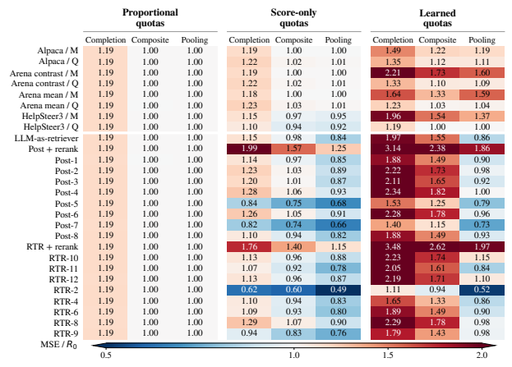
Figure 2 :Learning quotas and reusing labels are separate decisions.MSE relative to the one-stage proportional mean, using the same pilot samples and total budgets within each configuration. M and Q denote Mistral and Qwen. Blue indicates lower MSE. Within each group of three columns, the acquired labels are identical and only the estimator changes.
Original paper · CC BY 4.0 · Yang Liu, Ran Zou, Zhengtao Gui, Chao Xue · Human Evaluation with Automatic Scores: Separating Sampling and Estimation Gains · Original paper figure · Extracted the figure area from page 15 of the original PDF.Why a fair reference matters
A score-based method has to beat a simpler design that already uses the same scores before its extra machinery earns a place. An evaluation team can score every model response automatically, but human labels remain the scarce resource. Prior work offers several answers: prediction-powered correction, fitted weights, nonlinear calibration, and active or adaptive acquisition.
Each of these adds fitting or adaptation, so the authors ask whether it helps beyond a simpler design that already uses the same scores.
This stratified human mean needs neither a fitted correction nor a pilot, so it isolates what the extra steps add.
If the pilot outcomes both choose the next labels and get reused in the estimate, pooling all acquired labels can introduce bias. A favorable result for the whole procedure therefore doesn't show which component produced the gain. The authors hold the estimator fixed when changing quotas and hold the acquired labels fixed when changing estimators.
The authors apply these comparisons to released human judgments from AlpacaFarm, Chatbot Arena, and HelpSteer3, together with 19 AQA systems. Each replay reveals only the human outcomes that a procedure requests, so a team pays only for the labels it asks for.
The stratified human mean as the baseline
The stratified human mean groups items by automatic score and samples labels inside each group, so scores shape the sample before any estimate is formed. Within each natural group, items are partitioned by automatic score, and the strata are indexed across all groups as U1 to UH. The total label budget L is split into quotas nh that are fixed before any human outcome is observed.
Inside each stratum, the method draws a simple random sample without replacement, independently across strata, and computes the sampled human average. This design needs neither a fitted correction nor a pilot, which is why the authors treat it as the reference procedure.
The estimator weights each stratum mean by its population share, with a_h equal to N_h divided by N, giving the pool estimate as the sum of a_h times the sampled average. The two weighting levels collapse to one stratum weight, because (N_g/N)(N_h/N_g) equals N_h/N. Each sampled average is unbiased for its full-stratum human average, so the estimator is unbiased for the pool mean under the fixed sampling design.
The population weights hold even when some strata receive a disproportionate share of the label budget. Automatic scores therefore act only through the sampling design, while the estimate itself uses only acquired human outcomes. For the Arena contrast, the same construction uses signed weights, so the estimate becomes a difference between two group means.
Performance is measured by MSE relative to a reference that uses score stratification, proportional allocation, and this stratified mean. The original-group mean, which ignores score bins, is kept as a separate comparator to show what introducing score strata adds. Randomly reassigning scores within groups, or setting all scores to a constant, brings the stratified mean's MSE close to the original-group mean's MSE across 100 repetitions per configuration.
That result attributes the sampling gain to how scores separate items with different human outcomes. Within the ten-bin stratified setting, the local oracle correction reduces MSE by 1.00 to 3.48% on preference configurations, which is small relative to the same-quota mean. Shared Ridge stays near the reference, with MSE ratios of 1.001 to 1.005 on preferences.
How much correction and allocation add after stratification
The score-corrected estimator adds a term built from the gap between the full-stratum score mean and the sampled score mean, scaled by a coefficient b_h. Setting b_h to 0 recovers the stratified human mean, while b_h equal to 1 gives fixed prediction-error correction. The oracle picks the best fixed coefficients from the complete pool, so it uses retrospective outcomes that no deployed procedure can see.
Its risk gap from the stratified mean measures the MSE reduction that linear correction could still offer after stratification. Shared Ridge stays close to the reference, with MSE ratios of 1.001 to 1.005 on preferences and 0.975 to 1.004 on AQA.
The authors also tested nonlinear calibration, using LinearCal, MonoSpline, and IsoCal within each natural group. Varying the partition at the same total budget tests whether calibration depends on how much information the stratification already captures. Coarser partitions leave more room for correction, which means stratification and correction draw on overlapping information.
Unequal allocation asks a different question, namely where human outcomes vary. It can give larger gains in some pools, but it can also increase error when confident predictions send too few labels to strata with substantial human variation. Softening the judge probabilities with T = 2 reduced MSE in 20 configurations and moved quotas closer to proportional allocation in 25.
Sharpening with T = 0.5 increased MSE in 26 of 27 configurations.
Pilot estimators and learned quotas
A paid pilot first fixes a proportional sample of P labels, and the remaining budget then sets the final quotas. Three estimators then combine the same acquired labels: Completion, Composite, and Pooling. Completion stays conditionally unbiased under adaptive quotas, because the final sample is uniform within the remainder after the pilot.
Composite uses fixed weights set before pilot outcomes are seen, so it keeps unbiasedness while still reusing the pilot mean. Pooling gives every acquired label equal weight within its stratum, but pilot outcomes can change the final quotas and so their own weight. Completion has about 19% higher MSE than the matched proportional control at the primary budget.
Composite and Pooling recover the one-stage stratified mean exactly in that matched control.
The learned rule estimates within-stratum variability from pilot residuals, using the sample standard deviation of yi minus si. Taking the square root of that variance moderates allocation differences driven by a small pilot. The score-only rule instead uses the working variance from Equation (8) and needs no human labels beyond the pilot.
Shrinking learned quotas halfway toward score-only quotas and then pooling lowers pooled MSE for 17 of 19 AQA systems relative to the score-only procedure. Pooling can pick up bias once pilot outcomes set the final quotas, which is why its coverage is checked separately.
Pooling's pooled 95% intervals cover only 88.09 to 93.54% on AQA, so point gains do not carry over to intervals.
Ranking and interval checks: lower MSE is not enough
Working quotas lower mean-estimation MSE for 13 of the 19 AQA systems at 250 labels per system. Their best-system selection is still lower, at 97.21%, compared with 99.07% for the proportional mean. Thus, improving the individual MSEs of most systems doesn't establish an advantage for model selection.
The selection gap also depends on the label budget, with the systems and their full-pool human means held fixed. At 100 labels per system, working quotas pick the wrong winner in 14.21% of replays, versus 10.10% for proportional quotas. The increase is 4.11 percentage points, with a paired MCSE of 0.26 percentage points. At 350 labels, the error rates fall to 0.74% for working quotas and 0.16% for proportional quotas.
Both designs look highly accurate at that budget, though their errors differ clearly when labels are scarcer.
Ranking depends on the covariance between system estimates, not only on their individual variances. Score-only quotas with Pooling reduce MSE for 17 of the 19 systems, and they cut inverted pairs from 6.68% to 6.41%. Yet their best-system selection falls from 99.07% to 98.67%.
For intervals, the first check uses learned quotas with Composite at 250 labels per AQA system. Its point estimate and variance estimate are both unbiased, but coverage is only 84.97–92.99% across the 19 systems. Replacing each sample-based variance with a fixed reference variance raises coverage to 93.97–95.20%. Composite's variance estimates average 0.993–1.009 times the reference, but their medians are only 0.548–0.751 times it.
Unbiasedness of the variance estimate therefore doesn't ensure reliable coverage. Pooling's ordinary normal intervals cover only 75.24–91.22% across AQA, so its bias also matters for coverage.
Limits of the evidence
The oracle figures rest on complete human outcomes that are used after the fact, so they bound what a fixed linear correction could do. The authors don't present the oracle as a deployable estimator, since the best coefficients depend on the complete human annotations.
The experiments cover three preference datasets scored by Mistral and Qwen, together with 19 AQA systems scored by AutoAIS. Each replay reveals only the human outcomes that a procedure requests, so the results describe these pools rather than arbitrary evaluation sets. The five-bin result that lowers human-mean MSE is reported for one setting, HelpSteer3 with Qwen at 100 labels.
The paper's tables cover the primary budget, so the conclusions for other budgets rest on the separate budget checks.
Ordinary pooled 95% intervals for the shrinkage procedure cover only 88.09 to 93.54% of the time. The reference variance that raises coverage uses complete pool outcomes, so it is unavailable at deployment and serves only to diagnose the failure. Don't read the coverage gain as a deployable fix, because the fixed reference variance requires the human outcomes the procedure is meant to estimate.
Ranking results show that lower individual MSE doesn't guarantee better system selection on the AQA leaderboard.
Paper info
- Authors
- Yang Liu, Ran Zou, Zhengtao Gui, Chao Xue
- Venue
- arXiv · Preprint
- First published
- 2026-10-28
- Added
- 2026-11-1
- Updated
- 2026-10-28
- Version
- v1
- arXiv
- 2610.38282
- Category
- cs.CL
- Original paper terms
- CC BY 4.0
- What we show
- Paper info, commentary and permitted figures from the original paper
AI commentary is a separate explanation from the original paper and may contain errors. The original paper and figures follow each source's terms of use and any rights noted separately.
Abstract
Automatic judges offer inexpensive information about model outputs, but an evaluation team must decide how to turn that information into fewer human annotations. Scores can guide sampling, correct an estimate, or support adaptive acquisition, and these uses may capture overlapping gains. We compare their incremental value on fixed evaluation pools from three preference datasets, and 19 attributed-question-answering systems. Matched comparisons use the same scores, account for pilot labels and budget rules, and separate acquisition from estimation. Score stratification is a strong reference: after ten-bin stratification, the best fixed local linear correction offers only 1.00--5.27% further MSE reduction in the primary configurations. Unequal allocation offers larger gains in some pools, but can increase error when confident scores conceal variable human outcomes. Comparison on AttributedQA, shrinking learned quotas toward score-only quotas lowers pooled MSE for 17 of 19 systems relative to the score-only procedure, but ordinary pooled 95% intervals cover only 88.09--93.54%. The same shrinkage improves on the score-only reference in only one of eight preference configurations. Ranking experiments further show that lower individual MSE need not improve system selection. These findings support a simple starting procedure, proportional sampling within score strata followed by a stratified human mean, and identify what additional evidence is needed to justify correction or adaptation for the intended evaluation output.
Figures from the paper
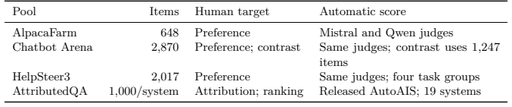
Table 1 : Primary evaluation pools. Preference scores average both response orders. One acquired label reveals one released outcome, which can aggregate several human judgments. Appendix A specifies annotation units; Appendix H reports scoring resources and cost definitions.
Original paper · CC BY 4.0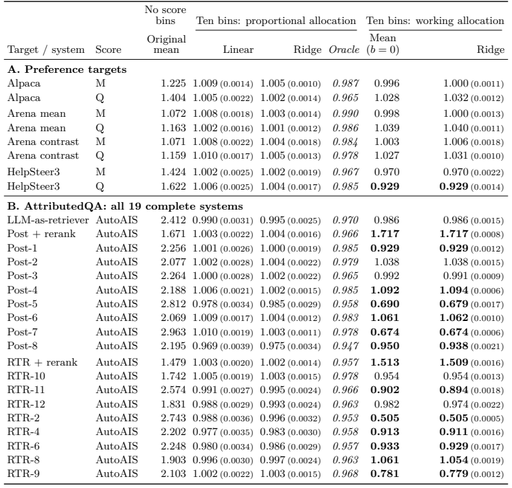
Table 2 :Separating gains from stratification, correction, and allocation.Primary-budget MSE divided by the matching ten-bin proportional-mean risk (reference1; lower is better).Meansetsbh = 0: scores guide sampling, while estimation uses weighted human averages without correction. Parentheses give one MCSE from 10,000 paired draws; means and oracles are exact. Among ten-bin non-oracle columns,bold marks displayed ratios≤ 0.95or ≥ 1.05, highlighting improvement and deterioration.Italicsidentify the full-label oracle. M/Q denote Mistral/Qwen; AQA uses AutoAIS.
Original paper · CC BY 4.0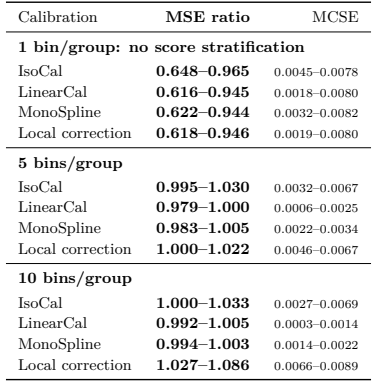
Table 3 :Calibration gains depend on how finely scores are stratified.Results for all eight preference configurations at the primary budget. Each block uses its own matching proportional stratified mean as the MSE reference1; lower is better. Entries are ranges across configurations; MSE ranges are bold throughout. MCSE gives the range of Monte Carlo standard errors for the MSE ratios.
Original paper · CC BY 4.0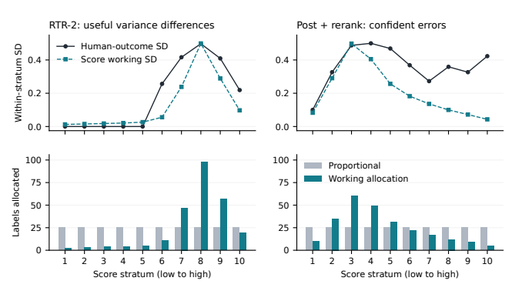
Figure 1 :Score-based uncertainty helps when it tracks human variation.Two AQA systems at
Original paper · CC BY 4.0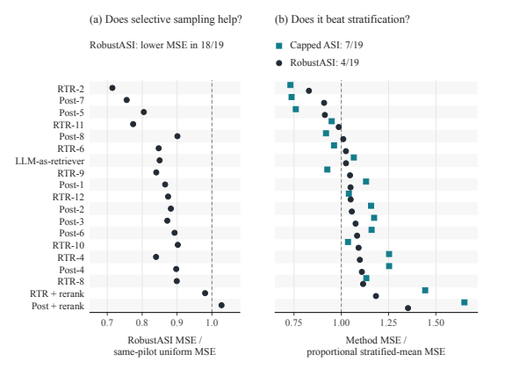
Figure 3 :The reference changes the apparent benefit of active acquisition.AQA at nominal budget L = 250. (a) RobustASI relative to its same-pilot uniform control; (b) capped ASI and RobustASI relative to the proportional ten-stratum human mean. Ratios below one favor the active method. Counts use point estimates; Monte Carlo standard errors are reported in Table 11.
Original paper · CC BY 4.0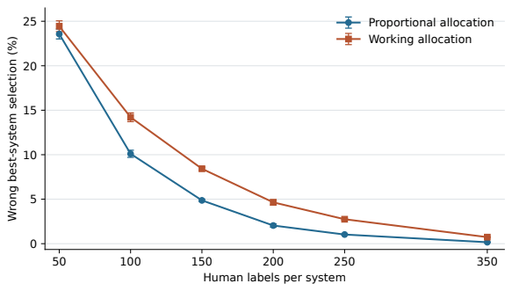
Figure 4 :The label budget changes how clearly selection errors differ.Probability of selecting the wrong best system among 19 AQA systems. Proportional and working quotas use the same stratified-mean estimator and the same score strata for each system. Each system receives exactlyL labels, for19L per leaderboard. Samples use the shared question ordering described in the text. Error bars are±2Monte Carlo standard errors.
Original paper · CC BY 4.0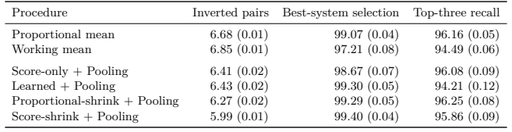
Table 5 : AQA ranking at 250 labels per system. Entries are percentages, with MCSE in parentheses. Lower inverted-pair rates and higher selection and recall rates are better. All rows use the same joint replay with shared question orderings. The last two rows shrink learned final quotas halfway toward proportional or score-only quotas, respectively, and use Pooling.
Original paper · CC BY 4.0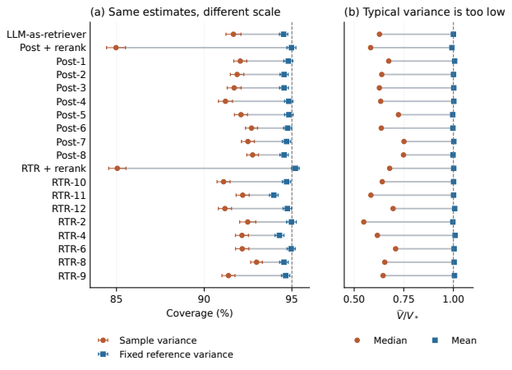
Figure 5 :An accurate average variance can hide unreliable interval widths.Learned quotas with Composite on the 19 AQA systems. Left: coverage of the same point estimates using either sample-based variance or a fixed reference variance; bars are±1.96MCSE. Right: the mean and median sample variance relative to the reference. The reference uses complete pool outcomes to diagnose the source of undercoverage.
Original paper · CC BY 4.0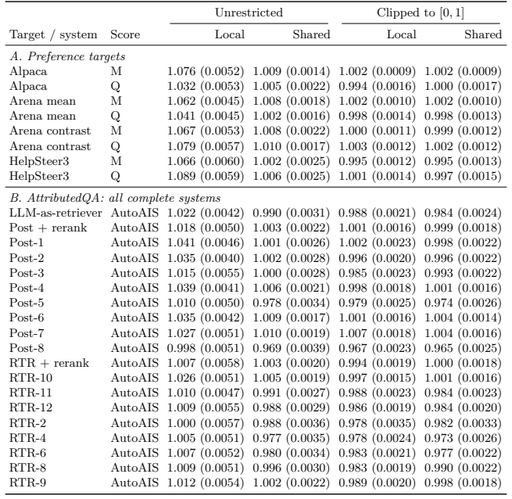
Table 6 : Coefficient sharing and clipping at the primary budgets, using ten score bins per natural group and proportional quotas. Entries are MSE divided byR0, the risk of the matching stratified human mean; lower is better. Parentheses give one Monte Carlo standard error from 10,000 paired draws. Local fits estimate one coefficient per stratum; Shared fits estimate one coefficient per natural group. M/Q denote Mistral/Qwen; AQA uses AutoAIS. The Shared column reproduces the proportional-allocation Linear results in the main table.
Original paper · CC BY 4.0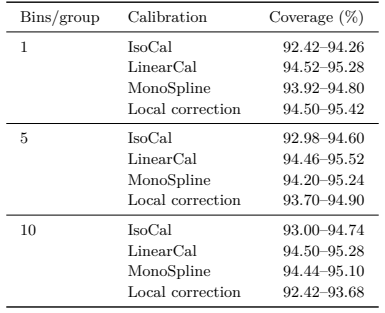
Table 7 : Coverage of nominal 95% residual normal intervals for the calibration comparison. Each entry gives the range of empirical coverage across the eight preference configurations at the primary budget. The corresponding point-estimation results appear in Table 3.
Original paper · CC BY 4.0
Table 8 : Temperature sensitivity across the 27 primary configurations. Entries count decreases relative to T= 1. Configurations share data and are descriptive comparisons, not independent replications.
Original paper · CC BY 4.0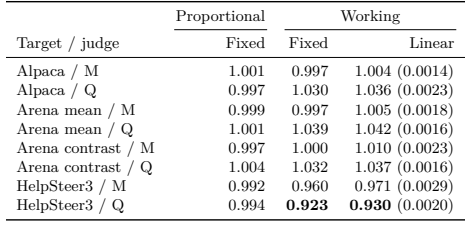
Table 9 : Additional correction–allocation comparisons. Every entry is MSE divided by the matching proportional stratified-mean riskR0. Fixed correction setsbh = 1; Linear fits a group-shared coefficient. Parentheses give one MCSE. Mean and Ridge results are reported in the main table. Bold marks ratios outside[0.95,1.05]. M/Q denote Mistral/Qwen.
Original paper · CC BY 4.0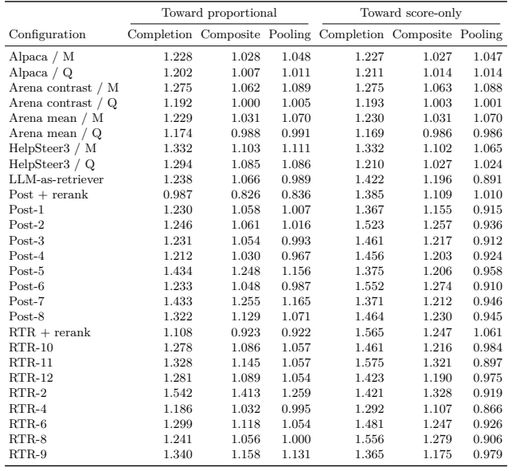
Table 10 : Shrinkage results for all 27 primary configurations. Every ratio uses the MSE of score-only quotas with Pooling as its denominator. Columns compare the three label-reuse estimators under each shrinkage rule. All procedures use the same pilot samples and total label budget within a configuration.
Original paper · CC BY 4.0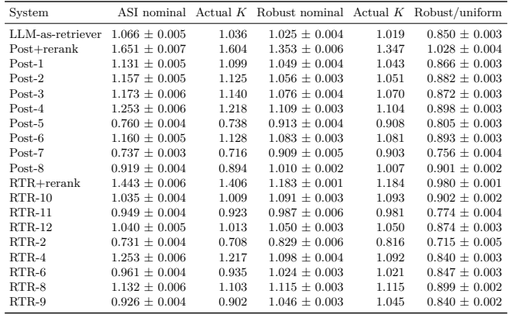
Table 11 : AQA active comparisons. Nominal ratios useRprop(L); actual-K ratios use EK[Rprop(K)]. The last column uses the same-pilot uniform control. Reported errors are one MCSE.
Original paper · CC BY 4.0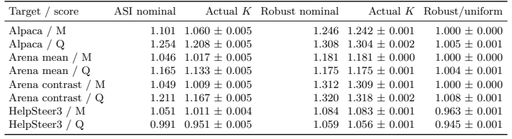
Table 12 : Preference comparisons with original groups respected. Denominators match Table 11; M/Q denote Mistral/Qwen. Errors are one MCSE. RobustASI MSE includes zero-support residual bias.
Original paper · CC BY 4.0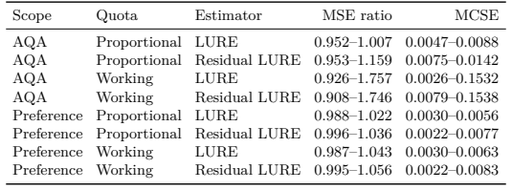
Table 13 : Fixed-budget active-testing controls. MSE and its MCSE both use the same-quota uniform mean as reference. Working stratum quotas and within-stratum second-moment proposals follow the annotation- specific model.
Original paper · CC BY 4.0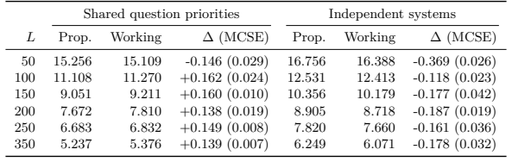
Table 14 : AQA pairwise inversion rates under both joint sampling designs. Rates are percentages;∆is working minus proportional in percentage points, with paired MCSE in parentheses. Lower inversion is better. A ranking costs19Lsystem–question labels.
Original paper · CC BY 4.0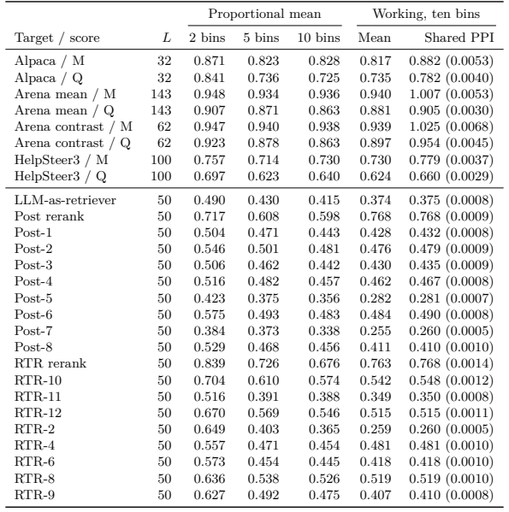
Table 15 : Five-percent budgets: every entry is MSE divided by the exact original-group proportional-mean MSE at the sameL =⌊0.05N⌋. This single denominator permits comparisons across partitions. The first three numeric risk columns use proportional means; the last two use ten-bin working quotas with a mean or group-shared PPI fit. Mean risks are exact. Parentheses give PPI MCSEs; preference fits use 10,000 draws and AQA fits use 20,000. Working quotas use the annotation-specific model. M/Q denote Mistral/Qwen, both using order-averaged scores. Rerank denotes AutoAIS reranking.
Original paper · CC BY 4.0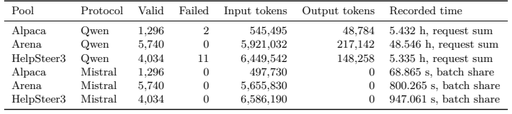
Table 16 : Recorded resources for the both-order preference scores. Input counts exclude unobserved failed-call tokens and, for Mistral, batch padding. Zero Mistral output tokens reflects forward-only likelihood scoring. Times have the measurement units shown and should not be summed as a common hardware-cost quantity.
Original paper · CC BY 4.0Quote from the paper
Yang Liu, Ran Zou, Zhengtao Gui, Chao Xue (2026). Human Evaluation with Automatic Scores: Separating Sampling and Estimation Gains. arXiv:2610.38282v1. https://arxiv.org/abs/2610.38282v1
BibTeX
@misc{liu2026human,
  title = {{Human Evaluation with Automatic Scores: Separating Sampling and Estimation Gains}},
  author = {Yang Liu and Ran Zou and Zhengtao Gui and Chao Xue},
  year = {2026},
  eprint = {2610.38282},
  archivePrefix = {arXiv},
  url = {https://arxiv.org/abs/2610.38282v1}
}