Paper commentary
AgentSSL: Can MLE Agents Leverage Unlabeled Data?
- Problem Existing MLE agents are tuned for settings with plenty of labels, while many scientific and medical tasks have few labels and a large unlabeled pool. Semi-supervised methods need design choices that cannot be checked reliably without labels.
- Method Frames SSL as a search over executable programs. An LLM agent drafts, debugs, improves and analyzes candidate programs under noisy validation or unsupervised feedback, and a final program is then chosen by unsupervised metrics or active model selection.
- Results The best agent program beats the best human SSL baseline in 8 of 12 dataset and shot settings, by up to +21.81 on Retinopathy with 40 shots under oracle test performance.
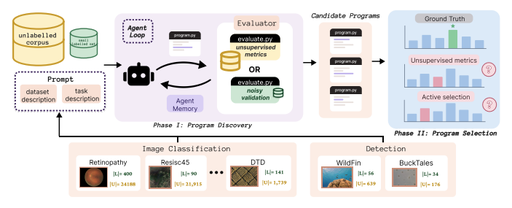
Figure 2 :Overview of AgentSSL. Given a small labeled set and a larger unlabeled corpus, an LLM-based agent generates SSL programs that are evaluated using either unsupervised SSL metrics or noisy validation feedback, with the resulting fitness score guiding iterative refinement. Following search, we must select the best program either using unsupervised metrics or active model selection. We evaluate AgentSSL on both image classification SSL benchmarks and real-world ecological detection tasks.
Original paper · CC BY 4.0 · Ethan Lin, Akanksha Sarkar, Ziang Liu, Kristin Branson, Jennifer J. Sun · AgentSSL: Can MLE Agents Leverage Unlabeled Data? · Original paper figure · Extracted the figure area from page 4 of the original PDF.Why SSL needs program search
Most MLE agent benchmarks assume that labeled data is abundant, so the search over programs is tuned to that assumption. In fields such as ecology, medicine and scientific discovery, the labeled set is small and the unlabeled corpus is large, which is the regime semi-supervised learning is built for.
SSL methods depend on how well the data fits their assumptions, such as cluster structure or consistency under augmentation, so each method usually needs dataset-specific tuning. Deploying SSL is therefore a search over a large design space of label propagation, pseudo-labeling and consistency methods, and that search itself needs a reliable way to judge candidates.
AgentSSL combines these two strands by treating the domain-specific use of SSL as a program search problem. The problem then has two parts: discovering effective programs when feedback is limited, and selecting one program from the discovered pool when no large labeled validation set exists.
How the agent searches over SSL programs
A candidate solution is a program A that takes the labeled set L and the unlabeled set U and returns a predictor h. Deep SSL methods fit this definition because they learn the parameters of a network from both L and U, and graph-based or transductive methods fit it as well.
The search is kept as a directed graph whose nodes are candidate programs and whose edges record which program was transformed into which.
A search is specified by the tuple \((F, \pi_{sel}, O, \pi_{op}, M)\), covering the fitness function, the node selection policy, the transformation operators, the operator selection policy and the language model. The operator set is Draft, Debug, Improve and Analyze, and the greedy, MCTS and evolutionary strategies differ in how they choose the nodes to expand.
The agent receives the task description together with L and U, and writes executable programs that map these inputs to a predictor. Each candidate runs in an isolated Apptainer environment under a user-defined fitness evaluation, and the execution logs, errors and fitness scores return to the agent as feedback for the next step.
Choosing a program without labels
The target is the program in the pool that maximizes Q(A), the test performance of the predictor it produces. Since Q(A) is unknown in practice, selection relies either on unsupervised metrics computed on an unlabeled validation set or on active model selection, which spends a limited label budget.
Selection regret is the oracle value minus the test performance of the program a method picks, so a smaller regret means the method picks a stronger program.
Noisy validation holds out a small labeled subset for evaluation, and its k-fold form lowers variance at the cost of longer evaluation times. The unsupervised fitness is the mean of eight normalized label-free metrics, including AMI, ARI, V-measure, FMI, Silhouette Score, RankMe, BNM and SND.
Datasets, baselines and search budgets
The experiments use six VTAB-based image classification datasets: DTD, SUN397, RESISC45, Retinopathy, CLEVR-Count and KITTI. Each dataset has two class-balanced shot settings, for example DTD with 3 and 6 shots, and three random splits are generated for each dataset and shot setting.
Six baselines are used: Supervised, FixMatch, SoftMatch, FineSSL, PET and V-PET, all run with CLIP ViT-B-16 and DINOv2-B backbones fine-tuned with LoRA. Agents are limited to the same two backbones and the same parameter-efficient fine-tuning library, and each search starts from a supervised warm-start program.
Two feedback metrics are tested: Unsupervised (U) and Noisy-validation (N), with a greedy search policy. Search runs last 8 hours on DTD, RESISC45 and KITTI and 15 hours on the larger datasets. Every program is evaluated on all three splits, and the best program is the one with the highest average across them.
Across 6 datasets, 2 shot settings and 3 seeds, the agent runs total 2,484 GPU hours for the two feedback settings combined. The baseline sweep totals 7,628.7 GPU-hours, so the baselines cost far more compute than the agent searches.
Oracle performance against human SSL baselines
Across the 12 dataset and shot columns of Table 1, the best agent program is ahead of the best human baseline in 8 of 12 settings. The differences run from −13.92 to +21.81.
The largest gain is +21.81, on Retinopathy with 40 shots. The losses sit on SUN397 with 3 shots (−0.54), SUN397 with 6 shots (−0.93), RESISC45 with 2 shots (−5.95) and CLEVR-Count with 20 shots (−13.92).
These are oracle numbers, so they assume the best program in each pool is known, which is a condition selection cannot meet in practice.
Selection regret with the feedback metric
Table 2 gives the regret when the program is picked from a single agent trajectory using its feedback metric.
The table prints these regrets with minus signs, and the text treats them as selection regret. Where the feedback metric tracks test accuracy, most of the oracle performance is kept, and where it does not, selection loses a lot.
The authors therefore treat practical program selection as a bottleneck for both the agent and the human pipelines, not only for the agent.
Spending labels on selection instead of training
The comparison pits 100% of the labels for training with unsupervised selection (0%) against a 50% training and 50% active selection split. Active selection methods include ActiveTesting, VMA, CODA, ModelSelector and IID.
On Retinopathy the gain is +25.59 for ActiveTesting, +26.07 for VMA and IID, +21.22 for CODA and +18.70 for ModelSelector. On DTD the same split costs −2.35 for ActiveTesting and −4.71 for IID, which shows the trade-off runs in both directions.
IID, ActiveTesting and VMA have much higher seed-to-seed variation than CODA, which is deterministic, and ModelSelector. Table 9 gives simple regret values of 3.80 for IID, 4.14 for ActiveTesting, 4.78 for VMA, 0.00 for CODA and 1.73 for ModelSelector.
CODA and ModelSelector reach zero regret with fewer than 25 labels on the Retinopathy 40-shot noisy validation task. After 40 labels, however, they suddenly pick a program with 30% worse accuracy, so faster convergence does not guarantee a stable choice.
When feedback misleads the search
The authors state that both unsupervised and noisy validation feedback can be negatively correlated with test accuracy on KITTI and Retinopathy.
On DTD, RESISC45 and SUN397 the coefficients are high, for example 0.77 for DTD and 0.89 for RESISC45 under the unsupervised metric.
Unsupervised metrics encode assumptions about what a good model looks like, and several of them measure learned representations. If the agent reuses one frozen representation with different downstream SSL procedures, representation-based metrics cannot separate those programs, even when their accuracy differs a lot.
Does the discovered program use unlabeled data?
The top AgentSSL program is fixed, the labeled set is held fixed, and only the size of the unlabeled corpus varies at evaluation time. The unlabeled sizes shown are 1 img, 10%, 50% and 100%, on DTD with k=3, KITTI with k=5 and RESISC45 with k=2.
Accuracy generally rises as more unlabeled data becomes available. The authors take this to mean that the discovered programs rely on structure in the unlabeled data itself, though the test covers only the top program on those three dataset settings.
Which SSL strategies the programs combine
An LLM-as-judge pipeline sorts each generated program into SSL categories, using six classical groups and four modern deep SSL groups. The manual check of the LLM-as-judge output is reported as part of the analysis.
Programs draw on a broad set of SSL paradigms, and many combine several strategies within one program. The frequency of each strategy differs across datasets and search strategies, but mixed exploration appears in every setting.
The authors suggest that future systems could use discovered programs as complementary pseudolabel generators, not only as search candidates.
LLM backbone and search strategy
GPT-5.4 and Gemini-3.1 are compared as program generators with accuracy (A) and diversity (D) on DTD with k=6, RESISC45 with k=2 and KITTI with k=5. On DTD, GPT-5.4 gives A 0.72 and D 0.37, while Gemini-3.1 gives A 0.71 and D 0.46.
Gemini-3.1 gives higher diversity on all three datasets, while GPT-5.4 is slightly higher on accuracy. Accuracies are comparable, so the model choice mostly changes which SSL solutions get explored.
On DTD, KITTI and RESISC45, greedy, MCTS and evolutionary search reach similar accuracy ranges but differ in diversity. Evolutionary search gives the highest diversity, with D 0.66 on DTD against 0.37 for greedy, and MCTS lies between the two.
Transfer of programs across datasets
Figure 5 shows that a program selected on one dataset often transfers poorly to the others, so the strongest programs tend to be specialized to their source domain.
The best Retinopathy program trains no classifier. It improves over the next-best baseline by 19%.
Ecology detection tasks
WildFin and BuckTales are detection tasks for fish and antelope, built from expert-trained detectors, and the agents receive 10% of the WildFin data and 20% of the BuckTales data. Performance is reported as mAP@0.5:0.95, and the ecologist baseline trained on the full training split is the reference.
On WildFin the full-data ecologist baseline is 47.9, and AgentSL and AgentSSL approach it while using 10% of the data. On BuckTales the full-data baseline is 36.2, and both agents stay below it in the figure, while the text reports that they match the low-label expert baseline.
The agents on BuckTales show high variance, and the caption states they underperform the full-data YOLOv8 baseline. Because AgentSL performs about as well as AgentSSL in both domains, the unlabeled data does not always add the most value.
Limitations
SSL is not always preferable to supervised learning, and on both ecology tasks AgentSL matches AgentSSL. Whether to use unlabeled data should be part of the search, so that reliable supervised gains are not traded for uncertain SSL gains.
The search uses AIRA-Dojo as a single controlled framework, so stronger LLMs or harnesses could find better programs than those reported.
The authors expect the selection gap to widen as agents generate more programs, which makes choosing among candidates the main bottleneck. Closing it calls for unsupervised and active selection methods that remain reliable across program families.
ProgramSelectBench
ProgramSelectBench contains 16,977 evaluated program instances from the AgentSSL runs, covering agent-generated programs and human-designed baselines across six classification datasets. It is organized into 35 selection tasks, one for each dataset, shot and evaluation setting in AgentSSL.
Programs trained on different labeled splits count as separate candidates, because training data can change predictions and test accuracy even when the algorithm is the same. Precomputed predictions and unsupervised metrics are released for each candidate, while the intermediate features are not included because they are much larger.
Paper info
- Authors
- Ethan Lin, Akanksha Sarkar, Ziang Liu, Kristin Branson, Jennifer J. Sun
- Venue
- arXiv · Preprint
- First published
- 2026-11-12
- Added
- 2026-11-14
- Updated
- 2026-11-12
- Version
- v1
- arXiv
- 2611.17323
- Category
- cs.AI · cs.LG
- Original paper terms
- CC BY 4.0
- What we show
- Paper info, commentary and permitted figures from the original paper
AI commentary is a separate explanation from the original paper and may contain errors. The original paper and figures follow each source's terms of use and any rights noted separately.
Abstract
Applying machine learning systems to new domains introduces bottlenecks in both labeled data acquisition and manual pipeline engineering. While recent MLE agents show promise in automating pipeline design, they have been studied almost exclusively in fully supervised settings, leaving them untested in realistic regimes where labeled data is scarce but unlabeled data is abundant. In this work, we introduce Agentic Semi-Supervised Learning (AgentSSL), framing SSL as a program search problem and studying how agents navigate this space under limited supervision. We find that even under weak feedback and matched compute, agents can synthesize code that combines and adapts established SSL techniques, exceeding the strongest human-engineered baselines in 8 of 12 settings by up to +21.8%. However, our results identify program selection as a critical bottleneck in AgentSSL, where performance drops by as much as 47% when selecting based on the agent's feedback metric. To systematically study this bottleneck, we introduce ProgramSelectBench, a large-scale benchmark with a combined total of 16,977 agent-generated and human-engineered SSL programs, and evaluate both unsupervised and active program selection methods. We further evaluate AgentSSL on real-world ecology detection tasks, highlighting the opportunities and challenges of transferring agent-discovered strategies beyond controlled benchmarks.
Quote from the paper
Ethan Lin, Akanksha Sarkar, Ziang Liu, Kristin Branson, Jennifer J. Sun (2026). AgentSSL: Can MLE Agents Leverage Unlabeled Data?. arXiv:2611.17323v1. https://arxiv.org/abs/2611.17323v1
BibTeX
@misc{lin2026agentssl,
  title = {{AgentSSL: Can MLE Agents Leverage Unlabeled Data?}},
  author = {Ethan Lin and Akanksha Sarkar and Ziang Liu and Kristin Branson and Jennifer J. Sun},
  year = {2026},
  eprint = {2611.17323},
  archivePrefix = {arXiv},
  url = {https://arxiv.org/abs/2611.17323v1}
}