Paper commentary
NaijaFacts: A Framework for Disentangling Language from Knowledge in Facts about Nigeria
NaijaFacts shows models know far less about Nigerian statistics than US facts
- Problem Translation benchmarks for African languages cannot tell a language failure from a missing fact. A wrong answer in Yoruba could mean the model cannot read Yoruba, or that the fact was never well represented in training data.
- Method NaijaFacts holds each fact fixed while changing the query language and the country asked about. Native speakers wrote 100 statistical questions in five languages, asked about Nigeria, the UK and the US.
- Results In English, accuracy averages 20% on Nigerian statistics against 49–50% for US and UK questions. Across eight models, the knowledge gap dominates the language effect.
Why a language failure looks like a missing fact
A wrong answer in a Nigerian language has two possible causes, and the answer alone doesn't reveal which one applies. The model may be unable to process the language, or the fact may never have been well represented in its training data. Existing multilingual benchmarks for African languages, such as AfriQA, AfroBench, and IrokoBench/AfriMMLU, largely translate generic questions into African languages.
Consider the question of Nigeria's total fertility rate in the 2023. A model that knows the value in English but answers wrongly in Yorùbá shows a language effect. Separating the two requires holding the fact fixed while only the language of the query changes. NaijaFacts does this by asking each question in five languages: English, Nigerian Pidgin, Yorùbá, Igbo, and Hausa.
The authors also vary the country, so a Nigeria-versus-English gap can't be read as a resource effect alone.
Holding the fact fixed across languages and countries
The key idea is to keep each question and its gold answer fixed while changing the language of the query and the country it asks about. NaijaFacts holds 100 factual questions about national demographic and health statistics, each available in English, Nigerian Pidgin, Yorùbá, Igbo and Hausa. Each question is asked about Nigeria, the United Kingdom and the United States, which gives 1,500 graded items per model.
That is what lets the benchmark separate a language effect from a knowledge effect.
Reading down a column shows the language effect at a fixed country, and reading across a row shows country familiarity at a fixed language. The UK and US columns matter because models hold far more knowledge about those countries. A language drop there shows what a language costs when there is knowledge to lose. A control for raw online prominence also sits in this design, since the US-versus-UK gap at fixed language is at most 1 point.
The questions were written natively in Yorùbá, Igbo, Hausa and Nigerian Pidgin by speakers at Obafemi Awolowo University, rather than translated into those languages. The same team then translated each question into English, and the authors reviewed every rendering. For Nigeria, the native speakers also gave the answers, grounded in NPC, NBS and NDHS statistics.
For the UK and US, a deep-research assistant first retrieved the figure from ONS or the U.S. Census Bureau. Then the four native speakers verified and corrected each answer, and retrieving the figure before writing it is meant to limit fabrication. The reference years in the answers span 2006 to 2025.
The answer-in-English condition reuses the same Nigerian-language questions but requests answers in English. Expression is therefore not the bottleneck, since removing translation from the answer does not recover the accuracy.
Extending the recipe to 54 African countries
The 54-country extension reuses the NaijaFacts recipe, but it is English-only and builds one set per African country. Each country gets 118 to 125 verified items, built to a fixed blueprint. Every answer comes from that country's own record, so no answer is borrowed from another country's statistics.
Statistical values come from the World Bank World Development Indicators and the DHS Program APIs, not from a model's transcription. A numeric gold answer therefore can't be hallucinated, and checking it means fetching the value again.
Claude Opus 5 scores 95.8% on culture over 689 items and 97.7% on politics over 642 items. On statistics, the same model reaches only 26.0% across 5,358 items. Aggregate accuracy is 40.1%, or 2,681 of 6,689, but the two easy domains pull that figure up. Per country, accuracy runs from 28.8% for Chad to 58.4% for Morocco, with Nigeria at 36.0%.
Inside the Nigeria set, eleven items about the statistical system score 59.8%, against 8.6% on items from the 2024 NDHS.
Accuracy therefore reflects fewer independent facts than the number of items.
How answers are generated and graded
Eight models are evaluated under one shared harness and one set of identical prompts. Six are frontier models spanning three geopolitical origins (US, EU, CN), and two are Nigeria-adapted open-weight models, N-ATLaS and AfroLlama-V1. Both adapted models are 8B Llama-3 fine-tunes, so they test whether targeted language adaptation helps. Frontier models are reached through AWS Bedrock, while the 8B models run locally on a single 24 GB GPU.
Every run gets the same 4,096-token answer budget, so no model is given more room to answer than another.
Sampling isn't fixed across all models, because Claude Opus 5 rejects an explicit temperature or top-p. The hosted models therefore keep each provider's default sampling setting. The mainline native condition asks each question in the target language and expects the answer in that same language.
Answers are free text, so each one gets light normalisation before grading. An LLM-as-judge, Claude Opus 5, then returns a binary verdict for each answer. On the cross-country sets, the judge also receives per-item grading notes that list accepted variants. Verdicts that stay unresolved are marked unclear and excluded, which removes 9 of 16,000 judgments, under 0.1%.
Language effect against knowledge effect
The language effect is real, and it follows web representation. Across the eight models on average, accuracy drops from English into Yorùbá in web-representation order. In Yorùbá, Claude Opus 5, GPT-5.6 and Grok 4.6 give up 14–35% of their English score. Qwen3, Kimi K2.5 and Mistral Large 3 shed 67–88%, which leaves them at 2–5% absolute.
The knowledge effect is much bigger. In English, the best model reaches only 29% on Nigerian statistics. Averaged over models, the English gap between the US/UK and Nigeria is 30 points, over three times the largest language effect on the Nigeria set. The authors treat most Nigerian failures as facts missing in every language, rather than translation slips.
Answering in English changes accuracy by at most 1.9 points across the four Nigerian languages.
The two Nigeria-adapted 8B models score 6–15% for N-ATLaS and 0–11% for AfroLlama-V1. Adaptation to the languages therefore doesn't supply Nigerian facts. N-ATLaS scores 6% in Igbo and 12% in Hausa, though its card reports roughly 200,000 Igbo instruction samples. Equal adaptation data didn't produce equal factual recall, so the authors expect closing the gap to need frontier scale or explicit injection of African knowledge.
US-built models average 28.3% in English on the Nigerian set, against 17.0% for EU models and 16.5% for CN models. The three US-built models score +1, −8 and +7 points on the US set relative to the UK set, so a home-country advantage doesn't appear.
Country against language in the matrix
The country axis dominates the matrix even after the query language changes, because the columns separate far more than the rows do. Averaged over all eight models, the country columns separate far more than the language rows do. The weakest cell is Yorùbá asked about Nigeria, at 11.2%, where both effects compound. The deficit is 30 points in English and 27 in Pidgin, narrowing to 20 to 21 in Hausa and Igbo and 16 in Yorùbá.
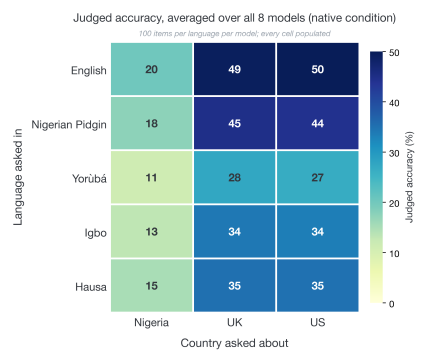
Figure 2 : Country×language judged accuracy, averaged over all eight models (native condition). Columns (country asked about) separate far more than rows (language asked in): the knowledge effect dominates. The worst cell is Yorùbá×Nigeria, where both effects compound.
Original paper · CC BY 4.0 · Zainab Afolabi, Nikita Kozodoi, Jack Butler, Babs Khalidson · NaijaFacts: A Framework for Disentangling Language from Knowledge in Facts about Nigeria · Original paper figure · Extracted the figure area from page 6 of the original PDF.Read down the columns, the English-to-Yorùbá drop is 9 points on Nigeria but 22 to 24 points on the UK and US sets. Averaged over models in English, the gap between the US/UK sets and the Nigerian set is 30 points.
Pure country prominence, by contrast, is near zero, since the US-versus-UK gap at fixed language is at most 1 point in any language. The US-versus-UK comparison serves as the control for raw online prominence, and it shows 50.2 against 49.2 in English. In Yorùbá the same comparison gives 26.6 against 27.5. Online prominence therefore cannot produce the 30-point Nigeria deficit, and how well the models know the country does.
Why the language effect follows web text
Per-language accuracy on the Nigeria statistics set falls from English to Yorùbá in the same order as each language's web representation. The authors use Wikipedia article counts as the proxy for web text, and Figure 3 plots accuracy against that count for each country set. Pidgin is the exception, because it has about 1.6k articles yet costs the least.
Averaged over models, the ordering English>Pidgin>Hausa>Igbo>Yorùbá holds on all three country sets.
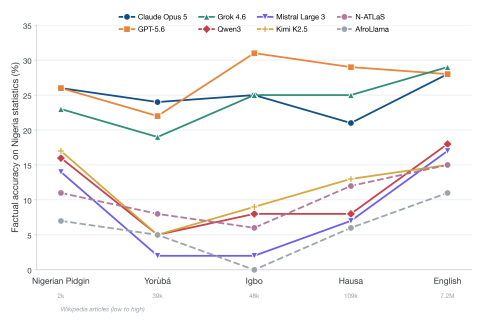
Figure 3 : Model-averaged judged accuracy per query language against the language’s web repre- sentation (Wikipedia articles, log scale), for each country set. Accuracy rises with representation; Pidgin sits far above the trend for its article count, consistent with its legibility through English.
Original paper · CC BY 4.0The size of the language drop depends on how much knowledge the model has to lose. Language degrades the retrieval of knowledge a model has, so it can't subtract knowledge the model lacks. Figure 7 breaks this down per model, and the gaps are measured where the models hold the knowledge.
Capability decides how much UK and US knowledge survives a Nigerian query language. Claude Opus 5 and GPT-5.6 keep nearly all of that knowledge, while Qwen3 and Mistral Large 3 keep about a third. Per country, that continental statistics pattern ranges from 28.8% in Chad to 58.4% in Morocco. Nigeria sits below the middle at 36.0%, so the deficit is continental rather than specific to Nigeria.
Answering in English doesn't recover Nigerian facts
The test asks whether a model that fails in Yorùbá could pass if it were allowed to answer in English. The authors reran the full Nigeria set with each question still asked in its Nigerian language, but with the answer requested in English. Expression failure would predict that this change recovers the accuracy lost in the native condition.
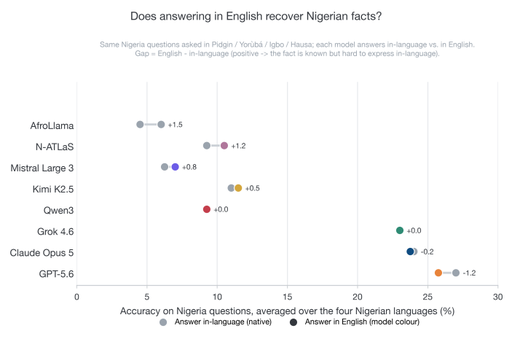
Figure 6 : Answering in English does not recover Nigerian facts. For each model, accuracy on Nigeria questions averaged over the four Nigerian languages when answering in-language (grey) versus in English (colour). The gaps are within±2points for every model: failures reflect missing knowledge, not an inability to express the answer in-language.
Original paper · CC BY 4.0The effect is negligible, so the answer language is not the limiting factor for these questions. It isn't merely unable to say the fact in Yorùbá. Figure 6 compares the two conditions for each model, so the per-model picture is visible there.
Whether the statistics deficit holds across Africa
Its domain split is large: it scores 95.8% on culture over 689 items and 97.7% on politics over 642 items. On statistics, the same model drops to 26.0% over 5,358 items, so the gap is far larger than in the culture and politics subsets. Frontier models hold salient, narrative facts such as capitals, leaders and landmarks, which is why a benchmark built only from such facts would suggest models know Africa well.
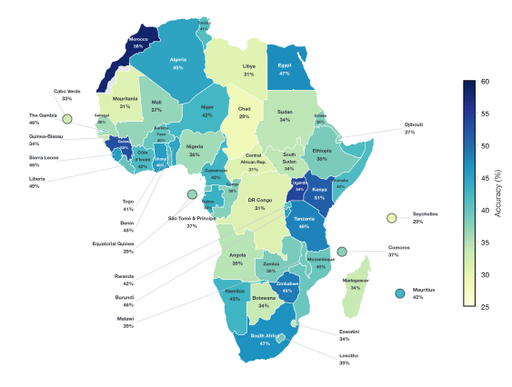
Figure 4 : Judged accuracy of Claude Opus 5 on country-grounded English questions across all 54 African countries (118–125 items each), spanning 28.8% (Chad) to 58.4% (Morocco), mean 40.1%.
Original paper · CC BY 4.0Aggregate accuracy is 40.1% over 6,689 items, which is 2,681 correct answers. Statistics make up most of the set, so the aggregate sits close to the statistics figure, pulled up by the two small, easy domains. Per country accuracy ranges from 28.8% for Chad to 58.4% for Morocco. Nigeria sits below the middle at 36.0%, and it scores above the 28% of the Section 5 Nigeria set only because the broader set mixes in the two easy domains.
The deficit is therefore continental rather than specific to Nigeria.
Items drawn from the 2024 NDHS score 8.6%, so the same split appears within one country. Items about the 2006 census score 9.2%, which is no better than the 2024 items. The authors read this as evidence that a stale training cut-off doesn't explain the deficit.
The UK and US sets still beat every African country on comparable facts, so the geographic part survives after the numeric part is accounted for. The authors attribute the deficit to the form of the statistics: they sit in PDF report tables, while pretraining corpora are dominated by running prose. That account predicts that retrieval over authoritative tables would help more than additional pretraining, and the authors didn't test this prediction here.
What the results do not establish
The Nigeria set holds only 100 items per language, so each language rests on a small sample. Most of its Nigerian items come from one source, since 81 of them come from one survey report. That means the set has fewer independent facts than items, because a model that memorised one table can answer many items at once. The 26 US items also come from one NCHS report, so the US comparison has the same concentration.
The 54-country extension is English-only, and Claude Opus 5 was the only model run on it. The Nigeria set probes grounded statistical knowledge, so it says little about broad knowledge of Nigeria. The eleven Nigerian items about the statistical system have non-numeric answers, so salience and answer type can't be separated.
Official statistics are public, so contamination can't be ruled out. The authors argue that the tables are poorly absorbed, which explains low accuracy, but they don't test contamination directly. Unresolved verdicts were marked unclear and excluded, which removed 9 of 16,000 judgments.
They didn't test retrieval over authoritative tables, although the authors predict it is the fix that works. The Nigeria-adapted 8B models are compared with frontier models of far larger size, so adaptation and scale aren't separated. Injecting statistical tables during training is left as a next step, so its effect on the gap is unknown.
Paper info
- Authors
- Zainab Afolabi, Nikita Kozodoi, Jack Butler, Babs Khalidson
- Venue
- arXiv · Preprint
- First published
- 2026-11-4
- Added
- 2026-11-6
- Updated
- 2026-11-4
- Version
- v1
- arXiv
- 2611.06504
- Category
- cs.CL · cs.AI · cs.LG
- Original paper terms
- CC BY 4.0
- What we show
- Paper info, commentary and permitted figures from the original paper
AI commentary is a separate explanation from the original paper and may contain errors. The original paper and figures follow each source's terms of use and any rights noted separately.
Abstract
Multilingual benchmarks for African languages mostly translate generic questions into local languages, measuring linguistic competence but not whether models know facts about Africa. We introduce \naija, a benchmark of factual and statistical questions about Nigeria, authored by native speakers and grounded in authoritative official statistics, with every question available in English, Nigerian Pidgin, \yoruba, Igbo, and Hausa. Answering similar questions for the UK and US yields a country by language matrix that disentangles a language effect (the model knows the fact but degrades in a low-resource language) from a knowledge effect (the fact is absent in every language). Across eight frontier and Nigeria-adapted models, the knowledge effect dominates: English-query accuracy is 49--50\% for the US/UK but 20\% for Nigeria. The language effect is smaller and tracks web representation, degrading from English to \yoruba{} (9 points on Nigeria, up to 24 on US/UK questions). We find scale does not help: the strongest models reach 66--79\% on the UK and the US but none exceed 31\% on Nigerian statistics. Extending to all 54 African countries with our best performing frontier model shows the same profile continent-wide, 96\% on culture and 98\% on politics against 26\% on statistics, so the gap is not specific to Nigeria.
Quote from the paper
Zainab Afolabi, Nikita Kozodoi, Jack Butler, Babs Khalidson (2026). NaijaFacts: A Framework for Disentangling Language from Knowledge in Facts about Nigeria. arXiv:2611.06504v1. https://arxiv.org/abs/2611.06504v1
BibTeX
@misc{afolabi2026naijafacts,
  title = {{NaijaFacts: A Framework for Disentangling Language from Knowledge in Facts about Nigeria}},
  author = {Zainab Afolabi and Nikita Kozodoi and Jack Butler and Babs Khalidson},
  year = {2026},
  eprint = {2611.06504},
  archivePrefix = {arXiv},
  url = {https://arxiv.org/abs/2611.06504v1}
}