Paper commentary
Fifty-Two Shades of Pig: What the UCR Archive Really Asks Classifiers to Do
Audit shows many UCR time series benchmark tasks are artificial or leaky
- Problem Archive-wide UCR scores are read as realistic time series classification performance. But many of its tasks were built from toy setups or repurposed labels, and many test splits overlap training data.
- Method The authors trace each of the 128 UCR datasets back to its source study. They then judge each dataset's label construction and whether its train and test splits are independent.
- Results The audit finds 52 of 128 datasets have constructed labels that are not real prediction problems. It finds 41 datasets where the test set is not independent of training.
Why UCR scores are hard to read
New univariate TSC methods are compared on the UCR archive again and again, so its rankings shape what looks like progress. The archive holds 128 univariate datasets, out of 158 tasks across the UCR and UEA archives. A ranking built on tasks that don't match deployment rewards capabilities a deployed classifier may never need.
The archive builds these labels in four ways: metadata as label, instance identity as label, task replacement and toy source tasks. Instance identity labels turn the bleeding-detection study behind the three Pig datasets into a 52-way subject-identification problem. Toy source tasks come from data that method developers simulated or staged, so the classes demonstrate a method rather than answer an external question.
For 41 of the 128 datasets, the test set isn't independent of the training set. In PowerCons, 37% of the test set (67/180) matches training series, so same-label matches let a classifier reproduce a label without generalising. Another 65 datasets lack the information needed to check source separation, so the leakage counts are lower bounds.
Earlier critiques each diagnosed one symptom, such as the simplifications of the pre-segmented setting or the competitiveness of tabular classifiers. The authors argue that scores should state which evaluation setting they represent.
How the audit sorts datasets and how far to trust it
The audit sorts each of the 128 UCR datasets with two questions, one on task construction and one on leakage. A dataset fails task construction when its source posed a toy task or no task, or when its label is metadata, instance identity or redefined. A dataset fails on leakage only when its split is judged Concern, and Unclear never counts as a pass.
This rule keeps the leakage verdict conservative, because missing information is never read as a clean split. The 65 datasets with underspecified subjects or sessions make the leakage counts lower bounds.
Each dataset gets six fields, two per stage, and only four of them take values from a fixed vocabulary. Those four categorical fields feed the counts, while the free-text source and split fields carry the evidence. The authors record data origin for every dataset, but it doesn't enter either verdict. Each value carries a tag marking whether it rests on source text, shipped data, inference or intended deployment.
When the sources are silent, the auditor sets the field to unknown or undocumented and states what is missing.
Drafting followed the archive's source links and forbade filling fields from prior knowledge. A separate review agent fetched every listed reference and marked each decisive claim as confirmed with quote, mismatch or not found. The authors decided the cases where the agents disagreed or rated their confidence as low.
Group overlap rests on documents or released data that show shared subjects, devices or recording sessions. Across the audit, 106 of 128 datasets either carry a Concern verdict or lack the information needed to verify separation.
Tasks built rather than observed
Of the 128 UCR datasets, 52 have a classification target that isn't a real-world prediction problem. The audit sorts these constructed labels into four mechanisms: metadata as label (13), instance identity as label (14), task replacement (13) and toy source tasks (17). The mechanisms aren't exclusive, and Appendix B marks the overlaps, with five datasets appearing under two mechanisms.
Only 38 of the 128 datasets are real temporal tasks, as Figure 1 shows.
Under metadata as label, the archive derives classes from a recording attribute such as season or recording date. ItalyPowerDemand labels demand curves by season, October to March versus April to September. Under instance identity as label, the archive uses the recording's source as the class, whatever the source study asked. The three Pig* datasets turn a bleeding-detection study into a 52-way subject-identification problem.
PigAirwayPressure asks which of 52 pigs produced each trace, while its source study compared traces before and during induced bleeding.
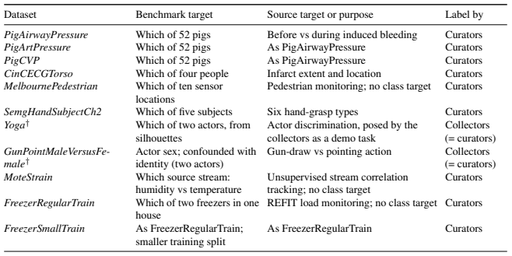
Table 2 : Task-construction cases in the current audit: identity. None means no classification target is documented, not that the source data had no scientific purpose. † also listed under another mechanism.
Original paper · CC BY 4.0Under task replacement, the archive swaps the source's label for a different task. Toy source tasks were simulated or staged by method developers, with classes chosen to demonstrate a method. ShapeletSim embeds one of two shapes in noise, so shapelet methods are guaranteed to separate them. A method can therefore rank first archive-wide by exploiting recording artifacts or generator mechanics, which a deployed TSC model doesn't need.
Test sets that leak into training
The audit finds that the test set isn't independent of training for 41 of the 128 UCR datasets. Leakage takes two forms: identical series in both splits, or a split that mishandles the grouping of subjects. Another 65 datasets can't be checked, because the information needed to separate their sources is missing. The leakage counts are therefore lower bounds, since the unclear datasets could also leak.
In PowerConsUCR, 37% of the test set (67/180) is duplicated, and in CropUCR, 16% (2753/16800) is. Figure 2 compares MiniRocket accuracy with duplicates kept in training against duplicates removed. On CropUCR, MiniRocket scores 0.992 on the repeated test series, compared to 0.722 on the rest. A repeated series can be answered by recalling its training label, so that score says little about generalisation.
Table 5 lists the duplicate counts and both accuracy columns for each affected dataset.
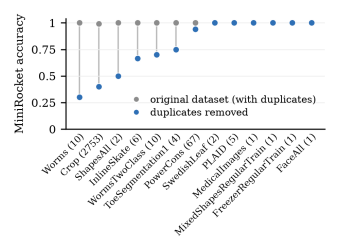
Figure 2 : MiniRocket accuracy with the origi- nal training set (with duplicates, grey) and af- ter removing the duplicates (blue). On several datasets, duplication inflates test accuracy.
Original paper · CC BY 4.0 · Omar Swelam, Jaris Küken, Shi Bin Hoo, Frank Hutter, Lennart Purucker · Fifty-Two Shades of Pig: What the UCR Archive Really Asks Classifiers to Do · Original paper figure · Extracted the figure area from page 4 of the original PDF.ElectricDevices and Strawberry run the other way. ElectricDevices scores 0.365 on repeated series and 0.752 on the rest. Strawberry scores 0.000 on repeated series and 0.986 on the rest. Some repeated groups carry conflicting labels, so no classifier can match every copy. So the direction of the duplicate effect depends on whether the copies agree.
Shared sources affect 24 datasets, where subjects or sessions appear on both sides of the split. Class recognition needs the split grouped by subject, while instance recognition needs new recordings of a known subject. Overall, 106 of 128 datasets (82.8%) get a Concern label or lack the information to verify separation. Scores should therefore state which evaluation setting they represent.
Questions the archive never tests
Many archive series are ordered but not temporal, such as spectra and image outlines. Ideas like warping, trends and periodicity have no direct counterpart on a spectral or spatial axis. Mixing the two kinds into one benchmark quietly assumes that what works on one transfers to the other. Zhang et al. found that a fixed permutation of every series barely changes accuracy on about a third of the 112 equal-length UCR datasets.
The authors read this as evidence that those tasks are solved from aligned values, not from order.
Pulling one channel out of a multivariate recording is a fair test of a univariate model. Counting several channels as separate datasets is different, because they share subjects, labels and acquisition. Archive-wide rank-based tests treat datasets as independent, so one source problem gets several correlated votes.
Every UCR series is pre-extracted, and many are aligned to a common reference before release. The archive therefore never asks where a class-defining pattern occurs in a stream. Hu et al. argued that this pre-segmented setting is far from how classification is deployed on streams. This may explain why tabular classifiers do well [8] and why disrupting temporal order often doesn't meaningfully change performance [29].
Limits of the verdicts
The leakage counts are lower bounds, because the audit flags 65 datasets whose subject or session identity is underspecified. The authors found no systematic leakage check run by the curators or the donors. Unclear is never counted as a pass on leakage, so those 65 datasets can't be read as clean. Of the 128 datasets, 106 (82.8%) either receive Concern or lack the information to verify source separation.
Each verdict qualifies only the setting its row describes, so a Concern label names the evaluation setting that fails.
A duplicate count alone doesn't settle which way accuracy moves once repeated series enter the picture. On ElectricDevices, MiniRocket reaches 0.365 on repeated test series, against 0.752 on the rest. Strawberry runs the other way, with 0.000 on repeated series against 0.986 on the rest. Both reversals come from repeated series with conflicting labels, so no classifier can satisfy every copy.
ElectricDevices has 54 mixed duplicate groups, and most of its matches are two-valued on/off days.
Archive-wide rank-based tests treat each dataset as an independent sample of TSC problems. Channels derived from one multivariate recording break that assumption, because they share subjects, labels and acquisition. Scores on constructed targets can reflect recording artifacts, subject identity or generator mechanics.
Paper info
- Authors
- Omar Swelam, Jaris Küken, Shi Bin Hoo, Frank Hutter, Lennart Purucker
- Venue
- arXiv · Preprint
- First published
- 2026-11-6
- Added
- 2026-11-9
- Updated
- 2026-11-6
- Version
- v1
- arXiv
- 2611.09843
- Category
- cs.LG
- Original paper terms
- CC BY 4.0
- What we show
- Paper info, commentary and permitted figures from the original paper
AI commentary is a separate explanation from the original paper and may contain errors. The original paper and figures follow each source's terms of use and any rights noted separately.
Abstract
The pigs were bleeding. That was the point of the experiment: could airway pressure reveal hemorrhage before it became critical? In the UCR Time Series Classification Archive, the de facto benchmark for Time Series Classification (TSC), the same recordings ask a different question: "which of 52 pigs produced this trace?". The dataset PigAirwayPressure is not an outlier. Although the archive is the standard benchmark, whether its tasks resemble the problems TSC is meant to solve has rarely been examined. We find that several datasets are repurposed from their original task, built from toy setups, or have flawed test splits. We further question how representative the archive's ordered non-temporal sequences (e.g. spectra, shape outlines) are of real TSC, and the potential downsides from the decomposition of multivariate problems. Our findings call for more careful interpretation of archive-wide scores and greater attention to deployment-relevant evaluation. The audit is at https://github.com/automl/ucr-provenance-audit.
Quote from the paper
Omar Swelam, Jaris Küken, Shi Bin Hoo, Frank Hutter, Lennart Purucker (2026). Fifty-Two Shades of Pig: What the UCR Archive Really Asks Classifiers to Do. arXiv:2611.09843v1. https://arxiv.org/abs/2611.09843v1
BibTeX
@misc{swelam2026fifty,
  title = {{Fifty-Two Shades of Pig: What the UCR Archive Really Asks Classifiers to Do}},
  author = {Omar Swelam and Jaris Küken and Shi Bin Hoo and Frank Hutter and Lennart Purucker},
  year = {2026},
  eprint = {2611.09843},
  archivePrefix = {arXiv},
  url = {https://arxiv.org/abs/2611.09843v1}
}