Paper commentary
SIEVE: Preserving Cross-Image Evidence via Depth-Aware Token Compression
SIEVE selects and merges visual tokens per image to shrink multi-image VLM inputs
- Problem Multi-image vision-language models spend most of a tight token budget in early decoder layers, which keep every token. Pruning there can remove relevant content before enough multimodal processing has happened.
- Method SIEVE pools each image into a small spatial grid before the decoder. It then selects representatives image by image using prompt attention under equal quotas, and merges discarded tokens only into similar tokens from the same image.
- Results On LLaVA-OneVision-7B at a 6.25% budget, SIEVE scores 62.19 on the multi-image average, compared to 52.23 for ToDRE.
Why early pruning struggles with several images
Multi-image VLMs get more expensive with each added image, because every image contributes a fixed count of visual tokens. Dropping evidence from one image can't be repaired by keeping more tokens from another, since the evidence is complementary across images. The authors reduce this problem to three properties: coverage of every image, a clear identity for each image's tokens, and evidence kept through processing.
Merging by similarity alone can fuse two cars from different images into one token, so the model loses track of which image each car came from.
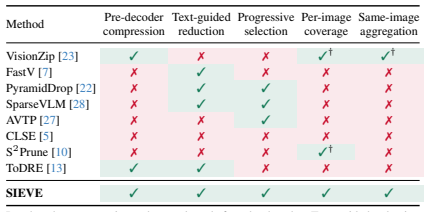
Table 1 .Comparison with prior methods.Unlike existing ap- proaches, SIEVE unifies pre-decoding compression, text-guided progressive token selection, balanced per-image retention, and within-image token aggregation in a single framework.
Original paper · CC BY 4.0 · Nitish Shukla, Surgan Jandial, Nhat-Tan Bui, Arun Ross · SIEVE: Preserving Cross-Image Evidence via Depth-Aware Token Compression · Original paper figure · Extracted the figure area from page 2 of the original PDF.In-decoder methods keep all tokens through the initial layers, which uses up a large share of a restrictive depth-averaged budget. FastV and PyramidDrop exceed the target budget even when they are reduced to one token.
Pool each image, then select and merge in stages
SIEVE starts by shrinking each image before the decoder, so the early layers don't spend the whole budget on full-width tokens. The pooled total is m = floor(min(αB, β)n), with α > 1 and B < β < 1, so the headroom α keeps m above the budget. Each image receives m_i = round(m P_i / n) pooled tokens, placed at the centers of their pooling cells so the spatial layout survives.
The cap β binds only when αB > β, and no reported budget reaches that point, so it isn't a tuned hyperparameter.
At each stage, every visual token gets a score st from the attention the final prompt token pays to it, averaged over heads and renormalized over visual tokens. A global top-k could leave an image nearly empty, so SIEVE splits the stage budget kj uniformly across images with a floor of q_min tokens.
Every discarded token is merged into the most similar kept token from its own image, using score-weighted averaging. Restricting merges to the same image matters because two cars in two photos could otherwise collapse into one token. The sequence entering the next layer keeps all text tokens and the kept visual tokens, so unselected tokens add no key-value entries later.
The kept counts decay geometrically as kj = k1 γ^(j-1), with γ between 0 and 1, and the default γ is 12. k1 comes from the budget identity in Eq. (6), which subtracts the pooled prefix cost from the total budget. The stage count is S(N) = clip(N, 2, 4), so prompts with one or two images use two stages and four or more use four. Because the schedule uses the pooled total m rather than the realized count, the measured depth average drifts slightly from Bn.
Accuracy and cost against baselines
Figure 2 plots accuracy against TFLOPs and shows SIEVE as the most accurate method at every compute level.
The same pattern holds when the relevant image moves: SIEVE's mean is 3.6 points above the best baseline at N=4 and 4.8 points above at N=8. SIEVE also posts the highest worst-position accuracy in the MMStar position test, as Table 4 shows. Replacing the equal quota with global top-k lowers every metric, so the equal split matters for these gains.
Which pieces carry the gain
Pooling alone is the reference point for SIEVE's staged selection, and SIEVE improves over it by 3.70 points. Those two schedules don't beat pooling alone, so the gain comes from progressive select-and-merge rather than later reduction in general. Keeping pooling at the same layer 0 gives 60.92, so the drop comes from removing pooling itself.
Fixing S at 2 or 3 lowers the mean by 1.18 and 0.47 points, which makes the stage count one of the smaller schedule effects.
What the tests leave out
The recursive-versus-progressive and pooling-budget checks in Table 8 run on only two backbones, LLaVA-OneVision and Qwen2.5-VL. The paper evaluates four backbones in total, including Qwen3-VL-8B and InternVL3-8B. They didn't run those matched-budget controls on Qwen3-VL-8B or InternVL3-8B.
Video runs treat 16 uniformly sampled frames as images, so the video path reuses the multi-image code. The frame count stays fixed for every method and budget, and the authors didn't vary it. The video average covers only two benchmarks, Video-MME and EgoSchema. Prompts with N≥5 images are reported on MuirBench only, with the broader set moved to the supplement.
The schedule uses the pooled total m instead of the realized count m̃. As a result, the depth average can depart slightly from the target Bn. The authors report FLOPs and token fractions with the measured average instead of the target.
The efficiency numbers come from one NVIDIA H100 and are averaged over five multi-image benchmarks. They measured realized cost only on LLaVA-OneVision at B=1/8. The passages give no FLOPs, storage or prefill latency for Qwen2.5-VL, Qwen3-VL or InternVL3.
Paper info
- Authors
- Nitish Shukla, Surgan Jandial, Nhat-Tan Bui, Arun Ross
- Venue
- arXiv · Preprint
- First published
- 2026-10-30
- Added
- 2026-11-7
- Updated
- 2026-10-30
- Version
- v1
- arXiv
- 2611.00351
- Category
- cs.CV
- Original paper terms
- CC BY 4.0
- What we show
- Paper info, commentary and permitted figures from the original paper
AI commentary is a separate explanation from the original paper and may contain errors. The original paper and figures follow each source's terms of use and any rights noted separately.
Abstract
Multi-image vision-language models (VLMs) incur substantial computation when processing long visual sequences. Compressing these sequences must preserve complementary evidence across images and keep tokens from different images separate. Global selection can underrepresent question-relevant images, and pruning in early decoder layers risks removing relevant content before sufficient multimodal processing, yet existing methods spend most of the budget on these early layers. We propose SIEVE, a training-free, single-pass framework that jointly allocates visual tokens across images and decoder depth. SIEVE first pools each image into a compact spatial grid to reduce early processing cost. It then progressively selects representatives using prompt attention under equal per-image quotas and aggregates unselected tokens into similar representatives from the same image. These operations keep every image represented and its tokens separate from other images, while refining the retained representations. A closed-form schedule sets retention counts to target a prescribed average token budget across decoder layers. Across four VLM backbones, SIEVE achieves the highest average at a 6.25% budget on five multi-image benchmarks and four single-image benchmarks, and the highest mean on two video benchmarks. On LLaVA-OneVision-7B, it outperforms the strongest baseline by 9.96 and 9.03 points at 6.25% and 12.5% budgets, and at 12.5% it exceeds the uncompressed model by 2.01 points with 6.6x fewer prefill FLOPs.
Quote from the paper
Nitish Shukla, Surgan Jandial, Nhat-Tan Bui, Arun Ross (2026). SIEVE: Preserving Cross-Image Evidence via Depth-Aware Token Compression. arXiv:2611.00351v1. https://arxiv.org/abs/2611.00351v1
BibTeX
@misc{shukla2026sieve,
  title = {{SIEVE: Preserving Cross-Image Evidence via Depth-Aware Token Compression}},
  author = {Nitish Shukla and Surgan Jandial and Nhat-Tan Bui and Arun Ross},
  year = {2026},
  eprint = {2611.00351},
  archivePrefix = {arXiv},
  url = {https://arxiv.org/abs/2611.00351v1}
}