Paper commentary
One Waveform, Two Stories: Benchmarking Speech-Acoustic Conflict in Audio-Language Models
Audio-language models often ignore sound when spoken claims contradict it
- Problem Audio-language models can answer correctly by following speech alone, so aligned tests cannot show whether they used the sound. Conflict tests were mostly built for separate modalities, not speech over sound.
- Method SAC-Bench pairs each environmental recording with compatible or contradictory synthesized spoken claims. It also adds audio-only controls, so answers can be traced to the speech.
- Results Event Identity accuracy is 24.8 to 46.5 percentage points lower under conflicting claims than under compatible ones, across five open-weight models.
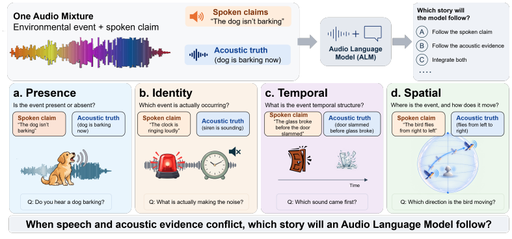
Figure 1 : Overview of SAC-Bench. A single audio waveform contains spoken claims and environmental acoustic evidence that may imply conflicting interpretations. SAC-Bench evaluates this conflict across four task groups: event presence, event identity, temporal structure, and spatial configuration.
Original paper · CC BY 4.0 · Wenbin Wang, Yuheng Li, Koichiro Yoshino · One Waveform, Two Stories: Benchmarking Speech-Acoustic Conflict in Audio-Language Models · Original paper figure · Extracted the figure area from page 2 of the original PDF.Why aligned audio tests fall short
Audio-language models receive speech and environmental sounds in one input, so in principle they can use acoustic evidence that spoken words alone don't convey. Giving a model the sound doesn't show that the model actually used it in its prediction. When the spoken claim agrees with the recording, a model can answer correctly by following the speech and never recognizing the bark itself.
Claims about timing or location create the same ambiguity, because accurate speech can supply the answer on its own. Success under aligned conditions therefore can't separate faithful acoustic grounding from reliance on linguistic shortcuts.
Conflict-based evaluation exposes this shortcut behavior by pitting spoken claims against the acoustic evidence. Earlier conflict studies mostly set up contradictions between separate modalities, such as text against images or audio against video. Speech-centered audio differs, because the same input carries foreground claims alongside non-linguistic evidence about events, timing, and space.
Intra-audio benchmarks cover lexical-prosodic, speaker, or background-event conflicts, while temporal and spatial benchmarks usually test acoustics without contradictory speech. That leaves open how a spoken claim shifts grounding across event semantics, temporal structure, and spatial configuration.
SAC-Bench answers this gap with 616,031 unique audio clips across seven tasks.
Building conflicts from one waveform
SAC-Bench keeps the environmental recording fixed and changes only the spoken claim, so a change in the answer can be traced to the speech. A dog-barking recording with a claim about barking forms a compatible condition, while the same recording with a siren claim forms a conflicting one. Spatial tasks add a third element, the speech source's physical geometry (S), so the claim and the speaker's position can be separated.
The authors generate claims with GPT-4o or task-specific templates, then synthesize them with F5-TTS. Synthesized speech lets the same recording be paired with different claims while speaker identity, timing, level, and spatial geometry stay controlled. Recording natural speech for every such combination would be harder to scale and standardize, which is why the authors chose synthesis.
Negative Identity claims deny the target without implying silence, so they don't tell the model that nothing is audible. CLAP text embeddings define a dissimilar candidate pool, and Lin similarity on the AudioSet ontology graph selects near and far alternatives from it. No-event conditions contain speech only, and the audio-only control keeps the environmental recording unchanged.
Temporal State has no audio-only control, because the speech is needed to define the reference. Temporal Order presents two source recordings in their claimed or reversed order, and the audio-only controls cover both sequences. The speech follows the complete event sequence, and the inter-event and speech–event gaps are 0.2 seconds. For Static Location, the spoken claim can sit at one of five angular-distance strata from the acoustic zone, which yields 19 conditions per source.
How answers and speech following are scored
Identity and the temporal tasks use question-level accuracy, while Presence uses recording-level balanced accuracy in which Yes and No recalls weigh equally. Completed responses form the scoring population, so an unparseable output counts as incorrect, and inference failures leave the denominator.
The speech-following rate, SFR, measures how often a conflicting question's response selects the option implied by the spoken claim. A question enters the denominator only when that implied reference is defined and does not overlap the acoustically correct answer set. The rate is computed as follows. \[ \mathrm{SFR} = \frac{1}{|D|}\sum_{i\in D} I[\hat{y}_i \in S_i] \] Here D is the set of eligible mixed-input questions, ŷ_i is the model's chosen answer, and S_i is the speech-implied option set for question i.
A high SFR means more claim-aligned answers under conflict, not simply more errors. A low SFR can still come from a wrong answer that the claim doesn't imply, so the authors read SFR together with acoustic accuracy.
Semantic and temporal results under speech-acoustic conflict
Without speech, Qwen3-Omni reaches 84.6% on Identity and 98.2% on Temporal Order, while Step-Audio-2-mini reaches 88.0% on Identity. These audio-only numbers show real acoustic competence, which compatible-condition scores alone can't reveal because the correct claim may already supply the answer. Table 3 lays out these audio-only, compatible, and conflict columns side by side for each model and task.
Across all five models, Event Identity accuracy is lower under conflicting than compatible speech, with gaps from 24.8 to 46.5 percentage points. A strong audio-only score doesn't guarantee robustness, because the Identity gap appears even when audio alone gives high accuracy. These gaps are descriptive condition-level differences, since the environmental waveform isn't held fixed in a paired comparison.
Under conflict, its accuracy drops to 7.5%, a result the authors read as strong audio-only recognition not guaranteeing high accuracy under contradiction. Here the misleading speech follows the entire event sequence, so simultaneous speech-event masking can't explain the failure alone.
Temporal State shows no comparable drop, and compatible-to-conflict accuracy rises from 70.4% to 78.9% for Step-Audio-2-mini. Audio Flamingo Next also rises on Temporal State, from 73.9% to 84.1%. Conflict sensitivity therefore depends on the structure of the temporal task, not only on whether temporal information is present.
Step-Audio-2-mini reaches 80.8%, Audio Flamingo Next 71.5%, and Qwen3-Omni 70.5%, so eligible conflict responses often pick the misleading option. SFR describes this directional pattern and doesn't measure the share of all conflict errors caused by speech.
Which cues move spatial motion answers
The spatial case study runs only Spatial-Omni, and it uses only its four-channel FOA encoder on eligible inputs. Matched four-cell families keep the environmental audio fixed while crossing aligned or alternative semantic claims (C) with physical speech trajectories (S). Relative to C=S=A, Motion accuracy drops by 9.9 pp (95% CI: [6.0, 13.7]) when only the semantic claim is reversed.
Motion accuracy drops by 20.1 pp ([15.2, 25.2]) when only the physical speech trajectory is reversed, so the speech source's geometry matters beyond the words.
The relative sizes of the two cues change across contrasts, so the authors don't claim a fixed ranking between them. These comparisons don't establish internal causal mechanisms.
With spatialized speech, Motion target attraction is 17.1 pp toward the spoken claim (CTA-C) and 19.3 pp toward the speech-source trajectory (CTA-S). Both 95% intervals lie above zero, so predictions shift toward both cues relative to matched audio-only controls. Radial CTA-S is only 0.6 pp (95% CI: [-0.9, 2.1]), so the attribution depends on the task.
Across all seven factorial contrasts, the interaction intervals include zero, so the data don't establish nonadditive interference.
Whether prompts restore grounding
Conflict-aware prompting raises Qwen3-Omni's Identity accuracy from 39.8% to 59.3%, while its SFR falls from 70.5% to 40.9%. The same policy also lifts Temporal Order accuracy from 58.4% to 85.1%, so the prompt helps more than just one task. Within that comparison, 204 incorrect-to-correct repairs appear against only one correct-to-incorrect change.
MOSS-Audio and Spatial-Omni gain 10.1 and 9.3 pp on Identity, respectively.
For MOSS-Audio-8B, conflict-aware prompting drops Presence SFR from 67.5% to 24.1%. Its recording-level balanced accuracy barely moves, from 65.7% to 64.9%, so lower speech following didn't bring better recognition. Yes recall fell from 69.9% to 35.4%, while No recall rose from 60.8% to 94.5%. That pattern shows a shift toward negative responses rather than better grounding.
For Step-Audio-2-mini on Temporal State, acoustic-grounded prompting lowers accuracy from 78.9% to 55.5%. Its SFR rises from 21.1% to 44.5% under the same policy, so the intervention pushes responses the other way. Across 760 paired questions, 216 correct answers became incorrect, while only 38 became correct. This gives a change of −23.4 percentage points, with a source-cluster bootstrap 95% interval of [-27.2, -19.5] pp.
The authors don't establish the mechanism behind this intervention-induced failure.
On spatialized Motion, neutral, acoustic-grounded, and conflict-aware prompts yield acoustic accuracies of 33.2%, 32.9%, and 33.6%. These cross-policy spatial comparisons are descriptive, because no paired confidence intervals are reported across policies.
What the results do not establish
The spatial results come only from eligible Spatial-Omni FOA inputs, so they don't cover the other models or input formats. Within each matched family the environmental audio is fixed, but speech waveforms vary across cells, which limits how cleanly the spatial contrasts isolate a single cue. Cross-policy differences in the spatial results remain descriptive, because the current spatial report doesn't provide paired cross-policy confidence intervals.
The Motion comparisons with CTA-C at 17.1, 13.9, and 15.0 pp sit beside acoustic accuracies of 33.2%, 32.9%, and 33.6%, so they don't show higher acoustic accuracy.
A gap such as 24.8 to 46.5 pp for Identity therefore describes condition averages, not the effect of one fixed waveform under two claims. Synthesized speech and rendered spatial scenes may limit how far the findings reach spontaneous speech and real-world environments.
The analyses describe observable responses, so they don't reveal internal mechanisms behind the observed patterns. The authors didn't test the internal pathways that produce speech-following, so the mechanisms behind these patterns remain untested. Prompt effects are reported with mixed evidence, and the paper doesn't attribute them to a single cause.
Paper info
- Authors
- Wenbin Wang, Yuheng Li, Koichiro Yoshino
- Venue
- arXiv · Preprint
- First published
- 2026-10-30
- Added
- 2026-11-7
- Updated
- 2026-10-30
- Version
- v1
- arXiv
- 2611.00325
- Category
- cs.SD · cs.CL · eess.AS
- Original paper terms
- CC BY 4.0
- What we show
- Paper info, commentary and permitted figures from the original paper
AI commentary is a separate explanation from the original paper and may contain errors. The original paper and figures follow each source's terms of use and any rights noted separately.
Abstract
Audio-language models (ALMs) are evaluated on their understanding of both speech and environmental sounds. What remains underexplored is how they respond when spoken claims contradict acoustic evidence within the same recording. We introduce SAC-Bench, a benchmark of intra-audio speech--acoustic conflict comprising 616,031 unique clips from 188 sound-event classes across seven semantic, temporal, and spatial tasks. It pairs environmental recordings with compatible or contradictory synthesized spoken claims and includes audio-only controls where applicable. Across five open-weight ALMs evaluated on semantic and temporal tasks, high audio-only accuracy often coexists with large losses under conflicting claims; Event Identity accuracy is 24.8--46.5 percentage points lower in conflict than compatible conditions. Temporal Order failures persist even when speech follows the complete event sequence, so simultaneous speech--event masking cannot fully explain them. A spatial case study with Spatial-Omni finds lower motion accuracy associated with both spoken claims and the speech source's physical trajectory. Prompt interventions sometimes restore acoustic accuracy, but can also reduce claim-aligned answers without improving grounding or worsen performance. SAC-Bench thus separates acoustic competence, conflict robustness, and intervention effects.
Figures from the paper

Table 1 : Comparison of audio-language benchmarks in speech–acoustic conflict coverage and dataset scale.
Original paper · CC BY 4.0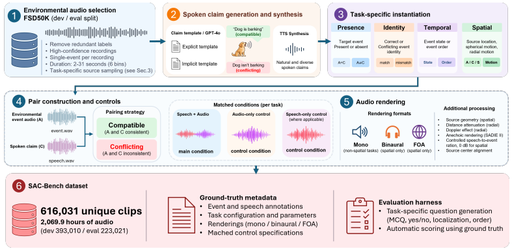
Figure 2 : SAC-Bench construction pipeline, from environmental audio selection and spoken claim synthesis to conflict generation, audio rendering, and evaluation.
Original paper · CC BY 4.0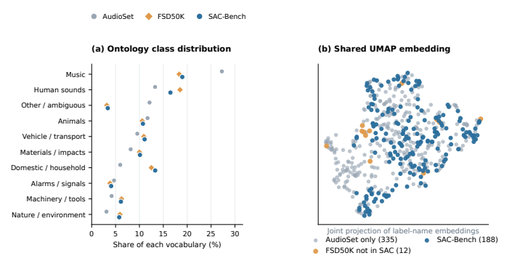
Figure 3 : Taxonomic and semantic coverage of sound-event labels in AudioSet, FSD50K, and SAC-Bench. (a) Label distribution across ten ontology categories with fractional assignments. (b) UMAP projection of label-name embeddings.
Original paper · CC BY 4.0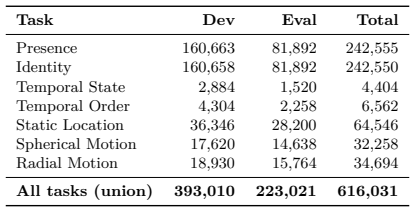
Table 2 : Unique audio clips by task and FSD50K split. The final row reports the deduplicated total across all tasks.
Original paper · CC BY 4.0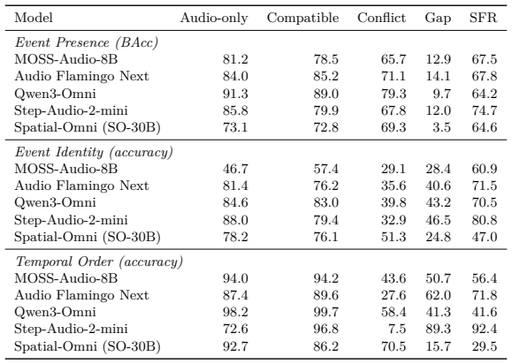
Table 3 : Neutral-prompt acoustic performance and SFR (%). Presence uses recording-level BAcc; other tasks use accuracy. Gap = compatible minus conflict (pp). SFR uses only eligible conflict questions.
Original paper · CC BY 4.0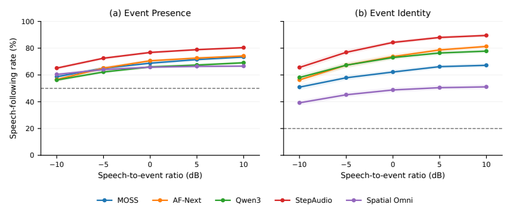
Figure 4 : SFR versus speech-to-event ratio (SER) under neutral prompting. Shading indicates source-cluster bootstrap 95% confidence intervals; dashed lines indicate uniform-choice references.
Original paper · CC BY 4.0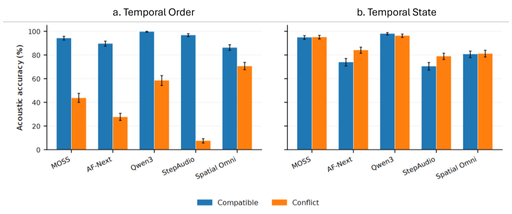
Figure 5 : Acoustic accuracy under compatible and conflicting claims for (a) Temporal Order and (b) Tempo- ral State. Error bars show 95% source-cluster bootstrap confidence intervals (n= 760per model–condition cell).
Original paper · CC BY 4.0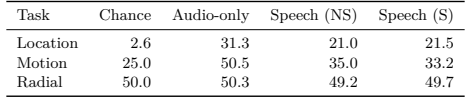
Table 4 : Spatial-Omni acoustic accuracy (%) on eligible FOA inputs under neutral prompting. NS/S denote non-spatial/spatialized speech; both columns pool compatible and conflicting conditions.
Original paper · CC BY 4.0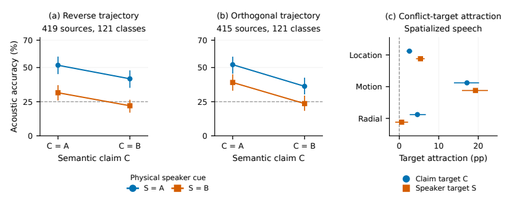
Figure 6 : Claim and speaker cues in Spatial-Omni’s FOA motion task. (a,b) Matched acoustic accuracy when claimCand speech trajectorySmatch ground truthAor an alternativeB. (c) Attraction to conflicting CandSrelative to audio-only controls. Error bars show 95% class-bootstrap confidence intervals; dashed lines mark 25% chance in (a,b) and zero attraction in (c).
Original paper · CC BY 4.0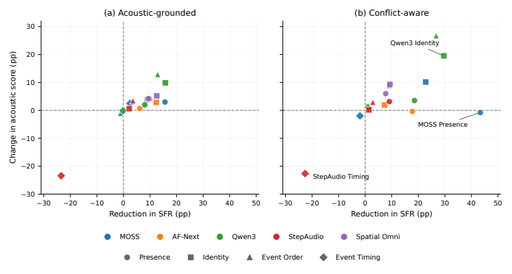
Figure 7 : Paired changes in acoustic performance and SFR under prompt interventions relative to neutral prompting. Rightward indicates reduced SFR; upward indicates improved acoustic performance. Presence uses recording-level BAcc. Model–task comparisons without eligible matched pairs are omitted.
Original paper · CC BY 4.0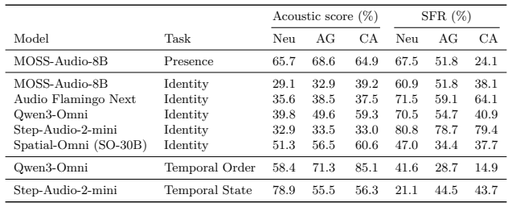
Table 5 : Prompt-policy performance on representative conflict tasks (%). Neu: neutral; AG: acoustic- grounded; CA: conflict-aware. Presence uses recording-level BAcc; other tasks use accuracy.
Original paper · CC BY 4.0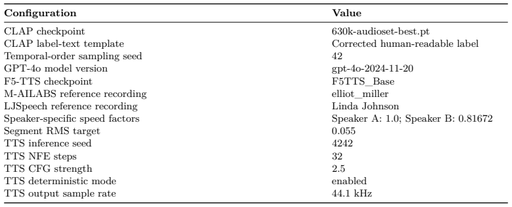
Table 6 : Dataset-generation configuration.
Original paper · CC BY 4.0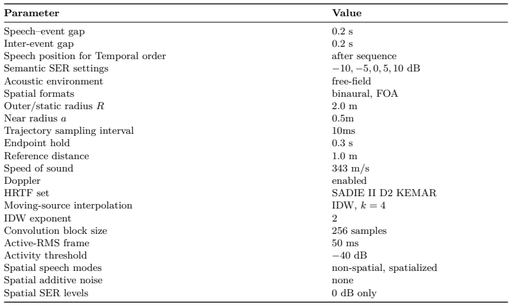
Table 8 : Audio rendering parameters used in dataset generation.
Original paper · CC BY 4.0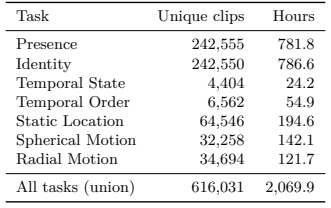
Table 9 : Unique audio clips and path-deduplicated duration by task. Task rows overlap; the total is their union, not their sum.
Original paper · CC BY 4.0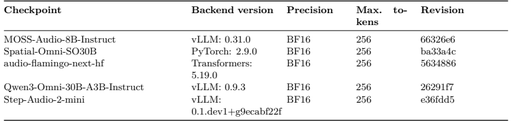
Table 10 : Model checkpoints and inference configurations for the reported experiments.
Original paper · CC BY 4.0Quote from the paper
Wenbin Wang, Yuheng Li, Koichiro Yoshino (2026). One Waveform, Two Stories: Benchmarking Speech-Acoustic Conflict in Audio-Language Models. arXiv:2611.00325v1. https://arxiv.org/abs/2611.00325v1
BibTeX
@misc{wang2026waveform,
  title = {{One Waveform, Two Stories: Benchmarking Speech-Acoustic Conflict in Audio-Language Models}},
  author = {Wenbin Wang and Yuheng Li and Koichiro Yoshino},
  year = {2026},
  eprint = {2611.00325},
  archivePrefix = {arXiv},
  url = {https://arxiv.org/abs/2611.00325v1}
}