Paper commentary
Latency, Speech Recognition and Turn-Taking in Voice Agents for Spanish Phone Negotiation: An Externally Measured Comparison of Pipecat, LiveKit and GPT-Live
Outside measurement compares three phone voice agents
- Problem Phone voice agents must reply quickly and catch spoken amounts, but frameworks report only their own latency. That self-reported figure leaves out the transport time the caller actually waits through.
- Method The authors play identical recorded carrier lines to three voice architectures and time each reply on the listener's side. Pipecat and LiveKit are cascades, while GPT-Live is a single speech model without separate stages.
- Results GPT-Live had a median wait 171.2 ms shorter than Pipecat, but the confidence interval includes zero. Its amount error was 2.86%, against 13.01% for Pipecat and 12.61% for LiveKit.
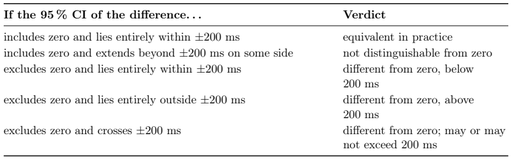
Table 5 . How the 95 % CI of a difference is read against the 200 ms margin
Original paper · CC BY 4.0 · Jovan Popoca Moran, Eduardo de Avila-Armenta, Raúl Alejandro Aquino-Ibarra, Jorge Octavio Nicolás-Díaz, Umberto Leon-Dominguez · Latency, Speech Recognition and Turn-Taking in Voice Agents for Spanish Phone Negotiation: An Externally Measured Comparison of Pipecat, LiveKit and GPT-Live · Original paper figure · Extracted the figure area from page 11 of the original PDF.Why a phone negotiation agent is harder than a text one
A voice agent that negotiates freight rates by phone has to reply before the silence becomes uncomfortable. It also has to hear a spoken price correctly, because an amount is the word that carries the money in a negotiation. The study's application, SPOTS, already negotiates with carriers over WhatsApp and hands the same configuration to a voice agent after 30 minutes without agreement.
Moving that negotiation to a phone line therefore brings the voice-specific requirements into play.
A cascade chains a speech recognizer, a language model and a synthesizer, so the delays of each stage add up. A native speech model takes audio in and produces audio out with a single model, so it skips those separate stages.
In human conversation the gap between one speaker's turn and the next is short, with the most frequent gap between 0 and 200 ms.
One shared caller for three architectures
The key idea is to replace the caller with a program that plays the same recorded lines to every architecture. Because the audio is identical and the end of each line is known exactly, any difference in the wait comes from the architecture. The harness plays the carrier's audio, listens to the agent and timestamps both ends on the listener's side.
The same instrument serves all three architectures, and only the connection to each one changes.
Pipecat and LiveKit Agents are two cascades that share the same Deepgram nova-3 recognizer in multi mode. Both cascades use ElevenLabs eleven_flash_v2_5 for speech synthesis, and LiveKit uses the same voice. They differ in their voice activity detectors, with Silero set to 0.2 s of minimum silence in Pipecat and 0.55 s in LiveKit. GPT-Live has no separate stages, and it hands each tool call to gpt-4.1-mini while it can keep talking.
The audio path also differs, with a local WebSocket for Pipecat, a LiveKit Cloud room for LiveKit and a local bridge to the OpenAI API for GPT-Live.
All three architectures share one system prompt with the same trip data and four tools. The propose-price tool rejects any amount above 21,000 pesos, a limit known only to that function. All runs use the same Windows 11 PC with an AMD Ryzen 5 3400G and 16 GB of RAM. Six of the 40 turns branch on what the agent said, so the carrier still answers sensibly.
How the wait is timed from outside
Pipecat and LiveKit time their own responses from the moment they detect the end of speech to the moment they release the first audio. That release happens before the audio travels back to the carrier, so the frameworks' figures leave out the trip. GPT-Live doesn't publish a per-response latency, so the harness has to time it from outside as well.
OpenAI's published 0.8 s figure starts from the user's turn end, and the paper doesn't say where on the audio path that instant lies. The harness plays the carrier, listens to the agent and timestamps both ends with the clock of one computer. Only the connection to each architecture changes, so the rule stays the same for all three.
The harness counts a 20 ms frame as speech when its RMS level reaches -44.3 dBFS. Speech frames separated by less than 0.3 s are joined into one run. For each line i, the latency is the agent's first audible frame minus the end of the carrier's speech. The unit of analysis is the line, because each framework's end-of-turn detector segments turns differently.
The end of speech is the end-of-speech mark of the played audio, so its timing is known rather than estimated.
The observed latency splits into inbound transport, the framework's own interval and outbound transport. Outbound transport runs from the framework's audio release until the harness hears it. GPT-Live doesn't reveal when it detects the carrier has finished, so only its outbound transport can be measured. The latency without transport is computed response by response, not from the medians.
The cost of a tool call is the median latency of lines with a tool minus the median of lines without one. Because the LLM decides when to call a tool, the two groups may differ in other respects, so the authors call the cost approximate. GPT-Live's API returns start_ms and end_ms for each word, which the authors call GPT-Live's timestamps.
Splitting the GPT-Live wait into four segments with those timestamps lets the wait be checked against the published figure.
Checking the harness against a known delay
The authors validate the harness by replacing the agent with a simulated one whose delay is known in advance. The simulated agent recognizes which line it hears and starts speaking exactly d ms after that line's end of speech. These conditions ran over the five scenarios, giving 30 calls and 240 turns per path.
The error of each turn is the latency the harness reports minus the actual delay d, and Table 4 gives its median per condition. That maximum sits well below the 200 ms margin the authors use to judge latency differences. The authors keep that trip in the campaign, where it counts as part of transport. On the GPT-Live path, direct measurement on the recording covered every response, with the same errors as the Pipecat path.
Latency: transport explains the LiveKit gap
The median wait to the content response was 2,616.0 ms for Pipecat, 3,090.0 ms for LiveKit and 2,444.8 ms for GPT-Live. GPT-Live came 171.2 ms ahead of Pipecat, but the confidence interval runs from -3.2 to 322.5 ms, so the lead can't be separated from zero. The authors count the latency as measured on the listener's side, which is why these medians differ from the frameworks' own figures.
LiveKit ran 474.0 ms behind Pipecat, with an interval from -583.0 to -404.5 ms that lies entirely outside the 200 ms margin. Its transports add up to about 637 ms, with 423.1 ms inbound and 213.8 ms outbound, against 188 ms in Pipecat. LiveKit's end-of-turn detector judged the carrier unfinished in 31.2% of responses and waited its maximum of 2.5 s, a separate source of delay.
That cost is larger than any difference between the frameworks, so tool use matters more than framework choice in this setup.
Measured to the first sound, GPT-Live was heard 471.4 ms before Pipecat, with an interval from 348.1 to 559.0 ms. GPT-Live opens with a filler, so the caller learns that the agent has heard sooner. The authors link this early signal to fillers softening the perception of a delayed response.
Why the published 0.8 s differs from the caller's wait
GPT-Live's own timestamps put the start of its answer 800 ms after the carrier's line ended, which is close to the published figure. OpenAI's 0.798 s figure counts from the moment the user finishes a turn until the model starts responding. The listener's wait is a different segment of the same path, running from the end of the carrier's speech to the moment the carrier hears the answer.
The GPT-Live timestamps don't include the audio's trip to the model and back, so they can't capture that stretch.
The harness split the GPT-Live wait into four segments that add up to the total, using the timestamps and the arrival time of each service message. Only the second segment, the time GPT-Live takes to start answering according to its timestamps, is what the timestamps measure.
Pipecat's own figure of 2,371.0 ms falls 245 ms (9%) short of the 2,616.0 ms the listener waited. LiveKit's own figure of 2,417.3 ms falls 673 ms (22%) short of the 3,090.0 ms the listener waited. Subtracting the two transports brings the heard latency close to the frameworks' figures, so the gap is mostly transport. Because of that, the frameworks' numbers hide the transport cost that the caller actually pays.
The paper concludes that latency has to be measured from outside the agent, because the agent's own timestamps miss the caller's wait. The 0.8 s published for GPT-Live matches its own timestamps, not the 2,444.8 ms the listener waited. The authors didn't test where OpenAI spends the 1,367 ms, and they plan to ask the provider.
Hearing spoken amounts across the three architectures
Word error rate counts substitutions, deletions and insertions over the reference words, while the error on amounts restricts the same count to sums of money. The authors normalized both texts before comparing them, so that numbers written in words or in digits count as equal. WER was computed once per call, because each system segments its turns in its own way.
The last line was left out of a call that closed less than 4 s after it finished playing, since its transcript had no time to arrive.
The error on amounts was much higher in the two cascades, at 13.01% in Pipecat and 12.61% in LiveKit. GPT-Live's error on amounts was 2.86%, so a low overall error rate hides the failures on the words that matter most in a negotiation. To compare what each agent understood, the authors used the self-correction in scenario 5, turn 4, from eighteen thousand to eighteen thousand five hundred.
J. P. M. classified each agent's response to that line blind to the architecture, as understanding 18,500, understanding 18,000, or unclassifiable.
The paper treats that comprehension measure as a single rater's judgement, so the authors flag it as a limit. They didn't test whether a second rater would agree with these classifications.
Backchannels and interruptions: what each agent does when the caller talks over it
The probe tests what each agent does when the caller talks over it, which the main campaign never did. In six turns per call, the harness played an interruption, a backchannel or a silent control once the agent had spoken for 1 s. The harness counted a stop only when the agent's speech broke off for at least 0.7 s within 3 s of the event.
Each framework ran with its default interruption handling, so the harness never changed these settings. Pipecat stops at any speech its detector confirms after 0.2 s, LiveKit stops after 0.5 s of speech, and GPT-Live offers no options.
Pipecat stopped at 26 of 28 backchannels, LiveKit at 21 of 22 and GPT-Live at 20 of 29. On the control turns, where nothing played, Pipecat and LiveKit never stopped on their own, while GPT-Live stopped 13 times in 29. Pipecat stopped at 26 of 27 interruptions, LiveKit at 22 of 22 and GPT-Live at 25 of 26. The median time to stop an interruption was 344 ms for Pipecat, 878 ms for LiveKit and 1,242 ms for GPT-Live.
Pipecat and LiveKit cut the sentence at almost every backchannel, and they often treated it as the carrier's answer. When the agent stopped at a backchannel, GPT-Live's median pause was 1,241 ms, against 3,331 ms for LiveKit, and this difference passed the correction at p < 0.001. That pause is as long as the pauses GPT-Live makes without a backchannel, so the "ajá" does not explain it.
Limitations of the carrier simulation, the timing comparison and the scope
The carrier was simulated from recordings of one speaker, made with a headset, so the recognition results are probably optimistic. Every line was recorded once and then processed to sound like a call, which fixes the timing of each carrier turn.
The GPT-Live figures belong to gpt-live-1 as it was in service in October 2026, so another version could differ. Playing the GPT-Live voice as a telephone would, the median moves from 2,444.8 to 2,455.6 ms. The verdict for Pipecat minus GPT-Live doesn't change, at 160.4 ms, which is not distinguishable from zero.
Not all architectures heard the same lines, because the branches and the closing point differ for each agent. Between Pipecat and GPT-Live this matters, since GPT-Live leads the overall median while the equal-weight-per-line verdict is equivalent in practice.
Each framework ran only its default configuration, and only in Spanish, so other settings could change the turn-taking results. They didn't test the switch to English that the instructions allow. Several authors are employed by Freight Technologies Inc., which builds negotiation technology related to the study.
How differences are judged against 200 ms
The study reads each latency difference through a 95 % confidence interval from a bootstrap that draws whole calls. GPT-Live ran on another day, so its comparisons with the other two are unpaired.
For two architectures A and B, the estimated difference is the median of the responses in set A minus the median in set B. Each of the 10,000 replicates draws the calls of each set with replacement, and the 95 % CI is the 2.5th and 97.5th percentiles of the replicate differences.
A CI that includes zero and lies entirely within ±200 ms is read as equivalent in practice. A CI that includes zero but extends beyond ±200 ms on some side is read as not distinguishable from zero. A CI that excludes zero and lies entirely within ±200 ms is read as different from zero, below 200 ms. A CI that excludes zero and lies entirely outside ±200 ms is read as different from zero, above 200 ms.
A CI that excludes zero and crosses ±200 ms is read as different from zero, though it may or may not exceed 200 ms.
As a second check, the authors ran rank tests on the median of each call, with N = 231 calls. Kruskal–Wallis covers the three architectures, the Wilcoxon signed-rank test covers Pipecat versus LiveKit, and a rank-sum test covers GPT-Live against each of the others. Bonferroni correction over the three pairs turns each raw p-value into pcorr = min(1, 3p).
The latency comparisons were also repeated by resampling calls within each scenario and by giving equal weight to each of the 38 lines.
Paper info
- Authors
- Jovan Popoca Moran, Eduardo de Avila-Armenta, Raúl Alejandro Aquino-Ibarra, Jorge Octavio Nicolás-Díaz, Umberto Leon-Dominguez
- Venue
- arXiv · Preprint
- First published
- 2026-11-14
- Added
- 2026-11-17
- Updated
- 2026-11-14
- Version
- v1
- arXiv
- 2611.19118
- Category
- cs.CL · cs.AI · cs.SD
- Original paper terms
- CC BY 4.0
- What we show
- Paper info, commentary and permitted figures from the original paper
AI commentary is a separate explanation from the original paper and may contain errors. The original paper and figures follow each source's terms of use and any rights noted separately.
Abstract
A voice agent that negotiates by phone must answer quickly, understand spoken amounts and cope with a caller who talks over it. We compared three architectures for such an agent, negotiating freight rates in Spanish: two cascades (speech recognition, language model and speech synthesis) orchestrated by Pipecat and by LiveKit Agents, and GPT-Live, an OpenAI speech model that listens and speaks without separate stages. A program played the carrier with the same 47 recordings of one speaker for all agents, without the telephone network, in 77 calls per architecture over five negotiation scenarios, and measured latency on the listener's side with a validated instrument. Median latency to the content response was 2,616.0 ms (Pipecat), 3,090.0 ms (LiveKit) and 2,444.8 ms (GPT-Live); the confidence interval of GPT-Live's 171.2 ms advantage over Pipecat includes zero. According to its own timestamps, GPT-Live began to answer 800 ms after the end of the line, close to the 0.8 s published by OpenAI; most of the remaining wait, about 1,367 ms and nearly constant, is the audio's round trip through OpenAI's service. A tool call added 0.9-1.1 s in every architecture, more than any difference between them, and the frameworks' self-reported latency fell short of the listener's wait by 9% (Pipecat) and 22% (LiveKit). Word error rates were low (6.03, 4.93 and 1.47%), but the error on amounts was 13.01% and 12.61% in the cascades, against 2.86% in GPT-Live. With default settings, Pipecat and LiveKit stopped at almost every backchannel and often took it as the carrier's answer: an "ok" spoken over the agent ended in a registered agreement in 3 of 15 Pipecat calls, 2 of 15 LiveKit calls and no GPT-Live call (descriptive counts, not tested). Latency should therefore be measured on the listener's side, and a cascade needs safeguards for spoken amounts and backchannels.
Quote from the paper
Jovan Popoca Moran, Eduardo de Avila-Armenta, Raúl Alejandro Aquino-Ibarra, Jorge Octavio Nicolás-Díaz, Umberto Leon-Dominguez (2026). Latency, Speech Recognition and Turn-Taking in Voice Agents for Spanish Phone Negotiation: An Externally Measured Comparison of Pipecat, LiveKit and GPT-Live. arXiv:2611.19118v1. https://arxiv.org/abs/2611.19118v1
BibTeX
@misc{moran2026latency,
  title = {{Latency, Speech Recognition and Turn-Taking in Voice Agents for Spanish Phone Negotiation: An Externally Measured Comparison of Pipecat, LiveKit and GPT-Live}},
  author = {Jovan Popoca Moran and Eduardo de Avila-Armenta and Raúl Alejandro Aquino-Ibarra and Jorge Octavio Nicolás-Díaz and Umberto Leon-Dominguez},
  year = {2026},
  eprint = {2611.19118},
  archivePrefix = {arXiv},
  url = {https://arxiv.org/abs/2611.19118v1}
}