Paper commentary
Generalization Testing of Grid Foundation Models for Power Flow and Optimal Power Flow
Grid foundation models fail when tested beyond their training conditions
- Problem Grid foundation models give one prediction with no error warning, and their accuracy is tested only on their own benchmarks. Their limits on unseen networks and changed grids were unclear.
- Method The authors propose a three-axis framework that measures distance from training data. It changes admittance matrices, load levels and grids, then tests GENCO, LUMINA and GridSFM against the DC baseline.
- Results Adding a line degrades all models more than removing one. Fine-tuned GENCO's error rises up to 20 times after a line is added, compared with 5.5 times after removals.
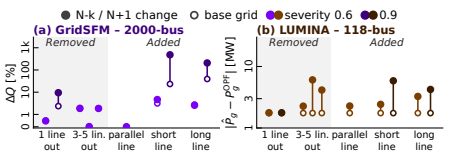
Fig. 3 . (a) GridSFM on 2000-bus: reactive violation∆Q, mean over the three generator buses nearest to the topology change, over 500 samples. (b) LUMINA on 118-bus: dispatch error, mean over all generators in each sample, median over 1k samples. Base grid (hollow), modified grid (filled).
Original paper · CC BY 4.0 · Ayushi Jolotia, Parikshit Pareek · Generalization Testing of Grid Foundation Models for Power Flow and Optimal Power Flow · Original paper figure · Extracted the figure area from page 3 of the original PDF.Why a single answer makes failures hard to see
Grid foundation models are meant to serve networks they were never trained on, so their value depends on that claim. Two modes matter here: zero-shot prediction with frozen weights, and fine-tuning on solved cases of the target network.
Fine-tuning recovers accuracy, but it needs solved-instance data and training compute for each target network. A warm-started exact solver behaves differently, because the solver supplies the convergence guarantee.
Both zero-shot and fine-tuned models output one prediction and give no warning when it is wrong. Their failures are silent, so a bad answer passes unnoticed unless someone checks it with a solver. Testing the limits of these models therefore matters more than measuring their average accuracy.
The framework measures how far each test case lies from the training data on three axes. On the unseen-grid axis, distance comes from grid properties such as condition number, R/X ratio, loops per bus and depth.
Three ways to move a test case away from training
The framework measures distance from the training data with one factor changed at a time, and each axis gets its own measure. On the admittance matrix axis, the model keeps a network it was trained on, but its Y bus changes by removing or adding lines, or by lengthening transmission lines.
They didn't find any grid FM tested on added components, because the data generators behind these models provide at most N-k conditions. The framework is applied to GENCO for AC-PF, and to LUMINA and GridSFM for AC-OPF. The ground truth is computed with PowerModels, using NR for AC-PF and Ipopt for AC-OPF.
On the admittance matrix axis, line addition turns out more severe than line outage. On the unseen-grid axis, zero-shot FM performance on new networks is worse than DC approximations.
So the authors propose two tests beyond these: network graph changes, and longer lines.
Graph changes show that adding a line hurts more than removing one
A short new line joins buses two lines apart and uses the grid's median line parameters. A long new line joins buses seven or more lines apart and doubles those parameter values. Severity is the ratio of a line's power flow to its rating, and the authors keep cases at severities of 0.6 and 0.9. Three to five lines out only reach severity 0.6, and a parallel line never reaches 0.9 because it carries about half the flow of its line.
More solved samples steadily reduce the base-grid error, but the modified-grid error saturates at 10k samples. At 250k samples, the modified-grid error still exceeds the base-grid error by more than 10 times.
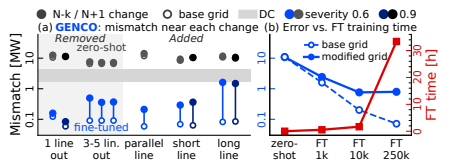
Fig. 2 . GENCO on 118-bus. (a) Mean real power mismatch over the buses within three hops of each removed or added line, base grid (hollow) and modified grid (filled). (b) The same mismatch averaged over line-addition cases, with fine-tuning (FT) training time (red) from the authors’ logs. Such changes occur in practice through maintenance, faults and network expansion, and the topology given to a model can also be wrong due to topology estimation errors [14]. A removal takes out a single line or three to five lines (N-k), and an addition adds a parallel line or a new line between two buses that are two lines apart (short new line) or seven or more lines apart (long new line). A short new line has the grid’s median line parameters, and a long new line has these values doubled. The severity of a change (adding or removing a line) is defined as the ratio of the power flow on that line to its rating, measured before and after the change. To test medium and severe changes of each type, we keep cases leading to severities of 0.6 and 0.9, such that the modified grid stays within its voltage limits and has an AC-OPF solution. Note that three to five lines out are built only at severity 0.6, and the parallel line takes about half the flow of the line it connects, so it never reaches severity 0.9. We test on the 118- and 2000- bus grids, which the models (except zero-shot GENCO) were trained on, drawing 1k and 500 new samples, respectively, with each FM’s own data generator. Considering locality of voltage and reactive power in trans- mission grids, we measure mismatch at buses within three hops of a removed or added line for GENCO, and at the three nearest generator buses for the GridSFM performance measure. Further, LUMINA’s dispatch error is measured over all generators, since the active-power changes are global. Fig. 2a shows that zero-shot GENCO is worse than DC-PF in every modified-grid case, which is consistent with reporting in [4]. In contrast, fine-tuned (FT) GENCO’s error rises up to 5.5×afterN-kand up to20×afterN+1, while staying below DC-PF in all cases. However, this improvement comes at the cost of solved samples and training time: Fig. 2b shows that the error on the base grid decreases steadily with both, but on the modified grid it saturates at 10k samples, and at 250k samples it remains more than 10 times that on the base grid. Next, we use GridSFM to predict generator set-points for the 2000-bus grid and solve an AC-PF from them via NR, following [5], without PV–PQ bus conversion at reactive limits. Therefore, we measure the generators’ reactive-limit violation∆Qas a percentage ofQ max −Q min. We observed that, on the base grid,∆Qis7×lower than with DC-OPF set- points, it stays below 10% after lines are removed, and rises from 23 to 482% after a short new line is added at severity 0.9 (Fig. 3a). Importantly, the generation-cost error reported in [5] stays at 1.1% and misses this reactive-limit failure. Further, for
Original paper · CC BY 4.0After a short new line is added at severity 0.9, ΔQ rises from 23 to 482%. The generation-cost error of 1.1% reported for GridSFM misses this reactive-limit failure. New lines added at severity 0.9 push the LUMINA dispatch error to the level of DC-OPF.
The authors argue that adding a line gives B+ = B0 + baa^T, which places the matrix outside the convex hull of outage matrices.
Why added lines fall outside the training coverage
The DC analysis gives the clearest reason why an added line falls outside what outage-based training can cover. Adding a line to the positive definite reduced susceptance matrix B0 yields B+ = B0 + b a a^T, a rank-one change. Here b is positive, and a is the reduced line-incidence vector of the new line. The update pushes eigenvalues away from zero, whereas each outage pulls them toward zero, though some stay unchanged.
Assuming a base grid with positive reactances and fixed other parameters, each outage matrix B_D stays below B0 in the semidefinite order. Convex combinations of these outage matrices keep that ordering, so B+ falls outside their convex hull. The authors note that this DC argument is only indicative of AC-PF and AC-OPF performance. Outage-only training therefore leaves an extrapolation requirement, which learned models can struggle with.
GENCO's training data include only one line out, so its three to five line removals are already new to it. Its error after those multi-line removals rose more than its error after a single line out. Fine-tuned GENCO's error rises up to 5.5 times after N-k and up to 20 times after N+1 on the 118-bus grid. LUMINA and GridSFM saw only intact grids, so even a line removal is new to them.
The test cases sit at severities of 0.6 and 0.9, so the modified grids keep valid voltage limits and an AC-OPF solution.
A short new line uses the grid's median line parameters, while a long new line doubles them. Together, the DC argument and the GENCO results point the same way: added lines lie beyond what removal-only training covers.
Longer lines: a smooth drift away from training
The corridor test multiplies the resistance, reactance and shunt of selected lines by m, so the R/X ratio stays fixed. Each selected line's DC weight falls by a factor of m, which pushes the matrix toward a joint line outage in a smooth way. The authors lengthen the 12 lines in the 118-bus grid and the 20 lines in the 2000-bus grid that contribute most to the smallest eigenvalue of B.
This raises the condition number from 2.9k to 8.6k at m = 10 on the 118-bus grid. On the 2000-bus grid, the condition number climbs from 193k to 545k at m = 8.
Angle error is the fair measure here, because a line m times longer carries m times less power for the same angle error. At m = 10, the fine-tuned model performs more than 2× worse than DC-PF, with an error of 16.3 degrees. A scratch-trained model performs similarly, whereas zero-shot GENCO stays worse than DC-PF at every length.
LUMINA's own PF mismatch stays at 136 MW on the 118-bus grid at every m. That constant mismatch means LUMINA gives no error growth warning as its dispatch error rises. GridSFM's dispatch error stays at or below DC-OPF's at every m.
The lengthened matrix can be written as B(m), which combines m^-1 B0 with (1 - m^-1) times the matrix B_out,S that removes all selected lines. B(m) lies in the convex hull of B0 and the training outage matrices only if |S|(1 - m^-1) ≤ k, where k is the largest number of training outage lines. With 12 or 20 lengthened lines, every tested m of at least 2 falls outside that hull whenever k is below |S|/2.
For GENCO's single-line outages (k = 1), the bound is m ≤ 1.09.
Loading beyond the training range
The three FMs' training data scale total load to about 1.25 times the base load. The only published test beyond that range reports an error 81.5× larger at the loading limit for GENCO. The authors raise each sample's load in steps of λ/λ⋆, keeping that sample's load pattern intact. For GENCO on the 118-bus grid, λ⋆ lies at 2.45 to 3.43 times the base load.
For LUMINA and GridSFM on the 2000-bus grid, λ⋆ sits at 1.31 times the base load.
Fine-tuned GENCO follows the true voltage inside its training range. The 10k fine-tuned model breaks down from λ/λ⋆ = 0.8, while zero-shot GENCO performs poorly throughout.
At λ⋆, that error reaches 16× DC-OPF's error. From λ/λ⋆ = 0.90, no PF from LUMINA's answer converges. GridSFM's dispatch error and ΔQ stay below DC-OPF's, with ΔQ doubling to 15%. A PF from 40% of GridSFM's answers doesn't converge at λ/λ⋆ = 1.10, so it keeps answering past the limit.
The P–V curve steepens near its nose, so a small demand increase can cause a large voltage change. A PF solver corrects the state with the nonlinear equations at each loading level, whereas an FM relies on its training data.
Unseen grids show no simple trend
Each model's own data generator draws the samples, so the test grid is the only variable. Of 500 samples per unseen grid, 302 to 500 were kept, namely those whose true solution could be computed. Each grid is compared with the model's training range on five properties: buses, κ, R/X, loops per bus, and depth from the slack.
Zero-shot GENCO's mismatch error is worse than DC-PF's on every grid, including one of its training grids. Its mismatch ratio to DC-PF reaches 72 on the 10192-bus far grid. On the near grid, LUMINA's dispatch error is 17 times DC-OPF's, and its PF converges for only 22% of samples. GridSFM's dispatch error stays close to its training-grid value on the edge grids, at 1.5 and 2.2 times DC-OPF.
On the far grid, GridSFM's dispatch error grows to 10 times DC-OPF's.
Closeness in these five properties doesn't predict accuracy, so the models don't follow a simple trend. LUMINA errs on the near grid even though that grid lies inside its training range. Under the DC approximation, bus angles follow θ = B^-1 p, so a grid change alters the map from injections to states. Similar sizes or condition numbers don't fix that map, and a shared graph architecture can process a new grid without matching its solution map.
Limits of the evidence
The experiments use only GENCO, LUMINA and GridSFM, so the tests say nothing about HH-MPNN, MxGPS or the unified grid representation in Table I. The shift tests ran on the 118-bus and 2000-bus grids, which the models were trained on, except zero-shot GENCO. Each test drew its samples from the model's own data generator, so the results depend on how those generators sample the space.
The DC-PF and DC-OPF baselines show whether a model beats a simple approximation on the same samples. The authors call their DC-based analysis indicative only of AC-PF and AC-OPF performance. Their theoretical arguments for line addition rest on that DC analysis, so they don't prove the AC behaviour.
A grid inside all five property ranges doesn't guarantee accuracy, because LUMINA is 17× worse than DC-OPF on the near grid. On that grid, the PF from LUMINA's answer converges for only 22% of samples. The five properties don't fully determine the solution map, so they give an idea of generalization but no guarantee.
Fine-tuning improves accuracy, but it needs solved samples and training compute for each target network. For fine-tuned GENCO on the modified grid, the error stays more than 10 times the base-grid error even at 250k samples. The tests don't show whether a fine-tuned model reaches the accuracy of a solver on a new network. Because the models fail silently, a user needs extra solver runs to check each point estimate.
Paper info
- Authors
- Ayushi Jolotia, Parikshit Pareek
- Venue
- arXiv · Preprint
- First published
- 2026-11-14
- Added
- 2026-11-17
- Updated
- 2026-11-14
- Version
- v1
- arXiv
- 2611.19194
- Category
- eess.SY · cs.LG
- Original paper terms
- CC BY 4.0
- What we show
- Paper info, commentary and permitted figures from the original paper
AI commentary is a separate explanation from the original paper and may contain errors. The original paper and figures follow each source's terms of use and any rights noted separately.
Abstract
There is growing interest in foundation models (FMs) for power grids, particularly for power flow and optimal power flow. Their usefulness depends on generalization accuracy, which existing works test on their own benchmarks. We propose a three-axis framework to test their generalization limits: changed admittance matrices of training grids, load levels, and unseen grids. We test GENCO, LUMINA and GridSFM against the DC baseline, alongside their reported limitations, and discuss theoretical reasons for their failures. Experiments reveal that adding a line degrades all FMs more than removing one, and longer lines eventually make LUMINA and fine-tuned GENCO worse than DC. All three degrade beyond their training load range, where the loading-voltage curve steepens. On unseen grids, LUMINA degrades sharply even inside its training range, and GridSFM fails on the grid farthest from it. Thus, beyond training conditions, FMs behave more like meta-models requiring test-time fine-tuning data and compute.
Quote from the paper
Ayushi Jolotia, Parikshit Pareek (2026). Generalization Testing of Grid Foundation Models for Power Flow and Optimal Power Flow. arXiv:2611.19194v1. https://arxiv.org/abs/2611.19194v1
BibTeX
@misc{jolotia2026generalization,
  title = {{Generalization Testing of Grid Foundation Models for Power Flow and Optimal Power Flow}},
  author = {Ayushi Jolotia and Parikshit Pareek},
  year = {2026},
  eprint = {2611.19194},
  archivePrefix = {arXiv},
  url = {https://arxiv.org/abs/2611.19194v1}
}