Paper commentary
The Critic Can Hurt: On the Safety of Critics in LLM-Guided AutoML Search
Naive LLM critics can drive AutoML search below random search
- Problem Studies of LLM critics in closed-loop search measure whether feedback helps but rarely whether it can hurt. Critiques are rarely scored or filtered, so their errors reach every later proposal.
- Method The authors run the same AutoML loop with and without a critic over one frozen set of configurations, then compare test utility.
- Results A naive 8B critic drove search below no-critic random search on 7 of 8 binary tabular datasets, losing up to 0.245 AUC.
Why the critic is the weak point
In an LLM-guided AutoML loop, a weak proposal is scored and then dropped by the best-so-far rule, so the loop checks proposals by construction. A critique gets no such check, because it is typically neither scored nor filtered. Yet the critique conditions every subsequent proposal, so its errors reach the whole remaining trajectory. The paper's claim is that a naive LLM critic can push search below the floor of using no critic at all.
Related evidence points to the same risk without measuring it. That evidence mostly concerns one-shot judgment, where a bad call costs a single decision. Closed-loop papers ablate feedback to measure how much it helps, but they rarely rerun the same loop with the critic removed. So the implicit harmlessness assumption of critic feedback goes mostly untested.
The paper's first figure makes this concrete on ADULT, where an 8B critic falls below the no-critic floor. Its picks pin search at AUC 0.68, far below no-critic random search at 0.93. The below-floor sign holds on 7 of 8 datasets in that figure.
A four-arm audit on a shared frontier
The audit runs the critic and a no-critic loop under the same budget, over one frozen set of configurations. Each dataset is split once, and all 96 configurations in the pipeline space are scored before search begins. The critic makes one LLM call per round: it sees the evaluated history and the untried menu, then names the next configuration.
When the response names no untried configuration, a uniform draw from the menu takes its place.
The four arms are no critic, random feedback, the real critic, and an oracle that bypasses the language channel. Random feedback is an independently seeded uniform random search, so it redraws the floor rather than testing critique content. The main contrast, ΔNC(D), subtracts the no-critic result from the real critic's expected test utility, J_D(real).
J_D(r) is the expectation of test utility over search randomness, so each condition is compared at the level of its distribution. A critic counts as below floor when ΔNC(D) is negative, and the headline claim rests on a suite-level sign-flip permutation test. Because every outcome is cached, the authors can audit an additional critic without repeating pipeline training.
Fault injection asks how critic errors are structured rather than how often they occur. Each round follows a clean reference policy with probability 1 minus p and a corrupted choice with probability p. RANDOM picks uniformly among untried configurations, WORST picks the lowest-utility untried one, and MISLEAD picks the lowest-utility incumbent neighbor.
In-space headroom stays below 0.01 AUC on all 12 datasets, from 0.0013 on ADULT to 0.0077 on ELECTRICITY.
Where the critic falls below the floor
On ADULT the naive 8B critic reached 0.68 AUC, while plain random search reached 0.93. Across the eight binary datasets, the critic's No-Critic Δ was negative on 7. Estimates ran from −0.009 on PHONEME to −0.245 on ADULT, and only CREDIT-G was positive at +0.006. An exact one-sided sign-flip test over 28 sign assignments gave p = 0.0078 for a negative suite-level mean, so one dataset isn't driving the sign.
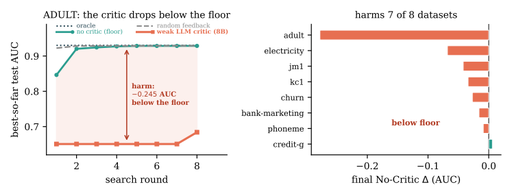
Figure 1 :A weak LLM critic actively harms search. Left:worst case onADULT—an 8B critic (coral, AUC 0.68) pins search far below no-critic random search (teal, 0.93) and an independently seeded second random search (gray). Right:the below-floor sign holds on 7/8 datasets. Bars show theNo-Critic ∆, the critic-guided minus no-critic final test AUC, so negative means below floor (used throughout).
Original paper · CC BY 4.0 · Gaoyuan Du, Xiaoyang Liu, Rex Zhou, Dengdu Jiang, Rong Fu, Meng Ding, Defu Cao · The Critic Can Hurt: On the Safety of Critics in LLM-Guided AutoML Search · Original paper figure · Extracted the figure area from page 2 of the original PDF.The clean hill-climbing reference gains only +0.001 to +0.005 AUC over the no-critic floor. Headroom, the gap between oracle and no-critic, is under 0.01 AUC on all 12 datasets. The authors read this asymmetry as the main reason to worry, since upside is bounded and downside is not.
Table 1 reports the No-Critic Δ across seven model tiers, and the 2024 8B model gives −0.245 on ADULT. At every tier from 14B up, ADULT stays within 0.011 AUC of zero. The authors read this as attenuation tied to the task, not as a capability threshold.
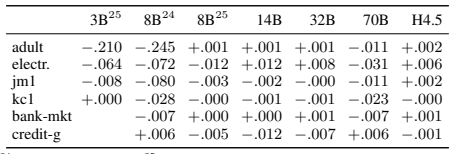
Table 1 : Capability ladder: No-Critic ∆ (AUC, 8 seeds) across seven tiers spanning four providers and two generations (2024–2025). The 3B model was evaluated on four of the six datasets.
Original paper · CC BY 4.0On a 250-configuration frontier with T=20, the same critic's ADULT delta moves from −0.245 to +0.0003. Frontier and horizon changed together, so this contrast can't separate headroom from budget.
The published CAAFE system, run with Llama-3.1-8B on eight frozen splits, is negative on three datasets. Chain-of-thought reduces the ADULT loss from −0.278 to −0.041, but three of four datasets still fall below floor.
Why error structure matters more than error rate
The loop reports the best configuration seen so far, so a random pick spends a round without lowering that result. A directional pick keeps steering away from the good region, so the incumbent loses chances to improve round after round. Fault injection bears this out: RANDOM corruption leaves final degradation below 0.005 AUC even at p = 1, on every tested dataset.
WORST and MISLEAD show a measured threshold of 0.6 to 0.9 on the primary binary datasets, with LETTER at the boundary value 1.0. Error frequency alone doesn't determine harm, because errors at similar rates differ depending on whether they preserve exploration or redirect it.
The elitist update keeps the incumbent monotone, so each new best is at least the previous one: b_t = max(b_{t-1}, s(a_{π(t)})) ≥ b_{t-1}. RANDOM substitutes a uniform untried configuration, while ADVERSARIAL (WORST or MISLEAD) substitutes an argmin-type one. Proposition 1 says that under uniform corruption, the expected final incumbent equals the no-critic expectation for every corruption rate p and horizon T.
The proof rests on without-replacement exchangeability, so both loops visit the same distribution over configurations. Assumption 1 says an adversarial round picks a configuration whose score doesn't exceed the current incumbent, so it never raises the incumbent. Empirically, 90.5% of adversarial picks fail to raise the incumbent, with per-dataset values from 87% to 93%.
Proposition 2 bounds the expected gap to the ceiling by δ plus the probability that the number of effective rounds K falls below T_sat. The approximation p⋆ ≈ 1 − T_sat/T gives 0.63 to 0.88 for T=8 and T_sat between 1 and 3, which matches the measured 0.6 to 0.9. The loop stays robust because the critic only has to supply enough good rounds out of T, not perfect ones.
Real critics look adversarial in a diagnostic sense: harmed trajectories under-select the dominant families, with a KL of 8.4 for Llama-3.1-8B versus 3.2 for Claude Haiku 4.5.
The idealized model gives each critic round a competence rate q, a lookahead m, and an adversarial rate β, with uniform selection otherwise. Conditioned on K_c competent and K_u uniform rounds, the final incumbent matches the maximum of N_eff = mK_c + K_u i.i.d. score draws. Taking expectations gives T_eff = T(1 + q(m − 1) − β), so T_eff exceeds T exactly when q(m − 1) > β.
This is a necessary condition for net benefit, not a sufficient one, since higher-order terms matter away from the tail.
Gates that try to block harmful feedback
Verification-Gated Critique, or VGC, sets its gate from the most recent realized transition. The proposal is evaluated once and counted against the budget, and the gate opens when its validation utility sits within a tolerance of the incumbent. When the gate closes, VGC discards the critique so the next round follows the critique-free fallback policy.
The tolerance depends on how stable the validation ranking is, which the authors measure by bootstrapping the ranking over the configurations tried so far. The formula τt = τmin + (1 − ρ̂t)(τmax − τmin) interpolates between a strict minimum and a wider maximum tolerance. A low-stability policy can also abstain and use uniform proposals for the remaining rounds, which limits further exposure to the critic.
The learned detector is a gradient-boosted classifier trained on CRITFAULT, which holds about 3,840 labeled loop transitions across 12 datasets. On six datasets and 384 realized critic transitions, the three-feature detector attains 0.982 AUC. Classification AUC alone doesn't establish a safe filter, so the authors test both gates end to end.
In the paired VGC audit over eight datasets and eight paired seeds, adaptive minus fixed is −0.00006 AUC, with a 95% CI of −0.00109 to 0.00090. Against uniform search, the fixed rule's difference is −0.00032 with a lower bound of −0.00140, which the authors read as exploratory non-inferiority at a 0.002 margin. The learned detector averages −0.00015 in the same rerun, and the simple gate significantly beats raw on bank-marketing and kc1.
The authors recommend recalibrating the operating thresholds when the critic, search space, or data regime changes. They don't claim results for long horizons, which lie outside the small fixed frontiers they studied.
Where the critic results stop
The main estimates come from small, fixed frontiers of 96 configurations run for T=8 rounds. Oracle-minus-floor gaps stay beneath 0.01 AUC on every dataset, so guidance has little room to help. The authors make no claim about long horizons, where Proposition 2 expects directional corruption to be absorbed once the budget is large relative to Tsat.
Moving to 250 configurations and T=20 weakens the effect, but both settings changed together, so the cause stays unclear.
The capability ladder covers six datasets, and the authors chose them partly for the 8B critic's effect. So the ladder shows task-dependent attenuation, not a capability threshold. Each per-dataset interval reflects search randomness on one frozen split, not variation across splits.
The authors treat q(m−1) > β as a necessary condition from an idealized model, not as a sufficient one. The triple (q, m, β) isn't identified for real critics, so family KL serves only as a proxy for directional mismatch. The mismatch explanation for cross-domain differences hasn't been tested directly, for example by anonymizing configuration names.
Critique and proposal share one LLM call, so the audit measures the whole selection policy, parser and fallback included. The random-feedback arm is a separately seeded random search, not a semantic placebo. The VGC adaptive-minus-fixed gap is −0.00006 AUC, with a paired 95% CI from −0.00109 to 0.00090. Average non-inferiority holds only at a 0.002 margin, and the authors call it exploratory rather than dataset-wise safety.
Paper info
- Authors
- Gaoyuan Du, Xiaoyang Liu, Rex Zhou, Dengdu Jiang, Rong Fu, Meng Ding, Defu Cao
- Venue
- arXiv · Preprint
- First published
- 2026-11-14
- Added
- 2026-11-17
- Updated
- 2026-11-14
- Version
- v1
- arXiv
- 2611.19037
- Category
- cs.LG · cs.AI
- Original paper terms
- CC BY 4.0
- What we show
- Paper info, commentary and permitted figures from the original paper
AI commentary is a separate explanation from the original paper and may contain errors. The original paper and figures follow each source's terms of use and any rights noted separately.
Abstract
LLM critics increasingly steer iterative search in agentic AutoML, prompt optimization, and self-refinement--evaluated for whether they help, but rarely for whether they can hurt. We isolate the critic's marginal effect through a four-arm audit and characterize the loop's tolerance through controlled fault injection. We show a naive 8B critic drives search below the no-critic random-search floor on 7 of 8 tabular datasets, losing up to 0.245 AUC in the worst case; the magnitude varies strongly with dataset, frontier, and budget. When: stronger critics attenuate the loss on the evaluated suite, without establishing a universal capability threshold. Why: controlled fault injection shows that non-directional errors are nearly costless under best-so-far search, whereas directional errors consume finite search opportunities; an idealized effective-sample calculation yields a necessary condition, $q(m-1) > β$, not a deployment certificate. How: a simple observable validation gate and a learned detector can reduce realized loss, but neither is guaranteed to preserve the full-budget no-critic baseline. We will release CRITFAULT, to our knowledge the first benchmark for detecting harmful critic feedback in AutoML. A critic is not a free addition: audit before trusting, and gate when capability or verification is insufficient.
Quote from the paper
Gaoyuan Du, Xiaoyang Liu, Rex Zhou, Dengdu Jiang, Rong Fu, Meng Ding, Defu Cao (2026). The Critic Can Hurt: On the Safety of Critics in LLM-Guided AutoML Search. arXiv:2611.19037v1. https://arxiv.org/abs/2611.19037v1
BibTeX
@misc{du2026critic,
  title = {{The Critic Can Hurt: On the Safety of Critics in LLM-Guided AutoML Search}},
  author = {Gaoyuan Du and Xiaoyang Liu and Rex Zhou and Dengdu Jiang and Rong Fu and Meng Ding and Defu Cao},
  year = {2026},
  eprint = {2611.19037},
  archivePrefix = {arXiv},
  url = {https://arxiv.org/abs/2611.19037v1}
}