Paper commentary
A predictive, per-engine energy roofline of the Apple Neural Engine
Fused-graph dispatch shows which engine suits each operator on Apple silicon
- Problem Apple's Neural Engine is only reachable through CoreML, which hides which engine runs each operator. A single roofline model also mispredicts its speed and energy.
- Method aneforge bypasses CoreML and lowers an operator graph into one fused ANE program. It then measures the ANE against the GPU and CPU on the same device, with per-engine energy accounting.
- Results The ANE has higher perf/watt than the GPU on 11 of 13 single-stream workload classes. On large fp16 GEMM, the GPU is 2.8× faster and more accurate.
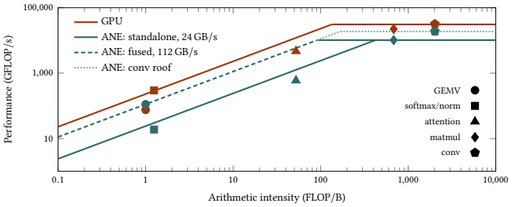
Fig. 3 . Per-device roofline on the M5 Pro: five operator archetypes on the ANE (triangles) and the GPU (circles), placed by arithmetic intensity. The ANE shows two bandwidth slopes, a24 GB/sstandalone-activation path and a faster weight-stream path used by compiled programs; per-archetype, per-device placement is in Tables 3 and 4.
Original paper · CC0 1.0 · Spencer H. Bryngelson · A predictive, per-engine energy roofline of the Apple Neural Engine · Original paper figure · Extracted the figure area from page 8 of the original PDF.Why the published ANE figures don't settle the question
The publicly quoted ANE figure is a peak 38 TOPS, quoted for the M4 part. Community guidance says the engine pays off mainly for inference on large transformer models. Both the headline figure and that guidance come from CoreML, the only sanctioned interface to the engine.
The question the authors start from is which workloads favor the ANE over the Apple GPU and CPU on the same device, in speed and in watts. Without a CoreML-free dispatch path, that question can't be answered with controlled batch, dtype, and warm state. The textbook single roofline is the natural tool for this question, and the authors report that it mispredicts the ANE.
The better engine for an operator therefore depends on which path that operator uses, not on a single peak figure.
The authors measure this with aneforge, which lowers an operator graph to one fused ANE program and submits it through Apple's e5rt runtime. They compare the ANE with MLX on the GPU in fp16 and with numpy/Accelerate on the CPU in fp32, on an Apple M5 Pro. The CPU path is a contextual reference, so the main comparison is the ANE against its companion GPU.
Timing the ANE without CoreML
The authors bypass CoreML with aneforge, a fused-graph compiler and runtime. It lowers a user's operator graph into one fused ANE program and submits that program through Apple's e5rt runtime. Because no CoreML model is involved, no CoreML placement policy decides which operators land on the engine. Batch, data type and warm state are fixed for every timed operator, which keeps the per-operator comparison fair.
Two checks confirm that each benchmarked operator ran on the ANE rather than on a fallback device.
The GPU side runs MLX v0.31.2 in fp16, so the ANE and the GPU execute the same fp16 math. The CPU side runs numpy with Accelerate in fp32 on AMX, and the authors treat it as a contextual reference. Accelerate has no fast fp16 GEMM, so the CPU path upcasts and doubles its bytes per element. Latency is the minimum end-to-end time over repetitions after warmup, taken from a probe separate from the power window.
The ANE works in sub-millisecond bursts, so the sampling strategy matters for its power readings. A fixed-time stop integrating at 100 ms gave a 60–140 % CV, while sampling at 500 ms over the whole window gave 1–25 % CV. The DRAM rail is left out, and the authors call that the conservative choice for ANE-versus-GPU comparisons.
Perf/watt and mJ per inference are computed inside one 6 s window, so they never splice statistics across runs. The GPU is more accurate than the ANE in fp16, most of all on large GEMMs.
Two bandwidth tiers and two ridges
The core idea is that the ANE moves standalone activations and compiled weight matrices along different paths, each with its own ceiling. The activation path stays flat at 22 to 24 GB/s across streaming and reduction, and it is reached already at the smallest sizes measured. The GPU reaches 230 GB/s on the streaming archetype, so its memory-bound work runs far faster.
A decode GEMV with K=N=4096 gives an effective 112 GB/s, well above that activation ceiling.
A decode GEMV has M=1 and does almost no compute, so its effective bandwidth reflects how the weights are streamed. Sweeping K=N from 512 to 8192 shows the ANE's bandwidth rising from dispatch-bound small sizes toward a plateau. At K=4096 the ANE reaches 113.5 GB/s, and it then plateaus at 130 to 143 GB/s. The GPU overtakes the ANE from K=4096, reaching 221 GB/s, while the ANE saturates near 143 GB/s.
The authors call the weight path a candidate mechanism rather than an established one, since an external measurement can't separate a dedicated transfer engine from constant handling or residency.
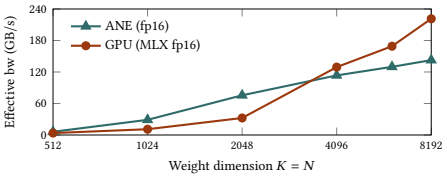
Fig. 2 . Weight-stream effective bandwidth versus weight dimension 𝐾=𝑁 for a decode GEMV (𝑀= 1) on the M5 Pro. The ANE’s bandwidth exceeds the GPU’s up to𝐾= 2048( 76 GB/s versus 32 GB/s) as it amortizes its dispatch floor, then plateaus near 130–143 GB/s; the GPU’s unified memory is higher from𝐾= 4096and reaches 221 GB/s.
Original paper · CC0 1.0The ridge point is the arithmetic intensity where the compute roof meets the bandwidth slope. On the activation path the ANE's ridge is about 424 FLOP/B, which is 3.2× the GPU's 134. On the weight-stream path the ridge drops to about 71 FLOP/B, below the GPU's 134. So an operator that streams weights becomes compute-bound on the ANE at a lower intensity than on the GPU.
A single 424 ridge would place the GEMV at 466% of its roof, while the weight-path roof puts it at 78%.
Where the ANE's compute roof falls
The compute roof is measured by sweeping square GEMM and a 3×3 convolution until each device plateaus. The GPU reaches 30.9 TFLOP/s on GEMM, compared to 10.2 for the ANE, and 31.8 TFLOP/s on convolution, compared to 18.8. The sweep also records idle-subtracted active package power and fp16 relative error at every size.
The ANE's GEMM throughput peaks at N=2048 at 10.2 TFLOP/s. It then degrades to 8.3 TFLOP/s at N=4096 and 4.9 TFLOP/s at N=8192, a 52% drop that reproduces across runs. Active power falls with the throughput, from 12.7 W to 6 W. The authors read this as a stalled engine rather than one busy at a reduced rate. Once the square operand exceeds the ANE's working-set window, on-chip tiling and weight streaming stop feeding the multiply–accumulate array fully.
Their argument is that the error tracks the square root of K as independent rounding errors accumulate.
A deepened fused chain of small matmuls reaches a slope of 19.6 TFLOP/s, against the 10.2 single-matmul peak. So the gap reads as utilization rather than a silicon limit. On conv the GPU keeps a small edge, 1392 against 1372 GFLOP/s/W, so the efficiency claim holds for GEMM at peak only.
From the two ridges to an energy predictor
The energy predictor starts from the roofline's per-call accounting, where each call's energy is a per-FLOP term plus a per-byte term. The per-byte cost depends on the dispatch path, so the fused graph reaches the weight-stream path at 16.5 pJ/B. The same operator issued standalone reaches the activation path at 503 pJ/B, and the predictor takes that dispatch state as given.
The device crossover AI★ compares the two engines' byte and FLOP energies, and on the weight path it is negative. On the activation path the expensive 503 pJ/B moves the crossover up to AI★≈ 933. Standalone operators below that intensity belong on the GPU, while fused work stays on the weight path.
The roofline alone under-predicts dispatch-bound rows by large factors, because a fixed per-call cost dominates their package energy. The authors add one per-call energy term and one per-call time term, and the fitted ANE constants are 681 µJ and 136 µs. The smallest GEMM moves from −97.6 % to 30.1 %, while the near-roof classes stay within 5 %.
The fitted 136 µs agrees to 2.5 % with the expected 139 µs, which comes from a 70 µs probe floor scaled by a sustained-to-probe ratio of 1.99.
Near the roof the predicted energy per FLOP lands within 7 to 28 %, with a median of 14 %. The authors treat the roofline as a one-sided bound, since predicted energy per FLOP stays below measurement on every single-dispatch class. The standalone group norm at AI 2.5 is GPU-favored, as the predictor expects. So the placement rule keeps FLOP-denominated work fused on the weight path and sends standalone low-intensity ops to the GPU.
Single-stream device map and real models
The single-stream device map runs thirteen synthetic workload classes at batch 1 on the M5 Pro, with a 6 s power window and an idle package at 1196 mW. Each class reports latency, fp16 relative error, active package power with CV%, and perf/watt for both the ANE and the GPU. Table 5 uses M·K·N for GEMM shapes and marks replicated rows with an asterisk.
On large square fp16 GEMM with K=4096, the GPU is 2.8× faster and more accurate than the ANE. Yet the ANE does that work at 8.71 W, compared to 33.05 W for the GPU. The ANE leads on latency for convolution, convolution stacks, short attention and mid-size GEMM.
The ANE has higher perf/watt on 11 of 13 classes, with the largest margin of 13× on the ResNet-like conv stack. The stencil margin is 4.7× and the Jacobi solve margin is 3.6×, both against the GPU. Over ten independent cold starts, the GPU keeps a small edge on group_norm, at 0.949 with a 95% CI of [0.900, 0.997].
Table 6 reports three real models, with energy per inference for the ANE, MPS and compiled MLX. ViT-B/16 is the exception among the real models, since the GPU is faster on it. Against torch-MPS fp16, the margin is small, at 15.9 ms for the GPU versus 18.3 ms for the ANE. Decode throughput is the next test, and it reverses the single-GEMV result.
Decode and weight encodings
The decode forward runs eight layers per token, with 602.4 M weight parameters and a 1.20 GB fp16 weight stream. The GPU leads on throughput at every batch, reaching 200 tok/s against 115 tok/s on the ANE at batch 1. The intercept is the batch-invariant weight stream, read at an effective 154 GB/s. Single-stream decode on the ANE is weight-stream-bound, and dispatch would dominate only if each operation ran as its own program.
Per-channel int8 halves the weight bytes but lifts batch-1 throughput only 7 %, from 115 to 123 tok/s. Past batch 1, int8 matches fp16 throughput within 1 % for every batch of at least 2. The three encodings lower to different constant operators, and their measured rates separate with them.
Halving the weight bytes through int8 cuts energy per token by 20 % at batch 1, from 27.8 to 22.4 mJ. That energy saving comes at roughly twice the fp16 relative error, about 5×10 −2. Int8 costs 0.11 percentage points of ResNet-18 top-1, while int4 costs 2.55 points. At batch 1 the ANE reaches 44.7 tok/s/W with int8, against 19.3 tok/s/W for the GPU.
The ANE keeps the higher tok/s/W up to batch 16, and the GPU's efficiency crosses above only at batch 32. The authors attribute that batch-32 crossover to host CPU feeding the KV cache each step.
Limitations: where the results stop applying
The magnitudes come from one Apple M5 Pro, and the other generations are only single- or dual-run point estimates. The base M4 carries a higher effective weight byte, about 34 pJ/B against 16.5 on the M5 Pro, so the energy magnitude stays on the M5 Pro alone. The cross-generation reproductions weren't replicated under the cold-start protocol.
The decode results cover one model configuration, with one size, a 32 000-token vocabulary, and synthetic weights. The energy crossover isn't claimed for other models, since it depends on the ratio of KV and host-feeding cost to the weight stream. That crossover is therefore an extrapolation, not a measurement.
Power comes from modeled SoC telemetry, not from a wall-socket meter, and the two estimators only cross-validate each other. The DRAM rail is excluded from the combined power, and excluding it is the conservative choice for ANE-versus-GPU comparisons. Sixteen subprocess-bridge operators are excluded from the speed comparison, because each call pays a process-spawn cost.
The int4 output alone doesn't show that every weight streams, so the ResNet-18 classification check carries that evidence. The mechanism behind the two bandwidth tiers remains a candidate, since an external measurement can't separate it from a distinct transfer engine.
Paper info
- Authors
- Spencer H. Bryngelson
- Venue
- arXiv · Preprint
- First published
- 2026-11-14
- Added
- 2026-11-17
- Updated
- 2026-11-14
- Version
- v1
- arXiv
- 2611.19101
- Category
- cs.CE · cs.AR · cs.LG · cs.PF
- Original paper terms
- CC0 1.0
- What we show
- Paper info, commentary and permitted figures from the original paper
AI commentary is a separate explanation from the original paper and may contain errors. The original paper and figures follow each source's terms of use and any rights noted separately.
Abstract
The Apple Neural Engine (ANE) is in over a billion devices, but is characterized indirectly via CoreML. Using a CoreML-free fused-graph dispatch path, we measure the ANE, along with the Apple GPU and CPU on the same device, with per-engine energy accounting. The consumer-available roofline does not predict the ANE in practice. A critical correction is that the ANE sees two effective memory bandwidths: a slow activation path and a fast weight-stream path. Two roofline ridges follow, and the weight-stream ridge is below that of the GPU. The ANE single-operand compute peak decreases instead of plateauing. Its weight stream is byte-bound in fp16 but limited by the dequantizer's element rate in int8. As a result, int8 compression saves energy at unchanged throughput and an int4 lookup-table stream raises throughput and efficiency at a cost of 2.55 points of ImageNet top-1. The corrected roofline identifies the lower-energy ANE paths and bounds it from below. A constructed device map reproduces across four unique ANE generations. Results show that operators should be placed by arithmetic intensity and fused for optimal performance.
Quote from the paper
Spencer H. Bryngelson (2026). A predictive, per-engine energy roofline of the Apple Neural Engine. arXiv:2611.19101v1. https://arxiv.org/abs/2611.19101v1
BibTeX
@misc{bryngelson2026predictive,
  title = {{A predictive, per-engine energy roofline of the Apple Neural Engine}},
  author = {Spencer H. Bryngelson},
  year = {2026},
  eprint = {2611.19101},
  archivePrefix = {arXiv},
  url = {https://arxiv.org/abs/2611.19101v1}
}