Paper commentary
No Task Left Behind: Isotropic Model Merging with Common and Task-Specific Subspaces
Iso-CTS flattens the merged singular spectrum and adds task-specific directions
- Problem Merged multi-task models still trail single-task models by a wide margin. Cosine similarity between task vectors does not explain why Task Arithmetic works, so the cause stayed unclear.
- Method Iso-C flattens the singular value spectrum of the Task Arithmetic matrix by giving every retained direction the same scale. Iso-CTS then keeps the top common directions and fills the rest of the basis with task-specific directions.
- Results Iso-CTS reaches 82.4 average absolute accuracy on 20 ViT-B/16 tasks, versus 79.6 for Iso-C. The paper reports state-of-the-art results across the tested backbones and task sets.
Why merged models still fall short
Task Arithmetic merges models by summing each task's weight change, the task matrix, and adding it to the pre-trained weights. A scaling factor alpha is chosen on a held-out validation dataset, so the merged model needs no additional training. Earlier methods mostly reduced interference through sign conflict resolution, gradient alignment, or magnitude-based selection.
Orthogonality was seen as a fundamental property enabling effective merging with reduced interference. The authors tested whether cosine similarity between each task vector and the Task Arithmetic vector tracks the normalized accuracy improvement, NAI. They observed no clear correlation between the two, as Figure 2b shows. Models with very different NAI values show very close cosine similarities, so cosine similarity alone can't account for why Task Arithmetic works.
The authors conclude that the gain likely comes from other factors, which they examine through spectral analysis of the task matrices. They hypothesize that the subspace of the Task Arithmetic matrix approximates the union of the subspaces of each task matrix. To measure that overlap, they introduce the Subspace Alignment Ratio, SAR, which compares a task matrix against a merged task matrix.
The number of singular vectors kM is set by an approximation error threshold of epsilon equal to 0.05.
Subspace alignment as the explanatory variable
The authors propose that a merge works when its leading directions cover the leading directions of each task matrix. They measure this with the Subspace Alignment Ratio, SAR, written as \( SAR(\Delta_t, \Delta_M; k_M) = \|\Pi_{k_M,M}\Delta_t\|_F / \|\Delta_t\|_F \), where the projection uses the top k_M left-singular vectors of the merged matrix.
The number k_M is the smallest count whose leftover squared singular values stay within epsilon squared of the total, with epsilon set to 0.05. Averaging SAR over layers gives SARavg, the single score used for each model.
For Task Arithmetic, the per-task alignment with the merged matrix ranges from 0.75 to 0.87. The alignment differs across datasets, and it tracks the gain: the Pearson correlation between per-task normalized accuracy improvement and SARavg is 0.94. This correlation comes from one merged model, Task Arithmetic, and it links alignment to performance without testing a cause.
Tasks group by their alignment: MNIST, SVHN and GTSRB align closely, as do EuroSAT and RESISC45. Cars, DTD and SUN397 align less with the other tasks, and the authors say their directions are underrepresented in the dominant subspace of the Task Arithmetic matrix. From this pattern the authors hypothesize that a merge which raises alignment will also raise performance, a hypothesis that the next section tests by construction.
Flattening the spectrum with Iso-C
Iso-C targets the skewed spectrum of the Task Arithmetic sum, where singular values concentrate in a few leading values. That concentration favors the tasks whose directions sit in those leading values, so the other tasks get less representation. Iso-C keeps the directions of that sum but gives every retained direction the same scale. Figure 1 contrasts the uneven Task Arithmetic spectrum with the uniform Iso-C spectrum.
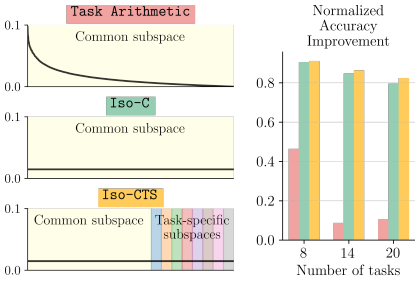
Figure 1 . Spectrum of singular values for a single layer weight update matrix obtained by merging using Task Arithmetic (top) compared to our approaches:Iso-C (middle) and Iso-CTS (bottom). Task Arithmetic sums the task-specific matrices, which result in a spectrum with a few dominant components. Iso-C instead replaces this spectrum with a uniform one, which results in significant performance improvement. Iso-CTS en- hances the common subspace with task-specific subspaces and yields state-of-the-art model merging performance.
Original paper · CC BY 4.0 · Marczak, Daniel, Magistri, Simone, Cygert, Sebastian, Twardowski, Bartłomiej, Bagdanov, Andrew D., van de Weijer, Joost · No Task Left Behind: Isotropic Model Merging with Common and Task-Specific Subspaces · Original paper figure · Extracted the figure area from page 1 of the original PDF.For each layer, Iso-C sums the task matrices into the Task Arithmetic matrix and takes its SVD, giving ΔTA = UΣV^T. It then computes one scale, the average of the r singular values, and rebuilds the update as σ U V^T. Because the scale is shared, the singular values no longer decide how strongly each direction contributes. The merged weights keep the Task Arithmetic form, θ = θ0 + αΔ, with α chosen on a held-out validation set.
The authors change only the scale of the directions and leave the fine-tuning procedure untouched. Flattening raises the number of components that count as dominant, which in turn raises SAR. The authors link that higher SAR to less inter-task interference in internal activations, which they measure in an appendix.
Adding task-specific directions with Iso-CTS
Iso-C spends its whole basis on the common subspace, and that is its weak point. The top singular directions of the sum capture only the dominant common variations. Singular vectors tied to near-zero singular values add negligible information, so they waste basis slots. Tasks whose directions are orthogonal to the common ones stay underrepresented, and this gets worse as the number of tasks grows.
Iso-CTS keeps the top k common directions and replaces the lowest singular vectors with task-specific ones. Each task matrix is first projected off the common subspace, which gives the projection Δt minus U1:k times (U1:k) transposed times Δt. That projection makes both the left and right task directions orthogonal to the kept common directions.
The method then takes the SVD of each projected matrix and retains the top s = r − kT directions per task.
Iso-CTS concatenates the common and task-specific bases into U* and V*, each with r columns. The projection doesn't make the left and right bases orthogonal to each other, so Iso-CTS whitens both, following Gargiulo et al. (2025). The scale σ is the sum of the retained common and task-specific singular values, divided by r. The merged update is Δ Iso-CTS equal to σ U* V*⊤, and the model is θ0 plus αΔ, with α chosen on a held-out validation set.
The authors pick the common subspace size as a fraction kr of the basis. Iso-CTS with kr equal to 1 reduces to Iso-C and loses 2.8% accuracy from the maximum on 20 tasks. Iso-CTS improves over Iso-C for any kr in (0.0, 1.0), so the method stays robust to this choice.
Vision merging across task-set sizes
The authors merge fully fine-tuned CLIP models with ViT-B/32, ViT-B/16 and ViT-L/14 visual encoders over sets of 8, 14 and 20 tasks. They take the checkpoints from Wang et al. (2024b), and ViT-B/16 serves as the default backbone. Weight averaging, Task Arithmetic, TIES-Merging, Consensus TA and TSV-M form the baselines. Zero-shot and fine-tuned models set the lower and upper bounds for every comparison.
On ViT-B/16 with 20 tasks, Iso-CTS reaches 82.4 average absolute accuracy, versus 79.6 for Iso-C and 80.6 for TSV-M. The table caption claims state-of-the-art results for every backbone and evaluated scenario. The ViT-B/32 8-task column is the exception, where Iso-C scores 86.3 against 86.2 for Iso-CTS. In the other columns, Iso-CTS sits ahead of Iso-C mostly in the larger task sets.
For ViT-L/14 with 20 tasks, Iso-CTS scores 90.1 while Iso-C scores 87.6.
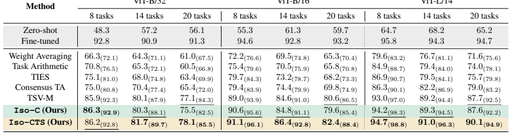
Table 1 . Iso-CTS achieves state-of-the-art performance for all backbones on all evaluated scenarios. We present average absolute accuracy and average normalized accuracy (in subscript) in %. The best method in bold and the second-best underlined.
Original paper · CC BY 4.0With 8 models the two methods perform almost alike, so a small task set seems to fit in the common subspace. With 14 and 20 models, Iso-CTS outperforms Iso-C by up to 2.8% in absolute accuracy. The authors read this as evidence that a small number of tasks can be represented faithfully in the common subspace. They argue that larger task sets make the task-specific directions necessary for effective merging.
Iso-CTS fills the remaining basis with task-specific directions taken from the orthogonal complement of the common subspace. Those task-specific vectors aren't guaranteed to be orthogonal to each other, so Iso-CTS whitens them before reconstruction. Its scaling factor averages the singular values of both the common and task-specific vectors.
LoRA merging results
Iso-C and Iso-CTS work on low-rank updates by operating on reconstructed task matrices, not on the LoRA factors. Each task matrix is rebuilt as ΔW_t = B_t A_t, where A_t and B_t are the LoRA matrices for task t. The authors follow the KnOTS evaluation protocol, using its codebase and checkpoints. The checkpoints are ViT-B/32 and ViT-L/14 fine-tuned with rank 16 LoRA on 8 vision tasks.
The authors compare Iso-C and Iso-CTS against TIES and DARE-TIES, both with and without KnOTS, and against TA.
On ViT-L/14, Iso-CTS reaches 85.3 normalized per-task average accuracy, while Iso-C reaches 83.7. KnOTS-TIES reaches 78.2 on the same backbone, so the Iso methods score higher than the best KnOTS variant shown. On ViT-B/32 the two Iso variants are almost equal, with 73.7 for Iso-CTS and 73.6 for Iso-C. KnOTS-TIES reaches 68.0 on ViT-B/32, which places it below both Iso variants on that backbone.
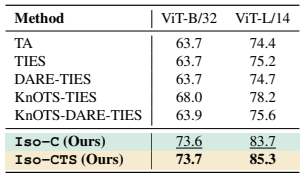
Table 2 . Normalized per-task average accuracy. We merge 8 mod- els fine-tuned with LoRA following (Stoica et al., 2025).
Original paper · CC BY 4.0KnOTS was designed specifically for LoRA merging, while the Iso methods are general-purpose merges. Applying the same general-purpose merge to the reconstructed matrices gives the Iso methods a clear advantage. The authors read this as evidence that the Iso methods carry over to the low-rank case. The Limitations section notes that the low-rank structure of task matrices could be exploited for further gains and efficiency.
Language model merging with T5 models
For language, the authors follow the MaTS setup with T5-Large-LM-Adapt models fine-tuned on subsets of 8 and 7 tasks from the T0 mixture. The baselines are weight averaging, Task Arithmetic, TIES, Fisher Merging, RegMean and MaTS. Fisher Merging and RegMean are both compared alongside the per-parameter and task-arithmetic families, so the table spans several merging styles.
The fine-tuned model, at 80.7 on 8 tasks and 85.9 on 7 tasks, serves as the upper reference.
On the 8-task set, Iso-C scored 75.6 average absolute accuracy, compared to 63.8 for Task Arithmetic and 72.5 for MaTS. On the 7-task set, Iso-C scored 83.3, compared to 81.5 for MaTS. Both Iso-C and Iso-CTS significantly outperform the competing approaches, which shows the proposed methods carry over from vision to language.
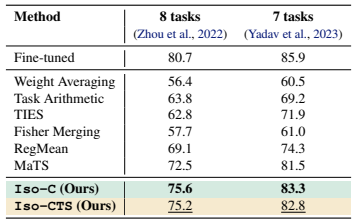
Table 3 . NLP results using T5-Large-LM-Adapt fine-tuned on tasks from T0 mixture. We present average absolute accuracy.
Original paper · CC BY 4.0Iso-CTS scored 75.2 and 82.8 on the two sets, so it trails Iso-C slightly here. The authors suggest that the common space captures all the directions these 7 and 8 NLP tasks need. Because the common subspace already covers these tasks, adding task-specific directions brings no extra gain in this setting. The Iso-CTS and Iso-C difference matters for the paper's claim, since Iso-CTS was designed for large task counts.
The same section also checks how the singular value spectrum shapes the outcome, using an interpolation coefficient β between Task Arithmetic and Iso-C. As β goes to 1, the skewed Task Arithmetic spectrum becomes isotropic, and SARavg and NAI rise across tasks.
Where the gain comes from
The authors first ask what happens to the spectrum when Task Arithmetic is moved toward Iso-C. They interpolate the singular values as Σβ = (1 − β)ΣTA + βΣIso-C, where β is an interpolation coefficient. As β goes to 1, the skewed Task Arithmetic spectrum becomes isotropic, so the scaling factor is equal along all singular directions. Figure 4a shows this change, and the number of preserved components kM grows as the spectrum flattens.
Figure 4b shows SARavg rising steadily as β approaches 1, and Figure 4c shows NAI improving across all tasks. These results match the correlation between alignment and final performance from Section 3.3.
Next, the authors truncate the flattened Iso-C spectrum and keep only the k leftmost directions. The singular values after index k are set to zero, so the remaining directions carry no weight. Figure 5a plots NAI against the fraction of retained components k/r from Iso-C. The first few directions produce fast NAI gains on several tasks, especially in the aligned groups.
The directions tied to the least significant singular values of ∆TA contribute little to performance. This supports the authors' choice to replace the least significant common directions with task-specific ones in Iso-CTS.
For Iso-CTS, the common fraction kr is the remaining hyperparameter, and the authors tune it on the 20-task setting. Any kr in (0.0, 1.0) improves on Iso-C, while kr in [0.5, 0.9] varies by less than 0.5% from the optimum.
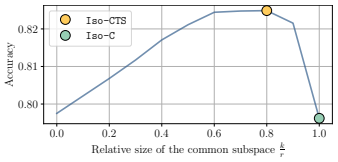
Figure 6 . Iso-CTS is robust to the selected size of the common subspace as any value leads to improvement over Iso-C. These results are for the 20-task scenario.
Original paper · CC BY 4.0Limitations of the Iso methods
The authors name one constraint directly: the common subspace is determined by Task Arithmetic. They note that Task Arithmetic can be suboptimal, so better methods could be developed for finding that subspace. Iso-C and Iso-CTS both start from the singular vectors of the summed task matrix, so their common subspace inherits any weakness of that starting point.
The LoRA experiments cover only ViT-B/32 and ViT-L/14, each merging 8 vision tasks fine-tuned with rank 16 LoRA. The authors point out that the methods could leverage the low-rank structure of task matrices to improve performance and efficiency. They didn't test that low-rank exploitation, so its benefit remains open.
The paper considers static merging exclusively, so dynamic methods that change the inference procedure are outside the comparison. On the language sets, Iso-CTS also trails Iso-C, with 75.2 against 75.6 on 8 tasks and 82.8 against 83.3 on 7 tasks. The largest Iso-CTS gain over Iso-C appears with 14 and 20 tasks, where it improves by up to 2.8% in absolute accuracy.
Paper info
- Authors
- Marczak, Daniel, Magistri, Simone, Cygert, Sebastian, Twardowski, Bartłomiej, Bagdanov, Andrew D., van de Weijer, Joost
- Venue
- arXiv · Preprint
- First published
- 2025-2-7
- Added
- 2026-10-29
- Updated
- 2025-6-11
- Version
- v3
- arXiv
- 2502.04959
- Original paper terms
- CC BY 4.0
- What we show
- Paper info, commentary and permitted figures from the original paper
AI commentary is a separate explanation from the original paper and may contain errors. The original paper and figures follow each source's terms of use and any rights noted separately.
Abstract
Model merging integrates the weights of multiple task-specific models into a single multi-task model. Despite recent interest in the problem, a significant performance gap between the combined and single-task models remains. In this paper, we investigate the key characteristics of task matrices -- weight update matrices applied to a pre-trained model -- that enable effective merging. We show that alignment between singular components of task-specific and merged matrices strongly correlates with performance improvement over the pre-trained model. Based on this, we propose an isotropic merging framework that flattens the singular value spectrum of task matrices, enhances alignment, and reduces the performance gap. Additionally, we incorporate both common and task-specific subspaces to further improve alignment and performance. Our proposed approach achieves state-of-the-art performance on vision and language tasks across various sets of tasks and model scales. This work advances the understanding of model merging dynamics, offering an effective methodology to merge models without requiring additional training. Code is available at https://github.com/danielm1405/iso-merging .
Quote from the paper
Marczak, Daniel, Magistri, Simone, Cygert, Sebastian, Twardowski, Bartłomiej, Bagdanov, Andrew D., van de Weijer, Joost (2025). No Task Left Behind: Isotropic Model Merging with Common and Task-Specific Subspaces. arXiv:2502.04959v3. https://arxiv.org/abs/2502.04959v3
BibTeX
@misc{daniel2025task,
  title = {{No Task Left Behind: Isotropic Model Merging with Common and Task-Specific Subspaces}},
  author = {Marczak, Daniel and Magistri, Simone and Cygert, Sebastian and Twardowski, Bartłomiej and Bagdanov, Andrew D. and van de Weijer, Joost},
  year = {2025},
  eprint = {2502.04959},
  archivePrefix = {arXiv},
  url = {https://arxiv.org/abs/2502.04959v3}
}