Paper commentary
Don't Just Trust Your Memory: Evidence-Linked Memory Reduces Memory-Induced Degradation in LLM Agents
Evidence-linked memory lets LLM agents check lessons against their source runs
- Problem Lessons are wrong or misapplied and arrive without the trajectories they came from, so agents cannot check them. Memory can make LLM agents fail tasks they solve without it.
- Method WikiTrace links each lesson to its source run, so the agent can descend and check it. Descent happens only when an insight is missing details or conflicts with another.
- Results WikiTrace averaged 90.2 across eight suites, against 79.5 for No Memory, and reduces regression.
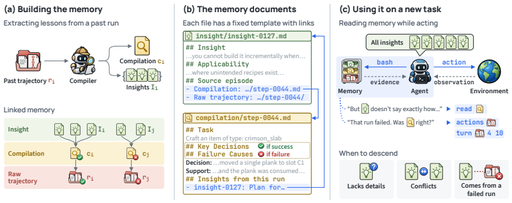
Figure 2 :Overview of WikiTrace.(a) A compiler turns each past run into a compilation, a diagnosis of why the run succeeded or failed, and insights, each a concise lesson. All layers stay linked. (b) Each layer’s documents follow a fixed template. (c) The agent starts from every insight and descends through the links under the conditions shown.
Original paper · CC BY 4.0 · Yukyeong Lee, Yumin Choi, Jinheon Baek, Sung Ju Hwang · Don't Just Trust Your Memory: Evidence-Linked Memory Reduces Memory-Induced Degradation in LLM Agents · Original paper figure · Extracted the figure area from page 3 of the original PDF.Why lessons from memory can hurt
Memory lets an agent reuse what past runs taught it, but that reuse can backfire. Average accuracy can't separate these failures from the gains, so the authors measure Gain and Regression separately. Existing memory methods show Regression comparable to, or even higher than, rerunning the agent without memory.
To find the source of the degradation, the authors analyzed tasks the agent solved in all three no-memory trials but failed with memory. The judge sorts each cause into one of five kinds. Most often the item itself was wrong, at 20%. The failure counts for all 355 cases appear in Figure 3, where 70 are wrong items.
Figure 4 shows a wrong rule from ExpeL that fails a task the agent solves without memory. The root cause is that a trajectory carries only a single success or failure label. That label doesn't reveal which of its many actions caused the outcome. Existing approaches provide lessons without their trajectories, so the agent has no way to check them.
Keeping each lesson tied to its run
WikiTrace stores every lesson with a route back to the run it came from, so the agent can inspect that run before trusting the lesson. The memory has three layers, with a concise insight at the top, a compilation below it, and the raw trajectory at the bottom. The insight is short and says what to do, while the raw trajectory is complete but too long to reread at every decision.
A compiler reads each past task, its trajectory, and its success or failure label, and writes one compilation. For a successful run, the compilation records decisions tied to success, while for a failed run it records plausible explanations for the failure. The authors treat these accounts as interpretations rather than verified explanations of the outcome.
The compiler writes each run separately, so every insight keeps a clear source, and the authors never update or delete insights once written.
The raw trajectory stays unchanged, recording task metadata, each turn's reasoning, action, and observation, and whether the run succeeded. Each insight links to both its source compilation and its raw trajectory. Each layer also has an index, which helps the agent navigate the memory.
How the agent descends at test time
At test time, WikiTrace starts the agent from all insights and lets it descend to source runs only when needed. It also asks for another descent whenever an action fails. A command format is the example the prompt gives for such a fact.
Insights Only is the baseline that receives the same insights but no compilations or raw trajectories. Both methods use the same agent and the same memory built once from the No Memory training runs. Because of this setup, any gap between them can be attributed to that access. WikiTrace's Regression is 4.5%, versus 6.5% for Insights Only and 9.7% for the rerun baseline.
The gap between Descent and Stay grows from 1.8 points on Easy tasks to 4.1 on Hard ones.
Does checking the source reduce regressions?
The 3.2 point gap over Insights Only isolates the value of source evidence, since the two methods receive identical insights. WikiTrace averages 90.2 against 87.0 for Insights Only, so the difference comes from access to source runs rather than from the insights themselves. Insights Only and WikiTrace differ only in whether they can open compilations and raw trajectories, and the descent prompt is also absent from Insights Only.
Regression falls from 6.5% for Insights Only to 4.5% for WikiTrace. The no-memory rerun baseline sits at 9.7%, so WikiTrace is the only method whose Regression interval lies entirely below the rerun band. WikiTrace's Gain exceeds the rerun baseline by 35 percentage points, compared to 27 for Insights Only and 7 to 14 for existing memory methods.
The authors attribute both shifts to access to source runs, since that is the only difference from Insights Only.
Failed runs help on their own, but they carry more regression risk. For Insights Only, this risk reaches 9.3% on PlanCraft and 9.4% on ScienceWorld when it uses failed runs alone. With the same insights, WikiTrace lowers these rates to 7.1% and 8.9%. With GLM-5.3-flash, WikiTrace averaged 92.7 on PlanCraft and ScienceWorld, 1.8 percentage points above Insights Only.
WikiTrace opens source runs in 22% of Easy-task runs and 44% of Hard-task runs. Because the agent chooses when to descend, the gap also reflects which runs it opens.
Limitations of evidence-linked memory
The method inherits the weakness of its inputs, because memory is built only from binary trajectory outcomes. The agent still has to judge the evidence it opens, so a misread run can keep a wrong insight in play.
Every insight sits in the first message, so the prompt grows with the memory. The second backbone was checked only on PlanCraft and ScienceWorld. Its results come from GLM-5.3-flash, so the claim of generalization covers those two suites and that model.
The causes of degradation and the descent labels both come from an LLM judge. The judge reads the agent's reasoning, so these labels describe what that reasoning states. They don't show what actually produced the outcome.
Paper info
- Authors
- Yukyeong Lee, Yumin Choi, Jinheon Baek, Sung Ju Hwang
- Venue
- arXiv · Preprint
- First published
- 2026-11-10
- Added
- 2026-11-12
- Updated
- 2026-11-10
- Version
- v1
- arXiv
- 2611.14320
- Category
- cs.AI · cs.MA
- Original paper terms
- CC BY 4.0
- What we show
- Paper info, commentary and permitted figures from the original paper
AI commentary is a separate explanation from the original paper and may contain errors. The original paper and figures follow each source's terms of use and any rights noted separately.
Abstract
External memory enables LLM agents to improve from experience by distilling trajectories of past tasks into concise lessons for new tasks. However, memory can also lead to memory-induced degradation, where an agent fails on tasks it would solve without memory, often because it follows a lesson that is incorrect, or misapplies or misreads a valid one. This is because lessons are inferred from trajectories labeled only with task success or failure, yet are typically provided without the trajectories they came from, leaving the agent no way to check them. To address this, we introduce WikiTrace, an evidence-linked memory system designed to let agents check each lesson against its original trajectory. Specifically, motivated by the finding that a trajectory often still holds the evidence needed to catch an erroneous lesson, WikiTrace stores each lesson as a concise insight linked to a summary of why its trajectory succeeded or failed and to the raw trajectory itself. Then, on a new task, the agent starts from all insights and, whenever one lacks details needed to act, conflicts with another, or comes from a failed task, descends through its links with terminal tools to fill in missing details or correct the insight before acting. We validate WikiTrace on five agentic benchmarks, showing that it consistently outperforms existing memory approaches and a baseline given the same insights alone, while also reducing memory-induced degradation. Our code is available at https://github.com/yukyeongleee/wikitrace
Figures from the paper
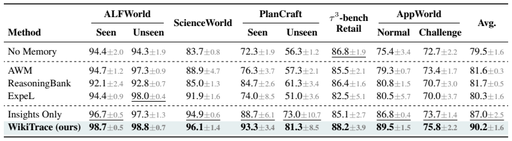
Table 1 :Main results.Mean over three trials, ± the standard deviation across trials in small type. Avg. averages the eight suites. Best results are bolded and second-best results are underlined.
Original paper · CC BY 4.0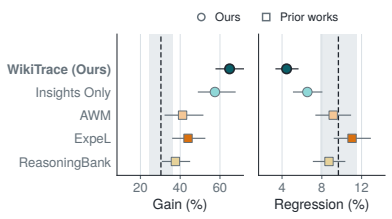
Figure 5 :Gain and Regression of WikiTrace and memory-based baselines, averaged over eight suites with 95% intervals.
Original paper · CC BY 4.0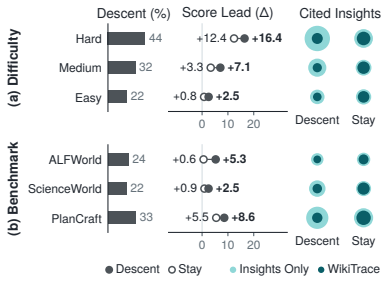
Figure 6 :WikiTrace against Insights Only by de- scentin the text-world benchmarks. Score Lead ∆ is WikiTrace minus Insights Only, and circle radius gives the insights reported as used. Difficulty: No Memory solves the task in none (Hard), one or two (Medium) or all three (Easy) trials.
Original paper · CC BY 4.0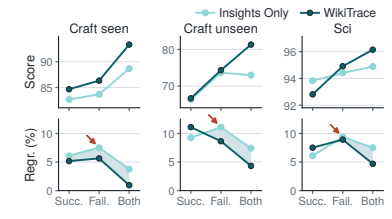
Figure 7 :Score and Regression by memory subset. Memory is built from successful runs (Succ.), failed runs (Fail.) or both. Arrows mark Insights Only’s higher Regression with failed runs.
Original paper · CC BY 4.0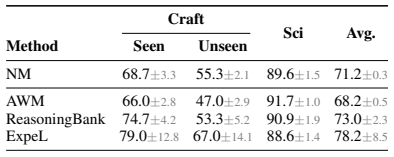
Table 2 :Results with GLM-5.3-flash. Mean over three trials. NM is No Memory and WT is WikiTrace.
Original paper · CC BY 4.0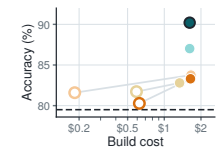
Figure 10 :Accuracy against build cost, averaged over the eight suites. A hollow mark is a default build and a filled mark the build run N times. The dashed line shows No Memory.
Original paper · CC BY 4.0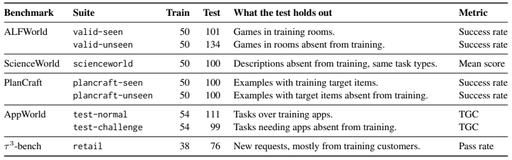
Table 3 :Benchmark suites.One training set per benchmark serves all of its test suites.
Original paper · CC BY 4.0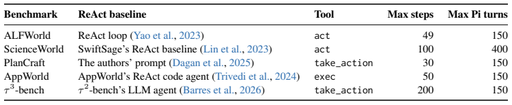
Table 4 :Agent harness per benchmark.The instruction, exemplars, and step budget follow the listed ReAct baseline. A step is one environment tool call, except in τ 3-bench, which counts agent, user, and tool turns as its authors do.
Original paper · CC BY 4.0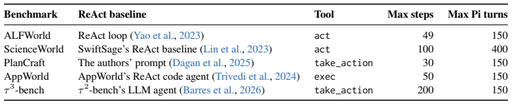
Table 5 :Compared methods.Formatted Rules are rules with required fields. WikiTrace links each to the compilation and raw trajectory it came from. Access is inject (I), retrieve (R) or traverse (T).
Original paper · CC BY 4.0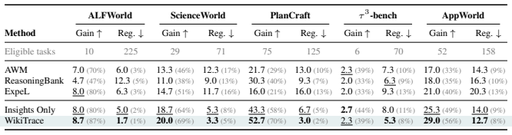
Table 6 :Gain and Regression counts per benchmark.Tasks moved on one trial, averaged over trials and summed over suites, with the rate over the eligible tasks (first row) in small type. Bold is best and underlined second best.
Original paper · CC BY 4.0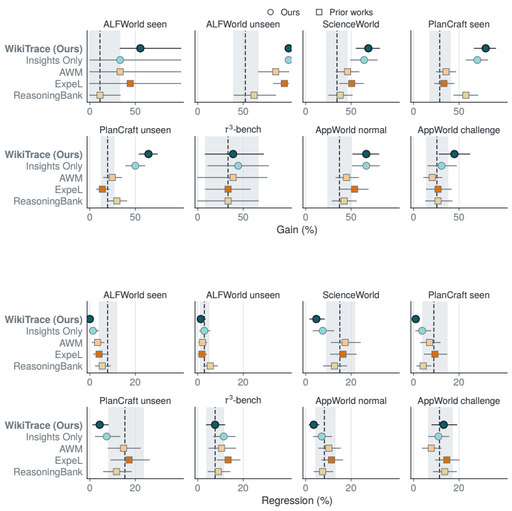
Figure 13 :Gain and Regression per suite, with 95% intervals. The dashed line and band denote rerunning without memory.
Original paper · CC BY 4.0Quote from the paper
Yukyeong Lee, Yumin Choi, Jinheon Baek, Sung Ju Hwang (2026). Don't Just Trust Your Memory: Evidence-Linked Memory Reduces Memory-Induced Degradation in LLM Agents. arXiv:2611.14320v1. https://arxiv.org/abs/2611.14320v1
BibTeX
@misc{lee2026just,
  title = {{Don't Just Trust Your Memory: Evidence-Linked Memory Reduces Memory-Induced Degradation in LLM Agents}},
  author = {Yukyeong Lee and Yumin Choi and Jinheon Baek and Sung Ju Hwang},
  year = {2026},
  eprint = {2611.14320},
  archivePrefix = {arXiv},
  url = {https://arxiv.org/abs/2611.14320v1}
}