Paper commentary
Agent Self-Improvement with Frozen Weights: The Added Value and Limits of Failure Traces
Failure traces add only a small gain beyond a plain search for agent notes
- Problem Gains from learned agent harnesses are hard to credit to failure traces, because a plain search over notes can also improve an agent. Earlier work often found that failure-derived lessons fix source tasks but rarely transfer to unseen ones.
- Method The authors have a larger teacher model write short WHEN-THEN lessons from a frozen Qwen3.5-9B agent's failure traces. They compare these lessons with a matched search that never sees the failures.
- Results On sealed decision cases, trace-written lessons scored 80.9% against 76.8% for the matched search, a gap of +4.0 points. Most of the total gain over the standard harness came from the search itself.
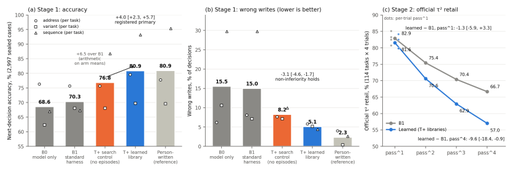
Figure1 :(a)Decision-level(“Stage1”)accuracyon2,997sealed 𝜏2 retailcases: modelonly(B0),standardharness(B1),no-evidence search (“T+ search control”), trace lessons (“T+ learned library”; T+ is the teacher writer) and a person-written reference. Markers are per-task values for the address, variant and sequence tasks. (b) Wrong writes (write calls that are not exactly the correct one) for the same arms. (c) Official𝜏2 retail conversations (“Stage 2”; 114 tasks× 4 trials): pass^𝑘 for the standard harness and the trace lessons. pass^𝑘 is the chance that all𝑘 trials of a task succeed, so it cannot increase as𝑘 grows (unlike pass@𝑘, where any one success counts). The learned arm uses a different lesson library in each trial while the standard harness uses one prompt, so for𝑘 >1 its pass^𝑘also reflects variation across libraries; the pass^4 gap is exploratory.
Original paper · CC BY 4.0 · Arkid Mitra · Agent Self-Improvement with Frozen Weights: The Added Value and Limits of Failure Traces · Original paper figure · Extracted the figure area from page 4 of the original PDF.Why a learned harness is hard to credit to failures
A learned harness can gain from more than the failures its writer read, which makes the source of the gain hard to pin down. Search alone can help: a writer that suggests candidate texts and keeps the top scorers on development data can lift the agent. The second source is evidence, meaning the writer read the agent's failures and encoded something about them.
The matched control keeps the same writer, loop and selection but withholds the episode contents, so it separates evidence only partly. The control still differs from the learned arm in how the actual search runs, so its gain can't be fully credited to the traces.
Recent work doubts such gains, and under matched budgets harness evolution did no better than sampling in parallel [5]. Failure-derived experience tends to repair source tasks, but it rarely transfers to unseen ones, including on the backbones the authors cite. Several later studies report regressions, but they don't include significance tests.
One of them reports that all sixteen evolved agents lost tasks they had previously solved.
So the open question is whether the agent's traces produced a gain when a loop does show one. The authors give a teacher access to a frozen Qwen3.5-9B agent's traces and compare its notes with a matched search that never sees a failure. On generated retail decisions, lessons written from failures beat that search by +4.0 points.
How the trace arm and its matched control differ
The trace arm starts from a frozen Qwen3.5-9B agent with its thinking mode off, so only the text it reads can change. A larger teacher, Qwen3.8-Flash-Next-FP8, turns the agent's failures into short WHEN-THEN lessons. The teacher's loop proposes a lesson, checks it on a validation split, and then keeps or reverts it. Each of the 12 seeded runs per task yields one lesson library.
The no-evidence search leaves the writer, its prompts, its loop and its selection unchanged. Only the episodes change, because a fixed sentence takes their place. That isolates the episode contents, but only partly, since the actual search could still differ from the trace arm. On BFCL, the control receives the function documentation instead of episodes, with the same step count and candidate screen.
The gate is a separate screen that judges single candidate lessons rather than whole libraries. A hierarchical Bayesian model pools each lesson's estimates across contexts, which are task by decision type on τ2 and domain family on BFCL. A lesson passes only with a credible gain above one point and enough exposure in every context. Per-context non-inferiority within the 1-point margin requires the probability of losing more than one point to stay below 0.10 in every context.
Bounded harm is checked as a wrong write on τ2 and as a wrong final state on BFCL.
On the decision level, the no-evidence search reached 76.8% while the trace-written lessons reached 80.9%, a gap of +4.0 points. The standard harness scored 70.3%, so the control achieved 6.5 of the 10.5 points, about 60%, without traces. That entire control gain fell on the task whose rule the writer's task description already stated. Most of the decision-level gain therefore came without the agent's failures being read.
Decision cases, conversations and the BFCL split
The decision level cuts each test case down to a synthetic conversation that stops at one choice, such as deciding between changing an address and asking first. The 2,997 sealed test cases cover three tasks, address, variant and sequence, and each is scored against a fixed answer. A wrong write is a write tool call, like changing an order, that isn't exactly the correct one.
Because τ-bench 2.0.0 isn't score-comparable with 1.x, the authors' numbers only hold for the pinned version. Full conversations reward the final state, and the lessons' behaviour changes can alter which final states are reachable. The decision cases are snapshots, so the agent can't explore or recover from a mistake inside them.
Each of the 200 BFCL roots has a Base instance and a Long-Context instance. The split assigns 50 roots to discovery, 30 to gate and 120 to held-out, giving 60 gate and 240 held-out instances. The BFCL writer, Qwen3.5-397B-A17B, reads 198 discovery episodes, and the 120 held-out roots stay reserved for testing.
On BFCL the no-evidence search keeps the writer, prompts, loop and candidate screen, but it receives function documentation instead of episodes. The neutral note is a fixed system message with no procedure, so it tests whether any note changes behaviour.
Decision accuracy: a modest gain over the matched search
Decision accuracy on 2,997 sealed cases was 70.3% for the standard harness, 76.8% for the search, and 80.9% for the lessons. The registered contrast, lessons minus search, is +4.0 [+2.3, +5.7] points, so the interval clears zero and passes the superiority test.
Against the standard harness, the lessons gained +10.5 points [+8.5, +12.5]. The no-evidence search alone accounted for 6.5 of those 10.5 points, about 60%, without any failure traces. That search keeps the writer, loop, selection and budget, but it replaces the episode contents with a fixed sentence. So most of the total gain came from the search procedure, and the traces added the remaining 4.0 points over it.
All of the search's gain falls on one task, the one whose rule the writer's task description already states.
The authors didn't test whether the teacher could discover such a rule from scratch. The decision cases are snapshots, so the agent couldn't explore or recover from an earlier mistake. At the conversation level, pass^1 was 82.9% for the standard harness and 81.6% with the lessons.
Full conversations show no demonstrated gain
Official 𝜏2 retail runs 114 tasks with 4 trials each, and the authors compare pass^1 for the standard harness with the lessons. The standard harness reached 82.9% pass^1, while the lessons reached 81.6%. The gap is −1.3 [−5.9, +3.3], so the interval covers both losses and gains. The lessons did change behaviour: conversations where the agent changed items before the address fell from 6 to 0.
The authors note that these behaviours can change which final states are reachable. Because 𝜏2 rewards the final state, the behaviour change did not become a demonstrated score gain.
The 𝜏2 gate started from 12 candidate lessons that the teacher wrote. It ran those candidates on 20,400 decisions over 1,200 prefixes. Two lessons passed every check under every prior. The address-first lesson gained +4.7 [+4.0, +5.4] points. The list-first lesson gained +2.7 [+2.0, +3.4] points. Together they gained +7.4 [+6.3, +8.4], with all three figures given as 90% credible intervals.
Four lessons that pushed towards asking or confirming again were rejected, since each credibly hurt at least one context.
These estimates come from the same data used to select the lessons. No held-out test was run on the two admitted lessons. Noise is large, since across four identical trials of published 𝜏2 retail configurations, 33 to 55% of task verdicts flipped.
BFCL: a gate winner that didn't hold on new roots
None of the eight trace-written lessons passed the screen. Every estimate lay within ±2.5 points, so the screen left no trace lesson standing. At the gate, that lesson's credible interval gave +4.9 [+1.9, +8.0] points. On the 18 instances the audit judged clean, the estimate fell to +3.9 [−0.4, +8.3], an interval that includes zero.
The held-out test used 120 unseen roots, giving 240 instances and 5,760 episodes. The registered difference, standard harness minus the search lesson, was +0.31 [−3.12, +3.65]. Its Holm-adjusted p was 1.000, so the test gave no demonstrated gain. Smaller positive effects remain compatible with these intervals. The lesson didn't replicate on held-out roots.
A neutral note with no procedure scored +4.5 [+0.7, +8.4] over the standard harness in a registered descriptive secondary analysis. That analysis wasn't corrected for multiple tests, and on clean instances the gain shrank to +3.4 [−1.9, +9.1]. On clean held-out instances, standard harness minus the search lesson was +6.0 [+0.2, +12.0], with Holm p 0.149.
Scorer defects and how they shift the BFCL estimates
They never read agent trajectories, so their labels came from the benchmark itself. An instance counts as defective when a plausible, natural response would flip its official verdict.
The official scores remain the primary results, and the audited estimate sits beside them. The authors fixed the defect lists before any outcome was opened, so the audit could not steer the results. On clean held-out instances, the search lesson gave +6.0 [+0.2, +12.0] against the standard harness, with Holm p 0.149. The eight trace lessons gave +6.2 [-0.5, +13.2] on the same clean instances, with Holm p 0.153.
The neutral note's gain also shrank, from +4.5 on all instances to +3.4 [-1.9, +9.1] on clean ones.
The gate winner followed the same pattern on the 18 instances the audit judged clean. Its estimate fell from +4.9 to +3.9 [-0.4, +8.3], an interval that includes zero. Most defective instances were flagged because a correct response was scored wrong, not because the agent erred. The audit changed how strongly the BFCL results can be read, even though it did not overturn the official scores.
Limitations of the frozen-weight evidence
The study covers one frozen 9B model, run with thinking off, on two benchmarks. It also uses one teacher family, so the results aren't claimed to carry over to other agents or writers.
It doesn't show whether a teacher can discover such a rule on its own. On BFCL, the search writers read function documentation that the trace writer didn't see. The decision cases are snapshots, so the agent can't explore or recover from its own actions.
The τ2 gate data were run again in full after the first run's folder was lost. In that run, the original database answered read calls in 0.27% of rows. Removing those rows leaves the admitted lessons unchanged, so the gate result stands. BFCL runs used sampled decoding at temperature 0.7 instead of the official 0.001. A scorer serialisation fix came after the run, and verdicts matched byte for byte wherever they could be compared.
Both writers already had the target rules, and without the matched search the decision gain would look 2.6 times larger.
What the controlled comparison adds
The matched control separates the trace effect from the search effect at the decision level, and that gap is where the claim lives. Trace-written lessons beat the no-evidence search by 4.0 points, with a 95% interval from +2.3 to +5.7. The no-evidence search reached 6.5 of the 10.5 points that the lessons gained over the standard harness, about 60%.
Access to mistakes therefore improved decision accuracy within this procedure, though by less than the registered worthwhile gain. Without the matched search, the decision-level gain would look 2.6 times larger.
The conversation-level test removes most of the decision-level gain from the headline claim. In official retail conversations, pass^1 was 82.9% for the standard harness and 81.6% with the lessons, a difference of −1.3 [−5.9, +3.3]. The lessons changed the targeted behaviour, but the authors didn't demonstrate a gain in final-state success.
Most of the decision-level gain therefore came without reading failures, and the trace-specific part is smaller than it looks.
Screens are not certifications, so the two admitted τ2 lessons still need tests on new data. Repeating four identical trials of published τ2 retail configurations flipped 33–55% of task verdicts.
The scorer audit changed how strongly the BFCL results can be read. The audit judged 146 of 240 held-out instances clearly defective, and the gate winner's gain fell to +3.9 on the clean instances. The authors didn't test a fully certified lesson or a conversation-level gain, so the claim stays limited to the decision level.
Paper info
- Authors
- Arkid Mitra
- Venue
- arXiv · Preprint
- First published
- 2026-11-8
- Added
- 2026-11-10
- Updated
- 2026-11-8
- Version
- v1
- arXiv
- 2611.11342
- Category
- cs.LG · cs.AI · cs.CL
- Original paper terms
- CC BY 4.0
- What we show
- Paper info, commentary and permitted figures from the original paper
AI commentary is a separate explanation from the original paper and may contain errors. The original paper and figures follow each source's terms of use and any rights noted separately.
Abstract
We evaluate whether an AI agent's harness, the notes around its model, can learn from the agent's failure traces beyond a matched search that never sees them. It can, but less than it looks. We tested an open 9-billion-parameter model with fixed weights; a larger teacher model wrote its notes. On generated customer-service decisions, where both note writers were told the target rules, notes based on the agent's mistakes improved accuracy by 4.0 percentage points over notes from the same process with the mistakes withheld. That process alone, trying and keeping better-scoring notes, reached about 60% of the total improvement. In full customer-service conversations the same notes showed no demonstrated improvement. Separately, a strict screen of single lessons admitted two customer-service lessons, still awaiting tests on new data, and one tool-use lesson, written without seeing the agent's mistakes, which showed no demonstrated gain on new tool-use tasks. A neutral note with no procedure scored higher than the learned lessons (exploratory). A blind audit judged 146 of 240 tool-use test items defective.
Figures from the paper
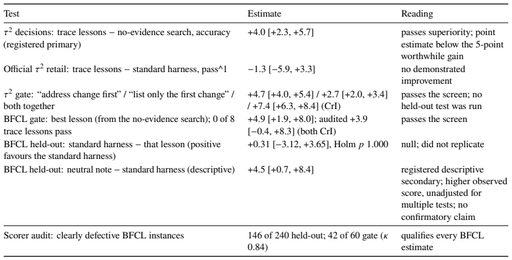
Table 1 :Headline registered results. Estimates are in percentage points: contrasts are first arm minus second, gate rows a lesson’s estimated gain; intervals are 95% confidence intervals except those marked CrI (90% credible intervals). The BFCL held-out primary is standard harness− lesson, so there a positive value favours the standard harness. Trace lessons were written from the agent’s own episodes; the no-evidence search used the same writer and procedure without them.
Original paper · CC BY 4.0Quote from the paper
Arkid Mitra (2026). Agent Self-Improvement with Frozen Weights: The Added Value and Limits of Failure Traces. arXiv:2611.11342v1. https://arxiv.org/abs/2611.11342v1
BibTeX
@misc{mitra2026agent,
  title = {{Agent Self-Improvement with Frozen Weights: The Added Value and Limits of Failure Traces}},
  author = {Arkid Mitra},
  year = {2026},
  eprint = {2611.11342},
  archivePrefix = {arXiv},
  url = {https://arxiv.org/abs/2611.11342v1}
}