Paper commentary
How to "train" a surgeon? Benchmarking generalist agents in surgical scene understanding
Agents that search surgical knowledge can partly close MLLM understanding gaps
- Problem General multimodal LLMs were hard to judge for surgery because surgical data is scarce and evaluation protocols are fragmented. Nobody knew which surgical tasks these models already handle from pretraining.
- Method SurgAgentGym is an agentic environment where general MLLM agents see the frame and search SurgWiki at inference time. Unlike retraining, the agents use these tools without any additional surgical training.
- Results Agentic inference narrows the gap mainly for perception-heavy tasks. Fine-grained localization and expert-style assessment remain persistent bottlenecks.
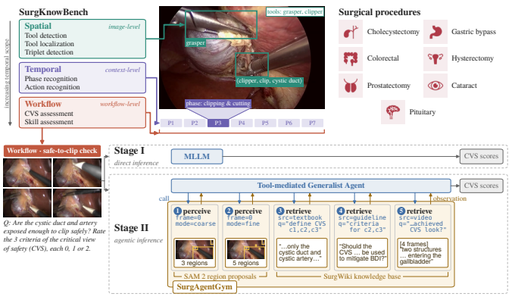
Fig. 1 : How to "train" a surgeon? In our two-stage evaluation: Stage I uses SURGKNOWBENCH to diagnose zero-shot surgical competence of MLLMs, while Stage II uses SURGAGENTGYMon SURGKNOWBENCH-Hard to test whether general-purpose MLLM agents can improve at inference time through bounded knowledge search and generalist visual grounding.
Original paper · CC BY 4.0 · Gengyuan Zhang, Xiao Han, Shijie Zhou, Abdullah Koukash, Jingpei Wu, Jindong Gu, Yuqicheng Zhu, Nassir Navab, Volker Tresp, Ghazal Ghazaei · How to "train" a surgeon? Benchmarking generalist agents in surgical scene understanding · Original paper figure · Extracted the figure area from page 2 of the original PDF.Why surgical competence of MLLMs is hard to judge
Surgical scene understanding asks a model to recognize instruments, anatomy, tissue states and actions, then place them within the workflow of one operation. The first obstacle is data: intraoperative videos are restricted by privacy constraints, and expert annotation is costly and procedure-specific. Surgical practice also varies across procedures, institutions, and surgeons, so the data stay fragmented and hard to share.
The second obstacle is that nobody knows which surgical tasks general-purpose MLLMs already handle through multimodal pretraining. They also don't know which failures persist without domain-specific adaptation.
That narrowness leaves a need for a unified evaluation protocol before the competence question can be answered. The authors split the question into two stages, so each one can be tested on its own. Stage II asks whether they can improve at inference time without additional training, since data-intensive surgical training is impractical.
The authors borrow the idea of scaffolded training from human surgeons, who consult references, review demonstrations, and connect knowledge to scenes. The transferable capability is epistemic control: recognizing when knowledge is missing, seeking evidence, and grounding it in the scene. Stage II therefore tests whether general-purpose MLLMs, equipped to see, search, and think, can show new scene-understanding capabilities.
SURGKNOWBENCH and the zero-shot results
SURGKNOWBENCH pools 11 public surgical datasets spanning seven procedures into one question-and-answer format. Its tasks fall into three families: spatial recognition, temporal reasoning and workflow assessment. Each source's labels are mapped to canonical strings, so every model answers the same questions. Frame-level tasks use annotated frames, while CVS and skill assessment keep temporal metadata and representative visual inputs.
The benchmark covers 376,602 samples in total, and 952 samples make up the Hard set.
Recognition metrics differ by task: macro-averaged F1 for tool detection, action recognition and triplet detection, and strict accuracy for phase recognition. Tool localization uses label-constrained F1@0.5 after Hungarian matching, so a box with the wrong instrument label earns no credit. The first result is that models recognize some instruments but localize them poorly.
For tool detection, 16 of the 17 models beat the majority baseline, yet the best macro-F1 is only 26.1%, compared to 13.5% for that baseline. Localization is weaker still: the best F1@0.5 is 22.7%, and a box counts only with the right label and enough overlap. Figure 2 places these dataset-task scores beside published specialist results, for context.
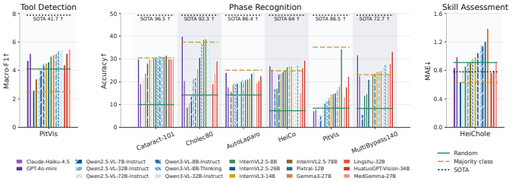
Fig. 2 : Stage I performance on dataset–task breakdown.
Original paper · CC BY 4.0The authors then build SURGKNOWBENCH-Hard from episodes that models fail without external tools. Candidates are ranked within each dataset by PanelError, which is one minus a task-normalized score averaged over a panel of open-source MLLMs. The aim is to reduce the pretrained-competence confound, so later gains aren't just knowledge the models already had.
How SURGAGENTGYM lets agents see and search
The agent in SURGAGENTGYM fills knowledge gaps during a run by looking at the frame and searching a curated corpus. The authors expected this to help because human trainees learn from references and prior cases, not only from labeled examples. They frame the skill as epistemic control: recognizing missing knowledge, seeking evidence, and grounding that evidence in the scene.
The agents use these tools without any additional surgical training.
The visual grounding tool, perceive(), works on the current surgical input. It proposes candidate regions with SAM 2, and the proposals are then filtered and ranked. Coarse mode keeps proposals whose area ratio lies in [0.5%,75%] and returns the top 10 proposals. Fine mode enforces only the lower area-ratio bound of 0.05% and returns the top 30 proposals.
If filtering removes every proposal, the tool falls back to the unfiltered SAM 2 output.
The retrieve() tool searches SURGWIKI, and the agent picks the query, a declared knowledge type and a source type. Source type is the only argument that restricts the retrieval pool. SURGWIKI holds 74,315 indexable chunks: 37,672 text, 35,951 tutorial-video and 692 case-record chunks. Each episode allows at most two retrieve() calls per source type, which gives an implicit maximum of eight calls.
Invalid calls don't end the episode, because the environment returns a success=False observation with guidance. When fewer than two steps remain, the environment restricts available tools to submit(), so the agent must commit an answer. The full observation history is stored as the trajectory, so the authors can inspect each step later. These constraints apply identically to proprietary, open-source and medical-domain models.
Did tools close the gap?
Two comparisons carry the tool result, and each isolates a different effect. Panel A pits each model's direct answers against its full agent setting on the hard set. Panel B keeps the prompt fixed and switches tools off and on, so the gap reflects tool access alone. The authors pair the changes per model and axis, using a clustered bootstrap and BH-FDR correction.
In Panel A, tool detection gains appear for 15 of 16 models. Action recognition gains appear for all 14 open-source models. GPT-4o-mini and Claude-Haiku-4.5 fall by 17.7 and 7.6 macro-F1 points, so tool use doesn't help every backbone. The best action recognition score in the full setting reaches 27.6% macro-F1. That score still sits below the 30.0% majority baseline.
The gains are relative, and agents still don't beat a trivial majority guess.
With prompts matched, tool detection changes range from +1.4 to +9.7 points across five backbones. Action recognition changes range from +4.6 to +26.2 points under the same matched comparison. Phase recognition also improves for all five backbones, though by smaller margins. Localization improves for four of the five backbones, so the Panel A drops don't show a harmful effect of tools.
InternVL2.5-8B loses 10.6 localization points in Panel A but gains 8.1 points in the matched setup. CVS and skill assessment change in both directions across models. The authors conclude that tool access alone doesn't settle rubric-based judgments.
Across 80 testable model-axis cells, 39 show significant Stage I to Stage II improvements. Only one cell regresses significantly, Qwen3-VL-8B-Thinking on tool detection. Phase and action recognition supply most of the significant improvements, with 14 of 16 models each. Skill assessment has no significant improvements at all.
What the agents actually did with the tools
Agents chose tools in a way that follows the task type. For phase recognition, agents called retrieve() in 72.6% of episodes. Tutorial videos dominated retrieval for action recognition, supplying 80.3% of retrieval calls. Tutorial videos also made up the majority of retrieval calls for triplet detection (62.2%), tool localization (53.6%), and phase recognition (51.9%).
Workflow assessment showed a different preference, because textbooks and guidelines together supplied 80.8% of CVS retrieval calls and 66.9% of skill-assessment retrieval calls.
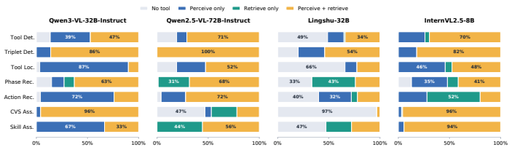
Fig. 4 : Full-setting tool-use patterns across four representative agents on SURGKNOWBENCH-Hard.
Original paper · CC BY 4.0Precision@1 ranges from 57% to 82%, so retrieved items often address the agent's query but not always. The retrieval relevance score reaches an AUROC of 0.817 against expert annotations. Against the LLM judge, the same score reaches an AUROC of 0.894.
The authors attribute most failures to the generated query rather than the retrieval pipeline. Visual grounding is a separate weak point, since perceive() returned no usable region proposals for GPT-4o-mini and Claude-Haiku-4.5 on action recognition. That happened in 90% to 100% of their trajectories. So weak grounding can starve the agent of usable evidence, even when retrieval itself works.
The authors also set the perceive() proposal filters for laparoscopic images, lowering two SAM 2 thresholds.
Where the agentic results stop
SURGWIKI is a closed, provenance-tracked corpus, so the agents can only search what it holds. The benchmark side has a similar boundary, because SURGKNOWBENCH harmonizes public surgical datasets.
The agentic evaluation runs only on SURGKNOWBENCH-Hard, so the tool gains are measured on the difficult episodes alone. Stage II doesn't test the full SURGKNOWBENCH, so the agent results can't be read as a general benchmark score. The matched tool comparison covers five backbones, and the paper's claims about tool access rest on those five.
Localization improves for four of the five backbones, so the gain isn't uniform even inside that matched set.
The retrieval relevance check rests on a calibration sample of 50 retrieval calls, which is a small set. The reported precision@1 ranges from 57% to 82%, so relevance can't be assumed for every call. The authors name wrong queries, imperfect evidence and weak grounding as open problems for agents. Visual grounding can also return unusable evidence, since perceive() returns no usable region proposals in 90% to 100% of action-recognition trajectories for GPT-4o-mini and Claude-Haiku-4.5.
Fine-grained localization and expert-style assessment stay weak after tool access, and tools don't fix subjective CVS and skill judgments.
Paper info
- Authors
- Gengyuan Zhang, Xiao Han, Shijie Zhou, Abdullah Koukash, Jingpei Wu, Jindong Gu, Yuqicheng Zhu, Nassir Navab, Volker Tresp, Ghazal Ghazaei
- Venue
- arXiv · Preprint
- First published
- 2026-11-8
- Added
- 2026-11-10
- Updated
- 2026-11-8
- Version
- v1
- arXiv
- 2611.11437
- Category
- cs.CV · cs.AI
- Original paper terms
- CC BY 4.0
- What we show
- Paper info, commentary and permitted figures from the original paper
AI commentary is a separate explanation from the original paper and may contain errors. The original paper and figures follow each source's terms of use and any rights noted separately.
Abstract
Evaluating general-purpose multimodal large language models (MLLMs) for surgical scene understanding remains limited due to scarce surgical data and fragmented evaluation protocols. We address these challenges through a two-stage evaluation framework for surgical scene understanding. In Stage I, we introduce SurgKnowBench, a diagnostic benchmark that harmonizes public surgical datasets across procedures and tasks and evaluates proprietary and open-source MLLMs to map the boundary of pretrained surgical competence. SurgKnowBench reveals that current models retain partial visual priors but remain weak on relational and procedural understanding and workflow assessment. Building on this failure frontier and motivated by the scaffolded nature of surgical training, we introduce SurgAgentGym, an agentic environment where general-purpose MLLM agents can use bounded knowledge search over SurgWiki and general-purpose visual grounding for surgical tasks. SurgAgentGym evaluates whether generalist agents can improve surgical understanding at inference time through tool-mediated evidence use, without additional surgical training. Our results show that agentic inference narrows the gap mainly for perception-heavy tasks, while fine-grained localization and expert-style assessment remain persistent bottlenecks. This opens a path toward future studies of agentic surgical understanding.
Quote from the paper
Gengyuan Zhang, Xiao Han, Shijie Zhou, Abdullah Koukash, Jingpei Wu, Jindong Gu, Yuqicheng Zhu, Nassir Navab, Volker Tresp, Ghazal Ghazaei (2026). How to "train" a surgeon? Benchmarking generalist agents in surgical scene understanding. arXiv:2611.11437v1. https://arxiv.org/abs/2611.11437v1
BibTeX
@misc{zhang2026train,
  title = {{How to "train" a surgeon? Benchmarking generalist agents in surgical scene understanding}},
  author = {Gengyuan Zhang and Xiao Han and Shijie Zhou and Abdullah Koukash and Jingpei Wu and Jindong Gu and Yuqicheng Zhu and Nassir Navab and Volker Tresp and Ghazal Ghazaei},
  year = {2026},
  eprint = {2611.11437},
  archivePrefix = {arXiv},
  url = {https://arxiv.org/abs/2611.11437v1}
}