논문 해설
How to "train" a surgeon? Benchmarking generalist agents in surgical scene understanding
외과의를 어떻게 "훈련"시킬까? 수술 장면 이해에서 범용 에이전트 벤치마킹
- 연구 문제 일반 목적 MLLM은 수술 장면 이해에서 추가 학습 없이 어디까지 가능한지, 추론 시점의 도구 사용이 그 한계를 줄이는지 묻는 연구입니다.
- 연구 방법 SURGKNOWBENCH로 제로샷 역량을 진단하고, SURGAGENTGYM에서 시각 제안 도구와 SURGWIKI 검색 도구를 가진 에이전트를 평가합니다.
- 주요 결과 도구 접근은 도구 검출과 행동 인식 같은 지각 중심 과제에서 이득을 주었지만, 위치 지정과 기술 평가에서는 일관된 개선이 확인되지 않았습니다.
일반 목적 MLLM의 수술 장면 이해 한계
수술 장면 이해에는 수술 도구, 행위, 절차 단계, 워크플로 평가처럼 전문성이 필요한 판단이 포함됩니다. 그러나 수술 영상은 개인정보 제약과 전문가 주석 비용 때문에 대규모로 모으기 어렵고, 기관과 집도자마다 절차가 달라 표준적인 지도 학습 레시피를 그대로 적용하기 어렵습니다. 이 논문은 먼저 추가 수술 학습 없이 일반 목적 MLLM이 무엇을 이해하는지 진단하고, 이어서 추론 시점에 도구를 사용하는 에이전트가 그 한계를 줄일 수 있는지 묻습니다.
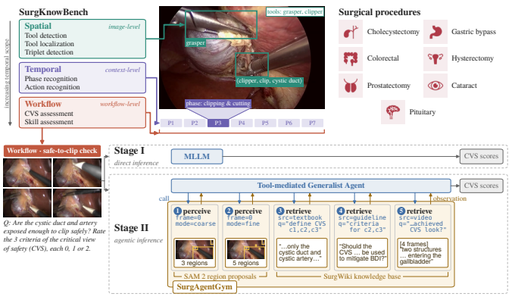
Fig. 1 : How to "train" a surgeon? In our two-stage evaluation: Stage I uses SURGKNOWBENCH to diagnose zero-shot surgical competence of MLLMs, while Stage II uses SURGAGENTGYMon SURGKNOWBENCH-Hard to test whether general-purpose MLLM agents can improve at inference time through bounded knowledge search and generalist visual grounding.
원문 · CC BY 4.0 · Gengyuan Zhang, Xiao Han, Shijie Zhou, Abdullah Koukash, Jingpei Wu, Jindong Gu, Yuqicheng Zhu, Nassir Navab, Volker Tresp, Ghazal Ghazaei · How to "train" a surgeon? Benchmarking generalist agents in surgical scene understanding · 원문 그림 인용 · 원본 PDF 2쪽에서 그림 영역을 추출했습니다.SURGKNOWBENCH의 구성과 평가 방식
SURGKNOWBENCH는 11개의 공개 수술 데이터셋을 7개 시술과 7개 과제 축으로 맞추어 통합한 진단 벤치마크입니다. 원천 주석은 공통 QA 형식으로 변환되며, 프레임 단위 과제는 주석된 프레임을, 구간 단위 CVS와 기술 평가는 시간 정보와 대표 시각 입력을 사용합니다. 과제 축은 공간 인식, 시간 추론, 워크플로 평가의 세 영역으로 묶입니다. 도구 검출은 매크로 F1, 위치 지정은 헝가리안 매칭 후 레이블 일치와 IoU 0.5 이상을 요구하는 F1@0.5로 평가합니다. 기술 평가는 MAE와 이차 가중 κ를 함께 보고합니다.
Stage I 진단 결과와 한계
일부 모델은 빈번한 등급으로 몰아 높은 정확도를 얻었지만 κ는 0 근처나 음수였습니다. 순위에서 Qwen3-VL-32B가 평균 순위 3.6으로 가장 좋았으나, 통계적으로 유의한 우위는 도구 검출에서만 확인되었다고 원문이 보고합니다.
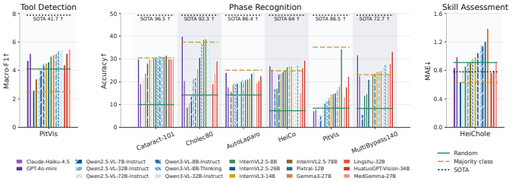
Fig. 2 : Stage I performance on dataset–task breakdown.
원문 · CC BY 4.0 · Gengyuan Zhang, Xiao Han, Shijie Zhou, Abdullah Koukash, Jingpei Wu, Jindong Gu, Yuqicheng Zhu, Nassir Navab, Volker Tresp, Ghazal Ghazaei · How to "train" a surgeon? Benchmarking generalist agents in surgical scene understanding · 원문 그림 인용 · 원본 PDF 5쪽에서 그림 영역을 추출했습니다.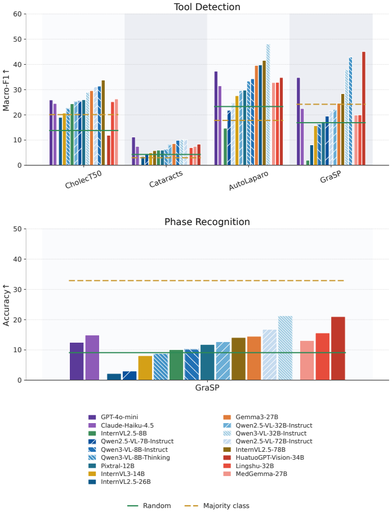
Fig. 6 : Stage I performance on dataset–task cells with random and majority baselines: tool detection and phase recognition.
원문 · CC BY 4.0 · Gengyuan Zhang, Xiao Han, Shijie Zhou, Abdullah Koukash, Jingpei Wu, Jindong Gu, Yuqicheng Zhu, Nassir Navab, Volker Tresp, Ghazal Ghazaei · How to "train" a surgeon? Benchmarking generalist agents in surgical scene understanding · 원문 그림 인용 · 원본 PDF 44쪽에서 그림 영역을 추출했습니다.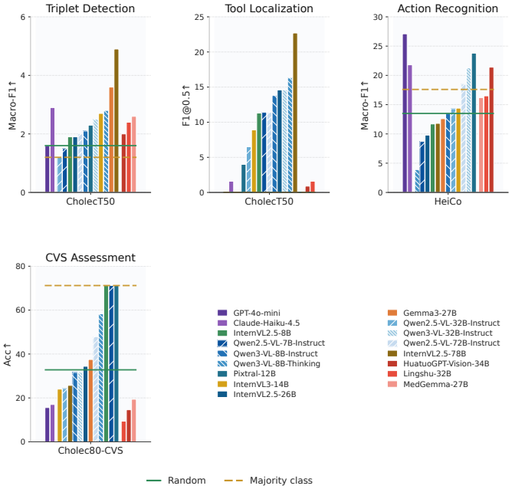
Fig. 6 : Stage I performance on dataset–task cells with random and majority baselines (continued): triplet detection, tool localization, action recognition, and CVS assessment.
원문 · CC BY 4.0 · Gengyuan Zhang, Xiao Han, Shijie Zhou, Abdullah Koukash, Jingpei Wu, Jindong Gu, Yuqicheng Zhu, Nassir Navab, Volker Tresp, Ghazal Ghazaei · How to "train" a surgeon? Benchmarking generalist agents in surgical scene understanding · 원문 그림 인용 · 원본 PDF 45쪽에서 그림 영역을 추출했습니다.SURGAGENTGYM과 도구 구성
SURGAGENTGYM은 일반 목적 MLLM 에이전트가 추론 시점에 두 도구를 사용하는 환경입니다. perceive()는 질의 없이 SAM 2 자동 마스크 생성으로 클래스 비의존적 시각 제안 영역을 만들고, Set-of-Mark 형식의 번호 오버레이를 반환합니다. retrieve()는 에이전트가 만든 질의, 선언한 지식 유형, 출처 유형을 받아 SURGWIKI에서 근거 청크를 검색합니다. 에이전트는 모델 가중치를 바꾸지 않으며, 도구 호출 횟수와 출처별 예산을 환경이 제한합니다.
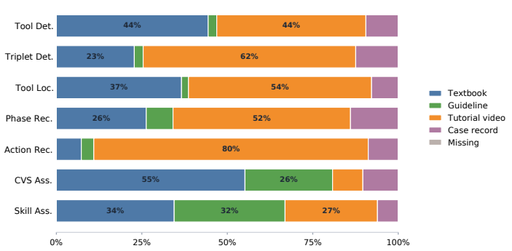
Fig. 8 : Retrieval source distribution aggregated over the four trajectory-analysis models. Percentages are computed over retrieval calls for each task.
원문 · CC BY 4.0 · Gengyuan Zhang, Xiao Han, Shijie Zhou, Abdullah Koukash, Jingpei Wu, Jindong Gu, Yuqicheng Zhu, Nassir Navab, Volker Tresp, Ghazal Ghazaei · How to "train" a surgeon? Benchmarking generalist agents in surgical scene understanding · 원문 그림 인용 · 원본 PDF 63쪽에서 그림 영역을 추출했습니다.SURGWIKI 색인과 하이브리드 검색
SURGWIKI는 교과서, 임상 가이드라인, 튜토리얼 영상, 사례 기록의 네 출처 계열로 구성된 출처 추적 가능한 지식 기반입니다. 오프라인 단계에서 문서를 파싱해 청크로 나누고 jina-embeddings-v4로 밀집 표현을 만들며 BM25 희소 색인을 구축합니다. 검색 시에는 BM25와 밀집 검색을 병렬로 수행하고 Reciprocal Rank Fusion으로 순위를 합친 뒤 텍스트 재순위화를 적용합니다. 시각 요소는 밀집 신호로만 기여하며, 재순위화기는 이미지 픽셀을 직접 소비하지 않습니다.
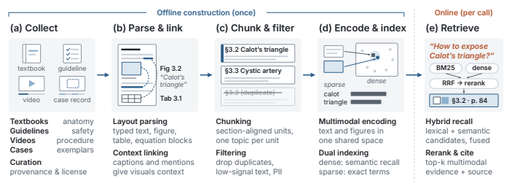
Fig. 5 : SURGWIKIknowledge base construction pipeline.(A)Source Collection assembles provenance-tracked corpora from reference texts, clinical guidelines, tutorial videos, and case records.(B)Parsing & Linking uses MinerU [ 53] to extract structured text, figures, and tables, linking visual elements to captions and in-text mentions.(C)Chunking & Filtering applies qual- ity filtering and heading-aware segmentation.(D)Encoding & Indexing embeds knowledge units with jina-embeddings-v4 [54] and stores them in dense Qdrant 4 and sparse BM25 [55] indices. (E)Retrieval & Search combines BM25 and dense recall with RRF fusion [56], followed by text-only reranking [57] over textual candidates and multimodal text surrogates, to return top-k evidence with source attribution.
원문 · CC BY 4.0 · Gengyuan Zhang, Xiao Han, Shijie Zhou, Abdullah Koukash, Jingpei Wu, Jindong Gu, Yuqicheng Zhu, Nassir Navab, Volker Tresp, Ghazal Ghazaei · How to "train" a surgeon? Benchmarking generalist agents in surgical scene understanding · 원문 그림 인용 · 원본 PDF 39쪽에서 그림 영역을 추출했습니다.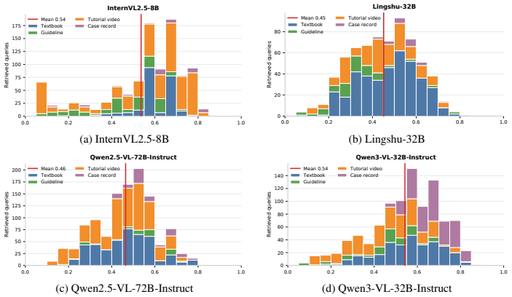
Fig. 7 : Reranker score distributions across four backbones on SURGKNOWBENCH-Hard in the Full setting. Bars are stacked by retrieval source type, and the red vertical line marks the mean Jina reranker score for each model.
원문 · CC BY 4.0 · Gengyuan Zhang, Xiao Han, Shijie Zhou, Abdullah Koukash, Jingpei Wu, Jindong Gu, Yuqicheng Zhu, Nassir Navab, Volker Tresp, Ghazal Ghazaei · How to "train" a surgeon? Benchmarking generalist agents in surgical scene understanding · 원문 그림 인용 · 원본 PDF 62쪽에서 그림 영역을 추출했습니다.SURGKNOWBENCH-Hard의 선정 기준
SURGKNOWBENCH-Hard는 여러 오픈소스 패널 모델의 성능으로 난이도를 매긴 부분집합입니다. 각 에피소드 x에 대해 PanelError는 패널 모델 집합의 과제 정규화 성능 1−Perf의 평균으로 정의됩니다. 여기서 Perf는 [0,1] 범위의 과제별 점수이며, 각 데이터셋 안에서 PanelError로 후보 에피소드를 순위화해 어려운 부분을 고릅니다. 이 선정은 외부 도구 없이 MLLM이 실패하는 에피소드를 모아 이후 에이전트 평가에서 사전 역량의 혼입을 줄이려는 목적을 가집니다.
도구 사용의 효과와 적용 범위
Stage II의 전체 에이전트 설정은 여러 백본에서 도구 검출과 행동 인식을 개선했지만, 그 이득은 과제와 백본에 따라 달랐습니다. GPT-4o-mini와 Claude-Haiku-4.5의 행동 인식은 하락했습니다. 일치된 프롬프트에서 도구를 켠 비교에서는 다섯 백본 모두 도구 검출과 행동 인식이 개선되었고, 위치 지정은 네 백본에서 개선되었습니다. 기술 평가는 도구 접근만으로 일관된 이득이 없었습니다. 따라서 이 결과는 SURGKNOWBENCH-Hard와 측정한 백본 범위에서 해석해야 합니다.
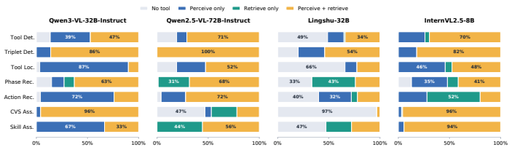
Fig. 4 : Full-setting tool-use patterns across four representative agents on SURGKNOWBENCH-Hard.
원문 · CC BY 4.0 · Gengyuan Zhang, Xiao Han, Shijie Zhou, Abdullah Koukash, Jingpei Wu, Jindong Gu, Yuqicheng Zhu, Nassir Navab, Volker Tresp, Ghazal Ghazaei · How to "train" a surgeon? Benchmarking generalist agents in surgical scene understanding · 원문 그림 인용 · 원본 PDF 9쪽에서 그림 영역을 추출했습니다.한계와 적용 범위
저자들은 SURGKNOWBENCH가 공개 데이터셋을 통합하므로 범위가 원천 데이터의 절차, 기관, 카메라 시점, 주석 체계, 과제 정의에 제한된다고 밝힙니다. SURGWIKI 역시 폐쇄적이고 출처 추적이 가능한 근거 저장소이지만, 콘텐츠는 출처 가용성과 라이선스의 제약을 받습니다. 또한 도구 사용이 실패 원인을 모두 해결하지 못하며, 질의 품질·잡음 있는 증거의 견고성·증거 통합이 여전히 과제로 남아 있다고 해석합니다.
논문 정보
- 저자
- Gengyuan Zhang, Xiao Han, Shijie Zhou, Abdullah Koukash, Jingpei Wu, Jindong Gu, Yuqicheng Zhu, Nassir Navab, Volker Tresp, Ghazal Ghazaei
- 학회·저널
- arXiv · 프리프린트
- 최초 공개일
- 2026년 11월 8일
- 등록일
- 2026년 11월 10일
- 수정일
- 2026년 11월 8일
- 버전
- v1
- arXiv
- 2611.11437
- 분류
- cs.CV · cs.AI
- 원문 이용 조건
- CC BY 4.0
- 제공 범위
- 논문 정보, 해설, 허용된 원문 그림
AI 해설은 논문 원문과 별개의 설명이며 오류가 있을 수 있습니다. 원문과 그림은 각 출처의 이용 조건과 따로 표시된 권리를 따릅니다.
초록
Evaluating general-purpose multimodal large language models (MLLMs) for surgical scene understanding remains limited due to scarce surgical data and fragmented evaluation protocols. We address these challenges through a two-stage evaluation framework for surgical scene understanding. In Stage I, we introduce SurgKnowBench, a diagnostic benchmark that harmonizes public surgical datasets across procedures and tasks and evaluates proprietary and open-source MLLMs to map the boundary of pretrained surgical competence. SurgKnowBench reveals that current models retain partial visual priors but remain weak on relational and procedural understanding and workflow assessment. Building on this failure frontier and motivated by the scaffolded nature of surgical training, we introduce SurgAgentGym, an agentic environment where general-purpose MLLM agents can use bounded knowledge search over SurgWiki and general-purpose visual grounding for surgical tasks. SurgAgentGym evaluates whether generalist agents can improve surgical understanding at inference time through tool-mediated evidence use, without additional surgical training. Our results show that agentic inference narrows the gap mainly for perception-heavy tasks, while fine-grained localization and expert-style assessment remain persistent bottlenecks. This opens a path toward future studies of agentic surgical understanding.
원문 인용
Gengyuan Zhang, Xiao Han, Shijie Zhou, Abdullah Koukash, Jingpei Wu, Jindong Gu, Yuqicheng Zhu, Nassir Navab, Volker Tresp, Ghazal Ghazaei (2026). How to "train" a surgeon? Benchmarking generalist agents in surgical scene understanding. arXiv:2611.11437v1. https://arxiv.org/abs/2611.11437v1
BibTeX
@misc{zhang2026train,
  title = {{How to "train" a surgeon? Benchmarking generalist agents in surgical scene understanding}},
  author = {Gengyuan Zhang and Xiao Han and Shijie Zhou and Abdullah Koukash and Jingpei Wu and Jindong Gu and Yuqicheng Zhu and Nassir Navab and Volker Tresp and Ghazal Ghazaei},
  year = {2026},
  eprint = {2611.11437},
  archivePrefix = {arXiv},
  url = {https://arxiv.org/abs/2611.11437v1}
}