Paper commentary
VeriLadder: A Multi-Agent Specification Refinement System for Tool-Verified Verilog Datasets
VeriLadder builds a tool-verified Verilog dataset using LLM agents and EDA checks
- Problem Most Verilog datasets only check that code compiles, so a pair can pass without becoming hardware. An instruction that fits many circuits teaches the model a wrong mapping.
- Method VeriLadder lets LLM agents rewrite each instruction, then keeps a rewrite only if another model rebuilds an equivalent circuit from it, as a formal checker confirms.
- Results The share of rebuildable designs rose from 26.1% to 78.2% after refinement, compared with the original instruction.
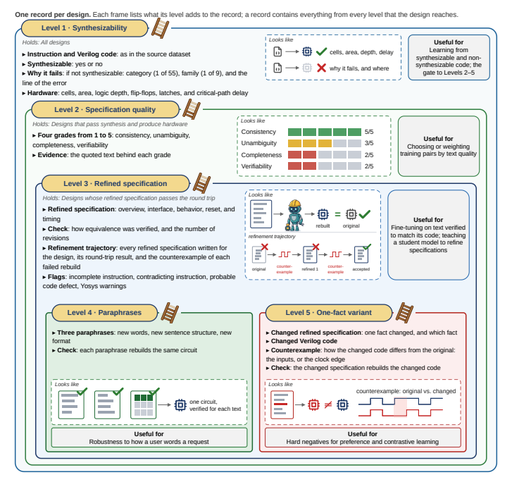
Fig. 2 . What a record of VeriLadder contains. Each frame lists what one level adds and holds only the designs that reach that level. At Level 3 the record keeps the refinement trajectory, and at Level 5 the counterexample of every one-fact variant. “Looks like” boxes are simplified drawings, “Useful for” names a use of what the level adds, and Figures 3–20 show real records.
Original paper · CC BY 4.0 · Rajabi, Saeid, Yang, Chengmo, Patnaik, Satwik · VeriLadder: A Multi-Agent Specification Refinement System for Tool-Verified Verilog Datasets · Original paper figure · Extracted the figure area from page 7 of the original PDF.Why public Verilog pairs are hard to trust
Verilog models learn from instruction-code pairs, so each pair teaches what an instruction should produce. Public RTL is scarce and uneven in quality, which makes every pair worth checking before training. Yet most datasets only check that code compiles or parses, so a pair can pass without ever becoming hardware. When an instruction contradicts its code, or fits many different circuits, the model learns a wrong mapping.
The authors list six gaps in how these datasets are built. Failing designs are usually dropped or kept without a label, so the cause of each failure is lost. Specifications are never measured or repaired, and each design comes with only one wording. Hard negatives are missing as well, because the only negatives are code that fails to compile or carries a seeded bug.
No dataset teaches the step of turning an imprecise request into a precise specification.
Letting tools decide acceptance
The core idea is to rewrite each instruction until a separate model can rebuild an equivalent circuit from the text alone. Only then is the text trusted as a specification of that circuit. A rewrite that fails returns its counterexample to the writer, so each failure becomes usable data.
The roles are split on purpose.
The LLMs only write and revise text. A synthesis tool or a formal equivalence checker decides whether a design or a specification is accepted. The five levels follow the order an engineer checks a design, and each level adds one kind of protection.
Level 1: checking that the code becomes hardware
Level 1 synthesizes each design with Yosys and maps it to Nangate 45 nm standard cells. A design counts as effectively synthesizable only if its netlist contains at least one cell. Empty circuits arise when an output is undefined, constant, or wired straight to an input.
In RTLCoder, 71.9% of designs synthesize, but only 60.0% are effectively synthesizable. The gap is 11.8% of all designs, which map to an empty circuit. Overall, 28% of RTLCoder designs fail synthesis, and 43% of PyraNet designs do. A pass label alone overstates how much hardware a dataset holds, so the cell count is released with every pass.
Level 1 also flags seven critical warnings for defects that synthesis reports without failing the design. Among the 14,385 effectively synthesizable RTLCoder designs processed at Levels 2 to 5, 16.3% carry at least one. Such designs still continue, with the warning kept in their label.
An LLM rating is no substitute for a synthesis check. PyraNet's LLM quality rating has a Spearman rank correlation of 0.08 with whether its designs synthesize.
Level 2 and 3: grading and rebuilding instructions
The qualities are consistency, unambiguity, completeness and verifiability, each defined by what can be seen at the ports.
The other three judge the text alone.
The four grades together predict whether a rebuild succeeds, with a ROC AUC of 0.89 on the original instructions.
Level 3 then rewrites the instruction and tests the result with a round trip. A builder receives only the refined specification and writes five attempts. An attempt that fails to compile gets one repair turn with the Yosys error.
The equivalence checker builds a miter and asks a SAT solver whether any output can differ, starting from all-zero registers.
The Writer keeps the refined specification functional and grounded in the code, and a program rejects any spec that contains code. A failing specification is returned once for correction, and a failed round trip sends the counterexample back to the Writer, at most twice.
Refinement lifts rebuilds, most for state machines
The builder rebuilds 26.1% of the 14,385 RTLCoder designs from the original instruction. That is a gain of 52 percentage points, and the authors report that every design type gains about 50 points.
With an open-source builder, the rebuilt share rises from 28% to 71%. The authors read the gain as a change in the specification rather than in the builder, since the same builder rebuilds most designs once the specification is refined.
Finite-state machines gain the most, from 4.2% rebuilt from the original instruction to 65.6% from the refined specification. Designs that fail Level 3 are larger, with a median of 47 cells, compared to 16 for those that pass.
Do refined specs describe behavior or copy the code?
A specification could pass by copying the code, which would teach one implementation rather than the circuit's behavior. The authors test this on all 11,247 accepted designs.
A line-by-line translation would give one sentence per line of code, but sentence count grows roughly with the 0.22nd power of the number of lines. The 842 designs with 31 to 100 lines have a median of 40 lines and only 15 sentences. Small designs get more sentences than lines, because the specification also states the interface, reset and timing.
Only 0.7% of refined specifications contain Verilog syntax, compared to 7.0% of the original instructions.
Structural similarity is measured with winnowing, and a verified rebuild from the refined specification has a median similarity of 0.24 to the original code. Only 6.0% of those rebuilds reach a similarity of 0.9 or more. The rebuilds from refined specifications are slightly less similar to the original than rebuilds from the instruction, with medians of 0.21 and 0.23.
Two builders writing from the same specification differ, with a median similarity of 0.40 across 1,012 designs. The authors attribute this structure to each builder's own style rather than to the specification.
What training on the refined pairs changes
The Level 2 grader is Qwen2.5-Coder-7B-Instruct, fine-tuned on 13,992 graded instructions with 300 held out. Its grades correlate at 0.80 to 0.83 with the Level 2 grades on unambiguity, completeness and verifiability. Its mean grade predicts the round-trip outcome with a ROC AUC of 0.86, far above the 0.59 before fine-tuning.
Training Qwen2.5-Coder-7B-Instruct on refined specifications raises VerilogEval v2 functional pass@1 from 39.4% to 44.7%. On RTLLM v2 the same comparison goes from 31.2% to 41.6%. The authors use 10,893 designs for training and hold out 300 as VeriLadder-Bench.
The final model also adds 3,248 designs of underrepresented categories from CodeV-R1 and OriGen, so the Table 4 numbers don't isolate the refined specifications alone. On RTLLM v2 it scores 45.2, compared to 35.0 for the pre-trained model.
For wording robustness, Claude Haiku 5.5 rebuilds the same circuit in 93.5% to 94.4% of paraphrase attempts. Qwen3-Coder-30B does so in 69.9% to 72.2%.
Limitations
The equivalence check of sequential designs is bounded to the first 20 clock cycles after reset. Random simulation adds coverage, but it still runs only three sequences of 3,000 cycles.
Flags for contradiction, incompleteness and code defects don't decide acceptance, so users have to filter them.
The fine-tuned grader's consistency correlation is only 0.61, and it was tested on 300 held-out instructions.
Paper info
- Authors
- Rajabi, Saeid, Yang, Chengmo, Patnaik, Satwik
- Venue
- arXiv · Preprint
- First published
- 2026-11-21
- Added
- 2026-11-24
- Updated
- 2026-11-21
- Version
- v1
- arXiv
- 2611.28617
- Category
- cs.AI · cs.SE
- Original paper terms
- CC BY 4.0
- What we show
- Paper info, commentary and permitted figures from the original paper
AI commentary is a separate explanation from the original paper and may contain errors. The original paper and figures follow each source's terms of use and any rights noted separately.
Abstract
Training data is a bottleneck in AI, especially for large language models (LLMs) that write Verilog, because register-transfer-level (RTL) code is rarely published and existing datasets mostly check code for syntax, not instruction correctness. This paper presents VeriLadder, a five-level Verilog dataset, and the multi-agent framework that builds it, in which LLM agents write and revise specifications, and EDA tools (a synthesizer and a formal equivalence checker) decide what is accepted. Its levels follow an engineer's checks. Level 1 labels designs from two large Verilog corpora, namely RTLCoder and PyraNet, with synthesis results, failure causes, critical warnings and post-synthesis metrics. 28% of RTLCoder designs fail synthesis and are kept as negatives. Level 2 grades each instruction on four specification qualities, and low grades predict failed rebuilds. Level 3 rewrites each instruction into a refined specification and accepts it only if an LLM from another model family, reading only that specification, writes a circuit formally equivalent to the original. This raises the share of rebuildable designs from 26.1% to 78.2%, keeping every failed specification with its counterexample. Levels 4 and 5 add verified paraphrases and one-fact variants, hard negatives that differ only in one behavior from the verified design. VeriLadder labels the synthesizability of 716,627 designs and, from RTLCoder, provides 11,247 refined specifications, 32,393 paraphrases and 8,397 one-fact variants. Fine-tuning Qwen2.5-Coder-7B-Instruct on VeriLadder raises functional pass@1 from 31.7% to 50.0% on VerilogEval v2 and from 35.0% to 45.2% on RTLLM v2. The dataset and fine-tuned models are publicly available.
Quote from the paper
Rajabi, Saeid, Yang, Chengmo, Patnaik, Satwik (2026). VeriLadder: A Multi-Agent Specification Refinement System for Tool-Verified Verilog Datasets. arXiv:2611.28617v1. https://arxiv.org/abs/2611.28617v1
BibTeX
@misc{saeid2026veriladder,
  title = {{VeriLadder: A Multi-Agent Specification Refinement System for Tool-Verified Verilog Datasets}},
  author = {Rajabi, Saeid and Yang, Chengmo and Patnaik, Satwik},
  year = {2026},
  eprint = {2611.28617},
  archivePrefix = {arXiv},
  url = {https://arxiv.org/abs/2611.28617v1}
}