Paper commentary
Zero-Shot VLA Adaptation with Retrieved Guidance
RAGu steers a frozen robot policy with retrieved demonstrations from other domains
- Problem Pretrained vision-language-action models break under small domain shifts such as new camera viewpoints or robot bodies. Pasting retrieved demonstrations into the prompt fails because the context window is too short and the retrieved trajectories carry the same domain gap.
- Method RAGu warps DROID demonstrations into the target scene and picks the candidate with the smallest gradient norm at the first denoising step. Instead of adding examples to the input, it uses that trajectory as guidance on the flow-matching velocity.
- Results RAGu raised real-world success from 20% to 80%, compared with 40% for Omniguide.

Figure 3 :Real-to-Sim Cross-Embodiment Warping.Real-world DROID demonstrations are warped to provide structural priors in simulated environments. The background streams visualize the distribution of candidate trajectories retrieved via coarse-grained DTW filtering.
Original paper · CC BY 4.0 · Subin Kim, Anh-Quan Pham, Dinesh Jayaraman · Zero-Shot VLA Adaptation with Retrieved Guidance · Original paper figure · Extracted the figure area from page 4 of the original PDF.Where frozen VLAs stall under domain shift
Pretrained vision-language-action models still struggle when the camera viewpoint, scene background, object identity or robot embodiment changes. Small domain shifts are enough to break them, even after large-scale demonstration pretraining. The paper points to two reasons: pretraining datasets and models remain relatively small in robotics, and the models are constrained by near-real-time execution.
Retrieval-augmented generation looks like a natural fix, because it adds non-parametric knowledge to a model that has limited parametric knowledge. In robotics, though, retrieved trajectories still carry the domain gap, since even the best-matched trajectories in large datasets exhibit domain shifts. Earlier robot retrieval methods avoid this by restricting pools to narrow, identical-embodiment datasets or by fine-tuning policy networks, which limits their utility.
A retrieved trajectory also has to be policy-aware, because geometric proximity alone doesn't let a robot policy follow it smoothly and stably. Pasting retrieved demonstrations into the prompt fails for a second reason: a VLA's context window is too short to hold them next to the current observation. The authors therefore frame three challenges: cross-domain generalization, policy-aware retrieval, and context-efficient adaptation.
Their answer, RAGu, handles these by injecting geometric and semantic priors from Cartesian traces instead of concatenating examples to the input. Instead of adding retrieved examples to the input, RAGu builds a test-time guidance field that steers the VLA's outputs.
Warping and pruning the demonstration pool
RAGu turns a DROID demonstration into a target-scene candidate in three moves: filtering, warping, and pruning. The filter keeps only demonstrations whose language labels match broad task categories with similar kinematic profiles. For the task of putting a towel on the plate, a query with the keywords "pick" and "place" builds the pool.
The warp starts from Tether, which maps source waypoints to target waypoints and interpolates displacements between neighbouring waypoints. RAGu replaces Tether's visual matching with semantic bounding boxes from DINO for the task-relevant entities in the target scene. The correspondence follows the functional role an object plays in the task, because cross-domain scenes often lack matching object instances.
Direct inverse kinematics on cross-domain warped paths is unreliable, so RAGu keeps the warped path only as a spatial prior.
Primary retrieval runs Dynamic Time Warping once per episode against a single reference trajectory for each task category. The result is n warped candidate trajectories in the target frame, each a waypoint sequence over the horizon.
The RICL baseline draws from the same pool of 100 warped DROID demonstrations at test time, which keeps the comparison fair. Secondary retrieval then chooses the candidate with the smallest gradient norm at the first denoising step.
Choosing the guide and steering denoising
The base VLA is treated as a flow-matching policy that turns a noisy action representation into a clean action chunk by integrating a conditional vector field over denoising time. Guidance adds a correction to that velocity, the gradient of an energy scaled by a strength parameter gamma, and the policy parameters stay unchanged. Earlier steering methods take the desired trajectory y from a human operator or an external planner, and they use a squared-distance energy.
RAGu replaces that externally given target with a retrieved candidate, chosen in a second stage at inference time. At the first denoising step, the VLA's estimated action chunk is mapped to a Cartesian end-effector path by forward kinematics. Each candidate is scored by a squared distance between that path and its seqMatch projection, and RAGu keeps the candidate whose cost gradient has the smallest norm.
Selecting small-gradient references keeps the guide close to the VLA's learned priors over optimal actions, which is the reason for this rule.
The chosen candidate defines the guidance energy, so the warp energy equals the cost of the selected trajectory and replaces the externally given energy in the guided velocity. Selection runs once per inference, and the chosen trajectory stays fixed for the remaining denoising steps. Because only the velocity changes, the policy's weights and its context stay untouched.
Real-world and RoboLab results against baselines
The real-world and RoboLab tests used 10 rollouts per task on five tasks and 25 rollouts per task in simulation. RICL draws on the same pool of 100 warped DROID demonstrations that RAGu uses, so the comparison stays fair. RICL supplies the retrieved demonstrations as in-context visual tokens rather than as guidance. RICL scored 0% on every real-world task and 1% in RoboLab, below the unguided π0.5 baseline at 20% and 5%.
The authors read this as in-context examples forcing the VLA to resolve domain gaps visually on its own. Trajectory guidance, in contrast, gives the policy direct spatial priors it can follow without spending context.
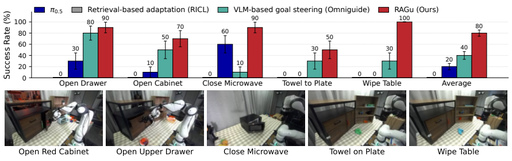
Figure 4 :Real-World Success Rates.Comparing RAGu against the base flow-matching policy ( π0.5), retrieval-based in-context learning baseline (RICL) and a VLM-based goal steering baseline (Omniguide). We evaluate the models across 5 diverse manipulation tasks: Open Drawer , Open Cabinet , Close Microwave , Towel to Plate , & Wipe Table.
Original paper · CC BY 4.0Omniguide and VLS steer with the same energy-based machinery as RAGu, but they aim at sparse VLM goal points instead of dense trajectories. In the real world RAGu reached 80% against 40% for Omniguide, and in RoboLab it reached 25% against 12% for VLS. The gap was widest on Wipe Table, where RAGu reached 100% compared to 30% for Omniguide.
The authors explain that sparse goals let Omniguide break surface contact between waypoints, as Figure 5 shows. Dense trajectories keep the approach and contact constraints that discrete goals leave out.
Transfer across domains and embodiments
For sim-to-real transfer, RAGu warps 100 MetaWorld Sawyer bin-picking trajectories into the real DROID Franka setup. The multi-stage Banana-to-Plate task gains the most on the Cabinet→Shelf layout. On that layout, π0.5 reaches 0%, Omniguide reaches 0%, and RAGu reaches 60%. The authors argue that operating on Cartesian traces makes guidance indifferent to whether a source was rendered or recorded.
The real-to-sim results point the same way, since RAGu lifts π0.5 from 5.33% to 25.33% on RoboLab.
Next, the authors test a larger morphology shift by guiding GR00T-N1.5 with 7-DoF Franka DROID demonstrations. The target robot is a 29-DoF Fourier GR-1 humanoid in RoboCasa. The base GR00T-N1.5 average rises from 33.6 to 47.2 with 100 trajectories. With 100 candidates, the average success gain reaches +13.6%. A single trajectory gives a smaller gain, reaching 39.2.
This transfer works because guidance acts on Cartesian wrist trajectories through differentiable forward kinematics.
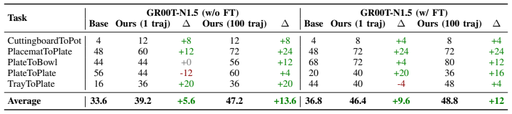
Figures from the paper Table II:Cross-embodiment humanoid manipulation with in-context trajectory guidance.We report success rates on RoboCasa tasks using the base GR00T-N1.5 model and its fine-tuned variant. The ∆ columns indicate absolute improvement over the corresponding unguided baseline. Refer to the project website for confidence intervals.
Original paper · CC BY 4.0The fine-tuned GR00T-N1.5 starts higher, at 36.8. One trajectory lifts it to 46.4. With 100 trajectories, it reaches 48.8. The authors read this as guidance that complements parametric training rather than replacing it. All warped demonstrations come from DROID, which already varies in camera viewpoints, backgrounds, and object instances.
Policy-aware selection and pool size
Secondary retrieval picks one guiding trajectory from a pool of 100 warped DROID demonstrations, so the selection rule decides which reference the policy follows. On three RoboLab tasks, the min grad rule gave an EE SPARC of −10.30, compared to −11.74 for min dist. Speed was 8.37 cm/s for min grad, versus 7.09 cm/s for min dist. Path lengths were nearly equal, 5.67 m for min grad and 5.79 m for min dist.
Because a higher EE SPARC means smoother motion, the gradient rule produced the smoother paths.
Mean success on nine RoboLab tasks was 23.6% for unguided π0.5. A single guiding trajectory raised it to 28.4%. A pool of 100 trajectories raised it to 36.4%. Success grows with pool size, so a single trajectory keeps only part of the gain.
On the selected RoboLab tasks, the 100-trajectory pool gave a path length of 5.25 m. Unguided π0.5 had a path length of 5.93 m on the same tasks. Speed was 8.89 cm/s with 100 trajectories, against 9.37 cm/s for unguided π0.5. Mean wall-clock time per episode across five RoboCasa tasks stayed within 6 s of the unguided baseline. Selection runs only once at the first denoising step, so the closed loop stays cheap.
Limitations and how far the numbers go
RAGu assumes the source database holds demonstrations that roughly match the target task category. The method stays sensitive to camera placement and occlusion, as the authors note in their limitations. Guidance can only reshape motion within the VLA's prior, because the selected reference stays close to what the policy already does.
For the RoboLab tasks, the authors estimate a 65.1% warping success rate over 900 total attempts. The remaining 34.9% of attempts are attributed to failures in the failure-mode analysis.
In a sanity check on all 45 RoboLab tasks, the authors' re-run of the unguided π0.5 reached a 14.0% average success rate. RoboLab reported 28.0% for the same unguided policy. The authors attribute the gap to RoboLab evaluating only 10 rollouts per task, so its reported rates may be noisy. Real-world results rest on 10 rollouts per task, and simulation results rest on 25 rollouts per task.
Because the authors evaluated all methods under identical conditions, they argue that relative comparisons remain valid.
Paper info
- Authors
- Subin Kim, Anh-Quan Pham, Dinesh Jayaraman
- Venue
- arXiv · Preprint
- First published
- 2026-11-7
- Added
- 2026-11-10
- Updated
- 2026-11-7
- Version
- v1
- arXiv
- 2611.10894
- Category
- cs.RO · cs.AI · cs.LG
- Original paper terms
- CC BY 4.0
- What we show
- Paper info, commentary and permitted figures from the original paper
AI commentary is a separate explanation from the original paper and may contain errors. The original paper and figures follow each source's terms of use and any rights noted separately.
Abstract
Pre-training large parametric "Vision-Language-Action" (VLA) models on large demonstration datasets has recently yielded promising results for general-purpose manipulation. However, these models still struggle under even small domain shifts relative to the training data, such as changes in camera viewpoint, background, object identity, or robot morphology. Motivated by the success of Retrieval-Augmented Generation (RAG) in language models, we pursue retrieval to boost VLA performance. Specifically, we seek to leverage retrieval from domain-mismatched, "in-the-wild" demonstration datasets like DROID to guide a VLA's behavior in a new target domain. To achieve this, we introduce RAGu, which overcomes robotics-specific challenges for RAG: (1) It incorporates simple geometric calibration to transform source demonstrations into the target setup and reduce cross-domain differences. (2) It uses a coarse-to-fine retrieval strategy that selects, from a large pool of pre-warped candidates, the trajectory most compatible with the base VLA. (3) It guides the VLA's flow-matching inference procedure rather than seeking to retrain the base model or expand its limited context window. We evaluate RAGu across real-world, simulation, sim-to-real transfer, and cross-embodiment humanoid manipulation. We find it improves real-world VLA success rates from 20% to 80% and outperforms the closest-related baselines in sim. Project website: raguvla.github.io
Quote from the paper
Subin Kim, Anh-Quan Pham, Dinesh Jayaraman (2026). Zero-Shot VLA Adaptation with Retrieved Guidance. arXiv:2611.10894v1. https://arxiv.org/abs/2611.10894v1
BibTeX
@misc{kim2026zero,
  title = {{Zero-Shot VLA Adaptation with Retrieved Guidance}},
  author = {Subin Kim and Anh-Quan Pham and Dinesh Jayaraman},
  year = {2026},
  eprint = {2611.10894},
  archivePrefix = {arXiv},
  url = {https://arxiv.org/abs/2611.10894v1}
}