論文解説
Zero-Shot VLA Adaptation with Retrieved Guidance
検索されたガイダンスを活用したゼロショットVLA適応
- 課題 事前学習済みのVLAは、カメラ視点、背景、物体、ロボットの形状が変わると性能が大きく下がります。既存の検索ベースの手法は、同一embodimentのデータやタスクごとのファインチューニングに頼ることが多いです。
- 手法 RAGuは、ドメインの異なるデモを意味的な対応関係に基づいて対象シーンにワーピングします。DTWで検索プールを絞り込み、推論時には方策の互換性に基づいて軌道を1つ選びます。その軌道を、flow-matching denoisingにエネルギーガイダンスとして適用します。
- 結果 実世界のタスクでは、RAGuはガイダンスなしのπ0.5の成功率20%を80%に引き上げました。RoboLabの9個のタスクの平均では、23.6%を36.4%に引き上げています。
VLAのドメインシフト問題と検索ベースのアプローチ
事前学習済みのVision-Language-Action(VLA)モデルは、大規模なデモデータで汎用的な操作を学習しますが、カメラ視点、背景、物体の種類、ロボットの形状が少し変わるだけで性能が下がりやすくなります。この論文は、言語モデルで性能を高めるRetrieval-Augmented Generation(RAG)の発想を取り入れ、ドメインの異なる大規模な'in-the-wild'デモデータセット(例:DROID)から関連する軌道を検索して、新しい対象ドメインのVLAの行動を導こうとしています。ロボットのデータでは、カメラ視点、シーンの配置、ロボットの形状の分布シフトが大きいため、もっとも似て見える軌道でも、ドメインの差は残ります。
既存のロボット向けの検索手法は、検索プールを同一embodimentのデータセットに限定するか、方策ネットワークをタスクごとにファインチューニングすることが多いです。そこでこの論文は、追加学習なしで凍結したVLAを適応させる方法を提案します。
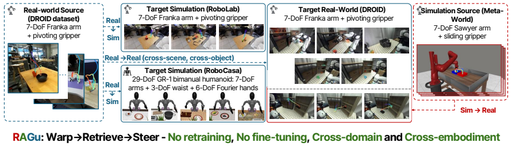
Figure 2 : RAGu enables zero-shot adaptation across domains and embodiments. RAGu transfers manipulation knowledge across four settings: Real→Real, Real→Sim, Sim→Real with different morphologies with the base VLA’s weights completely frozen without any parameter update.
出典 · CC BY 4.0 · Subin Kim, Anh-Quan Pham, Dinesh Jayaraman · Zero-Shot VLA Adaptation with Retrieved Guidance · 論文の図を引用 · 元のPDFの3ページ目から図の部分を抽出しています。RAGuのワーピング、検索、エネルギーガイダンスの構成
RAGuは、Warp、Retrieve、Steerの3段階で構成されます。まず、タスクカテゴリのキーワード(例:pickとplace)で大規模な実世界データのデモを絞り込みます。次にGrounding DINOで対象シーンのタスク関連物体のバウンディングボックスを見つけ、ソース軌道のwaypointを対象シーンの対応するwaypoint W′へ移します。この対応は、物体の類似性ではなく、タスク内での機能的な役割に基づいて決まります。その後、タスクカテゴリごとに参照軌道を1つ決め、Dynamic Time Warping(DTW)で各エピソードの候補をtop-Nまで枝刈りし、オフラインの検索プールを作ります。
推論時には、VLAが推定した行動チャンクÂ_τをforward kinematicsでCartesian end-effectorの経路X_tに変換し、各候補W(i)_tと比較するコストC_i(X_t)を計算します。選択基準は式(4)のarg min over i of ‖∇_{A0} C_i(X_t)‖₂で、著者らは、勾配ノルムの小さい候補ほど、VLAの学習された事前分布を大きく外れない参照を与えると解釈しています。選択は最初のdenoisingステップで1回行い、残りのステップでは固定します。選ばれた軌道からL_warp(A_τ) = C_{i⋆}(X_t)を作り、式(2)のguided velocity v_guided = v − γ∇_{A_τ}L_yでL_yをL_warpに置き換えてdenoisingを調整します。
このとき、方策の重みとコンテキストウィンドウは変更しません。

Figure 3 :Real-to-Sim Cross-Embodiment Warping.Real-world DROID demonstrations are warped to provide structural priors in simulated environments. The background streams visualize the distribution of candidate trajectories retrieved via coarse-grained DTW filtering.
出典 · CC BY 4.0 · Subin Kim, Anh-Quan Pham, Dinesh Jayaraman · Zero-Shot VLA Adaptation with Retrieved Guidance · 論文の図を引用 · 元のPDFの4ページ目から図の部分を抽出しています。実世界・シミュレーション転移での成功率比較
実世界のDROID 7-DoF Frankaタスク5個で、RAGuは80%の成功率を示しました。同じ実験設定ではRICLは0%、ガイダンスなしのπ0.5のベースラインは20%でした。Omniguideは40%でした。この比較は、タスクごとに10回ずつのrolloutで測定されました。論文の表では、GR00T-N1.7とπ0.5の平均を、この表の3個のタスク列の平均と区別して読む必要があります。RICLとRAGuは同じ100個のワーピング済みDROIDデモのプールを使ったため、この比較は、コンテキストトークンの入力と軌道ガイダンスの違いを示しています。OmniguideとVLSは、まばらなVLMの目標地点にガイダンスを与えます。
接触の多いWipe Tableタスクでは、Omniguideは中間waypointの間で表面との接触を失うと、論文では説明されています。この結果は、特定の基盤方策(π0.5)と特定のタスク集合から得られたものです。
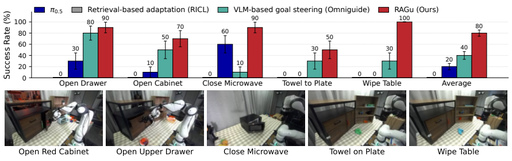
Figure 4 :Real-World Success Rates.Comparing RAGu against the base flow-matching policy ( π0.5), retrieval-based in-context learning baseline (RICL) and a VLM-based goal steering baseline (Omniguide). We evaluate the models across 5 diverse manipulation tasks: Open Drawer , Open Cabinet , Close Microwave , Towel to Plate , & Wipe Table.
出典 · CC BY 4.0 · Subin Kim, Anh-Quan Pham, Dinesh Jayaraman · Zero-Shot VLA Adaptation with Retrieved Guidance · 論文の図を引用 · 元のPDFの4ページ目から図の部分を抽出しています。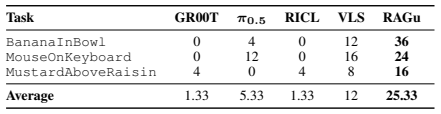
論文の図 Table I:RoboLab Real-to-Sim Success Rates.Comparing RAGu vs. base VLA policies ( π0.5, GR00T-N1.7), RiCL, and VLS. For fair comparison, RiCL and RAGu use the same pool of 100 demonstrations from DROID. VLS uses π0.5 as the base model. Also see Tab IV
出典 · CC BY 4.0 · Subin Kim, Anh-Quan Pham, Dinesh Jayaraman · Zero-Shot VLA Adaptation with Retrieved Guidance · 論文の図を引用 · 元のPDFの4ページ目から図の部分を抽出しています。Sim-to-real転移とヒューマノイドのクロスembodiment
Sim-to-real実験では、MetaWorld Sawyerのbin-pickingの軌道100個を、実世界のDROIDの設定にワーピングしました。物体転移の設定のうち、Cabinet→Shelfでは、π0.5とOmniguideは0%、RAGuは60%でした。この結果は、Cartesian軌道ガイダンスが、レンダリングされたソースと実際に記録されたソースのどちらに対してもある程度無関係に機能することを示唆していると、著者らは解釈しています。クロスembodiment実験では、7-DoF FrankaのDROIDデモを、29-DoF Fourier GR-1ヒューマノイドのRoboCasaの5個のタスクのガイダンスとして使いました。
2つの改善値は、それぞれのチェックポイントのガイダンスなしのベースラインとの差で、同じ方策の条件を超えた共通の効果として合算してはいません。論文では、この転移は、テキストで定義された関節マッピングや逆運動学を使わず、微分可能なforward kinematicsでCartesian手首経路を合わせることで実現されると説明されています。
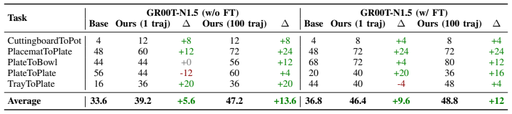
論文の図 Table II:Cross-embodiment humanoid manipulation with in-context trajectory guidance.We report success rates on RoboCasa tasks using the base GR00T-N1.5 model and its fine-tuned variant. The ∆ columns indicate absolute improvement over the corresponding unguided baseline. Refer to the project website for confidence intervals.
出典 · CC BY 4.0 · Subin Kim, Anh-Quan Pham, Dinesh Jayaraman · Zero-Shot VLA Adaptation with Retrieved Guidance · 論文の図を引用 · 元のPDFの5ページ目から図の部分を抽出しています。Secondary Retrieval規則と検索プールのサイズの影響
方策の互換性に基づく選択を検証するため、RoboLabの3個のタスクで、単一のヒューリスティックな軌道、最近傍距離に基づくmin dist、勾配ノルムに基づくmin gradを比較しました。平均のEE SPARCは、min gradが−10.30、速度は8.37 cm/s、経路長は5.67 mでした。min distはEE SPARCが−11.74、速度は7.09 cm/s、経路長は5.79 mでした。したがって、最近傍距離による選択は、ほぼ同じ経路長でより遅く、滑らかさの低い動きを示しました。単一の参照軌道はより滑らかな動きを示しましたが、本文の数値では、成功率は17.3%、100個の軌道プールは25.3%でした。
この数値は、RoboLab 9個のタスクの平均であるTable IVの28.4%、36.4%とは比較範囲が異なるため、一緒には解釈しません。検索プールを1、10、30、50、100個に増やした結果、9個のタスクの平均成功率は、π0.5のベースライン23.6%から、1個の軌道で28.4%、100個の軌道で36.4%に上がりました。さらにTable Vでは、100個の軌道プールは経路長を5.25 mに減らしました。この結果はRoboLabの9個のタスクに関するものです。論文では、学習ではなく検索規則の違いを分離して比較した、と説明されています。
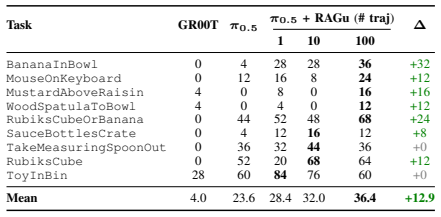
論文の図 Table III:Utility of policy-aware secondary retrieval. Trajectory metrics on RoboLab for three tasks in Table I, 25 rollouts per task. We use the same pool of 100 warped DROID demonstrations, while only the rule that picks the guiding trajectory changes.1 trajuses only a single heuristically selected trajectory.min distselects arg mini Ci(Xt) (Eq. 3), andmin gradselects arg mini ∥∇A0 Ci(Xt)∥2 (Eq. 4) from a 100 trajectory pool. Refer toSecondary Retrieval ablation in the project website.
出典 · CC BY 4.0 · Subin Kim, Anh-Quan Pham, Dinesh Jayaraman · Zero-Shot VLA Adaptation with Retrieved Guidance · 論文の図を引用 · 元のPDFの6ページ目から図の部分を抽出しています。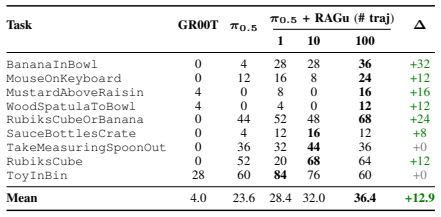
論文の図 Table IV:Scaling the retrieval pool on Real-to-Sim RoboLab.Task-wise success rates (%, 25 rollouts per task) for GR00T-N1.7, π0.5, and π0.5 + RAGu guided by 1, 10, or 100 warped DROID demonstrations. ∆ is the absolute gain of the 100-trajectory pool over π0.5; bold marks the best entry in each row. Expanding the pool consistently helps: mean success rises from 23.6% (unguided) to 28.4% with a single trajectory and 36.4% with 100. See Table VII in the Appendix for the full version.
出典 · CC BY 4.0 · Subin Kim, Anh-Quan Pham, Dinesh Jayaraman · Zero-Shot VLA Adaptation with Retrieved Guidance · 論文の図を引用 · 元のPDFの6ページ目から図の部分を抽出しています。適用範囲と確認されていない条件
論文では、RAGuは、ソースデータベースに対象タスクのカテゴリとおおむね一致するデモがあると仮定していると明記されています。また、カメラの配置や遮蔽に対して不変ではなく、意味的な対応の失敗は3Dワーピングを劣化させ、ガイダンス信号を損なう可能性があります。ガイダンスはVLAの事前分布の内側でしか動きを作り直せないため、方策が実行できない軌道を生成することはできません。RoboLabでのワーピングの成功率は65.1%と推定され、残りの34.9%の失敗のうち、デモのパースエラーは、シーン対応の失敗より約2倍大きいです。π0.5-DROIDのガイダンスなしのRoboLab平均成功率は、再測定で14.0%でした。
元のRoboLabの報告の28.0%とは差があり、著者らはサンプル数の違いが原因かもしれないと解釈しています。付録の信頼区間は、成功率表全体ではなく、Wilson法で計算された値なので、比較の解釈では区別する必要があります。
論文情報
- 著者
- Subin Kim, Anh-Quan Pham, Dinesh Jayaraman
- 学会・ジャーナル
- arXiv · プレプリント
- 公開日
- 2026年11月7日
- 登録日
- 2026年11月10日
- 更新日
- 2026年11月7日
- バージョン
- v1
- arXiv
- 2611.10894
- カテゴリ
- cs.RO · cs.AI · cs.LG
- ライセンス
- CC BY 4.0
- 掲載内容
- 論文情報・解説・論文の図
この解説は、Refivuの韓国語解説をAIで翻訳したものです。不正確な翻訳や誤りが含まれる可能性があります。論文と図の利用条件は各出典に従います。
アブストラクト
Pre-training large parametric "Vision-Language-Action" (VLA) models on large demonstration datasets has recently yielded promising results for general-purpose manipulation. However, these models still struggle under even small domain shifts relative to the training data, such as changes in camera viewpoint, background, object identity, or robot morphology. Motivated by the success of Retrieval-Augmented Generation (RAG) in language models, we pursue retrieval to boost VLA performance. Specifically, we seek to leverage retrieval from domain-mismatched, "in-the-wild" demonstration datasets like DROID to guide a VLA's behavior in a new target domain. To achieve this, we introduce RAGu, which overcomes robotics-specific challenges for RAG: (1) It incorporates simple geometric calibration to transform source demonstrations into the target setup and reduce cross-domain differences. (2) It uses a coarse-to-fine retrieval strategy that selects, from a large pool of pre-warped candidates, the trajectory most compatible with the base VLA. (3) It guides the VLA's flow-matching inference procedure rather than seeking to retrain the base model or expand its limited context window. We evaluate RAGu across real-world, simulation, sim-to-real transfer, and cross-embodiment humanoid manipulation. We find it improves real-world VLA success rates from 20% to 80% and outperforms the closest-related baselines in sim. Project website: raguvla.github.io
この論文を引用
Subin Kim, Anh-Quan Pham, Dinesh Jayaraman (2026). Zero-Shot VLA Adaptation with Retrieved Guidance. arXiv:2611.10894v1. https://arxiv.org/abs/2611.10894v1
BibTeX
@misc{kim2026zero,
  title = {{Zero-Shot VLA Adaptation with Retrieved Guidance}},
  author = {Subin Kim and Anh-Quan Pham and Dinesh Jayaraman},
  year = {2026},
  eprint = {2611.10894},
  archivePrefix = {arXiv},
  url = {https://arxiv.org/abs/2611.10894v1}
}