論文解説
Semantic Synthesis over Brute-Force Search: LLM-Guided Transformation Design for Efficient Learning
ブルートフォース探索の代わりに意味を合成する:効率的な学習のためのLLMによる変換設計
- 課題 大規模なブルートフォース探索を使わず、LLMでデータ変換プログラムを合成して学習性能を効率よく高められるか、また1 epochの選択スコアが長い学習結果をどの程度予測するかを扱います。
- 手法 LLMが実行可能なPyTorchの変換コードを生成し、精度の順序が付いたペアでLoRAによるファインチューニングを繰り返す方法です。
データ変換設計の探索コスト問題
学習データに適用する前処理・データ拡張のパイプラインはモデルの性能を大きく左右しますが、どのパイプラインが与えられたタスクに合うのかについて決まった答えはありません。従来は固定ポリシー、自動探索、コード生成などが使われてきました。その方法のコストは数倍から数桁まで違いがあります。自動探索では、多数の候補を短い学習予算でスコア化する必要があります。この論文では、その短い評価スコアが実際の長い学習結果をどの程度予測するかという問いも合わせて扱っています。
LLMが生成する変換プログラムとファインチューニングのループ
この研究では、変換プログラムは既存のサンプル集合に適用される前処理の分布を編集する、実行可能なコードです。ブルートフォースのベースラインは、torchvisionの変換辞書から N∈{1,2,3} 個の変換を順序付きの順列で組み合わせ、データセットごとに6,000個の候補を作ります。各候補には1 epochでの精度の注釈を付けます。生成にはOlympicCoder-7BとQwen2.5-Coder-7Bを使います。ファインチューニングのループでは、精度の順序が付いたペアにLoRAを学習させます。各サイクルでは、アンカーと参照の変換を選んでプロンプトを作ります。生成された候補は1 epochで評価し、閾値を超えたものをプールに入れます。
その後、ペアの集合を作り直して学習します。
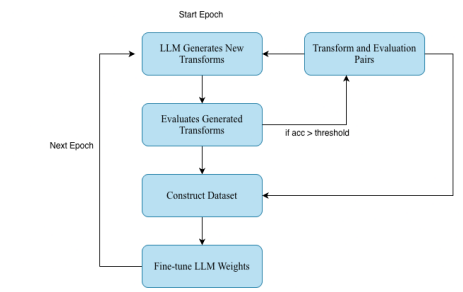
Fig. 1 :The fine-tuning loop. Each cycle samples reference transforms from the an- notated pool, generates candidates (Listing 1.2), evaluates them under the one-epoch protocol, admits those above a per-dataset threshold, and continues LoRA training on the rebuilt pair set. The loop runs27cycles.
出典 · CC BY 4.0 · Usha Shrestha, Radu Timofte, Dmitry Ignatov · Semantic Synthesis over Brute-Force Search: LLM-Guided Transformation Design for Efficient Learning · 論文の図を引用 · 元のPDFの6ページ目から図の部分を抽出しています。1 epochの選択スコアと20 epochの結果の相関
各候補は1 epochの評価スコアで選ばれ、戦略ごとの上位候補は20 epochかけて再学習され、最終的な精度が得られます。SVHNでResNet-18を使った場合、選択スコアと20 epochの精度のSpearman相関は0.756でした。CIFAR-10のMobileNetV2では0.470、CIFAR-10とCIFAR-100のResNetではそれぞれ0に近い値でした。著者らは、CIFAR-10で独立した2つの1 epochスコアを比較する陽性対照を設けたと説明しています。選択スコアの範囲に制限しても相関は0.816のままだったと報告しています。これは、範囲の制限だけでは低い相関を説明しにくいという根拠として示されています。
ブルートフォース探索とLLM生成結果の比較
ただし、SVHNではAutoAugmentの0.9480がブルートフォースを上回っており、LLMの優位は比較的小さいです。結果は単一シードによるもので、実行間のばらつきと切り分けにくいと、著者らは解釈しています。コストについては、ブルートフォースはデータセットごとに6,000個のモデルを学習しました。ファインチューニングありの生成器は270個、ファインチューニングなしの生成器は10個を評価しています。
解釈の範囲と残された限界
表2に見られる小さな差は、シードのばらつきと切り分けられません。相関係数もこのノイズを共有しています。固定ポリシーではデフォルト値の候補を1つずつだけ評価し、RandAugmentのハイパーパラメータは調整していません。ブルートフォースと生成手法の比較では、候補の分布と選択ルールが同時に変わります。そのため著者らは、この2つの要因を分けるためにランダムなサブセットでの対照実験が必要だと述べています。20 epochは、データ拡張の研究で使われる長い学習スケジュールより短いです。評価は畳み込み構造と低解像度に限られています。
論文情報
- 著者
- Usha Shrestha, Radu Timofte, Dmitry Ignatov
- 学会・ジャーナル
- arXiv · プレプリント
- 公開日
- 2026年11月7日
- 登録日
- 2026年11月10日
- 更新日
- 2026年11月7日
- バージョン
- v1
- arXiv
- 2611.10940
- カテゴリ
- cs.CV · cs.AI
- ライセンス
- CC BY 4.0
- 掲載内容
- 論文情報・解説・論文の図
この解説は、Refivuの韓国語解説をAIで翻訳したものです。不正確な翻訳や誤りが含まれる可能性があります。論文と図の利用条件は各出典に従います。
アブストラクト
Data transformation pipelines shape the training distribution in computer vision, but designing them is a computationally expensive problem. We investigate whether large language models can enable efficient discovery by synthesizing executable transformation programs outside predefined augmentation spaces. We compare nine strategies under a unified training protocol, including standard augmentation policies, brute-force search, direct code generation with two LLMs, and performance-guided generation using LLMs fine-tuned on accuracy-ordered transformation pairs. When the best candidates are retrained for 20 epochs, LLM-generated transformation programs lead on every dataset, reaching 0.8877 accuracy on CIFAR-10, 0.5825 on CIFAR-100, and 0.9588 on SVHN, surpassing brute-force search over 6,000 candidates. The best transform on CIFAR-10 and SVHN comes from a fine-tuned generator using 270 candidates, while the best on CIFAR-100 comes from an off-the-shelf generator using only 10. This needs 22x fewer candidate evaluations in the generation step and 600x fewer for off-the-shelf generations, relative to brute-force search. Beyond transformation discovery, we analyze the reliability of the reduced-budget evaluation commonly used for augmentation search. Correlating one-epoch selection scores with 20-epoch outcomes reveals strong, weak, and absent predictive relationships depending on the dataset and architecture, with correlations ranging from 0.756 to near zero. A positive control indicates that range restriction alone is unlikely to explain the low correlations. Our results indicate that semantic synthesis with code LLMs provides an efficient alternative to search-based transformation discovery and highlight the importance of validating evaluation fidelity when optimizing data transformations.
この論文を引用
Usha Shrestha, Radu Timofte, Dmitry Ignatov (2026). Semantic Synthesis over Brute-Force Search: LLM-Guided Transformation Design for Efficient Learning. arXiv:2611.10940v1. https://arxiv.org/abs/2611.10940v1
BibTeX
@misc{shrestha2026semantic,
  title = {{Semantic Synthesis over Brute-Force Search: LLM-Guided Transformation Design for Efficient Learning}},
  author = {Usha Shrestha and Radu Timofte and Dmitry Ignatov},
  year = {2026},
  eprint = {2611.10940},
  archivePrefix = {arXiv},
  url = {https://arxiv.org/abs/2611.10940v1}
}