論文解説
Imperfectly Imperfect: Evaluating Graded Cognitive Diversity in LLM Persona Simulations
不完全に不完全な:LLMペルソナシミュレーションにおける段階的な認知的多様性の評価
- 課題 LLMペルソナシミュレーションが、設定した認知的多様性を人間の集団と同じように再現するかを検証します。
- 結果 質問紙形式の特性はよく再現されますが、反省課題の得点は満点に集中し、2つのCRTの相関は過度に高く、BRTの行動は過剰に出力され、転移は一部でしか確認されていません。
合成集団は認知的多様性を再現するか
LLMエージェントは、社会・行動科学の研究で合成参加者としてますます使われるようになっています。ただし、エージェントがそれらしく話したり人口統計の分布を合わせたりするだけでは、集団が科学的に有用だとは言いにくいです。この論文は、設定した認知的反省の水準に応じて、推論の正確さ、直感的な誘惑による誤答、特性間の相関、行動の変動が人間と同じように分かれるかを問います。
質問紙形式の特性であるNeed for CognitionとBig Fiveは比較的よく再現されます。一方で、認知課題の得点と行動の転移が十分に再現されるかを確認することが、この研究の範囲です。
認知スイートと合成プロフィールの構成
評価体系のcognition-suiteは、CRT2、新たに作ったbCRT、Need for Cognition、BFI-10、BRTシナリオを組み合わせて使います。各ペルソナには、人口統計、Big Fiveの特性、NFCとCRT2に基づく反省の水準がプロンプトとして与えられます。bCRTには人間の基準データがないため、水準は与えません。
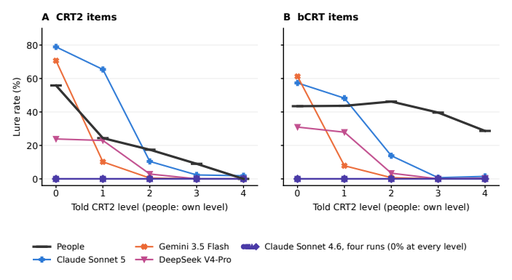
Figure 8 : Does telling a persona a lower reflection level produce more lure errors? Lure rate on CRT2 (A) and bCRT (B) at each told CRT2 level, 0–4, in each run, and in people (black) by their own CRT2 level, at the cutoffs the told levels were built on. The bCRT was never specified: its panel groups the same agents by their told CRT2 level. n at levels 0–4: synthetic-profile runs 109/86/103/106/67, human-derived runs 94/98/106/105/68, people 107/79/106/111/68.
出典 · CC BY 4.0 · Sion Weatherhead, Ben Newell, Aaron Belbasis, Flora Salim · Imperfectly Imperfect: Evaluating Graded Cognitive Diversity in LLM Persona Simulations · 論文の図を引用 · 元のPDFの24ページ目から図の部分を抽出しています。合成プロフィールは、人間の参照資料から推定した5,000件のプロフィールバンクから抽出します。このバンクはGaussian copulaによって、認知変数と性格変数の間の依存構造を保持します。人間由来のプロフィールは、参加者それぞれの実際のプロフィールをそのまま使い、2つの出どころを区別します。
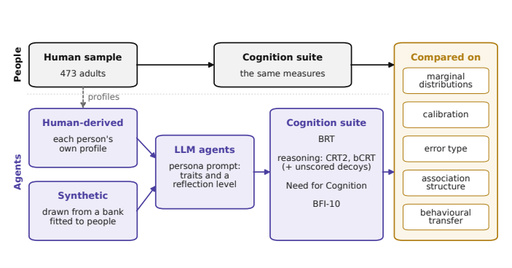
Figure 5 : How is each run evaluated? People and LLM agents answer the same cognition suite; the agents are conditioned on profiles taken from people, either each person’s own or drawn from a bank fitted to them, and the two sets of answers are compared on the five fidelity targets.
出典 · CC BY 4.0 · Sion Weatherhead, Ben Newell, Aaron Belbasis, Flora Salim · Imperfectly Imperfect: Evaluating Graded Cognitive Diversity in LLM Persona Simulations · 論文の図を引用 · 元のPDFの14ページ目から図の部分を抽出しています。実行手順と忠実度の判定
各実行では、ブロックごとに1回ずつモデルを呼び出します。順序はBRT、推論ブロック(CRT2、bCRTとデコイ項目)、Need for Cognition、BFI-10です。会話の履歴はペルソナごとに保持されます。実行結果は、周辺分布のJS発散、特定の構成概念に対する補正R2、相関構造の差、そしてBRT行動の有病率の差と条件別の転移によって評価されます。
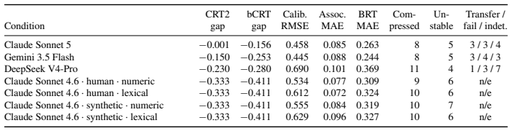
Table 1 : Fidelity scorecard: run-level summaries by condition.
出典 · CC BY 4.0 · Sion Weatherhead, Ben Newell, Aaron Belbasis, Flora Salim · Imperfectly Imperfect: Evaluating Graded Cognitive Diversity in LLM Persona Simulations · 論文の図を引用 · 元のPDFの6ページ目から図の部分を抽出しています。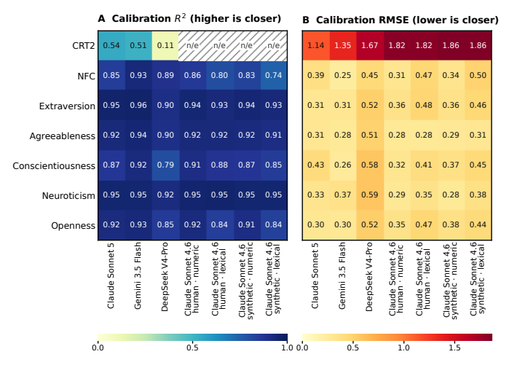
Figure 7 : How closely does each run’s realised score follow its persona’s specified score, construct by construct? (A) R2 and (B) RMSE of the realised score regressed on the specified score, one column per run. n/e: every agent scored 4 of 4, soR 2 cannot be estimated.
出典 · CC BY 4.0 · Sion Weatherhead, Ben Newell, Aaron Belbasis, Flora Salim · Imperfectly Imperfect: Evaluating Graded Cognitive Diversity in LLM Persona Simulations · 論文の図を引用 · 元のPDFの23ページ目から図の部分を抽出しています。転移の判定は、人間の相関または傾きを基準に、実行の差の区間を読む方法です。複数のペアや結果に対して多重比較補正を適用していないため、完全な忠実度であっても、約20個のうち1つが逸脱と読まれる可能性があると著者らは述べています。
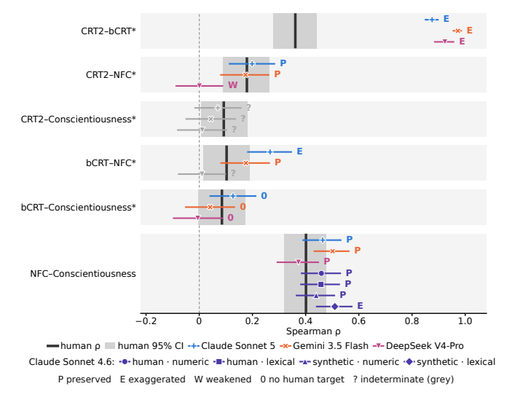
Figure 3 : Does each run reproduce the human correlations among the four focal constructs? Each band is one pair of constructs: the black bar and grey band give the human Spearman correlation and its 95% interval; each marker gives one run’s correlation with its 95% interval and its verdict (rules in Appendix A.2). “0”: people show no detectable correlation, so there is nothing to reproduce; “?”: people do, but the run’s interval is too wide to tell whether it kept the correlation or lost it. *The four Claude Sonnet 4.6 conditions are not estimable on these pairs, because every agent scored 4/4 on CRT2 and bCRT.N= 471 per side; 95% percentile bootstrap intervals from 10,000 resamples. Appendix Figure 9 gives the differences from the human values for all 28 pairs.
出典 · CC BY 4.0 · Sion Weatherhead, Ben Newell, Aaron Belbasis, Flora Salim · Imperfectly Imperfect: Evaluating Graded Cognitive Diversity in LLM Persona Simulations · 論文の図を引用 · 元のPDFの8ページ目から図の部分を抽出しています。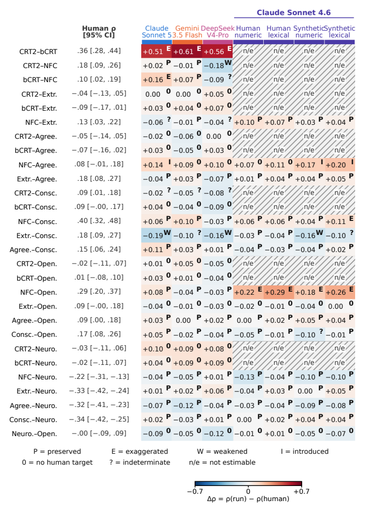
Figure 9 : Does each run reproduce the human correlation between every pair of constructs? Rows are the 28 pairs (Extr. Extraversion, Agree. Agreeableness, Consc. Conscientiousness, Neuro. Neuroti- cism, Open. Openness); the first column gives the human Spearman correlation with its 95% interval, each cell the run’s difference from it, ∆ρ=ρ run −ρ human, with the verdict symbols of Figure 3; I (introduced) marks a pair with no human correlation but a clearly non-zero run correlation; n/e, every agent scored 4/4. N= 471 per side; 95% percentile bootstrap intervals from 10,000 resamples; no correction across pairs.
出典 · CC BY 4.0 · Sion Weatherhead, Ben Newell, Aaron Belbasis, Flora Salim · Imperfectly Imperfect: Evaluating Graded Cognitive Diversity in LLM Persona Simulations · 論文の図を引用 · 元のPDFの25ページ目から図の部分を抽出しています。反省課題は評価得点では再現されない
質問紙形式の特性は比較的よく再現されます。NFCとBig FiveのJS発散は.10–.20と.11–.24の範囲で、CRT2とbCRTのJS発散は.34–.74の範囲です。一方、Claude Sonnet 4.6の4つの実行では、すべてのエージェントがCRT2とbCRTで4点満点を取り、反省の水準による変動はありませんでした。
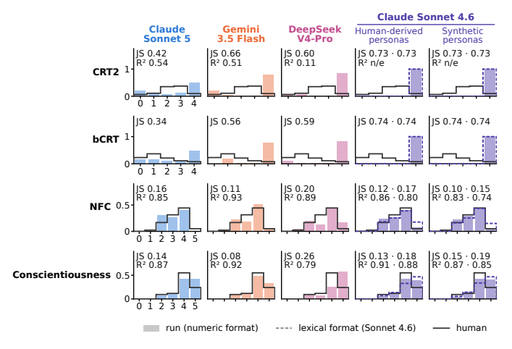
Figure 1 : Do the runs reproduce the human score distributions of the four focal constructs? Each panel sets one run against the human distribution. Corners give the Jensen–Shannon divergence from the human distribution (JS) and the calibration R2 of realised on specified score (bCRT was never specified); in the Claude Sonnet 4.6 panels the numeric value comes first. n/e: not estimable, because every agent scored 4/4 and there is no variation to calibrate. The other four Big Five traits are in Appendix Figure 6.N= 471per run; humanN= 471(bCRT 473).
出典 · CC BY 4.0 · Sion Weatherhead, Ben Newell, Aaron Belbasis, Flora Salim · Imperfectly Imperfect: Evaluating Graded Cognitive Diversity in LLM Persona Simulations · 論文の図を引用 · 元のPDFの6ページ目から図の部分を抽出しています。残りの3つの実行では得点は変化しますが、大半が満点に集中します。また、CRT2とbCRTの相関は人間では.36でしたが、この3つの実行では.88–.97と大きく高くなります。Claude Sonnet 5は、人間の項目別の誘惑による誤答パターンに最も近いものの、得点分布は依然として人間より狭く集中しています。
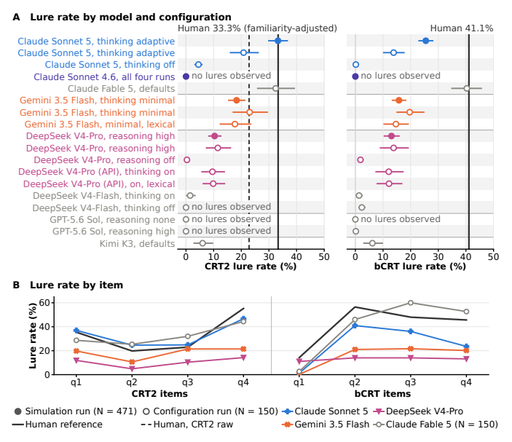
Figure 2 : Which runs produce intuitive-lure errors, and on which items? (A) Lure rate on CRT2 and bCRT with its 95% interval, for the simulation runs (N= 471 ) and for the configuration runs (Section 4.3). (B) Lure rate per item for people (CRT2 familiarity-adjusted) and the three runs that produce lures, with Claude Fable 5, the configuration run whose lure rates are closest to people’s. Models with configuration runs only are drawn in grey. Intervals are persona-clustered bootstrap intervals. Solid black lines are the human reference for each test (CRT2: familiarity-adjusted, people’s rate predicted for items not seen before; bCRT: as answered); the dashed line is people’s raw CRT2 rate.
出典 · CC BY 4.0 · Sion Weatherhead, Ben Newell, Aaron Belbasis, Flora Salim · Imperfectly Imperfect: Evaluating Graded Cognitive Diversity in LLM Persona Simulations · 論文の図を引用 · 元のPDFの7ページ目から図の部分を抽出しています。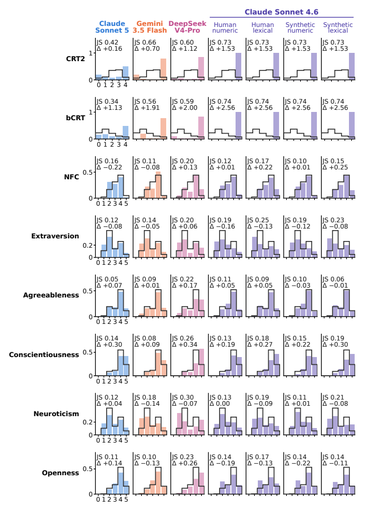
Figure 6 : Does each run reproduce the shape of the human score distribution, construct by construct? Rows are the eight constructs and columns the seven full-battery runs, grouped by model family. Bars show each run’s score distribution in its family hue; the black outline is the human distribution, repeated across the row, and the y-axis is shared within a row. Each panel’s corner gives the Jensen– Shannon divergence from the human distribution (JS) and the mean shift∆ (run − human). N= 471 per run; humanN= 471(bCRT 473).
出典 · CC BY 4.0 · Sion Weatherhead, Ben Newell, Aaron Belbasis, Flora Salim · Imperfectly Imperfect: Evaluating Graded Cognitive Diversity in LLM Persona Simulations · 論文の図を引用 · 元のPDFの22ページ目から図の部分を抽出しています。行動変動の圧縮と転移の限界
BRTでは、すべての実行が15個のコード化された行動のうち8個から11個について、人間より20パーセントポイント以上多く出力します。人間で確認された行動は、概ね過剰に出力される方向で現れ、人間より少なく出力される場合はほとんど報告されていません。
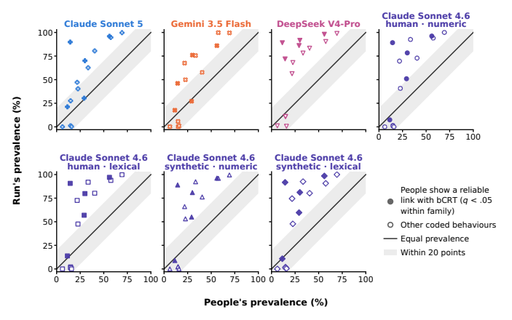
Figure 10 : Prevalence of the 15 coded BRT behaviours in each run against people, one panel per run.
出典 · CC BY 4.0 · Sion Weatherhead, Ben Newell, Aaron Belbasis, Flora Salim · Imperfectly Imperfect: Evaluating Graded Cognitive Diversity in LLM Persona Simulations · 論文の図を引用 · 元のPDFの28ページ目から図の部分を抽出しています。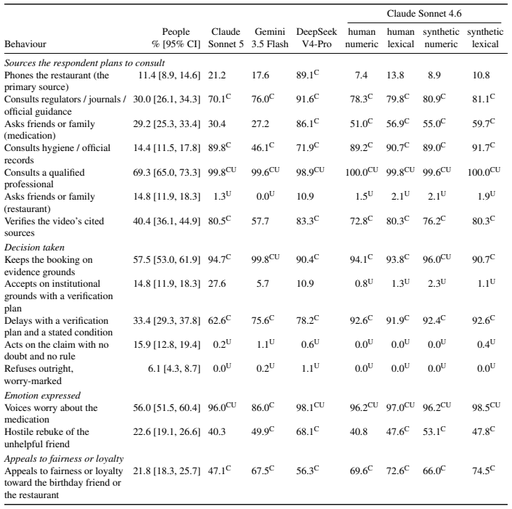
Table 10 : How often does each coded BRT behaviour occur in people and in each run? Prevalence (%) of the 15 coded behaviours.
出典 · CC BY 4.0 · Sion Weatherhead, Ben Newell, Aaron Belbasis, Flora Salim · Imperfectly Imperfect: Evaluating Graded Cognitive Diversity in LLM Persona Simulations · 論文の図を引用 · 元のPDFの30ページ目から図の部分を抽出しています。人間でbCRTとreliablyに結びついた5つの行動のうち、Claude Sonnet 5は3つ、Gemini 3.5 Flashも3つ、DeepSeek V4-Proは1つを転移させています。したがって、反省の水準と行動の結びつきは一部だけが移っています。
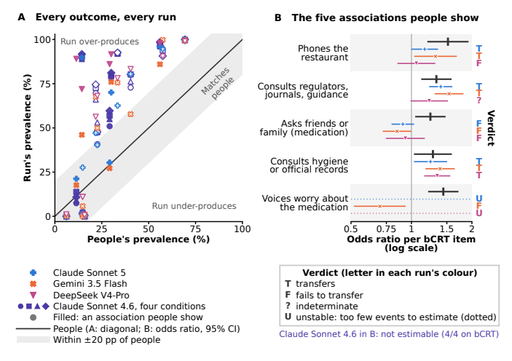
Figure 4 : Does human behavioural variation survive, and does its link to reflection carry over? (A) Prevalence of each of the 15 coded BRT behaviours in each run against its prevalence in people; the diagonal marks equal prevalence and the grey band ±20 percentage points. Filled markers are the five behaviours for which people show a reliable association with bCRT (Benjamini–Hochberg q < .05within family). (B) For those five, the odds ratio per bCRT item in people and in each run whose bCRT scores vary, with 95% intervals. The verdict tests the difference between run and human slopes (Section 4.4), so overlapping intervals can still differ. Appendix Figure 10 gives panel A run by run.N= 471per run (DeepSeek V4-Pro 467); peopleN= 473.
出典 · CC BY 4.0 · Sion Weatherhead, Ben Newell, Aaron Belbasis, Flora Salim · Imperfectly Imperfect: Evaluating Graded Cognitive Diversity in LLM Persona Simulations · 論文の図を引用 · 元のPDFの9ページ目から図の部分を抽出しています。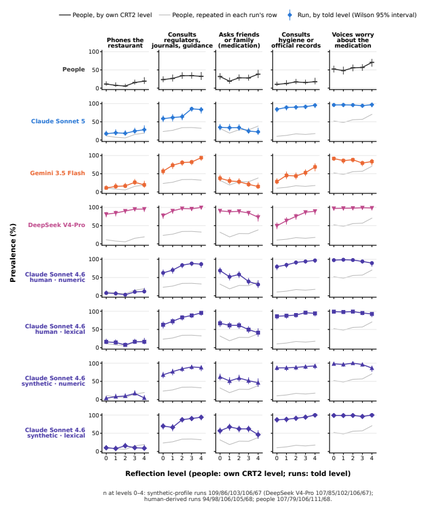
Figure 11 : Does each behaviour change with the reflection level, in people and in each run? Prevalence of the five behaviours for which people show a reliable association with bCRT (Figure 4B) at each reflection level 0–4; people’s levels use the cutoffs the told levels were built on. n per level is printed beneath the panels.
出典 · CC BY 4.0 · Sion Weatherhead, Ben Newell, Aaron Belbasis, Flora Salim · Imperfectly Imperfect: Evaluating Graded Cognitive Diversity in LLM Persona Simulations · 論文の図を引用 · 元のPDFの29ページ目から図の部分を抽出しています。
Table 12 : Does people’s link between bCRT and each behaviour carry over to the runs? Odds ratio per bCRT item in people and in the three runs whose bCRT scores vary, with the transfer verdict.
出典 · CC BY 4.0 · Sion Weatherhead, Ben Newell, Aaron Belbasis, Flora Salim · Imperfectly Imperfect: Evaluating Graded Cognitive Diversity in LLM Persona Simulations · 論文の図を引用 · 元のPDFの33ページ目から図の部分を抽出しています。推論項目の構成実験と条件の範囲
モデルと思考設定の影響は、固定された150個の合成プロフィールのパネルで、CRT2とbCRTの8項目だけを実行した構成実験で確認しています。この実験では、Claude Sonnet 5とDeepSeek V4-Proは思考を切ると、誘惑による誤答がほとんど消えます。同じパネルで、GPT-5.6 Solは両方の推論水準で、ほぼ誤答を生みません。
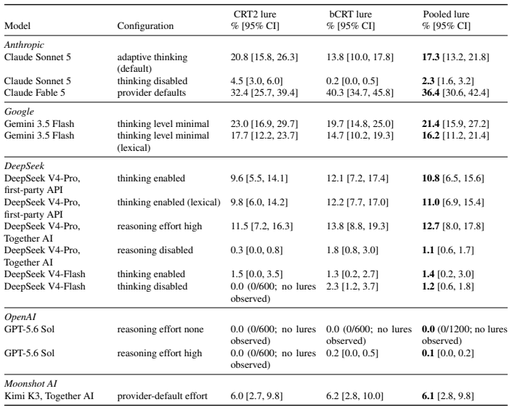
Table 5 : Which configurations produce intuitive-lure errors? The configuration ladder on the reasoning core: every model and thinking regime, each answering the eight reflection items for the same 150 profiles.
出典 · CC BY 4.0 · Sion Weatherhead, Ben Newell, Aaron Belbasis, Flora Salim · Imperfectly Imperfect: Evaluating Graded Cognitive Diversity in LLM Persona Simulations · 論文の図を引用 · 元のPDFの19ページ目から図の部分を抽出しています。この結果は、全体のバッテリー実行とは区別して読む必要があります。構成実験は、追加のモデルと思考設定を推論項目のみで確認したものです。
適用範囲と限界
著者らが挙げる限界はいくつかあります。全体のバッテリーは4つのモデルでのみ実行され、追加のモデルと思考設定は推論項目にのみ適用されました。人間の参照標本は英国と米国のProlific参加者であるため、他の地域の目標値は保証されません。BRTシナリオは単純化された探査であり、行動の結果はLLM補助のルーブリックコーディングに依存しています。
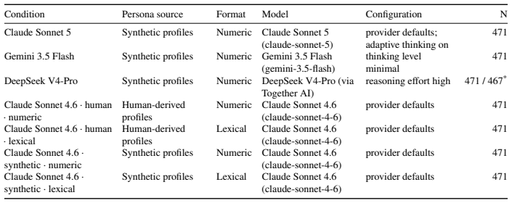
Table 4 : Experimental conditions: one row per full-battery simulation run.
出典 · CC BY 4.0 · Sion Weatherhead, Ben Newell, Aaron Belbasis, Flora Salim · Imperfectly Imperfect: Evaluating Graded Cognitive Diversity in LLM Persona Simulations · 論文の図を引用 · 元のPDFの17ページ目から図の部分を抽出しています。また、この研究は主にプロンプトによる調整を評価したもので、活性化調整、強化学習、ファインチューニングは評価していません。したがって、この結果をすべての調整手法やすべてのモデル設定に一般化すべきではありません。
論文情報
- 著者
- Sion Weatherhead, Ben Newell, Aaron Belbasis, Flora Salim
- 学会・ジャーナル
- arXiv · プレプリント
- 公開日
- 2026年11月7日
- 登録日
- 2026年11月10日
- 更新日
- 2026年11月7日
- バージョン
- v1
- arXiv
- 2611.10508
- カテゴリ
- cs.CL · cs.AI · cs.CY
- ライセンス
- CC BY 4.0
- 掲載内容
- 論文情報・解説・論文の図
この解説は、Refivuの韓国語解説をAIで翻訳したものです。不正確な翻訳や誤りが含まれる可能性があります。論文と図の利用条件は各出典に従います。
アブストラクト
Large language model (LLM) agents are increasingly used as synthetic participants in social, behavioural, and decision-making research, yet it remains unclear whether they can express graded cognitive diversity as assigned when engaging in simulated behaviour. We introduce a cognition-suite evaluation that tests whether simulated populations reproduce human variation in reasoning, self-reported traits, their associations, and downstream behaviour. Agents conditioned on synthetic or human-derived profiles of cognitive reflection, Need for Cognition, and Big Five personality answer the same suite as a cohort of 473 adults: two newly assembled tests, a Cognitive Reflection Test (CRT) and a Behavioural Reflection Test (BRT) whose decision scenarios measure reflection in behaviour, alongside an established CRT and the two trait questionnaires. Across seven full-battery simulation runs of four models, agents recover Need for Cognition and Big Five trait distributions on self-report questionnaires, but fall short on simulating diversity of cognitive task performance and downstream behaviours. In the four Claude Sonnet 4.6 runs, every agent scores full marks on both CRTs, whatever reflection level its persona was assigned. In the other three runs agents make intuitive-lure errors (the tempting wrong answers CRT items invite), but 49 to 85% score full marks, against under 10% in the human sample. Claude Sonnet 5 comes closest to people's item-by-item pattern of lures; the other two runs give fewer lures and vary less between items. In the BRT scenarios, every run over-produces 8 to 11 of 15 coded behaviours by at least 20 percentage points, and people's links between reflection and behaviour carry over only in part. Useful synthetic populations must preserve not only trait descriptors but the structured variation in reasoning, error type, and behaviour those descriptors are meant to organise.
この論文を引用
Sion Weatherhead, Ben Newell, Aaron Belbasis, Flora Salim (2026). Imperfectly Imperfect: Evaluating Graded Cognitive Diversity in LLM Persona Simulations. arXiv:2611.10508v1. https://arxiv.org/abs/2611.10508v1
BibTeX
@misc{weatherhead2026imperfectly,
  title = {{Imperfectly Imperfect: Evaluating Graded Cognitive Diversity in LLM Persona Simulations}},
  author = {Sion Weatherhead and Ben Newell and Aaron Belbasis and Flora Salim},
  year = {2026},
  eprint = {2611.10508},
  archivePrefix = {arXiv},
  url = {https://arxiv.org/abs/2611.10508v1}
}