論文解説
Policy Over Purpose: Auditing LLM Content Moderation of Reclaimed Slur Usage
目的より政策:再クレイミングされた侮蔑語の利用に対するLLMコンテンツモデレーションの監査
- 課題 Perspective APIの廃止を受けてプラットフォームがLLMベースのモデレーションへ移るなか、この論文は、再クレイミングされた侮蔑語をモデルがコミュニティの判断とどの程度一致させるかを監査しています。
- 結果 モデレーション専用かどうかでは再クレイミングの扱い方を十分に説明できず、どのシステムもコミュニティの判断と安定して一致するわけではありません。政策がどのように表現されているかが違いをよりよく説明し、プロンプトによるステアリングは主に定義の語彙に合わせて判断と根拠を変えます。
プラットフォームがLLMモデレーションへ移ることで生じる問題
Perspective APIが廃止されたことで、プラットフォームは汎用LLMまたはモデレーション専用LLMへコンテンツ審査を移しています。このとき政策は別個の分類器ではなく自然言語の定義として書かれ、モデルは推論時にその政策を解釈して判断します。再クレイミングされた侮蔑語は、この仕組みの弱点をよく示します。同じ単語が集団の内部では誇りや連帯の表現ですが、外部ではその集団を狙った侮蔑になりえます。誤って読むと、守られるべき発話が抑え込まれてしまいます。この研究はこの点を監査し、モデルの判断がコミュニティの判断とどの程度一致するか、失敗がどの集団に集中するか、プロンプトで政策を補足すると判断が変わるかを問います。
IYKYKコーパスと二値ラベルの定義
評価データはIYKYKコーパスです。このコーパスは、3つの侮蔑語(f-word、b-word、n-word)を含むソーシャルメディアの投稿300件で構成されています。各投稿には、コミュニティの構成員である注釈者が少なくとも5名以上ラベルを付けました。研究では、そのうち2つの質問だけを使います。1つ目は、投稿者が集団の内部者だと仮定したとき、どの種類の再クレイミングかを尋ねる質問です。誇りの再クレイミングと内部の再クレイミングを1つの再クレイミングラベルにまとめ、neitherは侮蔑として扱います。2つ目は、salient contextを尋ね、8つのカテゴリから1つを選ばせる質問です。IYKYKは正解ラベル1つではなく注釈者ごとのラベルを提供するため、研究は閾値で二値化した値と連続値を併用し、注釈間の不一致を一部残しています。
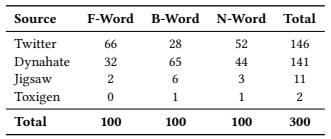
Table 1 . Distribution of annotated examples by source and slur.
出典 · CC BY 4.0 · Christina Chance, Kai-Wei Chang · Policy Over Purpose: Auditing LLM Content Moderation of Reclaimed Slur Usage · 論文の図を引用 · 元のPDFの3ページ目から図の部分を抽出しています。モデレーション専用モデルと汎用モデルの組み合わせ
研究では、4つのモデレーション専用システムと、各システムに対応する汎用モデルを比較しています。LlamaGuard 3はMLCommons AI Safetyの14の危険カテゴリを運用しており、そのうちS10(Hate)が、再クレイミングを憎悪と判断する際に中心的に働くカテゴリです。WildGuardはカテゴリ単位の決定は出さず、3つの二値出力のみを返します。Omni-Moderationはhateとharassmentのスコアを提供し、ShieldGemmaは政策テキストに対する違反確率を出力します。モデルごとに出力形式が異なるため、研究はそれらを同じ二値ラベル空間にそろえてから比較しています。
出力のマッピングと判定ルール
汎用モデルとOmni-Moderationには、自由テキストで再クレイミングまたは侮蔑のラベル、根拠、salient contextを直接生成するよう求めたため、別途の変換は必要ありません。一方、ShieldGemmaは違反確率しか出さないため、P(yes)が0.5を超えたら侮蔑と見なします。LlamaGuard 3は安全フラグと危険カテゴリのみを出すので、unsafeの判定を侮蔑に対応づけます。WildGuardは有害リクエストのフラグがyesであれば侮蔑と見なします。Perspective APIは連続値のアイデンティティ攻撃スコアを0.7の閾値で二値化します。根拠の分析は、自由テキストの根拠を出した5モデルに限られます。
根拠はモデルが予測したラベルごとにまとめられるため、人間の正解ではなく、モデルが実際に下した判断を説明するものです。
政策・判定・根拠・バイアス・ステアリングの5つの階層
監査は5つの階層で進めます。政策の階層では、各政策が再クレイミングの用法を明記しているか、曖昧にしているか、まったく扱っていないかを見ます。判定の階層では、ラベルの精度、繰り返し実行どうしの安定性、Perspective APIとの一致を見ます。根拠の階層では、自由テキストの根拠に現れる語彙の特徴を分析します。バイアスの階層では、slurごと、モデルごとの差を比較します。ステアリングの階層では、基準プロンプトとステアリングプロンプトを比べます。ステアリングプロンプトは、再クレイミングと侮蔑の用法について定義と説明を加えたもので、モデルがその定義に従って判断を変えるかを確かめるために使います。
再クレイミング識別の性能と人間の注釈との一致
再クレイミングを陽性クラスとしたF1では、b-wordが最も高く、n-wordが最も低くなりました。このパターンは汎用モデルとモデレーション専用モデルの両方に見られます。2つの系統をまとめて比べても、どちらが一貫して優れているとは言えません。WildGuardは再クレイミングをほとんど予測せず、F1は0%、精度は0.37で、モデルの中で最も低いです。これは再クレイミングの例をほぼすべて有害リクエストとして示し、その結果が侮蔑ラベルに対応づけられたためです。つまり多くのモデルは、人間の多数決と偶然の一致を下回るほど食い違うケースが多くなっています。
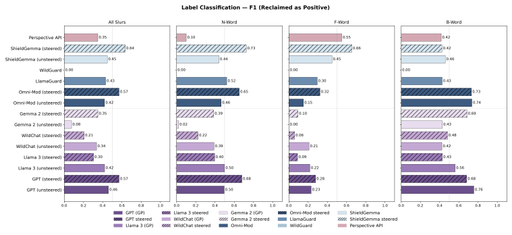
Fig. 1 . Label classification F1 with reclaimed treated as the positive class, per model and slur. Each panel covers a slur group (all slurs pooled, then N-word, F-word, B-word). General-purpose models are shown in purple, moderation-specific models in blue, and Perspective API in blush; steered conditions are hatched and unsteered are solid, with the dashed vertical line marking F1 = 0.5 and the horizontal divider separating general-purpose from moderation-specific models. ShieldGemma is included via its thresholded score (P(yes) > 0.5 mapped to derogatory), and WildGuard and LlamaGuard 3 appear once each as their output schemas do not vary by prompt.
出典 · CC BY 4.0 · Christina Chance, Kai-Wei Chang · Policy Over Purpose: Auditing LLM Content Moderation of Reclaimed Slur Usage · 論文の図を引用 · 元のPDFの7ページ目から図の部分を抽出しています。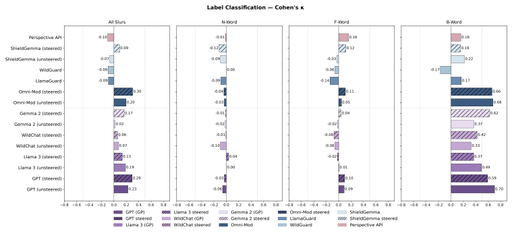
Fig. 2 . Label classification agreement with human ground truth (Cohen’s 𝜅), per model and slur. Layout, color, and hatching follow Figure 1; the vertical line at 𝜅= 0marks chance-level agreement, so bars to its left indicate below-chance agreement. Values are shown to the left of negative bars and to the right of positive bars.
出典 · CC BY 4.0 · Christina Chance, Kai-Wei Chang · Policy Over Purpose: Auditing LLM Content Moderation of Reclaimed Slur Usage · 論文の図を引用 · 元のPDFの8ページ目から図の部分を抽出しています。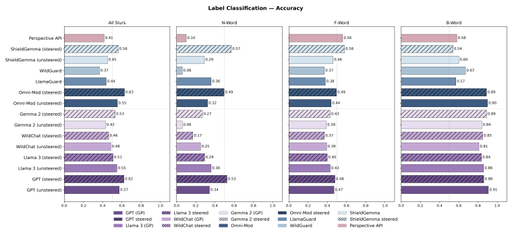
Fig. 6 . Label classification accuracy, per model and slur. General-purpose models are shown in purple, moderation-specific models in blue, and Perspective API in blush; steered conditions are hatched and unsteered are solid, with the dashed vertical line marking accuracy = 0.5 and the horizontal divider separating general-purpose from moderation-specific models.
出典 · CC BY 4.0 · Christina Chance, Kai-Wei Chang · Policy Over Purpose: Auditing LLM Content Moderation of Reclaimed Slur Usage · 論文の図を引用 · 元のPDFの22ページ目から図の部分を抽出しています。LlamaGuard 3、Omni-Moderation、WildGuardの失敗パターン
LlamaGuard 3は、3つのslurのすべてでS10(Hate)を圧倒的に返します。再クレイミングと侮蔑の例に付くカテゴリがほとんど同じなので、モデルは2つの用法を文脈に応じて区別していないと解釈できます。特にf-wordとn-wordでは、再クレイミングの例も高い割合でunsafeと表示されます。Omni-Moderationは、再クレイミングの例にも高いharassmentとhateのスコアが付くことが多く、b-wordの侮蔑の例の多くはhate確率がほぼ0に集中します。WildGuardは再クレイミングの例の100%を有害リクエストとして表示し、侮蔑の例の大半も同様に表示します。この結果が、WildGuardのF1 0.0と低い精度および一致度を直接説明しています。
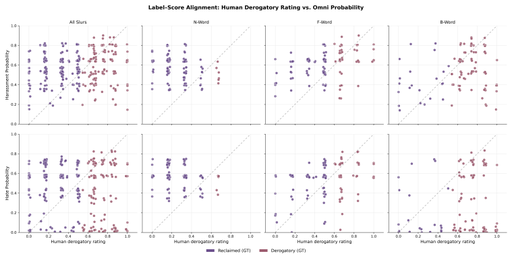
Fig. 3 . Alignment between human derogatory rating and Omni-Moderation’s continuous scores, by slur and score category. Each point is one tweet, with the x-axis giving the human derogatory rating (the proportion of annotators labeling the instance derogatory) and the y-axis giving Omni-Moderation’s probability for one category: harassment (top row) and hate (bottom row). Points are colored by ground-truth label (reclaimed, purple; derogatory, rose), and columns cover all slurs pooled, then the N-word, F-word, and B-word. The dashed diagonal marks perfect alignment (𝑦=𝑥 ), where the model’s score tracks human consensus: points above the diagonal indicate the potential for the model over-predicting relative to human rating, and points below indicate under-predicting. Vertical banding on the x-axis reflects the discrete annotator proportions.
出典 · CC BY 4.0 · Christina Chance, Kai-Wei Chang · Policy Over Purpose: Auditing LLM Content Moderation of Reclaimed Slur Usage · 論文の図を引用 · 元のPDFの9ページ目から図の部分を抽出しています。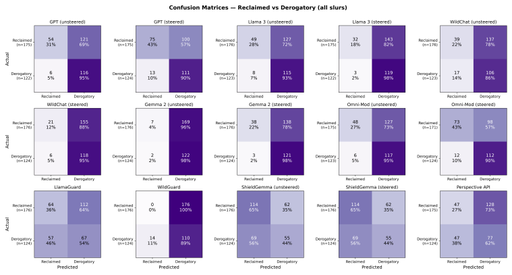
Fig. 7 . Confusion tables for each model under steered and unsteered condition aggregated across all three slurs.
出典 · CC BY 4.0 · Christina Chance, Kai-Wei Chang · Policy Over Purpose: Auditing LLM Content Moderation of Reclaimed Slur Usage · 論文の図を引用 · 元のPDFの22ページ目から図の部分を抽出しています。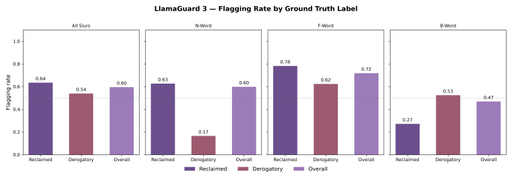
Fig. 9 . LlamaGuard 3 flagging rate by slur and human label. Bars give % of instances flagged as unsafe, separated by whether annotators labeled the usage reclaimed or derogatory. Reclaimed instances are flagged at high rates for the f-word and n-word, indicating that the model treats reclaimed usage as hateful even where it identifies the surrounding context correctly.
出典 · CC BY 4.0 · Christina Chance, Kai-Wei Chang · Policy Over Purpose: Auditing LLM Content Moderation of Reclaimed Slur Usage · 論文の図を引用 · 元のPDFの23ページ目から図の部分を抽出しています。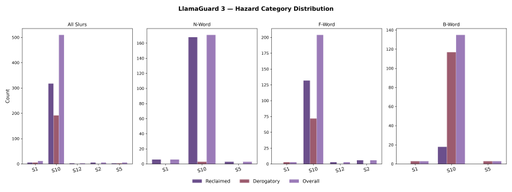
Fig. 8 . Hazard categories assigned by LlamaGuard 3, split by human label (reclaimed, purple; derogatory, rose). LlamaGuard 3 emits a safety flag and an MLCommons hazard category rather than a reclaimed or derogatory judgment. S10 (Hate) dominates for all three slurs, with all other categories appearing in fewer than ten instances. The distributions are largely the same for reclaimed and derogatory instances, indicating that the model’s hazard attribution does not distinguish between the two readings.
出典 · CC BY 4.0 · Christina Chance, Kai-Wei Chang · Policy Over Purpose: Auditing LLM Content Moderation of Reclaimed Slur Usage · 論文の図を引用 · 元のPDFの23ページ目から図の部分を抽出しています。根拠テキストの反復性と語彙のシグナル
BERTScore F1は、同じインスタンスで3回実行した根拠どうしの類似度を表しており、非ステアリング条件とステアリング条件のどちらも0.95を超えています。Llama 3、WildChat、Gemma 2は3つのslurのすべてで完全な類似度になっています。GPT-4oとOmni-Moderationは同じ基盤モデルを使いますが、完全に同じではなく、非ステアリング条件はステアリング条件よりわずかに高くなっています。モデル間の平均類似度も0.9を超えており、最終ラベルが異なっても根拠の表現は近いことが分かります。語彙の分析では、差は主にslurごとの用語に現れます。f-wordの侮蔑の根拠には性的な表現が、再クレイミングの根拠にはアイデンティティや共同体の語彙が現れます。
b-wordではwomenが両方に現れますが、侮蔑の側ではsexualizationやstereotypesなどと、再クレイミングの側ではempowermentやaffectionatelyなどと一緒に現れます。
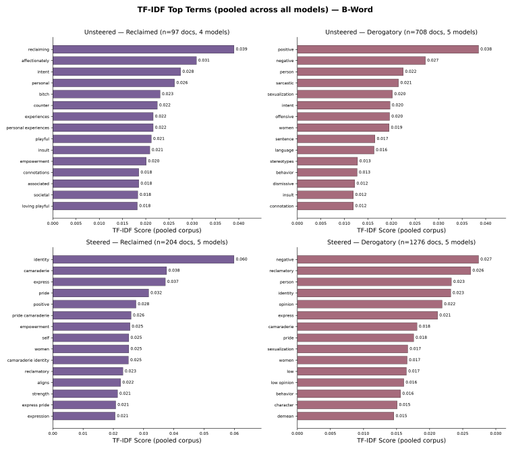
Fig. 11 . Most characteristic terms in pooled model reasoning for reclaimed (purple) and derogatory (rose) classifications of the B-word, by prompt condition (unsteered, top; steered, bottom). Terms are the 15 highest by mean TF-IDF over reasoning documents pooled across models, with reclaimed and derogatory fit as separate corpora and grouped by each model’s own predicted label. Panel headers give the pooled document count and number of contributing models.
出典 · CC BY 4.0 · Christina Chance, Kai-Wei Chang · Policy Over Purpose: Auditing LLM Content Moderation of Reclaimed Slur Usage · 論文の図を引用 · 元のPDFの25ページ目から図の部分を抽出しています。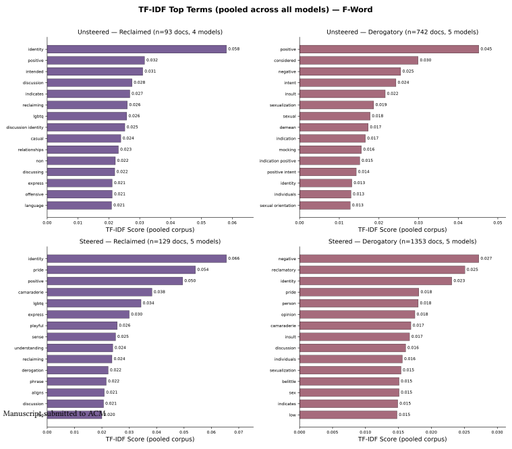
Fig. 13 . Most characteristic terms in pooled model reasoning for reclaimed (purple) and derogatory (rose) classifications of the F-word, by prompt condition (unsteered, top; steered, bottom). Terms are the 15 highest by mean TF-IDF over reasoning documents pooled across models, with reclaimed and derogatory fit as separate corpora and grouped by each model’s own predicted label. Panel headers give the pooled document count and number of contributing models.
出典 · CC BY 4.0 · Christina Chance, Kai-Wei Chang · Policy Over Purpose: Auditing LLM Content Moderation of Reclaimed Slur Usage · 論文の図を引用 · 元のPDFの26ページ目から図の部分を抽出しています。プロンプトベースのステアリングの効果
ステアリングは、再クレイミングと侮蔑の定義をプロンプトに加える方法です。ステアリングされた根拠は、プロンプトで与えた定義の語彙をそのまま使います。ステアリングプロンプトに含まれるidentity、camaraderie、pride、reclamatoryといった語は、ステアリング条件の上位語には現れますが、非ステアリング条件にはほとんど現れません。ShieldGemmaでは、ステアリングは政策テキストに、再クレイミングが違反ではないという一文を加える形をとります。その結果、再クレイミングと侮蔑の両方の例で違反確率が下がります。ただし著者らは、この効果が2つの用法をよりよく区別したことによるものではなく、全体的な違反の減少によるものだと解釈しています。
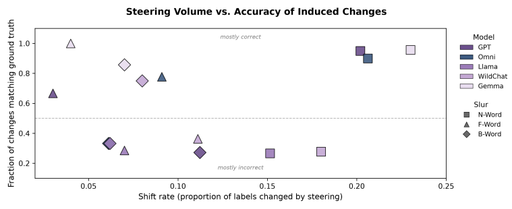
Fig. 4 . Steering volume against the accuracy of steering-induced changes, by model and slur. The x-axis gives the proportion of labels that changed between the unsteered and steered conditions; the y-axis gives the fraction of those changes that match the human majority-vote label. Because the label is binary, each change either corrects or introduces an error, so the dashed line at 0.5 marks the point at which steering’s changes are no better than chance.
出典 · CC BY 4.0 · Christina Chance, Kai-Wei Chang · Policy Over Purpose: Auditing LLM Content Moderation of Reclaimed Slur Usage · 論文の図を引用 · 元のPDFの11ページ目から図の部分を抽出しています。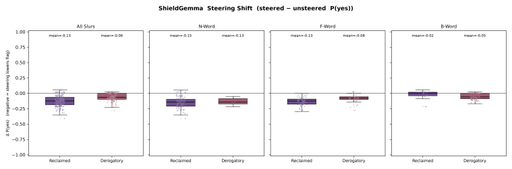
Fig. 12 . ShieldGemma steering shift, by slur and human label. Each point is one instance, with the y-axis giving the change in policy-violation probability between the steered and unsteered conditions (steered minus unsteered), so negative values indicate that the amended policy lowered the violation score. Steering for ShieldGemma is operationalized as policy-text variation: the unsteered condition supplies the documented hate speech policy, and the steered condition appends an explicit statement that reclaimed language does not constitute a violation. Boxes give the interquartile range and median, and annotations give the group mean. Reclaimed and derogatory refer to the human majority-vote label.
出典 · CC BY 4.0 · Christina Chance, Kai-Wei Chang · Policy Over Purpose: Auditing LLM Content Moderation of Reclaimed Slur Usage · 論文の図を引用 · 元のPDFの26ページ目から図の部分を抽出しています。適用範囲と限界
この研究の結果は、英語の300件のインスタンスと少数のソーシャルメディアプラットフォームから得られたものです。そのため、slurごとの分析は精密な性能推定値ではなく、傾向を示す証拠として読むべきです。二値マッピングは各システムの意図をできるだけ保つようにしましたが、出力の意味を単純化したものです。また、再クレイミングと侮蔑を二値で評価すると、コミュニティ内部での侮蔑的な用法のような区別が失われます。ステアリング実験も1つのプロンプト戦略だけを扱っており、検索ベースのプロンプトやコミュニティの例など、ほかの介入は評価していません。
論文情報
- 著者
- Christina Chance, Kai-Wei Chang
- 学会・ジャーナル
- arXiv · プレプリント
- 公開日
- 2026年11月6日
- 登録日
- 2026年11月10日
- 更新日
- 2026年11月6日
- バージョン
- v1
- arXiv
- 2611.10327
- カテゴリ
- cs.CL
- ライセンス
- CC BY 4.0
- 掲載内容
- 論文情報・解説・論文の図
この解説は、Refivuの韓国語解説をAIで翻訳したものです。不正確な翻訳や誤りが含まれる可能性があります。論文と図の利用条件は各出典に従います。
アブストラクト
As Perspective API is deprecated, platforms are turning to large language models for content moderation, encoding policy as natural language that the model must interpret at inference time. Reclaimed slurs test this design directly. The same term can express in-group pride or target the community that reclaimed it, and misreading it silences the speech moderation is meant to protect. We audit four general-purpose LLMs and four moderation-specific systems, with Perspective API as a legacy baseline, on IYKYK, a corpus of reclaimed and derogatory usage of three slurs annotated by community members. Across the policy, decision, reasoning, disparity, and steering layers of this audit, we find that whether a system was purpose-built for moderation explains little about how it handles reclaimed language. No system reliably agrees with community judgment, and all fail most on language reclaimed within Black communities. What separates systems is instead how their policy is represented. Only systems whose policy is expressed in the prompt can be steered at all, and even then, explicit definitions change how models justify a decision more than how they make it. We argue that policy transparency determines whether moderation failures can be corrected, but that correcting them requires contextual judgment that definitions supplied at inference time cannot provide.
この論文を引用
Christina Chance, Kai-Wei Chang (2026). Policy Over Purpose: Auditing LLM Content Moderation of Reclaimed Slur Usage. arXiv:2611.10327v1. https://arxiv.org/abs/2611.10327v1
BibTeX
@misc{chance2026policy,
  title = {{Policy Over Purpose: Auditing LLM Content Moderation of Reclaimed Slur Usage}},
  author = {Christina Chance and Kai-Wei Chang},
  year = {2026},
  eprint = {2611.10327},
  archivePrefix = {arXiv},
  url = {https://arxiv.org/abs/2611.10327v1}
}