논문 해설
Policy Over Purpose: Auditing LLM Content Moderation of Reclaimed Slur Usage
목적보다 정책: 재전유된 비하어 사용에 대한 LLM 콘텐츠 모더레이션 감사
- 연구 문제 Perspective API 폐지 이후 플랫폼이 LLM 기반 모더레이션으로 옮겨 가는 상황에서, 재클레이밍된 slur를 모델이 커뮤니티 판단과 얼마나 일치시키는지 감사합니다.
- 주요 결과 모더레이션 전용 여부는 재클레이밍 처리 방식을 충분히 설명하지 못하며, 어떤 시스템도 커뮤니티 판단과 안정적으로 일치하지 않습니다. 정책이 어떻게 표현되었는지가 차이를 더 잘 설명하고, 프롬프트 조향은 주로 정의 어휘에 맞춰 판단과 근거를 바꿉니다.
플랫폼이 LLM 모더레이션으로 옮겨 가며 생기는 문제
Perspective API가 폐지되면서 플랫폼은 범용 LLM이나 모더레이션 전용 LLM으로 콘텐츠 검열을 옮기고 있습니다. 이때 정책은 별도의 분류기가 아니라 자연어 정의로 적히고, 모델이 추론 시점에 그 정책을 해석해 판단합니다. 재클레이밍된 slur는 이 방식의 약점을 잘 드러냅니다. 같은 단어가 집단 내부에서는 자긍심이나 연대의 표현이지만, 외부에서는 그 집단을 겨냥한 비하가 될 수 있습니다. 이때 잘못 읽으면 보호해야 할 발화가 억눌립니다. 이 연구는 이 지점을 감사하여 모델의 판단이 커뮤니티 판단과 얼마나 일치하는지, 실패가 어느 집단에 집중되는지, 프롬프트로 정책을 덧붙이면 판단이 바뀌는지를 묻습니다.
IYKYK 코퍼스와 이진 라벨 정의
평가 데이터는 IYKYK 코퍼스입니다. 이 코퍼스는 세 가지 slur(f-word, b-word, n-word)가 들어간 소셜 미디어 게시물 300개로 구성되며, 게시물마다 커뮤니티 구성원인 주석자가 최소 다섯 명 이상 라벨을 붙였습니다. 연구는 그중 두 질문만 사용합니다. 하나는 작성자가 집단 내부자라고 가정했을 때 어떤 재클레이밍인지 묻는 질문이며, 자긍심 재클레이밍과 내부 재클레이밍을 하나의 재클레이밍 라벨로 묶고 neither는 비하로 봅니다. 다른 하나는 salient context를 묻는 질문으로, 여덟 개 범주 중 하나를 고르게 합니다. IYKYK는 정답 라벨 하나가 아니라 주석자별 라벨을 제공하므로, 연구는 임계값으로 이진화한 값과 연속 값을 함께 사용해 주석 간 불일치를 일부 보존합니다.
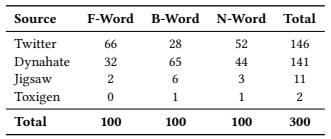
Table 1 . Distribution of annotated examples by source and slur.
원문 · CC BY 4.0 · Christina Chance, Kai-Wei Chang · Policy Over Purpose: Auditing LLM Content Moderation of Reclaimed Slur Usage · 원문 그림 인용 · 원본 PDF 3쪽에서 그림 영역을 추출했습니다.모더레이션 전용 모델과 범용 모델의 짝
연구는 네 개의 모더레이션 전용 시스템과 각 시스템에 대응하는 범용 모델을 비교합니다. LlamaGuard 3는 MLCommons AI Safety의 14개 위험 범주를 운영하며, 이 중 S10(Hate)가 재클레이밍을 혐오로 판단할 때 핵심적으로 작동하는 범주입니다. WildGuard는 범주 수준의 결정을 내놓지 않고 세 가지 이진 출력만 냅니다. Omni-Moderation은 hate와 harassment 점수를 제공하고, ShieldGemma는 정책 텍스트에 대해 위반 확률을 출력합니다. 모델마다 출력 형식이 달라서, 연구는 이들을 같은 이진 라벨 공간으로 맞춘 뒤 비교합니다.
출력 매핑과 판정 규칙
범용 모델과 Omni-Moderation은 자유 텍스트로 재클레이밍 또는 비하 라벨, 근거, salient context를 직접 생성하도록 요청받았기 때문에 별도의 변환이 필요하지 않습니다. 반면 ShieldGemma는 위반 확률만 내놓기 때문에 P(yes)가 0.5를 넘으면 비하로 봅니다. LlamaGuard 3는 안전 플래그와 위험 범주만 내놓으므로 unsafe 판정을 비하로 매핑합니다. WildGuard는 유해 요청 플래그가 yes이면 비하로 봅니다. Perspective API는 연속 정체성 공격 점수를 0.7 임계값으로 이진화합니다. 근거 분석은 자유 텍스트 근거를 낸 다섯 모델에 한정되며, 근거는 모델이 예측한 라벨별로 묶이므로 인간 정답이 아니라 모델이 실제로 내린 판단을 설명합니다.
정책, 판정, 근거, 편향, 조향의 다섯 계층
감사는 다섯 계층으로 진행됩니다. 정책 계층은 각 정책이 재클레이밍 용법을 명시하는지, 모호하게 두는지, 아예 다루지 않는지를 봅니다. 판정 계층은 라벨의 정확도, 반복 실행 사이의 안정성, Perspective API와의 일치를 봅니다. 근거 계층은 자유 텍스트 근거에 나타나는 어휘 특징을 분석합니다. 편향 계층은 slur별, 모델별 차이를 비교합니다. 조향 계층은 기준 프롬프트와 조향 프롬프트를 비교합니다. 조향 프롬프트는 재클레이밍과 비하 용법의 정의와 설명을 추가한 것이며, 모델이 그 정의에 따라 판단을 바꾸는지를 확인합니다.
재클레이밍 식별 성능과 인간 주석과의 일치
재클레이밍을 양성 클래스로 둔 F1에서 b-word가 가장 높고 n-word가 가장 낮으며, 이 패턴은 범용 모델과 모더레이션 전용 모델 모두에서 나타납니다. 두 계열을 전체로 묶으면 어느 쪽이 일관되게 낫다고 말할 수 없습니다. WildGuard는 재클레이밍을 거의 예측하지 않아 F1이 0%이고 정확도는 0.37로 모델 가운데 가장 낮습니다. 이는 재클레이밍 예시를 거의 모두 유해 요청으로 표시하고, 그 결과가 비하 라벨로 매핑되었기 때문입니다. 즉 대부분의 모델은 인간 다수결과 우연 수준 이하로 어긋나는 경우가 많습니다.
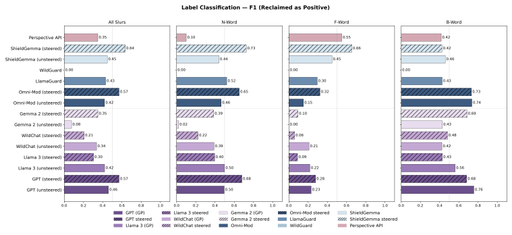
Fig. 1 . Label classification F1 with reclaimed treated as the positive class, per model and slur. Each panel covers a slur group (all slurs pooled, then N-word, F-word, B-word). General-purpose models are shown in purple, moderation-specific models in blue, and Perspective API in blush; steered conditions are hatched and unsteered are solid, with the dashed vertical line marking F1 = 0.5 and the horizontal divider separating general-purpose from moderation-specific models. ShieldGemma is included via its thresholded score (P(yes) > 0.5 mapped to derogatory), and WildGuard and LlamaGuard 3 appear once each as their output schemas do not vary by prompt.
원문 · CC BY 4.0 · Christina Chance, Kai-Wei Chang · Policy Over Purpose: Auditing LLM Content Moderation of Reclaimed Slur Usage · 원문 그림 인용 · 원본 PDF 7쪽에서 그림 영역을 추출했습니다.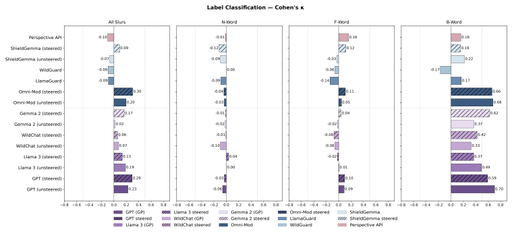
Fig. 2 . Label classification agreement with human ground truth (Cohen’s 𝜅), per model and slur. Layout, color, and hatching follow Figure 1; the vertical line at 𝜅= 0marks chance-level agreement, so bars to its left indicate below-chance agreement. Values are shown to the left of negative bars and to the right of positive bars.
원문 · CC BY 4.0 · Christina Chance, Kai-Wei Chang · Policy Over Purpose: Auditing LLM Content Moderation of Reclaimed Slur Usage · 원문 그림 인용 · 원본 PDF 8쪽에서 그림 영역을 추출했습니다.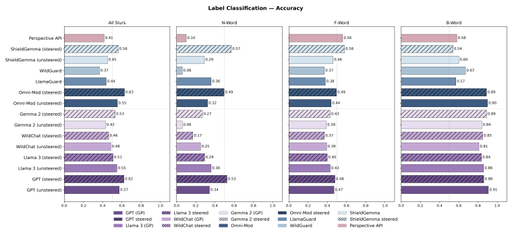
Fig. 6 . Label classification accuracy, per model and slur. General-purpose models are shown in purple, moderation-specific models in blue, and Perspective API in blush; steered conditions are hatched and unsteered are solid, with the dashed vertical line marking accuracy = 0.5 and the horizontal divider separating general-purpose from moderation-specific models.
원문 · CC BY 4.0 · Christina Chance, Kai-Wei Chang · Policy Over Purpose: Auditing LLM Content Moderation of Reclaimed Slur Usage · 원문 그림 인용 · 원본 PDF 22쪽에서 그림 영역을 추출했습니다.LlamaGuard 3, Omni-Moderation, WildGuard의 실패 양상
LlamaGuard 3는 세 slur 모두에서 S10(Hate)를 압도적으로 반환합니다. 재클레이밍과 비하 사례에 붙은 범주가 대부분 같아서, 모델이 두 용법을 맥락에 따라 구분하지 않는다고 해석할 수 있습니다. 특히 f-word와 n-word에서는 재클레이밍 사례도 높은 비율로 unsafe로 표시됩니다. Omni-Moderation은 재클레이밍 사례도 높은 harassment와 hate 점수를 받는 경우가 많고, b-word의 비하 사례 상당수는 hate 확률이 거의 0에 몰립니다. WildGuard는 재클레이밍 사례 100%를 유해 요청으로 표시하고, 비하 사례 대부분도 같은 방식으로 표시합니다. 이 결과는 WildGuard의 F1 0.0과 낮은 정확도 및 일치도를 직접 설명합니다.
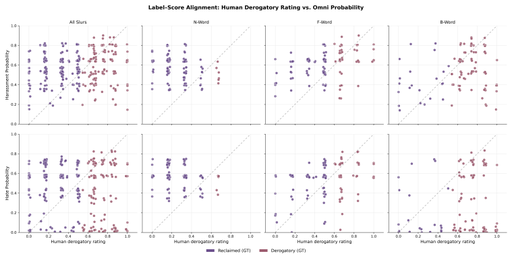
Fig. 3 . Alignment between human derogatory rating and Omni-Moderation’s continuous scores, by slur and score category. Each point is one tweet, with the x-axis giving the human derogatory rating (the proportion of annotators labeling the instance derogatory) and the y-axis giving Omni-Moderation’s probability for one category: harassment (top row) and hate (bottom row). Points are colored by ground-truth label (reclaimed, purple; derogatory, rose), and columns cover all slurs pooled, then the N-word, F-word, and B-word. The dashed diagonal marks perfect alignment (𝑦=𝑥 ), where the model’s score tracks human consensus: points above the diagonal indicate the potential for the model over-predicting relative to human rating, and points below indicate under-predicting. Vertical banding on the x-axis reflects the discrete annotator proportions.
원문 · CC BY 4.0 · Christina Chance, Kai-Wei Chang · Policy Over Purpose: Auditing LLM Content Moderation of Reclaimed Slur Usage · 원문 그림 인용 · 원본 PDF 9쪽에서 그림 영역을 추출했습니다.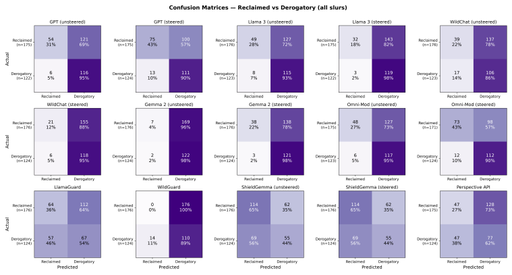
Fig. 7 . Confusion tables for each model under steered and unsteered condition aggregated across all three slurs.
원문 · CC BY 4.0 · Christina Chance, Kai-Wei Chang · Policy Over Purpose: Auditing LLM Content Moderation of Reclaimed Slur Usage · 원문 그림 인용 · 원본 PDF 22쪽에서 그림 영역을 추출했습니다.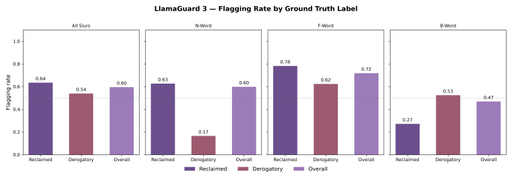
Fig. 9 . LlamaGuard 3 flagging rate by slur and human label. Bars give % of instances flagged as unsafe, separated by whether annotators labeled the usage reclaimed or derogatory. Reclaimed instances are flagged at high rates for the f-word and n-word, indicating that the model treats reclaimed usage as hateful even where it identifies the surrounding context correctly.
원문 · CC BY 4.0 · Christina Chance, Kai-Wei Chang · Policy Over Purpose: Auditing LLM Content Moderation of Reclaimed Slur Usage · 원문 그림 인용 · 원본 PDF 23쪽에서 그림 영역을 추출했습니다.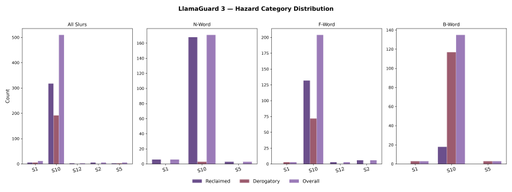
Fig. 8 . Hazard categories assigned by LlamaGuard 3, split by human label (reclaimed, purple; derogatory, rose). LlamaGuard 3 emits a safety flag and an MLCommons hazard category rather than a reclaimed or derogatory judgment. S10 (Hate) dominates for all three slurs, with all other categories appearing in fewer than ten instances. The distributions are largely the same for reclaimed and derogatory instances, indicating that the model’s hazard attribution does not distinguish between the two readings.
원문 · CC BY 4.0 · Christina Chance, Kai-Wei Chang · Policy Over Purpose: Auditing LLM Content Moderation of Reclaimed Slur Usage · 원문 그림 인용 · 원본 PDF 23쪽에서 그림 영역을 추출했습니다.근거 텍스트의 반복성과 어휘 신호
BERTScore F1은 같은 인스턴스에서 세 번 실행한 근거 사이의 유사도를 보여 주며, 비조향과 조향 조건 모두 0.95를 넘습니다. Llama 3, WildChat, Gemma 2는 세 slur 모두에서 완전한 유사도를 보입니다. GPT-4o와 Omni-Moderation은 같은 기반 모델을 쓰지만 완전히 같지는 않으며, 비조향 조건이 조향 조건보다 약간 높습니다. 모델 사이의 평균 유사도도 0.9를 넘어서, 최종 라벨이 달라도 근거의 표현은 가깝습니다. 어휘 분석에서 차이는 주로 slur별 용어에서 나타납니다. f-word의 비하 근거에는 성적 표현이 나타나고 재클레이밍 근거에는 정체성과 공동체 어휘가 나타납니다.
b-word에서는 women이 양쪽에 모두 나오지만, 비하 쪽은 sexualization과 stereotypes 등과, 재클레이밍 쪽은 empowerment와 affectionately 등과 함께 나타납니다.
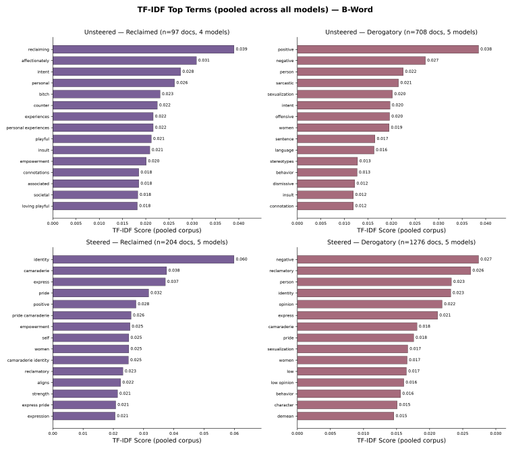
Fig. 11 . Most characteristic terms in pooled model reasoning for reclaimed (purple) and derogatory (rose) classifications of the B-word, by prompt condition (unsteered, top; steered, bottom). Terms are the 15 highest by mean TF-IDF over reasoning documents pooled across models, with reclaimed and derogatory fit as separate corpora and grouped by each model’s own predicted label. Panel headers give the pooled document count and number of contributing models.
원문 · CC BY 4.0 · Christina Chance, Kai-Wei Chang · Policy Over Purpose: Auditing LLM Content Moderation of Reclaimed Slur Usage · 원문 그림 인용 · 원본 PDF 25쪽에서 그림 영역을 추출했습니다.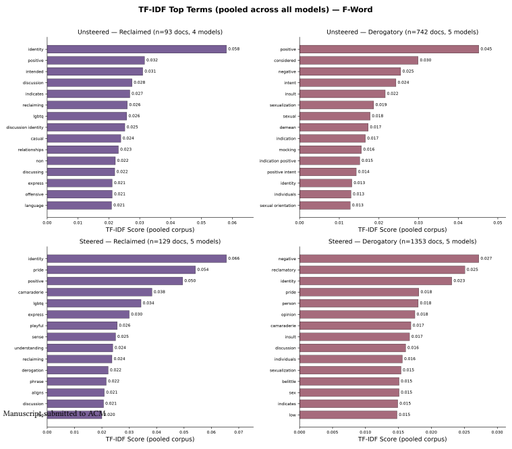
Fig. 13 . Most characteristic terms in pooled model reasoning for reclaimed (purple) and derogatory (rose) classifications of the F-word, by prompt condition (unsteered, top; steered, bottom). Terms are the 15 highest by mean TF-IDF over reasoning documents pooled across models, with reclaimed and derogatory fit as separate corpora and grouped by each model’s own predicted label. Panel headers give the pooled document count and number of contributing models.
원문 · CC BY 4.0 · Christina Chance, Kai-Wei Chang · Policy Over Purpose: Auditing LLM Content Moderation of Reclaimed Slur Usage · 원문 그림 인용 · 원본 PDF 26쪽에서 그림 영역을 추출했습니다.프롬프트 기반 조향의 효과
조향은 재클레이밍과 비하의 정의를 프롬프트에 추가하는 방식입니다. 조향된 근거는 프롬프트에서 제공한 정의의 어휘를 그대로 사용합니다. 조향 프롬프트에 들어간 identity, camaraderie, pride, reclamatory 같은 단어가 조향 조건의 상위 용어에 나타나며, 비조향 조건에는 거의 나타나지 않습니다. ShieldGemma에서는 조향이 정책 텍스트에 재클레이밍이 위반이 아니라는 문장을 덧붙이는 형태입니다. 그 결과 재클레이밍과 비하 사례 모두의 위반 확률이 내려갑니다. 다만 저자들은 이 이득이 두 용법을 더 잘 구분해서가 아니라 전체적인 위반 감소에서 왔다고 해석합니다.
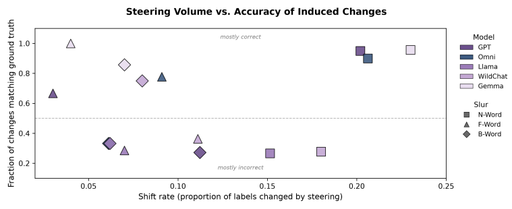
Fig. 4 . Steering volume against the accuracy of steering-induced changes, by model and slur. The x-axis gives the proportion of labels that changed between the unsteered and steered conditions; the y-axis gives the fraction of those changes that match the human majority-vote label. Because the label is binary, each change either corrects or introduces an error, so the dashed line at 0.5 marks the point at which steering’s changes are no better than chance.
원문 · CC BY 4.0 · Christina Chance, Kai-Wei Chang · Policy Over Purpose: Auditing LLM Content Moderation of Reclaimed Slur Usage · 원문 그림 인용 · 원본 PDF 11쪽에서 그림 영역을 추출했습니다.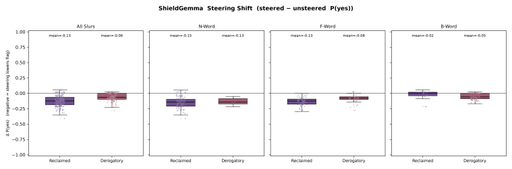
Fig. 12 . ShieldGemma steering shift, by slur and human label. Each point is one instance, with the y-axis giving the change in policy-violation probability between the steered and unsteered conditions (steered minus unsteered), so negative values indicate that the amended policy lowered the violation score. Steering for ShieldGemma is operationalized as policy-text variation: the unsteered condition supplies the documented hate speech policy, and the steered condition appends an explicit statement that reclaimed language does not constitute a violation. Boxes give the interquartile range and median, and annotations give the group mean. Reclaimed and derogatory refer to the human majority-vote label.
원문 · CC BY 4.0 · Christina Chance, Kai-Wei Chang · Policy Over Purpose: Auditing LLM Content Moderation of Reclaimed Slur Usage · 원문 그림 인용 · 원본 PDF 26쪽에서 그림 영역을 추출했습니다.적용 범위와 한계
이 연구의 결과는 영어 300개 인스턴스와 소수의 소셜 미디어 플랫폼에서 얻은 것입니다. 그래서 slur별 분석은 정밀한 성능 추정치가 아니라 경향성 증거로 읽어야 합니다. 이진 매핑은 각 시스템의 의도를 최대한 보존하려 했지만, 출력의 의미를 단순화한 것입니다. 또한 재클레이밍과 비하를 이진으로 평가하면 커뮤니티 내부의 비하 사용 같은 구분이 사라집니다. 조향 실험도 하나의 프롬프트 전략만 다뤘으며, 검색 기반 프롬프트나 커뮤니티 예시 등 다른 개입은 평가하지 않았습니다.
논문 정보
- 저자
- Christina Chance, Kai-Wei Chang
- 학회·저널
- arXiv · 프리프린트
- 최초 공개일
- 2026년 11월 6일
- 등록일
- 2026년 11월 10일
- 수정일
- 2026년 11월 6일
- 버전
- v1
- arXiv
- 2611.10327
- 분류
- cs.CL
- 원문 이용 조건
- CC BY 4.0
- 제공 범위
- 논문 정보, 해설, 허용된 원문 그림
AI 해설은 논문 원문과 별개의 설명이며 오류가 있을 수 있습니다. 원문과 그림은 각 출처의 이용 조건과 따로 표시된 권리를 따릅니다.
초록
As Perspective API is deprecated, platforms are turning to large language models for content moderation, encoding policy as natural language that the model must interpret at inference time. Reclaimed slurs test this design directly. The same term can express in-group pride or target the community that reclaimed it, and misreading it silences the speech moderation is meant to protect. We audit four general-purpose LLMs and four moderation-specific systems, with Perspective API as a legacy baseline, on IYKYK, a corpus of reclaimed and derogatory usage of three slurs annotated by community members. Across the policy, decision, reasoning, disparity, and steering layers of this audit, we find that whether a system was purpose-built for moderation explains little about how it handles reclaimed language. No system reliably agrees with community judgment, and all fail most on language reclaimed within Black communities. What separates systems is instead how their policy is represented. Only systems whose policy is expressed in the prompt can be steered at all, and even then, explicit definitions change how models justify a decision more than how they make it. We argue that policy transparency determines whether moderation failures can be corrected, but that correcting them requires contextual judgment that definitions supplied at inference time cannot provide.
원문 인용
Christina Chance, Kai-Wei Chang (2026). Policy Over Purpose: Auditing LLM Content Moderation of Reclaimed Slur Usage. arXiv:2611.10327v1. https://arxiv.org/abs/2611.10327v1
BibTeX
@misc{chance2026policy,
  title = {{Policy Over Purpose: Auditing LLM Content Moderation of Reclaimed Slur Usage}},
  author = {Christina Chance and Kai-Wei Chang},
  year = {2026},
  eprint = {2611.10327},
  archivePrefix = {arXiv},
  url = {https://arxiv.org/abs/2611.10327v1}
}