論文解説
Definitions, Label Names, or Demonstrations? Auditing What Governs LLM Annotation
定義、ラベル名、それともデモンストレーションか:LLMアノテーションを左右する要因の監査
- 課題 LLMによる注釈で精度が高くても、与えられた定義に従っている証拠にはなりません。
- 手法 定義を出力ラベルの間で割り当て直す反事実監査を行い、定義への準拠と元のマッピングの保持を分けて見ます。さらに、検索拡張とデモのラベル撹乱によって出所を切り分けます。
- 結果 割り当て直した条件では、予測は定義のマッピングより元のマッピングに従うことが多く、ファインチューニングは元のマッピングの再現を強めました。検索による向上は、主に隣接ラベルから来ていました。
精度が定義への準拠を意味しない問題
LLMで社会科学のテキストに注釈を付けるとき、精度が高くても、モデルが研究者の与えたカテゴリ定義を実際に守っているかは確認できません。モデルは定義文を読む代わりに、カテゴリ名への事前の連想や、ラベル付きデモのパターンに従うことがあります。普段はこれらの情報源が同じ答えを出すため、既存の評価では区別しにくいです。この論文では、この区別のために、定義と元のデータセットのマッピングが衝突する条件を作り、どちらのマッピングが予測を支配しているかを調べます。
定義の再割り当てによる反事実監査
監査では、各カテゴリの定義項目はそのままにして、その定義が付く出力ラベルだけを別のラベルに置き換えます。このとき使う対応πは、どのjについてもπ(j)≠jであるデランジメント(derangement)でなければならず、すべての定義が元のラベルとは別のラベルに付くことになります。予測が割り当て直された定義のラベルなら定義への準拠、元のラベルなら元のマッピングの保持に分類します。そのほかの有効なラベルはその他、無効な出力は無効に分類します。この分類からわかるのは予測がどのマッピングに一致するかだけで、予測を生んだ内部の原因までは確定しません。
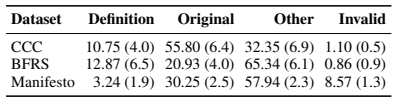
Table 2 : Zero-shot audit outcomes for Mistral-7B, in per- cent, across ten definition–label rearrangements (mean with standard deviation in parentheses; 1,000 documents per dataset).
出典 · CC BY 4.0 · Viraj Mishra, Shubham Gupta, Dhruv Gupta, Yuehong Cassandra Tai, Qunhua Li · Definitions, Label Names, or Demonstrations? Auditing What Governs LLM Annotation · 論文の図を引用 · 元のPDFの5ページ目から図の部分を抽出しています。ファインチューニングが元のマッピングを強める仕組み
ファインチューニングの監査では、データセットごとに人が注釈した学習セットでLoRAアダプターを1つずつ学習し、ベースモデルと同じ1,000件の文書、同じ10回の割り当て直しで比較します。LoRAは、大規模モデルの元の重みを固定したまま、低ランクのアダプターを学習する手法です。結果として、6つのモデルとデータセットの組み合わせすべてで元のラベルの一致率は上がりました。一方、定義への準拠率はCCCでは両モデルとも下がり、ほかのデータセットでは一貫して上がりませんでした。このことから、ファインチューニングは定義への反応を高めるよりも、既存の注釈を再現する方向を強めていると解釈できます。
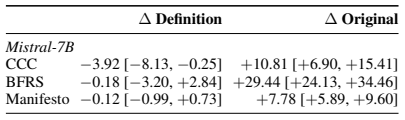
Table 3 : Paired percentage-point changes from base to fine-tuned models across ten definition–label rearrange- ments, with 95% confidence intervals in brackets.
出典 · CC BY 4.0 · Viraj Mishra, Shubham Gupta, Dhruv Gupta, Yuehong Cassandra Tai, Qunhua Li · Definitions, Label Names, or Demonstrations? Auditing What Governs LLM Annotation · 論文の図を引用 · 元のPDFの5ページ目から図の部分を抽出しています。検索拡張で隣接ラベルが果たす役割
Global Example-RAGは、学習プール全体からコサイン類似度で近い例を選び、1つの共有デモブロックとして提示します。Class-wise Example-RAGは、各カテゴリの中で例を個別に選び、対応するcodebook項目に付けます。実験では、MistralのGlobal codebook+demoプロンプトが、ManifestoとBFRSでcodebookのみの場合より高いF1を示しました。しかし、同じ検索の隣接例で直接kNN投票を行うと、ManifestoとBFRSの利得の74–93%が回復しました。このことから、隣接ラベルが予測の信号の多くを与えているように見えます。CCCでは利得が小さく、プロンプトによって変わるため、この割合は不安定だと報告されています。
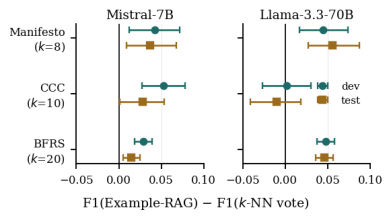
Figure 1 : Weighted- F1 difference between Global codebook-plus-demonstrations prompting and direct kNN using the same demonstrations. Positive values favor the LLM prompt; error bars show paired 95% con- fidence intervals. The numeric results are in Table 16
出典 · CC BY 4.0 · Viraj Mishra, Shubham Gupta, Dhruv Gupta, Yuehong Cassandra Tai, Qunhua Li · Definitions, Label Names, or Demonstrations? Auditing What Governs LLM Annotation · 論文の図を引用 · 元のPDFの6ページ目から図の部分を抽出しています。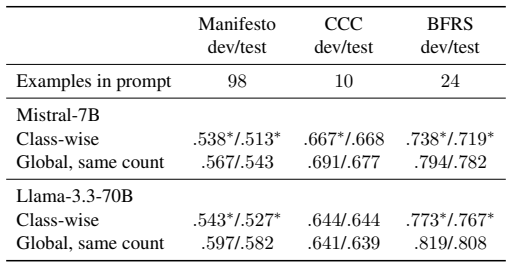
Table 11 : Class-wise Example-RAG against Global Example-RAG with the same number of examples; both prompts include codebook entries. Weighted F1, development/test. ∗ marks a Class-wise score whose paired difference from Global has a 95% bootstrap interval excluding zero; every starred difference favors Global.
出典 · CC BY 4.0 · Viraj Mishra, Shubham Gupta, Dhruv Gupta, Yuehong Cassandra Tai, Qunhua Li · Definitions, Label Names, or Demonstrations? Auditing What Governs LLM Annotation · 論文の図を引用 · 元のPDFの14ページ目から図の部分を抽出しています。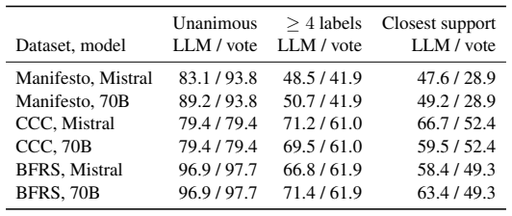
Table 17 : Development-set accuracy (%) of the Global codebook+demo prompt and of the direct kNN vote within retrieved-example subsets. Closest support is the quarter of documents with the smallest difference in summed similarity between the two leading labels. These are descriptive subsets without subgroup significance tests.
出典 · CC BY 4.0 · Viraj Mishra, Shubham Gupta, Dhruv Gupta, Yuehong Cassandra Tai, Qunhua Li · Definitions, Label Names, or Demonstrations? Auditing What Governs LLM Annotation · 論文の図を引用 · 元のPDFの17ページ目から図の部分を抽出しています。定義とデモが衝突するときの結果
クロスマッピング実験では、検索されたテキストを固定したまま、定義のマッピングとデモのラベルのマッピングをそれぞれ独立に変えます。割り当て直したデモだけを与えると、テストF1は元のラベルの条件より下がります。元のcodebookを加えると、一部の比較では回復しますが、完全には戻りません。デモのラベルを定義に合わせて変えたAligned条件は、定義の衝突条件よりテストF1が.114–.401高くなります。ただし、多くの場合、元のマッピングの条件よりは低いままです。このことから、デモは予測に強く影響し、定義はデモと同じマッピングを指示するときにより効果を持つと捉えられます。
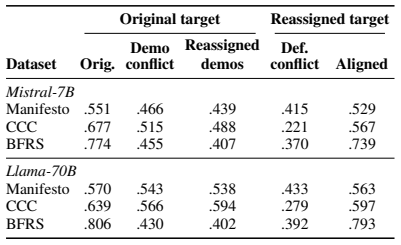
Table 5 : Test weighted F1 under original, conflicting, and aligned mappings. Targets follow the column group; Table 1 defines the conditions.Reassigned demoomits codebook information. Retrieved texts remain fixed.
出典 · CC BY 4.0 · Viraj Mishra, Shubham Gupta, Dhruv Gupta, Yuehong Cassandra Tai, Qunhua Li · Definitions, Label Names, or Demonstrations? Auditing What Governs LLM Annotation · 論文の図を引用 · 元のPDFの7ページ目から図の部分を抽出しています。結果の適用範囲と限界
この結果は、3つの英語の政治テキストのデータセットと、選ばれたオープンウェイトのモデルから得られたものです。割り当て直しはカテゴリの意味を保つため、新しいカテゴリ境界を学習するかどうかは確認していません。監査は観察可能な振る舞いを測るもので、内部の因果メカニズムは明らかにしません。また、衝突実験は事前に定めたラベルの入れ替えと割り当て直しを使うため、誤ってラベルされた個別の例やcodebookの文言の曖昧さへの反応については確立していません。
論文情報
- 著者
- Viraj Mishra, Shubham Gupta, Dhruv Gupta, Yuehong Cassandra Tai, Qunhua Li
- 学会・ジャーナル
- arXiv · プレプリント
- 公開日
- 2026年11月6日
- 登録日
- 2026年11月9日
- 更新日
- 2026年11月6日
- バージョン
- v1
- arXiv
- 2611.09457
- カテゴリ
- cs.AI
- ライセンス
- CC BY 4.0
- 掲載内容
- 論文情報・解説・論文の図
この解説は、Refivuの韓国語解説をAIで翻訳したものです。不正確な翻訳や誤りが含まれる可能性があります。論文と図の利用条件は各出典に従います。
アブストラクト
Large language models (LLMs) are increasingly used to annotate social-science texts, but high accuracy does not establish that they apply researcher-supplied category definitions: predictions may instead reflect prior associations with category labels or labeled demonstrations. We introduce a counterfactual audit that reassigns definitions among output labels, distinguishing adherence to supplied definitions from preservation of a dataset's original mapping. Across three political-text datasets, models rarely follow reassigned definitions, and standard fine-tuning strengthens the original mapping without reliably increasing definition adherence. We then study retrieval-augmented annotation. Retrieving the nearest training examples generally outperforms retrieving examples separately within each category despite using fewer demonstrations. On the two tasks with substantial gains, direct \(k\)-nearest-neighbor classification recovers 74--93\% of the improvement, indicating that neighborhood labels provide much of the predictive signal. Relabeling fixed demonstrations redirects predictions, whereas aligning demonstrations with reassigned definitions substantially increases adherence to the new mapping. Thus, accuracy-improving interventions need not increase codebook adherence; definitions, category labels, demonstrations, retrieval, and training data should be aligned and validated jointly.
この論文を引用
Viraj Mishra, Shubham Gupta, Dhruv Gupta, Yuehong Cassandra Tai, Qunhua Li (2026). Definitions, Label Names, or Demonstrations? Auditing What Governs LLM Annotation. arXiv:2611.09457v1. https://arxiv.org/abs/2611.09457v1
BibTeX
@misc{mishra2026definitions,
  title = {{Definitions, Label Names, or Demonstrations? Auditing What Governs LLM Annotation}},
  author = {Viraj Mishra and Shubham Gupta and Dhruv Gupta and Yuehong Cassandra Tai and Qunhua Li},
  year = {2026},
  eprint = {2611.09457},
  archivePrefix = {arXiv},
  url = {https://arxiv.org/abs/2611.09457v1}
}