論文解説
Generative Latent Priors for Interpreting and Steering Protein Language Models
Generative Latent Priors:タンパク質言語モデルの解釈と操作
- 課題 pLMの活性値を、疎な事前仮定を置かずに解釈して編集する方法が必要です。この論文は、GLPをESM-2の活性値に適用して評価しています。
- 手法 GLPは凍結したESM-2の活性値の分布を、フロー・マッチングの拡散モデルで学習します。メタニューロンのプロービングと、SDEditによる補正の2通りで使われます。
- 結果 GLPのメタニューロンは、離散概念のプロービングでSAEなどのベースラインより高いAUCを示しましたが、その多くは集中によるものと解釈されます。補正は属性操作の分離を高めましたが、デコード後の構造妥当性は改善しませんでした。
既存の疎な辞書的手法の限界
大規模モデルを解釈する主流の方法は、スパースオートエンコーダ(SAE)のように強い構造的仮定を置きます。pLMの活性値についても、SAEはSwiss-Prot注釈と対応する特徴を見つけてきましたが、活性値を疎な辞書に分解し、線形性を仮定するという点に限界があります。この論文は、そうした仮定を置かずに活性値の分布そのものを学習するGenerative Latent Priors(GLP)を、ESM-2の活性値に適用しています。GLPは凍結したホストモデルの活性値をフロー・マッチングで学習した拡散モデルで、プロービングのレンズと編集用の事前分布という2つの役割で評価されています。
ESM-2活性値上でのGLP学習
ホストモデルのESM-2-8MとESM-2-650Mは学習中に凍結され、それぞれ4番と18番の層の残差ストリームを読み取ります。標準化した残基ごとの活性値hを、ノイズϵと線形補間したh_t = (1−t)h + tϵで、速度目標ϵ−hを予測するネットワークu_θを次の損失で学習します: L(θ) = E_{h,ϵ,t} ||u_θ(h_t, t) − (ϵ−h)||²。この式で、損失は最小化の対象です。生成時には−u_θをt=1からt=0まで積分してノイズを取り除きます。中間の時刻t_0まで壊した編集後の活性値を入れると、同じ過程で多様体上に戻せます。u_θはSwiGLU MLPブロックを積み重ねた構造で、固定ノイズ水準t=τでブロックごとのゲート活性値を読んだ値がメタニューロンです。
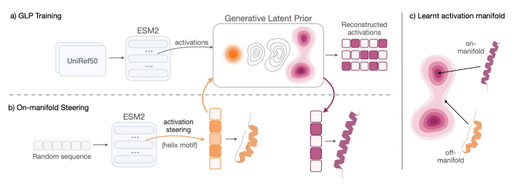
Figure 1 : Pipeline overview. (a) GLP trains by flow matching on ESM-2 activations from UniRef50 to learn their manifold. (b) Steering pushes an activation off that manifold toward a target property. (c) GLP correction re-noises and denoises the edit back onto the manifold.
出典 · CC BY 4.0 · Daniel Hinjos, Lucía Urcelay · Generative Latent Priors for Interpreting and Steering Protein Language Models · 論文の図を引用 · 元のPDFの2ページ目から図の部分を抽出しています。メタニューロンのプロービング設定
メタニューロンが生物学的概念を単一のユニットに分けているかを見るため、プロービングに使う概念集合は、GLPの出力を見る前に固定しています。残基レベルの離散概念は110個、連続の配列全体の属性は10個です。負例は正例と同じタンパク質から取るため、タンパク質の同一性だけでは区別できません。連続属性では、平均プーリングした活性値と属性の絶対値ピアソン相関で候補を選び、線形プローブのSpearman ρを使います。
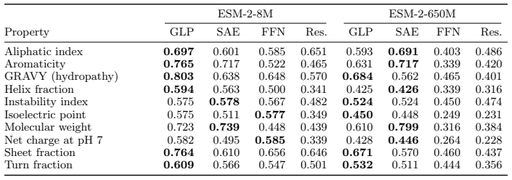
Table 9 : Per-property test Spearmanρ, all 10 continuous properties, both hosts. The shaded row is the mean, with the Wilcoxonpfor the leader against the runner-up.
出典 · CC BY 4.0 · Daniel Hinjos, Lucía Urcelay · Generative Latent Priors for Interpreting and Steering Protein Language Models · 論文の図を引用 · 元のPDFの22ページ目から図の部分を抽出しています。メタニューロンのプロービング結果と集中
8Mホストでは、GLPのメタニューロンは離散概念の平均テストAUCが0.903で、SAEの0.845、ESM FFNの0.877、残差ストリームの0.833を上回りました。この優位が新しい情報によるものかを確かめるため、8Mで勝ったメタニューロンの大半は、SAE辞書への線形な読み出し値で説明できました(中央値R² 0.76)。また、SAEの上位20個の特徴を組み合わせたプローブは、GLPが勝った104個の概念のうち94個で、同じテストAUCに到達しました。著者らは、これを情報の新しさよりも集中(concentration)として解釈しています。

Table 1 : 1-D probing: mean test AUC or Spearmanρ[95% bootstrap CI]. Bold: highest per column; ∗:p<0.05vs. all baselines (two-sided paired Wilcoxon).
出典 · CC BY 4.0 · Daniel Hinjos, Lucía Urcelay · Generative Latent Priors for Interpreting and Steering Protein Language Models · 論文の図を引用 · 元のPDFの4ページ目から図の部分を抽出しています。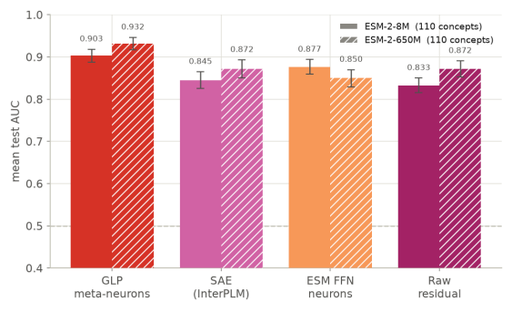
Figure 9 : 1-D probing mean test AUC by method and host (ESM-2-8M solid, ESM-2-650M hatched; 95% bootstrap CI). GLP meta-neurons lead at both host sizes.
出典 · CC BY 4.0 · Daniel Hinjos, Lucía Urcelay · Generative Latent Priors for Interpreting and Steering Protein Language Models · 論文の図を引用 · 元のPDFの19ページ目から図の部分を抽出しています。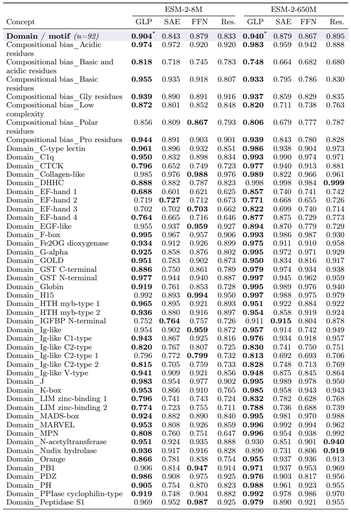
Table 8 : Per-concept test AUC, all 110 concepts, both hosts. Bold marks the highest value in each row within a host. Shaded rows are category means; * marks a lead over the runner- up withp<0.05(two-sided paired Wilcoxon over the category’s concepts, uncorrected). Categories withn≤4cannot reach this threshold even if the leader wins every concept.
出典 · CC BY 4.0 · Daniel Hinjos, Lucía Urcelay · Generative Latent Priors for Interpreting and Steering Protein Language Models · 論文の図を引用 · 元のPDFの20ページ目から図の部分を抽出しています。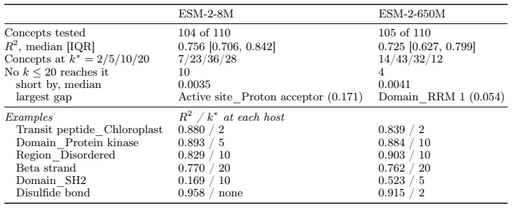
Table 10 : Falsification tests on the concepts GLP wins.R2: meta-neuron regressed on the full SAE dictionary (held-out).k ∗: fewest top-kSAE features whose joint probe matches its test AUC (“none” if nok≤20does).
出典 · CC BY 4.0 · Daniel Hinjos, Lucía Urcelay · Generative Latent Priors for Interpreting and Steering Protein Language Models · 論文の図を引用 · 元のPDFの22ページ目から図の部分を抽出しています。DiffMean操作とSDEdit補正
操作実験では、DiffMeanの方向vを、上位と下位のUniRef50四分位の間の平均活性値の差から得ます。方向のノルムは活性値の平均ノルム∥h∥に合わせて、v̂ = ∥h∥v/∥v∥に再スケールします。編集後のh̃ = ∥h∥(h+αv̂)/∥h+αv̂∥は、再び活性値のノルムを保ちます。補正アームでは、編集した残基の活性値をSDEditでt_0までノイズ化し、K段階でデノイズして、GLP多様体上に戻します。2つのアームは補正演算を実行するかどうかだけが違い、ループ全体では、ランダムに選んだ残基の10%を30ラウンドにわたってマスクドGibbsで再サンプリングします。属性はGRAVY、正味電荷÷長さ、Guruprasad不安定性指数を、配列から直接計算します。
補正で属性の分離は高まるが構造は保てない
3つの生化学的属性では、補正アームは上向きと下向きの方向を、naiveアームより明確に分けています。naiveアームは大半のαで2方向をほとんど分けられませんでしたが、補正アームはグリッドの大部分で3属性を分けました。α=0の実行では補正アームにも方向性のバイアスが見られましたが、これは補正演算自体のオフセットとして別に測り、発散度から差し引いています。補正自体は分布損失を戻します。単一の活性値では、SDEditを1回行うと、αの増加に伴って上がった拡散損失の大部分が回復します。しかし、デコード後に再埋め込みした配列では、補正アームはnaiveアームより多様体上にあるとは言えませんでした。構造妥当性を示すESMFold pTMも改善しませんでした。
著者らは、これをデコードのループが補正効果を失わせるためだと解釈しています。

Figure 2 : Property steering naive vs GLP correction, both directions. Change vs.α=0
出典 · CC BY 4.0 · Daniel Hinjos, Lucía Urcelay · Generative Latent Priors for Interpreting and Steering Protein Language Models · 論文の図を引用 · 元のPDFの4ページ目から図の部分を抽出しています。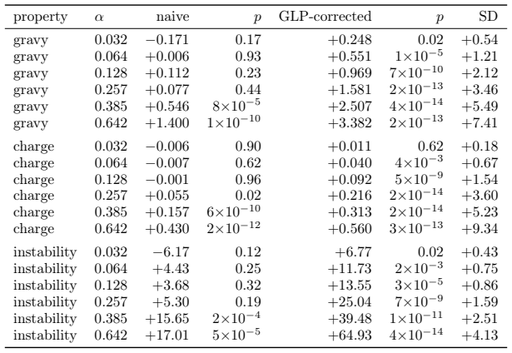
Table 3 : Steering-attributable divergence (up − down); α in units of ∥h∥, SD = divergence over the property’s UniRef50 spread. Unpaired Mann–Whitney, n=40 per direction.
出典 · CC BY 4.0 · Daniel Hinjos, Lucía Urcelay · Generative Latent Priors for Interpreting and Steering Protein Language Models · 論文の図を引用 · 元のPDFの13ページ目から図の部分を抽出しています。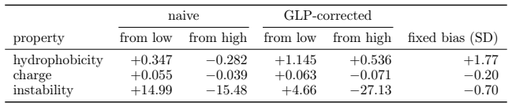
Table 4 : Concept change withnosteering applied (α=0), by arm and starting set, in each property’s own units. A fixed bias adds the same amount from both sets; mean reversion flips sign with the set and cancels in the corrected−naive difference, which is the last column.
出典 · CC BY 4.0 · Daniel Hinjos, Lucía Urcelay · Generative Latent Priors for Interpreting and Steering Protein Language Models · 論文の図を引用 · 元のPDFの14ページ目から図の部分を抽出しています。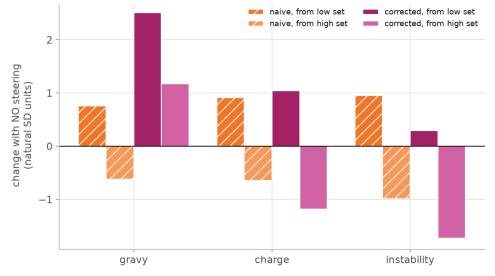
Figure 6 : Theα=0arms, in units of each property’s spread. Hatched: naive. A bias that reverses with the starting set is mean reversion; one that does not comes from the correction.
出典 · CC BY 4.0 · Daniel Hinjos, Lucía Urcelay · Generative Latent Priors for Interpreting and Steering Protein Language Models · 論文の図を引用 · 元のPDFの14ページ目から図の部分を抽出しています。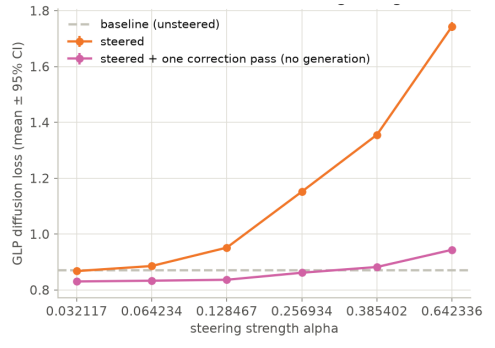
Figure 7 : GLP diffusion loss against steering strength, before and after a single correction pass applied directly to the steered activation (no generation), for hydrophobicity
出典 · CC BY 4.0 · Daniel Hinjos, Lucía Urcelay · Generative Latent Priors for Interpreting and Steering Protein Language Models · 論文の図を引用 · 元のPDFの14ページ目から図の部分を抽出しています。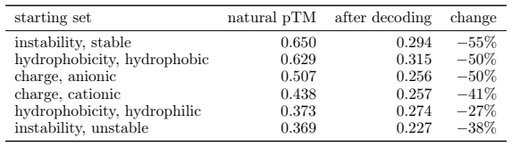
Table 5 : Foldability before and after the decoding loop, with no steering and no correction (α=0, naive arm), for all six held-out sets.
出典 · CC BY 4.0 · Daniel Hinjos, Lucía Urcelay · Generative Latent Priors for Interpreting and Steering Protein Language Models · 論文の図を引用 · 元のPDFの15ページ目から図の部分を抽出しています。SAEクランプによる構造操作の概念別の違い
SAE特徴をcの値でクランプする構造操作では、4つの概念で結果が異なります。Helix特徴5355は、DSSP helix fractionを補正アームでnaiveアームより高くし、補正アームはクランプがない場合でもこの割合を上げました。Beta strandはほとんど動かず、補正アームのstrand fractionは大半のcでnaiveより低くなりました。Coiled coilについては、pepcoilが長い単一のヘリックスをheptad反復として採点した結果かもしれないと、論文では指摘されています。Zinc fingerは、PROSITEとPfam zf-C2H2のアラインメントで確認すると完全なC2H2モチーフを作れませんでした。
連続HMMスコアでのみ、補正アームが高くなりました。この結果は、残基ごとのバイアスが局所的なヘリックス傾向は変えられるものの、β-sheet、コイルドコイル、ジンクフィンガーのような遠く離れた残基対の配置は作りにくいという、著者らの解釈とあわせて読む必要があります。
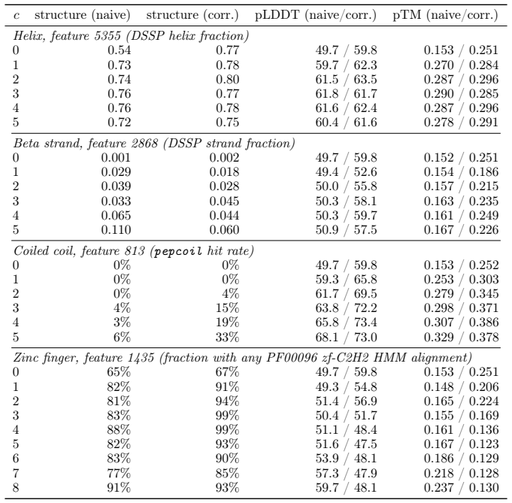
Table 7 : Structural steering byc, naive/GLP-corrected,n=100per cell. Structural column: DSSP secondary-structure fraction (per-chain residue fraction in that class) for Helix and Beta strand; EMBOSSpepcoilhit rate for Coiled coil; and, for Zinc finger, the fraction of sequences with any PF00096 zf-C2H2 profile-HMM alignment (a graded measure, no complete motif forms).
出典 · CC BY 4.0 · Daniel Hinjos, Lucía Urcelay · Generative Latent Priors for Interpreting and Steering Protein Language Models · 論文の図を引用 · 元のPDFの18ページ目から図の部分を抽出しています。適用範囲と残された問い
この研究では、ホストごとにhook層を1つだけ学習しました。プロービングは、ドメインやモチーフが多いプールで相関分析により行われ、操作は1つの層とマスクされた位置にだけ適用されました。生成品質のFDはサンプラーのステップ数によって変わるため、本結果のFDは1,000ステップで測定した値に限った結果です。デコードのループで構造妥当性が落ちる現象は、マスクドGibbsデコードの全面的な書き換えと関係しています。ビームサーチのように編集数を制限したデコーダは自然さをよく保ちましたが、操作効果は弱くなりました。そのため、この結果は連続事前分布でタンパク質配列生成を操作する際の構造上の限界として捉える必要があり、他のデコーダや操作方法の可能性はまだ検証されていません。
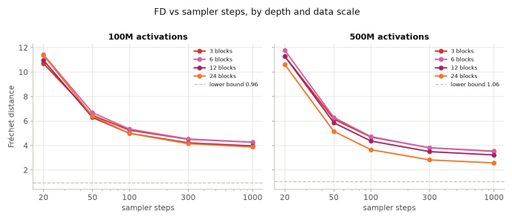
Figure 4 : Fréchet Distance vs. sampler steps, by GLP depth and data scale (sharedy-axis). FD falls with sampler steps everywhere. Depth lowers FD monotonically and the gain is larger at500M than at100M: more data lets extra depth pay off. The shallowest cells (3 vs.6blocks) are near-identical at both scales; separation appears at12–24blocks. Dashed lines: real-vs-real lower bound.
出典 · CC BY 4.0 · Daniel Hinjos, Lucía Urcelay · Generative Latent Priors for Interpreting and Steering Protein Language Models · 論文の図を引用 · 元のPDFの10ページ目から図の部分を抽出しています。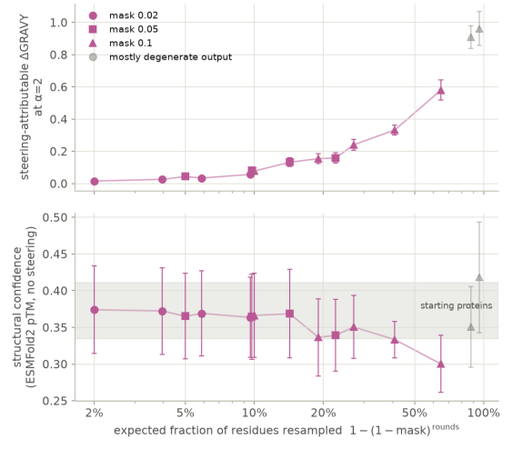
Figure 8 : Steering effect (top) and foldability (bottom) against how much of the protein the decoder rewrites,T=0.5. Marker shape distinguishes mask fraction; the three series fall on a single curve, i.e. mask fraction and round count act only through their product. Shaded band: the starting proteins’ own pTM (±SEM). Grey points are settings whose output is mostly degenerate and are excluded from the trend. This budget sweep predates the relative-αparameterisation and its axis label is in raw units; for the hydrophobicity vector itsα=2is the same perturbation as theα=0.257used elsewhere in this paper.
出典 · CC BY 4.0 · Daniel Hinjos, Lucía Urcelay · Generative Latent Priors for Interpreting and Steering Protein Language Models · 論文の図を引用 · 元のPDFの16ページ目から図の部分を抽出しています。論文情報
- 著者
- Daniel Hinjos, Lucía Urcelay
- 学会・ジャーナル
- arXiv · プレプリント
- 公開日
- 2026年11月6日
- 登録日
- 2026年11月9日
- 更新日
- 2026年11月6日
- バージョン
- v1
- arXiv
- 2611.09818
- カテゴリ
- cs.AI · cs.LG
- ライセンス
- CC BY 4.0
- 掲載内容
- 論文情報・解説・論文の図
この解説は、Refivuの韓国語解説をAIで翻訳したものです。不正確な翻訳や誤りが含まれる可能性があります。論文と図の利用条件は各出典に従います。
アブストラクト
Dominant methods for interpreting large models impose strong structural assumptions. Generative Latent Priors (GLP) are a complementary approach: a diffusion model that learns the distribution of a frozen model's activations directly, imposing no assumptions. We port GLP to ESM-2 activations (UniRef50) and evaluate it at two host scales (ESM-2-8M and -650M), both as a lens for protein representations and as a prior for editing them. Generation quality scales smoothly with depth and compute. As a lens, single GLP "meta-neurons" are the strongest probes of discrete Swiss-Prot concepts at both hosts, beating InterPLM's released SAE features, and lead on continuous properties at 8M though not at 650M; falsification tests show this is mostly concentration, not new information. As an editing prior, the on-manifold correction makes DiffMean steering of three biochemical properties effective and restores on-manifoldness, but only in isolation: re-embedding the sequences actually produced after several rounds of decoding, the structural plausibility is compromised. This is mainly reproduced in additional SAE-based clamping structural steering experiments, where only Helix motif succeeds. The naturalness failure is traced to the rewriting coverage and the decoder rather than the prior, highlighting what the method must clear before it can serve for both discovery-by-editing and discovery-by-exploration. Trained GLPs are released on huggingface.co/collections/HPAI-BSC/glprot.
この論文を引用
Daniel Hinjos, Lucía Urcelay (2026). Generative Latent Priors for Interpreting and Steering Protein Language Models. arXiv:2611.09818v1. https://arxiv.org/abs/2611.09818v1
BibTeX
@misc{hinjos2026generative,
  title = {{Generative Latent Priors for Interpreting and Steering Protein Language Models}},
  author = {Daniel Hinjos and Lucía Urcelay},
  year = {2026},
  eprint = {2611.09818},
  archivePrefix = {arXiv},
  url = {https://arxiv.org/abs/2611.09818v1}
}