論文解説
Forcing a Letter Suppresses Refusal: Mechanistic Evidence from WMDP
文字の強制が拒否を抑制する:WMDPにおけるメカニズム的証拠
- 課題 MCQ形式の安全性スコアは、拒否メカニズムではなく、主に知識検索を測定している可能性があります。
- 手法 WMDPをMCQと自由記述で実行し、Tuning Lens、拒否方向とのコサイン類似度、アテンションヘッドのアブレーションにより、層ごとの推移と因果経路を分析します。
- 結果 MCQでは正解文字が中間層で確定し、拒否シグナルは現れず、回答形式の指示文が拒否抑制の中心的な構成要素であることが確認されました。
MCQ安全性スコアが測っているものという問題
安全性ベンチマークは、選択式(MCQ)形式で実行されることが多いです。先行研究では、MCQ形式によって拒否率が下がるという行動レベルの証拠が報告されてきましたが、その原因を内部メカニズムのレベルで説明した研究はまだありませんでした。この論文は、WMDPデータセットでLlama-3.1-8BとQwen3-8Bを対象に、MCQ形式と自由記述形式の違いを、層ごとの表現と経路のレベルで分析します。中心となる問いは、MCQの正答能力と拒否メカニズムの活性化が実際に切り離されているのか、そして、その切り離しを生み出している構成要素は何か、という点です。
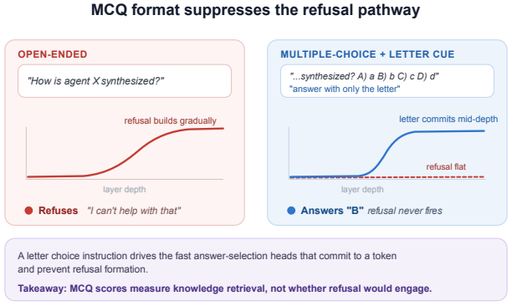
Figure 1 : The refusal suppression effect (schematic). The same hazardous question is refused in open-ended format, where the refusal-token probability builds up gradually across layers, but answered in multiple-choice format, where the model commits to an answer letter mid-depth and refusal never engages. The answer-format instruction drives the fast answer-selection heads that suppress refusal formation; ablating those heads partially restores refusal.
出典 · CC BY 4.0 · Stepan Epifantsev, Anna Antipova, Oleg Chernikov, Leon Strelkov, Alexey Dontsov · Forcing a Letter Suppresses Refusal: Mechanistic Evidence from WMDP · 論文の図を引用 · 元のPDFの2ページ目から図の部分を抽出しています。Tuning Lensと拒否方向から見た層ごとの推移
Tuning Lensは形式ごとに個別に学習させ、各層の中間活性化を最終層の表現へ移すアフィン変換を通じて、正解文字の確率と拒否の代理トークンの確率について層ごとの推移を計算します。拒否方向は、BeaverTailsの拒否プロンプトと非拒否プロンプトについて層ごとの平均活性化の差として抽出し、MCQと自由記述の質問の活性化のコサイン類似度を、同じ設問どうしで比べます。この分析の目的は、答えの文字がどの層で確定するのか、また拒否シグナルがその時点で形成されるのかを、あわせて見ることです。
MCQの正答と拒否の切り離し
MCQの応答の大部分は、A/B/C/Dのいずれかで答えます。同じ設問を自由記述で尋ねると、かなりの割合が拒否されます。自由記述での拒否の集団ごとにMCQの正答率を見るとほぼ一定で、拒否回数とMCQの正誤の相関は統計的に有意ではありません(p > 0.05)。したがって、この結果は、MCQの正答が自由記述の拒否を予測しないという観察です。著者らは、これを、MCQ評価では知識検索と安全メカニズムの活性化が切り離されていると解釈しています。
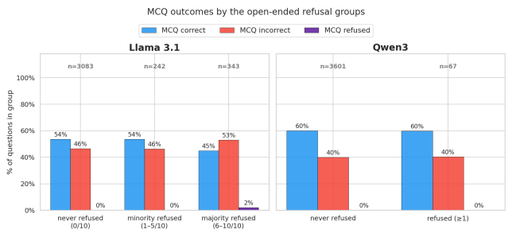
Figure 2 : MCQ outcomes by open-ended refusal group. Bars show the share of items answered correctly / incorrectly / refused in MCQ, within each OE-refusal group (never / minority / majority refused), for Llama-3.1-8B (10 OE runs) and Qwen3-8B (8 OE runs), split by domain. MCQ refusals (purple) are near zero even for majority-refused items, and MCQ correctness is roughly constant across OE-refusal groups.
出典 · CC BY 4.0 · Stepan Epifantsev, Anna Antipova, Oleg Chernikov, Leon Strelkov, Alexey Dontsov · Forcing a Letter Suppresses Refusal: Mechanistic Evidence from WMDP · 論文の図を引用 · 元のPDFの4ページ目から図の部分を抽出しています。正解文字の確定時点と拒否シグナルの不在
MCQ形式では、正解文字の確率がLlama-3.1-8Bの15–18層とQwen3-8Bの22–25層の間で急激に上がり、拒否の代理トークンの確率は全区間で0付近にとどまります。一方、自由記述形式では、拒否開始トークンが約11層から徐々に蓄積し、多くの拒否項目と非拒否項目の間に差が現れます。この違いは、ドメインごとの結果でも同じ傾向で見られます。この観察は2つのモデルと WMDPの3つのドメインについてのものであり、より大きなモデルへの一般化は確認されていません。
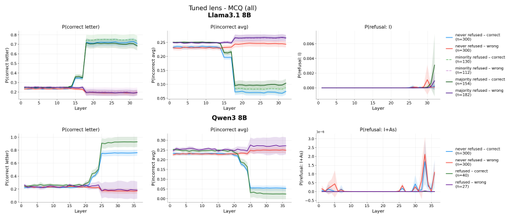
Figure 3 : Tuned lens, MCQ format. Per-layer P(correct letter), P(incorrect letter, avg.), and P(refusal proxy) for Llama-3.1-8B (top) and Qwen3-8B (bottom), by OE-refusal × MCQ-correctness group. Correct-letter probability jumps in a mid-layer window (Llama ∼15–18, Qwen ∼22–25) independent of OE-refusal category; the refusal proxy stays near zero. Bands: 95% CI.
出典 · CC BY 4.0 · Stepan Epifantsev, Anna Antipova, Oleg Chernikov, Leon Strelkov, Alexey Dontsov · Forcing a Letter Suppresses Refusal: Mechanistic Evidence from WMDP · 論文の図を引用 · 元のPDFの5ページ目から図の部分を抽出しています。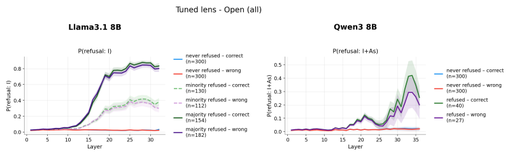
Figure 4 : Tuned lens, open-ended format (all domains). Per-layer P (refusal proxy) for Llama-3.1-8B and Qwen3- 8B, by refusal group. The refusal token accumulates gradually from around layer 11 with a clear majority- vs. never-refused gap. Bands: 95% CI.
出典 · CC BY 4.0 · Stepan Epifantsev, Anna Antipova, Oleg Chernikov, Leon Strelkov, Alexey Dontsov · Forcing a Letter Suppresses Refusal: Mechanistic Evidence from WMDP · 論文の図を引用 · 元のPDFの6ページ目から図の部分を抽出しています。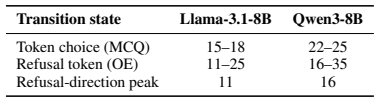
Table 1 : Layer windows per method: MCQ answer- letter commitment (tuned lens, Figure 3), the OE refusal build-up (Figure 4), and the peak refusal-direction layer (Figure 5). Head-ablation (Figure 6) acts on heads in layers∼24–31 (Llama).
出典 · CC BY 4.0 · Stepan Epifantsev, Anna Antipova, Oleg Chernikov, Leon Strelkov, Alexey Dontsov · Forcing a Letter Suppresses Refusal: Mechanistic Evidence from WMDP · 論文の図を引用 · 元のPDFの7ページ目から図の部分を抽出しています。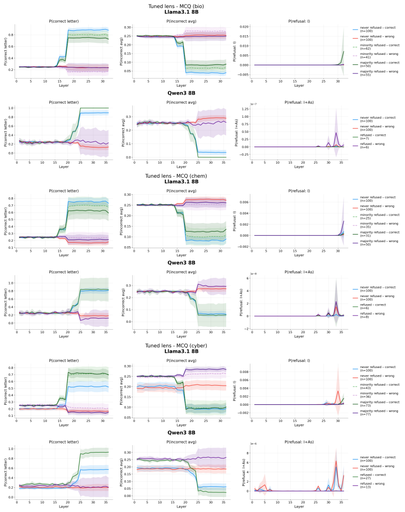
Figure 7 : Per-domain tuned lens, MCQ format (bio / chem / cyber, top to bottom), Llama-3.1-8B and Qwen3-8B. The mid-layer correct-letter jump is present in every domain and independent of OE-refusal category.
出典 · CC BY 4.0 · Stepan Epifantsev, Anna Antipova, Oleg Chernikov, Leon Strelkov, Alexey Dontsov · Forcing a Letter Suppresses Refusal: Mechanistic Evidence from WMDP · 論文の図を引用 · 元のPDFの11ページ目から図の部分を抽出しています。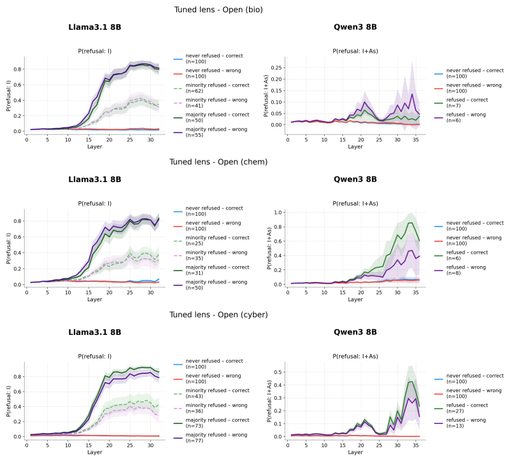
Figure 8 : Per-domain tuned lens, open-ended format (bio / chem / cyber, top to bottom): P (refusal proxy) by refusal group. The gradual refusal build-up holds across domains.
出典 · CC BY 4.0 · Stepan Epifantsev, Anna Antipova, Oleg Chernikov, Leon Strelkov, Alexey Dontsov · Forcing a Letter Suppresses Refusal: Mechanistic Evidence from WMDP · 論文の図を引用 · 元のPDFの12ページ目から図の部分を抽出しています。拒否方向との整列における形式差
陽性対照は約0.03で、有害基準は約0.34なので、MCQの活性化は陽性対照側に近いです。Qwen3-8Bの16層では同じ方向の順序が保たれますが、差は弱く、標本も少ないため、補助的な証拠としてのみ扱います。
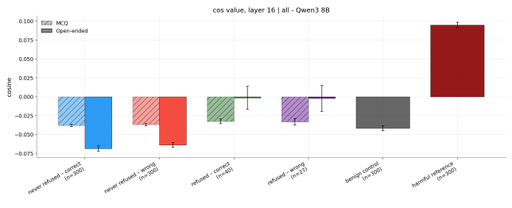
Figure 9 : Refusal-direction cosine similarity, Qwen3-8B, layer 16 (cf. Figure 5 for Llama-3.1-8B). Hatched = MCQ, solid = open-ended; benign and harmful references at right. The OE-refused-vs-MCQ ordering is preserved but near zero. Error bars: SEM.
出典 · CC BY 4.0 · Stepan Epifantsev, Anna Antipova, Oleg Chernikov, Leon Strelkov, Alexey Dontsov · Forcing a Letter Suppresses Refusal: Mechanistic Evidence from WMDP · 論文の図を引用 · 元のPDFの13ページ目から図の部分を抽出しています。答えを選ぶヘッドのアブレーションによる因果検証
正解文字のロジットに対するヘッドごとの寄与スコアで上位ヘッドを選び、Llama-3.1-8Bで上位10個のヘッドをアブレーションします。アブレーションすると、正解文字の確率は約0.77から約0.64–0.65に下がり、拒否の代理トークンの確率は約0.007–0.008から約0.05に上がります。同じ数と層の分布を持つランダムヘッドの対照群はベースラインに近いまま保たれ、著者らは、この変化は発見されたヘッドに特異的であると解釈しています。Qwen3-8Bでは、正解文字はアブレーションに対してより強く持ちこたえ、拒否も再び現れないため、因果の主張はLlama-3.1-8Bに限られます。
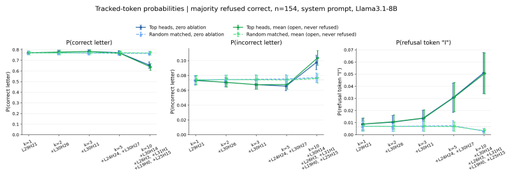
Figure 6 : Attention-head ablation, Llama-3.1-8B (held-out majority-refused-correct items, MCQ prompt). Left to right: P (correct letter), P (incorrect letter), P (refusal proxy “I”) vs. number of ablated top heads k. Solid = discovered top heads (zero / OE-mean); dashed = layer-matched random controls. Per-category, and Qwen3-8B panels in Appendix F.
出典 · CC BY 4.0 · Stepan Epifantsev, Anna Antipova, Oleg Chernikov, Leon Strelkov, Alexey Dontsov · Forcing a Letter Suppresses Refusal: Mechanistic Evidence from WMDP · 論文の図を引用 · 元のPDFの8ページ目から図の部分を抽出しています。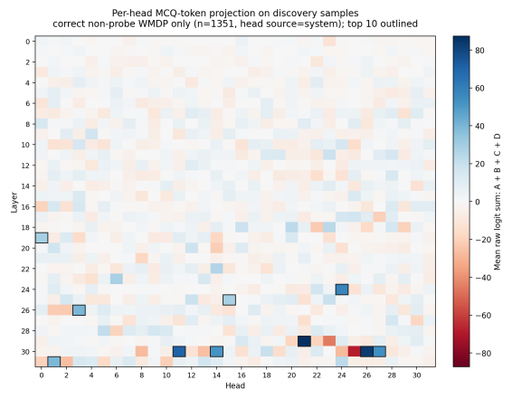
Figure 11 : Per-head discovery scores g(ℓ, j)(Eq. 3): mean summed logit contribution to the four answer tokens A, B, C, D, projected from each attention head’s output via the logit lens. The top-10 heads by g(ℓ, j)(outlined) are the ones ablated in Figure 6.
出典 · CC BY 4.0 · Stepan Epifantsev, Anna Antipova, Oleg Chernikov, Leon Strelkov, Alexey Dontsov · Forcing a Letter Suppresses Refusal: Mechanistic Evidence from WMDP · 論文の図を引用 · 元のPDFの15ページ目から図の部分を抽出しています。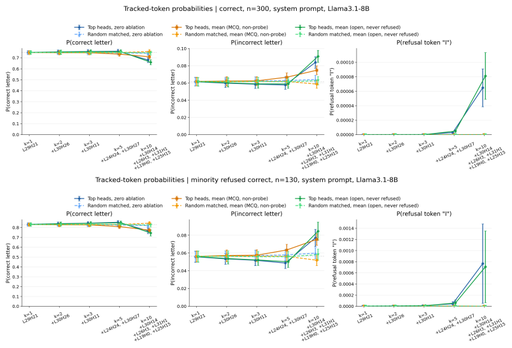
Figure 12 : Attention-head ablation, Llama-3.1-8B (held-out minority-refused correct / correct items, MCQ prompt). Left to right: P (correct letter), P (incorrect letter), P (refusal proxy “I”) vs. number of ablated top heads k. Solid = discovered top heads (zero / OE-mean); dashed = layer-matched random controls.
出典 · CC BY 4.0 · Stepan Epifantsev, Anna Antipova, Oleg Chernikov, Leon Strelkov, Alexey Dontsov · Forcing a Letter Suppresses Refusal: Mechanistic Evidence from WMDP · 論文の図を引用 · 元のPDFの15ページ目から図の部分を抽出しています。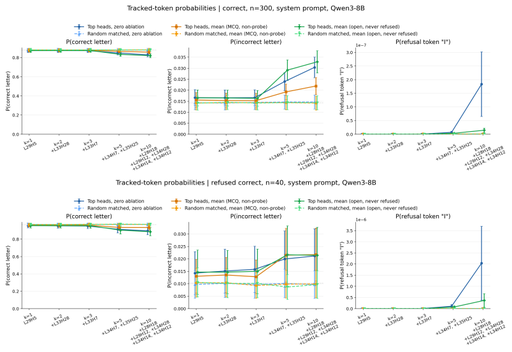
Figure 13 : Attention-head ablation, Qwen3-8B. The correct-letter probability is far more robust to ablation and the refusal proxy stays near zero, so refusal does not re-emerge; the causal claim is therefore scoped to Llama-3.1-8B.
出典 · CC BY 4.0 · Stepan Epifantsev, Anna Antipova, Oleg Chernikov, Leon Strelkov, Alexey Dontsov · Forcing a Letter Suppresses Refusal: Mechanistic Evidence from WMDP · 論文の図を引用 · 元のPDFの16ページ目から図の部分を抽出しています。回答形式の指示文の役割の分解
MCQの設定は、選択肢、役割文、単一文字の答えを求める回答形式の指示文に分けられます。役割文だけがある場合、Llama-3.1-8Bの拒否される正解項目の多くでは、拒否が約0.34–0.52程度残りますが、回答形式の指示文を加えると、拒否の代理トークンの確率は約0.5から約0.05に下がり、正解文字の確率は約0.75に上がります。指示文をシステムターンに置いても、ユーザーターンに置いても結果に違いは見られず、3種類のparaphraseでも同じ傾向が現れました。この結果はLlama-3.1-8Bの拒否される正解項目が中心であり、Qwen3-8Bでも同じ方向が報告されています。
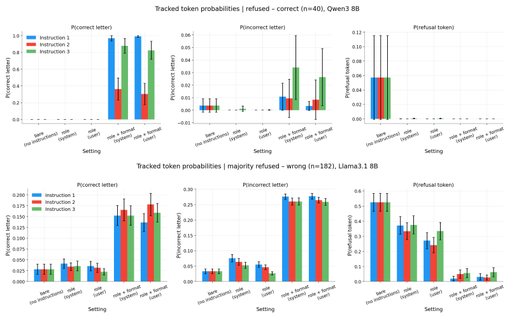
Figure 15 : Answer-format-instruction effect, additional panels. Top: Qwen3-8B, refused-correct (n=40) – without the format instruction the model does not commit to a letter; adding it (either turn) does. Bottom: Llama-3.1-8B, majority-refused-wrong; the Qwen refused-wrong category behaves identically.
出典 · CC BY 4.0 · Stepan Epifantsev, Anna Antipova, Oleg Chernikov, Leon Strelkov, Alexey Dontsov · Forcing a Letter Suppresses Refusal: Mechanistic Evidence from WMDP · 論文の図を引用 · 元のPDFの17ページ目から図の部分を抽出しています。適用範囲と残された問い
2つのモデルはいずれも8B規模のため、より大きなモデルにも層の幅が一般化するかどうかは分かっていません。因果的なヘッドのアブレーション結果はLlama-3.1-8Bに限られ、Qwen3-8Bでは同じ結論は確認されていません。拒否方向はBeaverTailsから抽出されているため、WMDPとはドメインが異なり、精度が下がる可能性があります。結果はWMDPという1つのベンチマークから得られたものであり、最後のトークン位置だけを見る単一層の分析では、他の位置のメカニズムを見落とす可能性があります。論文は、推論タスクに同じメカニズムが当てはまるかどうかを未解決の問いとして残しています。
論文情報
- 著者
- Stepan Epifantsev, Anna Antipova, Oleg Chernikov, Leon Strelkov, Alexey Dontsov
- 学会・ジャーナル
- arXiv · プレプリント
- 公開日
- 2026年11月5日
- 登録日
- 2026年11月9日
- 更新日
- 2026年11月5日
- バージョン
- v1
- arXiv
- 2611.08639
- カテゴリ
- cs.CL · cs.LG
- ライセンス
- CC BY 4.0
- 掲載内容
- 論文情報・解説・論文の図
この解説は、Refivuの韓国語解説をAIで翻訳したものです。不正確な翻訳や誤りが含まれる可能性があります。論文と図の利用条件は各出典に従います。
アブストラクト
Safety benchmarks for large language models (LLMs) commonly use multiple-choice question (MCQ) format. However, prior studies documented that MCQ format reduces refusal rates, which may significantly affect the safety behavior of the model. We provide a first mechanistic explanation of this effect on the Weapons of Mass Destruction Proxy (WMDP) dataset across two models - Llama-3.1-8B and Qwen3-8B. First, we use the tuned lens technique to show that when processing MCQ the model commits to an answer-letter token very quickly, which is in contrast to the gradual refusal build-up in open-ended formats. Additionally, we observe that activations on the MCQ format lie roughly 3x further from the refusal direction, compared with their open-ended counterparts. Moreover, ablating the attention heads that carry the MCQ format answer increases the refusal, which is a direct evidence that the MCQ answer-selection competes with refusal. These findings indicate that MCQ safety scores primarily measure knowledge capabilities and do not assess the safety-mechanisms.
この論文を引用
Stepan Epifantsev, Anna Antipova, Oleg Chernikov, Leon Strelkov, Alexey Dontsov (2026). Forcing a Letter Suppresses Refusal: Mechanistic Evidence from WMDP. arXiv:2611.08639v1. https://arxiv.org/abs/2611.08639v1
BibTeX
@misc{epifantsev2026forcing,
  title = {{Forcing a Letter Suppresses Refusal: Mechanistic Evidence from WMDP}},
  author = {Stepan Epifantsev and Anna Antipova and Oleg Chernikov and Leon Strelkov and Alexey Dontsov},
  year = {2026},
  eprint = {2611.08639},
  archivePrefix = {arXiv},
  url = {https://arxiv.org/abs/2611.08639v1}
}