論文解説
REFORM-3D: A Representation-Centric Evaluation Framework for 3D Medical Vision Foundation Models
REFORM-3D:3D医療ビジョン基盤モデルのための表現中心の評価フレームワーク
- 課題 3D医療ビジョン基盤モデルの評価は主に下流タスクのスコアに頼っており、固定表現が解剖学的構造を保持しているかを切り分けて確認するのは困難です。
- 手法 凍結した3Dエンコーダを、獲得頑健性、交差モーダル臓器整合、症例を分けた臓器転移の3つのモジュールで評価し、Med3DINOのISO・REL・SAの幾何ポリシーを統制したうえで比較しています。
- 結果 SAはCT–MR検索と臓器転移で最も高い結果を示し、RELは複数の獲得データセットで低いdriftを示しました。2つの結果は同じ方向を指さないため、単一の順位ではなく属性ごとの評価が必要であることがわかります。
下流タスクのスコアだけでは固定表現を評価しにくいこと
3D医療ビジョン基盤モデルは、多くの場合、セグメンテーションや分類といった下流タスクのスコアで評価されます。ただし、このスコアには事前学習済み表現の品質に加えて、デコーダ設計、最適化、監督の強さ、データ分割が混ざっています。そのため、モデルが適応後に強く見えても、その特徴が解剖学的構造に沿って編成されているのか、特定の評価プロトコルでのみ予測に効く狭い手がかりに頼っているのかは明らかではありません。この問題は3D医療画像で特に重要です。ボクセル間隔、面内方向の異方性、サンプリング密度は、解剖学的構造が同じでもエンコーダに与えられる根拠を変えてしまうからです。論文は、この空白を埋めるために、凍結された表現そのものを評価するREFORM-3Dを提案しています。
REFORM-3Dの3つのモジュールと幾何ポリシーの比較
REFORM-3Dは、凍結されたエンコーダの上で3つの問いを分けて評価します。Acquisition Robustnessは、同じスキャンを複数のボクセル間隔でリサンプリングした埋め込みのペアを比較します。このとき、cosine driftは間隔の変化によって同じスキャンの埋め込みがどれだけ動いたかを1−cosで測ります。CKAは間隔変形の間で特徴空間の編成が保たれているかを測ります。SemTransは、ある間隔で学習した分類器が別の間隔の特徴から対象ラベルを回復できるかを測ります。Cross-Modal Anatomical Alignmentは、CTのクエリに対してMRの候補を、またその逆方向にも順位付けし、同じ臓器の候補が他の臓器より上に来るかをmAPで評価します。
Anatomical Transferは、臓器ごとに2つの支援サンプルと症例を分けたクエリを用いて、nearest-centroid分類とlinear probeのBAを比べます。
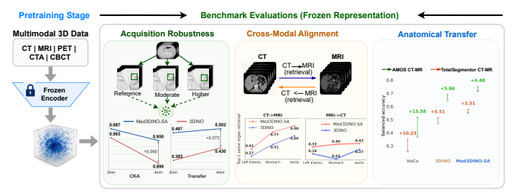
Figure 2 :Overview of REFORM-3D Framework. The framework assesses frozen 3D representa- tions along three axes: (a) Acquisition Robustness, using controlled same-scan spacing perturbations to measure stability, structural preservation (CKA), and transfer; (b) Cross-Modal Anatomical Align- ment, evaluating bidirectional cross-modal retrieval; and (c) Anatomical Transfer from limited labels under case-disjoint evaluation. Plots illustrate main trends across models and metrics.
出典 · CC BY 4.0 · Maregu Assefa, Muzammal Naseer, Divya Velayudhan, Gedamu Alemu Kumie, Naoufel Werghi · REFORM-3D: A Representation-Centric Evaluation Framework for 3D Medical Vision Foundation Models · 論文の図を引用 · 元のPDFの4ページ目から図の部分を抽出しています。3つの変形は、同じコーパス、初期化、構造、目的関数、最適化の予算を保ったまま、幾何ポリシーだけを変えています。ISOは1.5 mm等方格子にリサンプリングしたうえでボクセル相対クロップを使い、RELは元の間隔を保ったままボクセル相対クロップを使います。SAは元の間隔を保ち、面内方向には物理単位のクロップ範囲と異方性を考慮した回転を使います。この3つのポリシーは幾何ポリシー全体をまとめて比較したものなので、クロップ座標だけを切り離したアブレーション実験として読んではいけません。
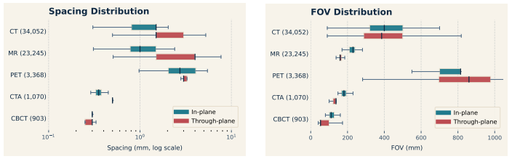
Figure 6 : Pretraining-corpus acquisition geometry. Left: voxel-spacing distributions. Right: physical field-of-view distributions. These figures show why fixed voxel-space crops can correspond to different physical anatomical support across the corpus.
出典 · CC BY 4.0 · Maregu Assefa, Muzammal Naseer, Divya Velayudhan, Gedamu Alemu Kumie, Naoufel Werghi · REFORM-3D: A Representation-Centric Evaluation Framework for 3D Medical Vision Foundation Models · 論文の図を引用 · 元のPDFの18ページ目から図の部分を抽出しています。獲得変化への安定性と意味的転移は指標ごとに異なる結果
統制されたMed3DINO比較では、CLS特徴を基準に示された4つのデータセットのうち3か所で、RELのdriftが最も低くなりました。SAは最も高いsemantic transferを示しました。ImageCASではdriftがISOで最も低く出ました。CKAはデータセットと特徴の種類によって変わりました。したがって、この結果は単一の全体的な頑健性順位を支持するものではありません。著者らは、driftが低くても、ラベルに関係する情報が一緒に保存されるとは見なせない点を示す根拠として、この比較を解釈しています。この結果は、AbdomenAtlas、KiTS23、ImageCAS、TotalSegmentator-MRの同じスキャン間隔変形から得たもので、外部エンコーダとの比較は文脈上の参照としてのみ示されています。
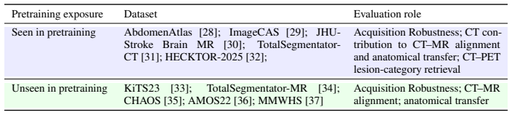
Table 1 : Evaluation datasets grouped by inclusion in the Med3DINO pretraining corpus. Exposure is defined at the dataset level and does not imply that individual anatomical classes were unseen.
出典 · CC BY 4.0 · Maregu Assefa, Muzammal Naseer, Divya Velayudhan, Gedamu Alemu Kumie, Naoufel Werghi · REFORM-3D: A Representation-Centric Evaluation Framework for 3D Medical Vision Foundation Models · 論文の図を引用 · 元のPDFの5ページ目から図の部分を抽出しています。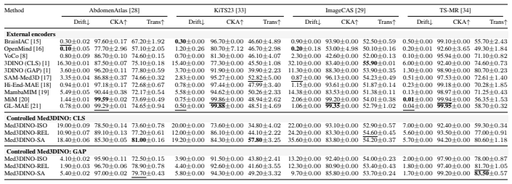
Table 3 : Controlled same-scan acquisition robustness under spacing perturbations. Reported results are mean ±SD over three-seed evaluations. External encoders provide contextual comparisons; ISO/REL/SA form the controlled geometric-policy comparison. 3DINO and Med3DINO use CLS and GAP; other feature interfaces follow Table 2. TS-MR denotes TotalSegmentator-MR.
出典 · CC BY 4.0 · Maregu Assefa, Muzammal Naseer, Divya Velayudhan, Gedamu Alemu Kumie, Naoufel Werghi · REFORM-3D: A Representation-Centric Evaluation Framework for 3D Medical Vision Foundation Models · 論文の図を引用 · 元のPDFの7ページ目から図の部分を抽出しています。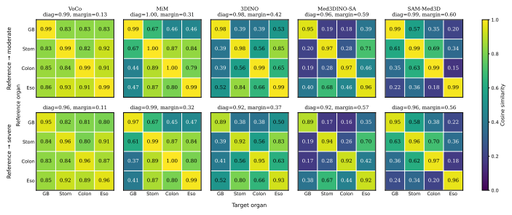
Figure 3 : Organ-specific feature separation under controlled same-scan spacing perturbations in AbdomenAtlas. Heatmaps show cosine similarity between dense features pooled within organ masks at reference spacing (1×1×1 mm) and moderate (1×1×3 mm; top) or severe (1×1×5 mm; bottom) target spacings. Diagonal entries compare the same organ; off-diagonal entries compare different organs. The margin is mean diagonal minus mean off-diagonal similarity, distinguishing organ-specific correspondence from uniformly high similarity.
出典 · CC BY 4.0 · Maregu Assefa, Muzammal Naseer, Divya Velayudhan, Gedamu Alemu Kumie, Naoufel Werghi · REFORM-3D: A Representation-Centric Evaluation Framework for 3D Medical Vision Foundation Models · 論文の図を引用 · 元のPDFの7ページ目から図の部分を抽出しています。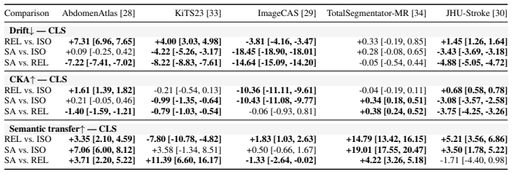
Table 14 : Paired ISO/REL/SA acquisition comparisons across five datasets. Entries are signed effects [Bonferroni-adjusted confidence intervals], scaled by 100. For A vs. B, effects are B−A for drift and A−B for CKA and transfer; positive values favor A, whereas negative values favor B. Intervals follow Section C.5 (50,000 bootstrap resamples; bootstrap seed 2026), with adjustment across the three contrasts within each dataset–feature–metric setting targeting 95% family-wise coverage. Bold entries exclude zero before rounding; intervals containing zero do not establish equivalence. Uncertainty reflects evaluation of fixed checkpoints, not independent pretraining runs.
出典 · CC BY 4.0 · Maregu Assefa, Muzammal Naseer, Divya Velayudhan, Gedamu Alemu Kumie, Naoufel Werghi · REFORM-3D: A Representation-Centric Evaluation Framework for 3D Medical Vision Foundation Models · 論文の図を引用 · 元のPDFの25ページ目から図の部分を抽出しています。CT–MR検索と臓器転移でのSAの優位
交差モーダル臓器整合では、TotalSegmentator CT–MR、MMWHS、AMOS22のCLS特徴とGAP特徴の両方で、SAがmAP、Top-1、Top-5のいずれでも最も高くなりました。この結果は臓器単位の双方向検索の平均であり、周辺の文脈を含む臓器バウンディングボックスのクロップから得た値です。臓器転移でもSAは、3つの多臓器CT–MRデータセットでBA_probeが最も高くなりました。ただし著者らは、適応による利得(∆adapt)が中心的なベースラインの弱さを反映している可能性があるため、最終的な精度と合わせて読む必要があると述べています。CHAOSは識別子に基づく肝臓専用のペアワイズ評価であるため、多臓器の結果とは別に報告されています。
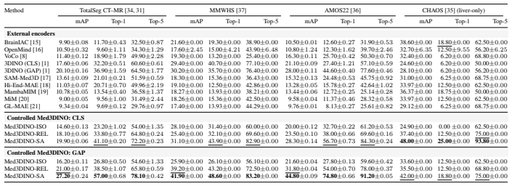
Table 5 : Frozen bidirectional CT–MR retrieval. Results are reported as mean±SD over three-seed evaluations. 3DINO and Med3DINO use CLS and GAP; other feature interfaces follow Table 2.
出典 · CC BY 4.0 · Maregu Assefa, Muzammal Naseer, Divya Velayudhan, Gedamu Alemu Kumie, Naoufel Werghi · REFORM-3D: A Representation-Centric Evaluation Framework for 3D Medical Vision Foundation Models · 論文の図を引用 · 元のPDFの8ページ目から図の部分を抽出しています。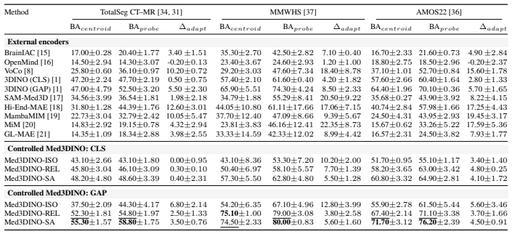
Table 6 : Case-disjoint organ classification with two support samples per organ and modality. Mean±SD are reported over three-seed evaluations. 3DINO and Med3DINO use CLS and GAP; other feature interfaces follow Table 2.
出典 · CC BY 4.0 · Maregu Assefa, Muzammal Naseer, Divya Velayudhan, Gedamu Alemu Kumie, Naoufel Werghi · REFORM-3D: A Representation-Centric Evaluation Framework for 3D Medical Vision Foundation Models · 論文の図を引用 · 元のPDFの9ページ目から図の部分を抽出しています。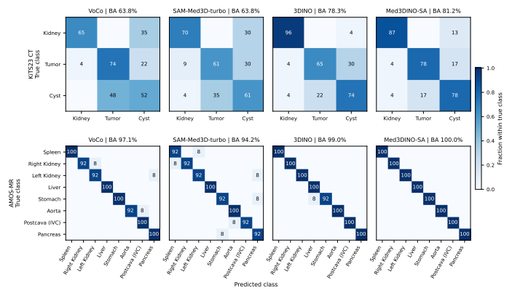
Figure 4 : Case-disjoint organ classification of frozen crop features on KiTS23 CT (top) and AMOS- MR (bottom). Logistic classifiers use 40 and 38 labeled, context-inclusive crops per class, respectively. Cells show row-normalized percentages; panel titles report BA. 3DINO and Med3DINO-SA use CLS features, V oCo uses multiscale GAP, and SAM-Med3D-turbo uses post-neck GAP.
出典 · CC BY 4.0 · Maregu Assefa, Muzammal Naseer, Divya Velayudhan, Gedamu Alemu Kumie, Naoufel Werghi · REFORM-3D: A Representation-Centric Evaluation Framework for 3D Medical Vision Foundation Models · 論文の図を引用 · 元のPDFの9ページ目から図の部分を抽出しています。下流セグメンテーションは補助的な根拠にとどまる
セグメンテーション実験は、エンコーダを凍結し、ViTAdapterUNETRデコーダを学習する設定で行われました。Med3DINO系列の中では、SAが十データセットすべてで最も高いDiceを示し、HD95は9データセットで最も低くなりました。ただし、AMOS-MRではISOの方がHD95が低く、外部比較では、BTCVで3DINOの方がDiceが高くなりました。著者らは、下流のスコアはデコーダの選択、監督、最適化にも左右されるため、この結果を表現レベルのベンチマークの代わりとは見なしていないと説明しています。
適用範囲と限界
著者らは、REFORM-3Dが特定の獲得条件、交差モーダル検索、症例を分けた臓器転移という範囲で表現の特徴を捉えるものであり、より広い不変性を立証するものではないと述べています。また、下流評価を置き換えるものでもありません。獲得の頑健性は主に統制されたリサンプリングで評価されているため、臨床画像獲得のばらつき全体を再現するものではなく、幾何ストレステストとして解釈すべきです。RELとSAの間の結果は、単一のアーキテクチャと単一の自己教師あり目的の中で確認されたものなので、他の事前学習方式でも同様の比較が必要です。
論文情報
- 著者
- Maregu Assefa, Muzammal Naseer, Divya Velayudhan, Gedamu Alemu Kumie, Naoufel Werghi
- 学会・ジャーナル
- arXiv · プレプリント
- 公開日
- 2026年11月6日
- 登録日
- 2026年11月10日
- 更新日
- 2026年11月6日
- バージョン
- v1
- arXiv
- 2611.10062
- カテゴリ
- cs.CV
- ライセンス
- CC BY 4.0
- 掲載内容
- 論文情報・解説・論文の図
この解説は、Refivuの韓国語解説をAIで翻訳したものです。不正確な翻訳や誤りが含まれる可能性があります。論文と図の利用条件は各出典に従います。
アブストラクト
Evaluation of 3D medical foundation models is typically dominated by downstream task scores, which entangle representation quality with adaptation choices. This is especially critical in volumetric imaging, where spacing and anisotropy can substantially alter image statistics while the anatomy itself remains unchanged. We therefore introduce \textbf{REFORM-3D}, a \textbf{R}epresentation-centric \textbf{E}valuation \textbf{F}ramew\textbf{OR}k for benchmarking frozen 3D medical vision foundation \textbf{M}odels across three questions: Acquisition Robustness, asking whether features remain stable when spacing varies while anatomy is fixed; Cross-Modal Anatomical Alignment, asking whether labeled anatomical structures remain recoverable across modalities under balanced bidirectional retrieval; and Anatomical Transfer, asking whether organ identity remains recoverable from limited labeled support under case-disjoint evaluation. These are also pretraining questions, because what a 3D encoder learns depends on how volumes are geometrically presented during self-supervised pretraining. We further introduce Med3DINO encoder family, pretrained on $62.6$K unlabeled MR, CT, PET, CTA, and CBCT volumes under three explicit geometric assumptions: isotropic normalization, voxel-relative sampling, and spacing-aware resampling. Across Med3DINO and heterogeneous external encoders, REFORM-3D reveals module-specific strengths rather than a single model ordering. Within the controlled Med3DINO comparison, voxel-relative sampling yields lower embedding drift, whereas spacing-aware resampling favors anatomical transfer; semantic-transfer advantages depend on the dataset and feature type. Project link: \href{https://endarzboy.github.io/reform3d-website/}{\highlightLR{REFORM-3D}}.
この論文を引用
Maregu Assefa, Muzammal Naseer, Divya Velayudhan, Gedamu Alemu Kumie, Naoufel Werghi (2026). REFORM-3D: A Representation-Centric Evaluation Framework for 3D Medical Vision Foundation Models. arXiv:2611.10062v1. https://arxiv.org/abs/2611.10062v1
BibTeX
@misc{assefa2026reform,
  title = {{REFORM-3D: A Representation-Centric Evaluation Framework for 3D Medical Vision Foundation Models}},
  author = {Maregu Assefa and Muzammal Naseer and Divya Velayudhan and Gedamu Alemu Kumie and Naoufel Werghi},
  year = {2026},
  eprint = {2611.10062},
  archivePrefix = {arXiv},
  url = {https://arxiv.org/abs/2611.10062v1}
}