論文解説
Adapting Frozen Promptable Segmenters to User-Defined Taxonomies via Few-Shot Proposal Learning
Few-Shot Proposal Learningによる固定プロンプト可能セグメンタのユーザー定義分類体系への適応
- 課題 固定されたSAM系セグメンテーションモデルが、学習語彙に縛られたクラス境界をプロジェクトのラベルだけで変えられるかを扱います。
- 手法 SAM2.1エンコーダを固定し、提案の記述子の上に多項ロジスティック回帰のヘッドSnapHeadをラベルで学習させます。
問題: プロジェクトごとに異なるクラス境界
アノテーション作業でマスクを得るコストは、SAM系プロンプトセグメンタのおかげで大きく下がりました。しかし、各プロジェクトが引くクラス境界は今も人が決める必要があります。生成モデルのクラス境界は学習語彙に固定されているため、人が区別したい細かいカテゴリ(例として、同じ車種の別モデル、互いに似た細胞株)をうまく区別できません。そこでこの研究では、固定したセグメンテーションモデルはそのままにして、プロジェクトごとのクラス境界だけをラベルから学習する問題を扱います。
論文ではこの境界学習をSNAPという注釈パイプラインで実装しており、主な比較対象はSAM 3のプロンプトオラクルです。互いに似た8つのLIVECell細胞株では、SAM 3のCohen's κは0.038で、SnapHeadは60個のラベル付き画像で0.754でした。この数値は、正解マスクにクラスだけを割り当てる条件で得られた結果です。
方法: 固定エンコーダ上のSnapHeadと記述子
SNAPは、SAM2.1エンコーダを画像ごとに1回だけ通し、その特徴量とデコーダ出力から提案領域と記述子を作ります。提案は、SAM2自動マスク生成器(AMG)の点格子から得られます。格子の再現率がラベル上で低いときだけ、学習提案器のボックス提案を追加します。
各提案マスクmは、マスク領域のstride-16埋め込みの平均φ̄(m)と、ボックスb(m)に対するオブジェクトポインタo(b(m))をそれぞれℓ2正規化して連結した512次元の記述子xで表されます。SnapHeadは、この記述子を入力とする多項ロジスティック回帰で、クラスか背景かを分類します。学習サンプルは、IoU 0.5以上で物体と重なる提案(クラス)と、すべての物体とのIoUが0.1未満の提案(背景)から作られ、あいまいな提案は除外されます。損失はクラス頻度の逆数で重み付けされ、L2正則化が加えられます。
エンコーダとデコーダは固定されており、学習されるのは、SnapHeadの重みW、学習提案器θ、クラスごとの出所の選択です。提案が最終マスクになる基準は、最大クラス確率を名前が付いたクラスの合計で割った値に、デコーダのマスク品質を掛けたスコアsです。閾値0.5と重複除去を適用します。
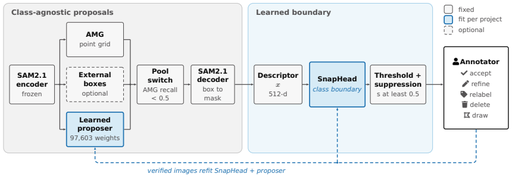
Figure 2 . Overview of SNAP. Gray blocks are frozen, blue blocks are fit to the labeled images L, and the dashed block is an optional proposal source. Every proposal passes through one frozen SAM2.1 decoder, and each newly labeled image refits SnapHead and the learned proposer.
出典 · CC BY 4.0 · Khayrul Islam, Christopher Frederic Miller · Adapting Frozen Promptable Segmenters to User-Defined Taxonomies via Few-Shot Proposal Learning · 論文の図を引用 · 元のPDFの4ページ目から図の部分を抽出しています。検証設定: クラス割り当てとラベル階層
最初の検証は、正解のインスタンスマスクをすべての手法に同じように与え、クラスだけを評価する設定です。SAM 3は、評価ラベルから選んだ5つの表現と4つの決定規則のプロンプトオラクルとして実行され、信頼度の閾値は0です。SnapHeadは、N個のラベル画像の固定された特徴量で学習されます。

Figure 3 . Class assignment on one LIVECell image of SH-SY5Y cells (densest third,112of190cells). Every panel draws the same ground-truth masks; color shows the assigned line. Titles give the count right in this crop and the accuracy over all35,458evaluation cells.
出典 · CC BY 4.0 · Khayrul Islam, Christopher Frederic Miller · Adapting Frozen Promptable Segmenters to User-Defined Taxonomies via Few-Shot Proposal Learning · 論文の図を引用 · 元のPDFの7ページ目から図の部分を抽出しています。つまり、語彙の中にクラス境界がすでにある場合は、生成モデルのプロンプトオラクルが強くなります。この結果は、その2つの対照データセットに限られます。
また、LIVECell-A172を面積の三分位で分け、名前だけを変えた2つの実験では、SAM 3はsmall/medium/largeという名前でκ=0.125、type A/B/Cでは−0.007でした。SnapHeadはラベルだけを使うため、2つの名前体系で同じスコア0.722を得ています。細かいラベル階層の実験では、Stanford Cars、FGVC-Aircraft、ShipRSImageNetでSAM 3と比較されました。
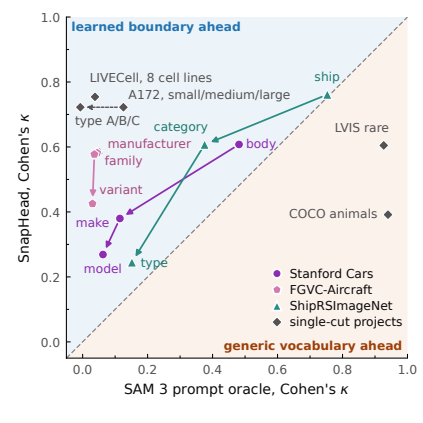
Figure 4 . Comparison with SAM 3 on the label ladders and class- assignment projects. Each point is one cut; above the diagonal, the learned boundary wins. Colored markers follow the three ladders, coarse to fine; SnapHead sees20labeled images per finest class. Gray diamonds are the single-cut projects of Tab. 1 atN=60. The dashed arrow renames the A172 size classes: SAM 3 moves, ours stays.
出典 · CC BY 4.0 · Khayrul Islam, Christopher Frederic Miller · Adapting Frozen Promptable Segmenters to User-Defined Taxonomies via Few-Shot Proposal Learning · 論文の図を引用 · 元のPDFの7ページ目から図の部分を抽出しています。結果: 全体の注釈パイプラインと設定別の比較
この差は、物体が提案段階で見落とされる問題が大きいことを意味します。
シードの平均と信頼区間は、比較対象ごとの表に沿って読む必要があります。
限界と適用範囲
この結果は、固定したSAM2.1特徴量と提案プールがある状態で、プロジェクトのラベルから得られたものです。SAM 3がクラス境界をすでに語彙に含んでいる場合は、生成モデルのプロンプトオラクルがSnapHeadより強くなります。ルーターは、その差を縮めるための選択段階です。
AMG格子は間隔が固定されているため、小さく密集した物体を見落とすことがあります。論文では、学習提案器を追加してこの差を縮めていますが、物体が小さすぎる航空タイルなどでは、提案段階そのものに限界があります。また、RF100-VLの転移評価はボックスIoUで比べたものです。5つのデータセットのうち2つでのみSAM 3オラクルに勝ったと報告されています。
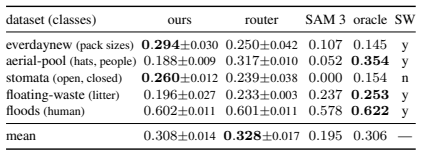
Table 3 . Transfer to five randomly drawn RF100-VL datasets at N=20. Instance F1 at box IoU0.5, mean±sd over three seeds; SAM 3 is deterministic.ours: SnapHead. SAM 3: class names, default threshold.oracle: best phrasing and threshold on evalua- tion labels.router: Sec. 3.3. SW: the automatic switch (Sec. 3.2) is within seed noise of the better fixed proposer. Last row: mean; sd over seeds.
出典 · CC BY 4.0 · Khayrul Islam, Christopher Frederic Miller · Adapting Frozen Promptable Segmenters to User-Defined Taxonomies via Few-Shot Proposal Learning · 論文の図を引用 · 元のPDFの8ページ目から図の部分を抽出しています。論文情報
- 著者
- Khayrul Islam, Christopher Frederic Miller
- 学会・ジャーナル
- arXiv · プレプリント
- 公開日
- 2026年11月6日
- 登録日
- 2026年11月10日
- 更新日
- 2026年11月6日
- バージョン
- v1
- arXiv
- 2611.10092
- カテゴリ
- cs.CV
- ライセンス
- CC BY 4.0
- 掲載内容
- 論文情報・解説・論文の図
この解説は、Refivuの韓国語解説をAIで翻訳したものです。不正確な翻訳や誤りが含まれる可能性があります。論文と図の利用条件は各出典に従います。
アブストラクト
Promptable segmenters of the SAM family turn a click or a phrase into an instance mask, so the costly part of a label is now its class. However, each annotation project draws its own class boundary, often through objects these models already know: people from cars, sedans from trucks, one sedan model from another. A generic model's boundary is fixed by its training vocabulary. We present SNAP, an annotation pipeline that learns the project's boundary from the labels the annotator draws anyway. On one frozen SAM2.1 pass per image, we fit a per-project head, SnapHead, that classifies every proposal and refits in seconds after each labeled image. Where SAM 3 is available, the same labels decide class by class whether to keep its boundary or ours. Given the true masks of eight look-alike cell lines, SAM 3 assigns classes at Cohen's kappa = 0.038 and SnapHead at 0.754 (60 labeled images), and when only the class names change, SAM 3 falls to chance and SnapHead's score is unchanged. End to end, with 20 labeled images, SNAP beats a SAM 3 oracle tuned on the evaluation labels on five microscopy projects (0.484 against 0.441 F1), and run unchanged on five held-out datasets, it beats SAM 3 as shipped on four. Our results suggest that frozen foundation features already encode the class boundaries a generic vocabulary misses, and that a project's own labels are enough to read them out.
この論文を引用
Khayrul Islam, Christopher Frederic Miller (2026). Adapting Frozen Promptable Segmenters to User-Defined Taxonomies via Few-Shot Proposal Learning. arXiv:2611.10092v1. https://arxiv.org/abs/2611.10092v1
BibTeX
@misc{islam2026adapting,
  title = {{Adapting Frozen Promptable Segmenters to User-Defined Taxonomies via Few-Shot Proposal Learning}},
  author = {Khayrul Islam and Christopher Frederic Miller},
  year = {2026},
  eprint = {2611.10092},
  archivePrefix = {arXiv},
  url = {https://arxiv.org/abs/2611.10092v1}
}