論文解説
TripletAD: Weakly Supervised Anomaly Detection in Embedding Space with Rare Anomalies and Scarce Labels
TripletAD:希少な異常と少ないラベルを扱う埋め込み空間での弱教師あり異常検知
- 課題 ラベル付きの異常が極めて少なく、ラベルのないデータを正常とみなせない埋め込みベースの異常検知で、既存の弱教師あり検知器やツリーアンサンブルを上回る手法を提案しています。
- 手法 triplet-marginの埋め込み学習と線形スコアヘッドを組み合わせ、すべてのtripletにラベル付きの異常が含まれるように構成します。そのうえで、partial cross-entropyとrelative-contrastのヒンジ項でスコアを補正します。
- 結果 約5%の割合では、ベースラインと同程度でした。
希少ラベル異常検知の難しさ
多くの実務的な異常検知の問題では、確認された異常サンプルが極めて少なく、確認されていない残りのデータを正常とみなすことも難しいです。この論文では、このような条件をcurated-labelプロトコルとして定義しています。このプロトコルでは、確認されていない異常を正常にラベルし直さず、学習セットから取り除きます。既存の弱教師あり検知器であるDevNet、PReNet、DeepSADは、ラベルのないプールを概ね正常として扱うため、ラベル付きの異常が非常に少なくなると、各異常が学習バッチに現れる回数が減り、決定境界を作るための陽性例も不足します。著者らは、生の表形式特徴量ではgradient-boosted treesが依然として強いものの、事前学習済み埋め込みを入力とする場合に希少な異常を扱うことが最も改善が必要な点だと考えています。
tripletの学習と線形スコアヘッド
TripletADは、エンコーダf_θと線形スコアヘッドで構成されます。エンコーダは入力xを32次元の埋め込みz=f_θ(x)に変換し、ヘッドはs(x)=σ(w⊤z+b)によって[0,1]の範囲の異常スコアを出力します。tripletは、各アンカーについて同じクラスの陽性と反対クラスの陰性をランダムに選んで作ります。異常アンカーは異常の陽性と正常の陰性を、正常アンカーは正常の陽性と異常の陰性を使うため、すべてのtripletにラベル付きの異常が少なくとも1つ含まれます。この規則により、別途のオーバーサンプリングやバッチのバランス調整がなくても、各ラベルをエポックごとに何度も再利用できます。
目的関数と2つの補正項
全体の目的関数はJ=L_trip+λ1 L_PCE+λ2 L_RCです。ここでL_tripは、埋め込み空間においてアンカーと陽性の距離が、アンカーと陰性の距離よりもmargin m=1以上小さくなるように押し出すtriplet-margin損失であり、異常同士、正常同士を集める役割を果たします。L_PCEは、ラベル付きの異常アンカーに対してのみ−log s(x)を平均するpartial cross-entropyです。正常アンカーは寄与せず、平均は全体のB個のtripletにわたって計算されます。L_RCは、バッチ内の異常の陽性集合と陰性集合の平均スコア差に対するヒンジで、2つの集合の平均スコア差が1より小さいときに勾配が生じるように定義されています。
つまりrelative contrastは、個々のサンプルを分類するのではなく、2つの集団の平均スコアを分離するバッチ単位のランキング制約です。著者らは、既定値λ1=1、λ2=0.25をすべてのデータセットで固定したと報告しています。
2段階の学習手順
学習は2段階で進みます。1段階目では、L_tripのみで50 epochにわたりエンコーダを事前学習し、この間は線形ヘッドが勾配を受け取りません。2段階目では、全体の目的関数Jを100 epochにわたって最適化します。オプティマイザはlearning rate 10−3のAdamで、バッチサイズは256 tripletです。バッチごとにアンカー、陽性、陰性を1回の順伝播にまとめて入れ、バッチ正規化が3つの役割をすべて参照できるようにしています。テスト時のスコアは学習済みのs(x)をそのまま用い、1回の順伝播で計算されます。
データと希少ラベルプロトコル
テキストは5件がBERT、画像3件とMVTec-AD 15カテゴリがResNet-18で表現され、Speechは400次元のi-vectorで表現されます。各シードで層化された70/30分割を行い、min–maxスケーリングは学習部分でのみ合わせます。性能はAUCPRを5シードの平均で報告しています。希少ラベルは比率ρで学習異常のランダムな一部のみを残し、残りの学習異常は正常に変えず取り除きます。異常比率のスイープは、テキストと画像の8データセットで正常サンプルをすべて残し、異常を部分サンプリングして2%と1%を作ります。ベースラインはrandom forest、CatBoost、DevNet、PReNet、DeepSADで、いずれも同じ入力と同じcuratedセットで学習されます。
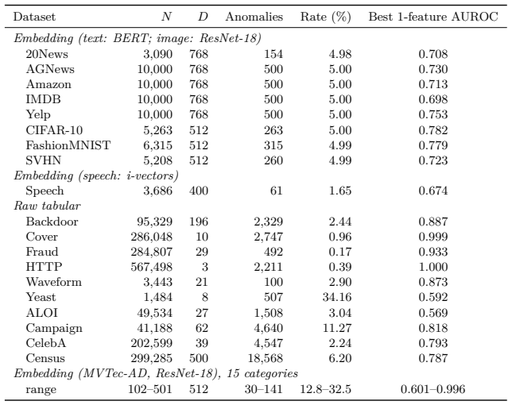
Table 1 : Datasets. “Best 1-feature AUROC” is the highest AUROC obtained by ranking on a single input coordinate (either sign).
出典 · CC BY 4.0 · Sumit Wadhwa, Souvik Nath · TripletAD: Weakly Supervised Anomaly Detection in Embedding Space with Rare Anomalies and Scarce Labels · 論文の図を引用 · 元のPDFの5ページ目から図の部分を抽出しています。希少異常設定での結果
異常比率1%では、TripletADは6つの手法のうち最も高い平均AUCPR 0.244を示しました。これは、DeepSAD 0.210、PReNet 0.207、DevNet 0.204、CatBoost 0.159、random forest 0.118と比べた値です。同じ1%の設定で、DevNetに対しては約20%、CatBoostに対しては約53%高くなっています。自然に希少なSpeech(異常1.65%)では、すべてのラベルを使った設定で0.394を記録し、最高のベースラインであるCatBoostの0.196の約2倍でした。ラベル比率を75%、50%に下げても優位性は保たれましたが、25%ではPReNetとDevNetがわずかに上回りました。
2%の設定では平均0.346で、DevNet 0.333、DeepSAD 0.326、CatBoost 0.289を上回りました。
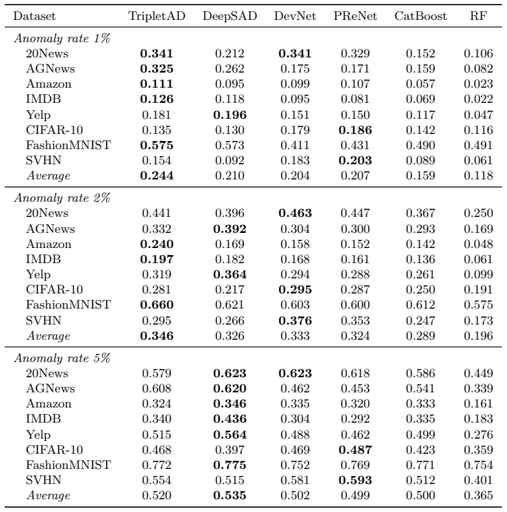
Table 2 : Anomaly-rarity sweep: AUCPR (mean of five seeds, with the anomaly subsample redrawn for each seed) when anomalies make up 1%, 2% or 5% (original) of each dataset. Best per row in bold.
出典 · CC BY 4.0 · Sumit Wadhwa, Souvik Nath · TripletAD: Weakly Supervised Anomaly Detection in Embedding Space with Rare Anomalies and Scarce Labels · 論文の図を引用 · 元のPDFの7ページ目から図の部分を抽出しています。
Table 3 : Speech (1.65% anomalies): AUCPR as the fraction of labelled training anomalies varies under the curated protocol.
出典 · CC BY 4.0 · Sumit Wadhwa, Souvik Nath · TripletAD: Weakly Supervised Anomaly Detection in Embedding Space with Rare Anomalies and Scarce Labels · 論文の図を引用 · 元のPDFの7ページ目から図の部分を抽出しています。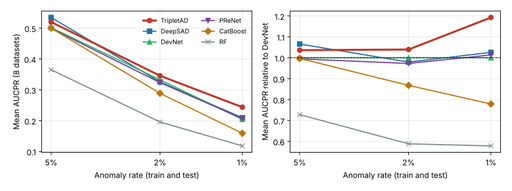
Figure 1 : Anomaly-rarity sweep on eight text and image embedding datasets.Left:mean AUCPR over datasets and five seeds as the anomaly rate falls from 5% to 1%.Right:the same, divided by DevNet’s score. TripletAD’s lead grows to 20% over DevNet at 1%, while the tree ensembles fall further behind as anomalies become rarer.
出典 · CC BY 4.0 · Sumit Wadhwa, Souvik Nath · TripletAD: Weakly Supervised Anomaly Detection in Embedding Space with Rare Anomalies and Scarce Labels · 論文の図を引用 · 元のPDFの8ページ目から図の部分を抽出しています。中間比率と統合統計
この設定では、TripletADはほとんどの場合でベースラインと同程度と報告されています。希少または少数ラベルのセル70個をまとめた分析では、平均順位はTripletADが2.21、DevNetが2.84、PReNetが3.04でした。Holm補正後は、5つのベースラインすべてに対して有意な優位性が報告されています。ただし、DevNetとPReNetに対する平均差は0.021~0.023 AUCPRで、DeepSADや木系ベースラインに対する差より小さくなっています。
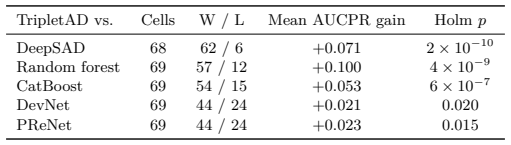
Table 5 : Pooled comparison over 70 rare- or sparse-label embedding cells (AUCPR averaged over five seeds per cell). W/L: cells where TripletAD is better/worse.p: two-sided Wilcoxon signed-rank, Holm-corrected over the five baselines. A few cells are missing for DeepSAD; one DevNet and one PReNet cell are tied.
出典 · CC BY 4.0 · Sumit Wadhwa, Souvik Nath · TripletAD: Weakly Supervised Anomaly Detection in Embedding Space with Rare Anomalies and Scarce Labels · 論文の図を引用 · 元のPDFの9ページ目から図の部分を抽出しています。アブレーション実験と感度
アブレーション実験は、Speech、Fraud、Coverで、すべてのラベルを使った設定で行われました。Fraudでは、RCを除くとAUCPRが0.773から0.514に下がり、Coverでは0.847±0.237と不安定になります。Speechでは、RCを除いても0.014の低下にとどまり、重要度はデータセットによって異なります。PCEの除去やtriplet事前学習の除去は、すべての説明データセットで最大0.014の低下でした。損失重みのグリッド(λ1∈{0.1,0.5,1}、λ2∈{0.05,0.1,0.25,0.5})では、平均AUCPRは0.477~0.495で、既定値は0.483です。
この感度分析は、9つの埋め込みデータセットと3シードで行った分析です。
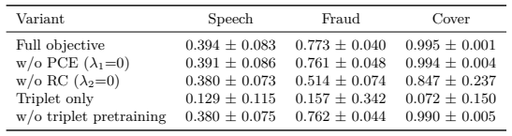
Table 6 : Ablation: AUCPR (mean±s.d. over five seeds), full labels.
出典 · CC BY 4.0 · Sumit Wadhwa, Souvik Nath · TripletAD: Weakly Supervised Anomaly Detection in Embedding Space with Rare Anomalies and Scarce Labels · 論文の図を引用 · 元のPDFの9ページ目から図の部分を抽出しています。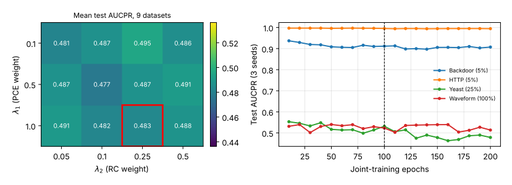
Figure 2 : Sensitivity.Left:mean test AUCPR over nine embedding datasets for each(λ1,λ 2); the colour scale spans ±0.05around the mean so the small spread is shown at true scale; the red box is the default.Right:test AUCPR against the number of joint-training epochs (dashed line: default of 100). The percentage after each dataset name is its label ratio.
出典 · CC BY 4.0 · Sumit Wadhwa, Souvik Nath · TripletAD: Weakly Supervised Anomaly Detection in Embedding Space with Rare Anomalies and Scarce Labels · 論文の図を引用 · 元のPDFの10ページ目から図の部分を抽出しています。表形式データと適用範囲
生の表形式データで完全なラベルを使う設定で測定した結果では、CatBoostなどのgradient-boosted treesがTripletADより強い選択肢として残りました。この結果は、TripletADが埋め込み入力のために設計されているという制限とあわせて読む必要があります。また、1%の画像埋め込みであるCIFAR-10とSVHNでは、PReNetとDevNetが依然として上回っています。したがって、この結果を他のデータセットや希少ラベルの条件まで広げることはしません。
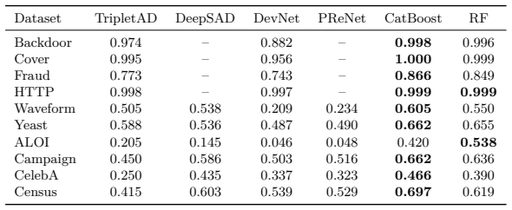
Table 10 : Raw tabular datasets with full labels: AUCPR (mean of five seeds). PReNet and DeepSAD were not run on Backdoor, Cover, Fraud and HTTP.
出典 · CC BY 4.0 · Sumit Wadhwa, Souvik Nath · TripletAD: Weakly Supervised Anomaly Detection in Embedding Space with Rare Anomalies and Scarce Labels · 論文の図を引用 · 元のPDFの14ページ目から図の部分を抽出しています。論文情報
- 著者
- Sumit Wadhwa, Souvik Nath
- 学会・ジャーナル
- arXiv · プレプリント
- 公開日
- 2026年11月7日
- 登録日
- 2026年11月10日
- 更新日
- 2026年11月7日
- バージョン
- v1
- arXiv
- 2611.10352
- カテゴリ
- cs.LG
- ライセンス
- CC BY 4.0
- 掲載内容
- 論文情報・解説・論文の図
この解説は、Refivuの韓国語解説をAIで翻訳したものです。不正確な翻訳や誤りが含まれる可能性があります。論文と図の利用条件は各出典に従います。
アブストラクト
Many practical anomaly detection problems come with only a handful of confirmed anomalies, and the unreviewed remainder of the data cannot be trusted to be normal. We study this setting under a curated-label protocol, in which unconfirmed anomalies are removed from training rather than relabelled as normal, and propose TripletAD, a weakly supervised detector that learns a triplet-margin embedding and calibrates a linear scoring head with two soft penalties: a partial cross-entropy on labelled anomalies and a relative-contrast hinge that separates the mean scores of anomalous and normal samples. Because every mined triplet contains a labelled anomaly, the few labels are reused across the entire training set instead of being diluted by it. On 24 ADBench datasets whose inputs are pre-trained embeddings (text, image and speech vectors), TripletAD outperforms established state-of-the-art weakly supervised detectors (DevNet, PReNet and DeepSAD) and gradient-boosted trees when anomalies are rare. At a 1% anomaly rate it has the highest mean AUCPR of six methods, 20% above DevNet; on the naturally rare Speech dataset it doubles the best baseline (0.394 vs. 0.196 AUCPR); and on MVTec-AD it is best when only a quarter or half of the anomalies are labelled. Pooled over 70 rare- or sparse-label settings, it has the best average rank (2.21 of 6) and outperforms each baseline under Wilcoxon signed-rank tests with Holm correction. When anomalies are more frequent it performs on par with these methods. The method needs no per-dataset tuning and is insensitive to its loss weights and training length; on raw tabular features, gradient-boosted trees remain the stronger choice.
この論文を引用
Sumit Wadhwa, Souvik Nath (2026). TripletAD: Weakly Supervised Anomaly Detection in Embedding Space with Rare Anomalies and Scarce Labels. arXiv:2611.10352v1. https://arxiv.org/abs/2611.10352v1
BibTeX
@misc{wadhwa2026tripletad,
  title = {{TripletAD: Weakly Supervised Anomaly Detection in Embedding Space with Rare Anomalies and Scarce Labels}},
  author = {Sumit Wadhwa and Souvik Nath},
  year = {2026},
  eprint = {2611.10352},
  archivePrefix = {arXiv},
  url = {https://arxiv.org/abs/2611.10352v1}
}