論文解説
BunshinRL: Splitting Live Agent Workspaces for Memory-Efficient Agentic RL
BunshinRL:メモリ効率に優れたエージェント強化学習のためのライブ作業空間の分割
- 課題 エージェントRLのロールアウトでは、サンプルごとに分離された作業空間を保つためメモリコストが大きく、遅いツール呼び出しがバッチ全体を遅らせます。
- 手法 BunshinRLは、ライブコンテナフォーク手法のBunshinFork上で、メモリ共有、ツール接頭辞キャッシング、投機的ツール実行を組み合わせます。
- 結果 論文では、OSWorldでCRIUと比べてピークメモリを30%、WebArenaでAgentENVと比べて43%削減し、ロールアウト遅延は23%改善したと報告されています。
エージェントRLロールアウトのメモリと遅延の問題
エージェント強化学習のロールアウトでは、モデルの推論とツール呼び出しが交互に起こります。各サンプルには、プロセス、メモリ、ファイル、GUIの状態を持つ永続的な作業空間が必要です。GRPOのようにタスクごとに複数の軌跡をサンプリングすると、環境インスタンスはさらに増えます。また、ツール呼び出し1回に数秒から数分かかることがあります。同期型RLでは、最も遅い軌跡がバッチ全体を待たせます。
この論文は、この2つのコストを再利用の機会として捉えています。同じGRPOグループの環境は、かなりのメモリ状態を共有しています。また、繰り返し行われる学習タスクは、前の反復と同じツール呼び出しの接頭辞を生成します。BunshinRLは、この2つの機会を、メモリ共有、ツール接頭辞キャッシング、投機的ツール実行によって活用するロールアウトシステムです。
BunshinFork:実行中の作業空間をフォークする基盤技術
3つの手法に共通する基盤がBunshinForkです。BunshinForkは、コンテナの作業空間を短時間凍結し、プロセスツリー、スレッド、開いているディスクリプタ、シグナルと同期状態、メモリマッピングのメタデータ、ファイルシステムのスナップショットを記録します。その後、PID、マウント、ネットワーク、IPCの名前空間を分離した移行先のコンテナに、元のプロセストポロジーを復元します。論文では、Linuxのfork()は各プロセスを元のプロセスの子にするため親子関係が崩れてしまい、この方式が必要だと説明されています。
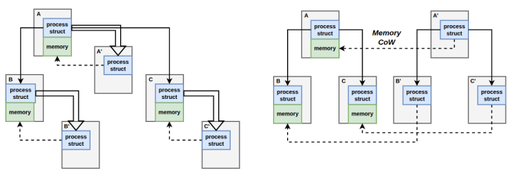
Figure 5 . Linux Process Fork vs. BunshinFork Process-Tree Fork. Left: native fork() duplicates one process as a child of the source process. Right: BunshinFork creates a sibling container and reconstructs the whole process tree inside an independent namespace.
出典 · CC BY 4.0 · Yutong Huang, Vikranth Srivatsa, Alex Asch, Yiying Zhang · BunshinRL: Splitting Live Agent Workspaces for Memory-Efficient Agentic RL · 論文の図を引用 · 元のPDFの7ページ目から図の部分を抽出しています。メモリは、変更のない匿名ページをコピーせず、元のページに書き込み保護マッピングを設定して共有します。書き込みが発生すると、既存のカーネルのcopy-on-write処理がプライベートページを割り当てます。この方式では、オンラインでのフォークとディスクへの書き込みが分離されます。元のプロセスは、スナップショットが一貫していれば、ディスク書き込みを待たずに再開します。
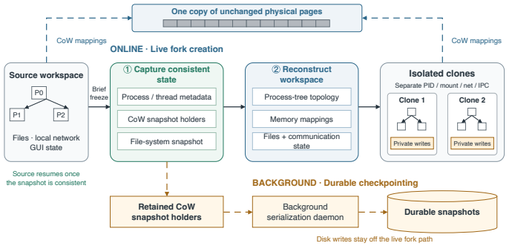
Figure 4 . BunshinFork architecture.A brief freeze captures a consistent workspace state. The live fork path reconstructs isolated clones that share unchanged pages copy-on-write and allocate private pages on writes. Retained snapshot holders support asynchronous serialization, allowing the source to resume without waiting for disk writes.
出典 · CC BY 4.0 · Yutong Huang, Vikranth Srivatsa, Alex Asch, Yiying Zhang · BunshinRL: Splitting Live Agent Workspaces for Memory-Efficient Agentic RL · 論文の図を引用 · 元のPDFの6ページ目から図の部分を抽出しています。メモリ共有、接頭辞キャッシング、投機的実行の動作
メモリの重複排除により、同じタスクのサンプルは1つの初期化済み作業空間から始まります。サンプルが同じツール呼び出しの順序をたどっている間は、キャッシュされたスナップショットを再利用します。呼び出しが分岐したら、書き込み可能な分岐を作成します。したがって、メモリコストは、共通状態、分岐ごとの書き込み、再構成メタデータの合計におおむね近くなります。
ツール接頭辞キャッシングでは、ルート初期状態C0から始まる接頭辞ツリーを使います。一致の条件は、開始状態から全ステップまでのツール名と引数がすべて同じであることです。引数だけが同じでは不十分です。スナップショットは各子ノードの差分としてディスクに保存され、よく使われるスナップショットだけをメモリに置きます。このとき、ancestor-aware LRUは、アクセスされたスナップショットの祖先も保持し、キャッシュが祖先に関する閉包性を保つようにします。疎なスナップショットは一部の境界でのみ具体化し、欠けた中間呼び出しは、最も近い保持済みの祖先から再実行することでメモリを削減します。論文では、この再実行はモデル推論と重なるため、クリティカルパスの外で行われると説明されています。
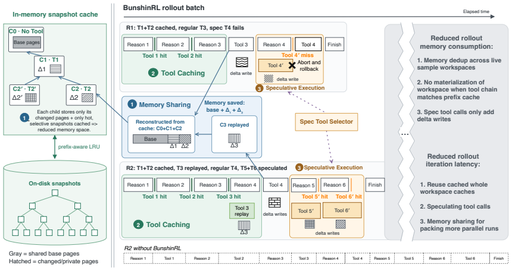
Figure 3 . Illustration of BunshinRL.Right shows two samples in a simplified rollout step; left shows the on-disk and in-memory workspace snapshot stores for tool call prefix. Reasoning steps’ generated tool call signatures are matched with the tool prefix tree. All initial matched tool calls are skipped until the first miss in tool signature (Tool 3 for R1 and Tool 4 for R2), at which point the corresponding snapshots are used to reconstruct the workspaces. As C3 is not cached in memory, Tool 3 is replayed for R2 and its delta write is added to the C0+C1+C2 snapshot. The samples execute actual Tool 3 for R1 and actual Tool 4 for R2, creating new delta CoW pages. After these calls finish, speculation starts from the resulting workspaces: Tool 4 for R1 and Tools 5 and 6 for R2. The Spec Tool Selector selects tool calls that are likely to happen from previous tool call history. When a reasoning step finishes, its output tool signature is compared with the speculative tool signature. For failed speculation, the system rolls back to the workspace snapshot before speculation.
出典 · CC BY 4.0 · Yutong Huang, Vikranth Srivatsa, Alex Asch, Yiying Zhang · BunshinRL: Splitting Live Agent Workspaces for Memory-Efficient Agentic RL · 論文の図を引用 · 元のPDFの5ページ目から図の部分を抽出しています。投機的ツール実行では、Spec Tool Selectorが記録済みのツール呼び出しから次の呼び出しを予測し、作業空間をフォークして推論と並行して実行します。モデルが実際の呼び出しシグネチャを出力すると、予測と比べます。一致すれば結果と状態を採用します。一致しなければ、投機的な書き込みを破棄し、直前の有効なスナップショットから実際の呼び出しを実行します。
メモリ削減効果の検証範囲
論文では、OSWorldにおいてBunshinRLはCRIUと比べてピークメモリを30%削減したと報告されています。WebArenaでは、AgentENVと比べてピークメモリを43%削減しました。同じ設定で総メモリ消費は最大51%まで減少し、エンドツーエンドのロールアウト遅延は23%改善しました。この数値は、Qwen3-VL-8Bを単純な同期型GRPOループで学習させた設定での結果です。
256個の同時ロールアウトでは、CRIUがBunshinRLの約1.8倍のピークメモリを使うという観察も示されています。著者らは、CRIUがフォークごとにプライベートなメモリのコピーを持つため、この差が大きくなると解釈しています。16個のフォークのマイクロベンチマークでは、BunshinRLが10.0 GB、CRIUが17.8 GB、AgentENVが12.3 GBだったと報告されています。ここで論文は、CRIUはフォークごとに約1.0 GBを追加し、BunshinRLは約0.5 GBを追加すると記録しています。
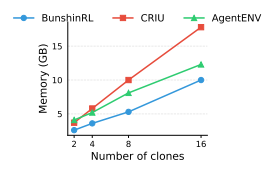
Figure 12 . Memory of Forks.Total memory of a source environ- ment and its forks as the number of forks grows, for BunshinFork, CRIU, and AgentENV .
出典 · CC BY 4.0 · Yutong Huang, Vikranth Srivatsa, Alex Asch, Yiying Zhang · BunshinRL: Splitting Live Agent Workspaces for Memory-Efficient Agentic RL · 論文の図を引用 · 元のPDFの10ページ目から図の部分を抽出しています。構成別のロールアウト遅延とメモリコスト
OSWorldの1エポックでは、Baseはメモリ共有のみを使い、Specは投機的ツール実行を、Fullはツール接頭辞キャッシングと投機的実行を追加します。Baseは20.8分、Specは19.2分、Fullは17.0分でエポックを終えました。Specは主に末尾を短縮し、最後のロールアウトがBaseより1.6分早く終わります。Fullでは、半分のロールアウトがBaseより1.4分、最後のロールアウトが3.8分早く終わると報告されています。
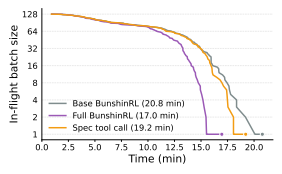
Figure 8 . Rollout Completion over Time. Number of rollouts still running over one OSWorld epoch for the Base, Full, and Spec configurations of BunshinRL (§5.3). A batch that drains sooner means higher roll- out throughput.
出典 · CC BY 4.0 · Yutong Huang, Vikranth Srivatsa, Alex Asch, Yiying Zhang · BunshinRL: Splitting Live Agent Workspaces for Memory-Efficient Agentic RL · 論文の図を引用 · 元のPDFの8ページ目から図の部分を抽出しています。メモリの面では、FullとSpecはBaseと比べてピークを約1 GiBだけ高め、69 GiBから70 GiBになります。キャッシュされたスナップショットと投機的フォークは、書き込み時にのみページを持つため、コストは環境全体のサイズではなく、その後の変更量に比例すると説明されています。報酬については、論文は3つの構成がエポックごとに同じ値を示したと報告しています。
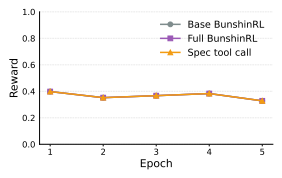
Figure 11 . Training Reward.Average roll- out reward in each OSWorld training epoch for the Base, Full, and Spec configurations of BunshinRL (§5.3).
出典 · CC BY 4.0 · Yutong Huang, Vikranth Srivatsa, Alex Asch, Yiying Zhang · BunshinRL: Splitting Live Agent Workspaces for Memory-Efficient Agentic RL · 論文の図を引用 · 元のPDFの10ページ目から図の部分を抽出しています。適用範囲と残る制約
外部サービスは、ローカル作業空間のスナップショットでは元に戻せません。そのため、フォーク中は外部接続を閉じ、各クローンが独立して再接続します。投機的な分岐では、まだ確定していないツール呼び出しがリモート効果を生まないよう、外部ネットワークを制限することもできます。
また、BunshinForkはコンテナを使うため、権限が必要な作業にはVMのほうが適している場合があると論文では説明されています。本研究のWebとGUIのロールアウトについては、コンテナによる分離で十分だと明記されています。その他のワークロードに関する結果は報告されていません。
論文情報
- 著者
- Yutong Huang, Vikranth Srivatsa, Alex Asch, Yiying Zhang
- 学会・ジャーナル
- arXiv · プレプリント
- 公開日
- 2026年11月7日
- 登録日
- 2026年11月10日
- 更新日
- 2026年11月7日
- バージョン
- v1
- arXiv
- 2611.10453
- カテゴリ
- cs.AI · cs.OS
- ライセンス
- CC BY 4.0
- 掲載内容
- 論文情報・解説・論文の図
この解説は、Refivuの韓国語解説をAIで翻訳したものです。不正確な翻訳や誤りが含まれる可能性があります。論文と図の利用条件は各出典に従います。
アブストラクト
Agentic reinforcement learning (RL) rollouts interleave model reasoning with tool calls in persistent workspaces. Scaling these rollouts incurs substantial memory costs for concurrent environments, while slow tool calls delay entire rollout batches. We present BunshinRL, an agentic RL rollout system that exploits shared environment state and recurring tool calls through three techniques: memory sharing across environments, tool-prefix caching, and speculative tool execution. These techniques build on BunshinFork, a novel live whole-workspace forking mechanism for containers. BunshinFork reconstructs process trees, shares memory copy-on-write, and preserves file, communication, and GUI state, enabling cached-state reuse and rollback after incorrect speculation. We implement BunshinRL and BunshinFork through Linux kernel module and CRIU modifications. BunshinRL reduces peak memory by up to 43%, total memory consumption by up to 51%, and end-to-end rollout latency by 23%.
この論文を引用
Yutong Huang, Vikranth Srivatsa, Alex Asch, Yiying Zhang (2026). BunshinRL: Splitting Live Agent Workspaces for Memory-Efficient Agentic RL. arXiv:2611.10453v1. https://arxiv.org/abs/2611.10453v1
BibTeX
@misc{huang2026bunshinrl,
  title = {{BunshinRL: Splitting Live Agent Workspaces for Memory-Efficient Agentic RL}},
  author = {Yutong Huang and Vikranth Srivatsa and Alex Asch and Yiying Zhang},
  year = {2026},
  eprint = {2611.10453},
  archivePrefix = {arXiv},
  url = {https://arxiv.org/abs/2611.10453v1}
}