논문 해설
BunshinRL: Splitting Live Agent Workspaces for Memory-Efficient Agentic RL
BunshinRL: 메모리 효율적인 에이전트 강화학습을 위한 라이브 에이전트 작업 공간 분할
- 연구 문제 에이전트 RL 롤아웃은 샘플마다 격리된 작업공간을 유지하므로 메모리 비용이 크고, 느린 도구 호출이 배치 전체를 지연시킵니다.
- 연구 방법 BunshinRL은 라이브 컨테이너 포크 기법인 BunshinFork 위에서 메모리 공유, 도구 접두사 캐싱, 투기적 도구 실행을 결합합니다.
- 주요 결과 OSWorld에서 CRIU 대비 피크 메모리를 30%, WebArena에서 AgentENV 대비 43% 줄였고 롤아웃 지연은 23% 개선되었다고 보고합니다.
에이전트 RL 롤아웃의 메모리와 지연 문제
에이전트 강화학습의 롤아웃은 모델 추론과 도구 호출이 번갈아 일어나며, 각 샘플은 프로세스·메모리·파일·GUI 상태를 가진 지속형 작업공간을 필요로 합니다. GRPO처럼 작업마다 여러 궤적을 샘플링하면 환경 인스턴스가 더 늘어납니다. 또한 도구 호출 하나가 수초에서 수분 걸릴 수 있어, 동기식 RL에서는 가장 느린 궤적이 전체 배치를 붙잡아 둡니다.
이 논문은 이 두 비용을 재사용 기회로 봅니다. 같은 GRPO 그룹의 환경은 상당한 메모리 상태를 공유하고, 반복되는 학습 과제는 이전 반복과 같은 도구 호출 접두사를 만듭니다. BunshinRL은 이 두 기회를 메모리 공유, 도구 접두사 캐싱, 투기적 도구 실행으로 활용하는 롤아웃 시스템입니다.
BunshinFork: 실행 중 작업공간을 포크하는 기반 기법
세 기법의 공통 기반은 BunshinFork입니다. BunshinFork는 컨테이너 작업공간을 짧게 동결하고 프로세스 트리, 스레드, 열린 디스크립터, 시그널과 동기화 상태, 메모리 매핑 메타데이터, 파일 시스템 스냅샷을 기록합니다. 그다음 PID·마운트·네트워크·IPC 네임스페이스가 분리된 목적지 컨테이너에 원래 프로세스 토폴로지를 복원합니다. 원문은 Linux fork()가 각 프로세스를 원본의 자식으로 만들어 부모-자식 관계를 깨뜨리므로 이 방식이 필요하다고 설명합니다.
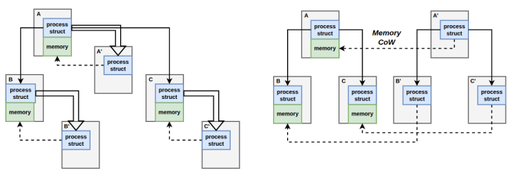
Figure 5 . Linux Process Fork vs. BunshinFork Process-Tree Fork. Left: native fork() duplicates one process as a child of the source process. Right: BunshinFork creates a sibling container and reconstructs the whole process tree inside an independent namespace.
원문 · CC BY 4.0 · Yutong Huang, Vikranth Srivatsa, Alex Asch, Yiying Zhang · BunshinRL: Splitting Live Agent Workspaces for Memory-Efficient Agentic RL · 원문 그림 인용 · 원본 PDF 7쪽에서 그림 영역을 추출했습니다.메모리는 변경되지 않은 익명 페이지를 복사하지 않고 원본 페이지에 쓰기 보호 매핑을 설치해 공유합니다. 쓰기가 일어나면 기존 커널의 copy-on-write 처리가 사적 페이지를 할당합니다. 이 방식은 온라인 포크와 디스크 기록을 분리하며, 원본은 스냅샷이 일관되면 디스크 쓰기를 기다리지 않고 재개합니다.
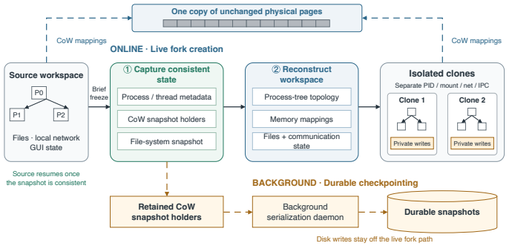
Figure 4 . BunshinFork architecture.A brief freeze captures a consistent workspace state. The live fork path reconstructs isolated clones that share unchanged pages copy-on-write and allocate private pages on writes. Retained snapshot holders support asynchronous serialization, allowing the source to resume without waiting for disk writes.
원문 · CC BY 4.0 · Yutong Huang, Vikranth Srivatsa, Alex Asch, Yiying Zhang · BunshinRL: Splitting Live Agent Workspaces for Memory-Efficient Agentic RL · 원문 그림 인용 · 원본 PDF 6쪽에서 그림 영역을 추출했습니다.메모리 공유, 접두사 캐싱, 투기적 실행의 동작
메모리 중복 제거는 같은 작업의 샘플들이 하나의 초기화된 작업공간에서 출발하게 합니다. 샘플들이 같은 도구 호출 순서를 따르는 동안에는 캐시된 스냅샷을 재사용하고, 호출이 갈라질 때 쓰기 가능한 분기를 만듭니다. 따라서 메모리 비용은 공통 상태, 분기별 쓰기, 재구성 메타데이터의 합에 가깝습니다.
도구 접두사 캐싱은 루트 초기 상태 C0에서 시작하는 접두사 트리를 씁니다. 일치 조건은 시작 상태부터 모든 단계의 도구 이름과 인자가 같은 것이며, 인자만 같다고 충분하지 않습니다. 스냅샷은 각 자식 노드의 델타로 디스크에 저장되고, 자주 쓰이는 스냅샷만 메모리에 둡니다. 이때 ancestor-aware LRU는 접근한 스냅샷의 조상도 함께 유지해 캐시가 조상 닫힘 상태를 지키게 합니다. 희소 스냅샷은 일부 경계에서만 구체화하고, 빠진 중간 호출은 가장 가까운 보존 조상에서 재실행해 메모리를 줄입니다. 원문은 이 재실행이 모델 추론과 겹쳐 임계 경로 밖에서 이루어진다고 설명합니다.
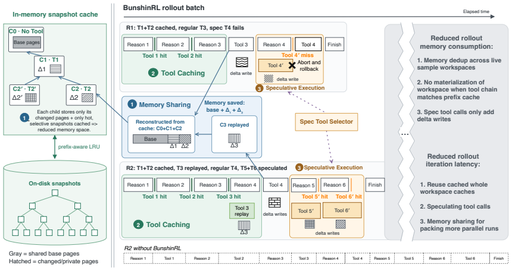
Figure 3 . Illustration of BunshinRL.Right shows two samples in a simplified rollout step; left shows the on-disk and in-memory workspace snapshot stores for tool call prefix. Reasoning steps’ generated tool call signatures are matched with the tool prefix tree. All initial matched tool calls are skipped until the first miss in tool signature (Tool 3 for R1 and Tool 4 for R2), at which point the corresponding snapshots are used to reconstruct the workspaces. As C3 is not cached in memory, Tool 3 is replayed for R2 and its delta write is added to the C0+C1+C2 snapshot. The samples execute actual Tool 3 for R1 and actual Tool 4 for R2, creating new delta CoW pages. After these calls finish, speculation starts from the resulting workspaces: Tool 4 for R1 and Tools 5 and 6 for R2. The Spec Tool Selector selects tool calls that are likely to happen from previous tool call history. When a reasoning step finishes, its output tool signature is compared with the speculative tool signature. For failed speculation, the system rolls back to the workspace snapshot before speculation.
원문 · CC BY 4.0 · Yutong Huang, Vikranth Srivatsa, Alex Asch, Yiying Zhang · BunshinRL: Splitting Live Agent Workspaces for Memory-Efficient Agentic RL · 원문 그림 인용 · 원본 PDF 5쪽에서 그림 영역을 추출했습니다.투기적 도구 실행은 Spec Tool Selector가 기록된 도구 호출 중 다음 호출을 예측하고, 작업공간을 포크해 추론과 병렬로 실행합니다. 모델이 실제 호출 서명을 내면 예측과 비교해 일치하면 결과와 상태를 채택하고, 불일치하면 투기적 쓰기를 버리고 이전 유효 스냅샷에서 실제 호출을 수행합니다.
메모리 절감의 검증 범위
OSWorld에서 BunshinRL은 CRIU 대비 피크 메모리를 30% 줄였다고 원문은 보고합니다. WebArena에서는 AgentENV 대비 피크 메모리를 43% 줄였습니다. 같은 설정에서 총 메모리 소비는 최대 51%까지 줄었고, 종단 간 롤아웃 지연은 23% 개선되었습니다. 이 수치는 Qwen3-VL-8B를 단순 동기식 GRPO 루프로 학습한 설정에서의 결과입니다.
256개 동시 롤아웃에서 CRIU가 BunshinRL보다 약 1.8배 많은 피크 메모리를 쓴다는 관찰도 제시되었습니다. 저자들은 CRIU가 포크마다 사적 메모리 복사본을 가지기 때문에 이 격차가 커진다고 해석합니다. 16개 포크 미세 벤치마크에서는 BunshinRL 10.0 GB, CRIU 17.8 GB, AgentENV 12.3 GB를 보고합니다. 여기서 CRIU는 포크당 약 1.0 GB, BunshinRL은 약 0.5 GB를 더한다고 원문이 기록합니다.
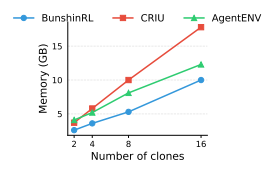
Figure 12 . Memory of Forks.Total memory of a source environ- ment and its forks as the number of forks grows, for BunshinFork, CRIU, and AgentENV .
원문 · CC BY 4.0 · Yutong Huang, Vikranth Srivatsa, Alex Asch, Yiying Zhang · BunshinRL: Splitting Live Agent Workspaces for Memory-Efficient Agentic RL · 원문 그림 인용 · 원본 PDF 10쪽에서 그림 영역을 추출했습니다.구성별 롤아웃 지연과 메모리 비용
OSWorld 한 에포크에서 Base는 메모리 공유만 사용하고, Spec은 투기적 도구 실행을, Full은 도구 접두사 캐싱과 투기적 실행을 추가합니다. Base는 20.8분, Spec은 19.2분, Full은 17.0분에 에포크를 끝냅니다. Spec은 주로 꼬리를 줄여 마지막 롤아웃이 Base보다 1.6분 빨리 끝나고, Full은 절반의 롤아웃이 Base보다 1.4분, 마지막 롤아웃이 3.8분 빨리 끝난다고 보고합니다.
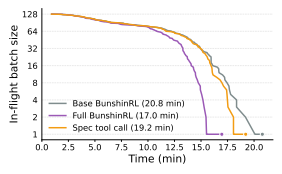
Figure 8 . Rollout Completion over Time. Number of rollouts still running over one OSWorld epoch for the Base, Full, and Spec configurations of BunshinRL (§5.3). A batch that drains sooner means higher roll- out throughput.
원문 · CC BY 4.0 · Yutong Huang, Vikranth Srivatsa, Alex Asch, Yiying Zhang · BunshinRL: Splitting Live Agent Workspaces for Memory-Efficient Agentic RL · 원문 그림 인용 · 원본 PDF 8쪽에서 그림 영역을 추출했습니다.메모리 측면에서 Full과 Spec은 Base보다 피크를 약 1 GiB만 높여 69 GiB에서 70 GiB가 됩니다. 캐시된 스냅샷과 투기적 포크는 쓰기 시에만 페이지를 가지므로 비용이 환경 전체 크기가 아니라 이후 변경량에 비례한다고 설명됩니다. 보상은 세 구성이 에포크마다 같은 값을 보였다고 원문이 보고합니다.
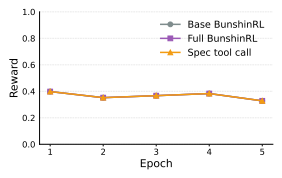
Figure 11 . Training Reward.Average roll- out reward in each OSWorld training epoch for the Base, Full, and Spec configurations of BunshinRL (§5.3).
원문 · CC BY 4.0 · Yutong Huang, Vikranth Srivatsa, Alex Asch, Yiying Zhang · BunshinRL: Splitting Live Agent Workspaces for Memory-Efficient Agentic RL · 원문 그림 인용 · 원본 PDF 10쪽에서 그림 영역을 추출했습니다.적용 범위와 남은 제약
외부 서비스는 로컬 작업공간의 스냅샷으로 되돌릴 수 없습니다. 그래서 포크 중 외부 연결은 닫히고 각 클론이 독립적으로 다시 연결하며, 투기적 분기는 아직 확정되지 않은 도구 호출이 원격 효과를 만들지 않도록 외부 네트워크를 제한할 수 있습니다.
또 BunshinFork는 컨테이너를 사용하므로 권한이 필요한 작업에는 VM이 더 적합할 수 있다고 원문은 설명합니다. 본 연구의 웹과 GUI 롤아웃에는 컨테이너 격리가 충분하다고 밝혀져 있으며, 그 밖의 워크로드에 대한 결과는 보고되지 않았습니다.
논문 정보
- 저자
- Yutong Huang, Vikranth Srivatsa, Alex Asch, Yiying Zhang
- 학회·저널
- arXiv · 프리프린트
- 최초 공개일
- 2026년 11월 7일
- 등록일
- 2026년 11월 10일
- 수정일
- 2026년 11월 7일
- 버전
- v1
- arXiv
- 2611.10453
- 분류
- cs.AI · cs.OS
- 원문 이용 조건
- CC BY 4.0
- 제공 범위
- 논문 정보, 해설, 허용된 원문 그림
AI 해설은 논문 원문과 별개의 설명이며 오류가 있을 수 있습니다. 원문과 그림은 각 출처의 이용 조건과 따로 표시된 권리를 따릅니다.
초록
Agentic reinforcement learning (RL) rollouts interleave model reasoning with tool calls in persistent workspaces. Scaling these rollouts incurs substantial memory costs for concurrent environments, while slow tool calls delay entire rollout batches. We present BunshinRL, an agentic RL rollout system that exploits shared environment state and recurring tool calls through three techniques: memory sharing across environments, tool-prefix caching, and speculative tool execution. These techniques build on BunshinFork, a novel live whole-workspace forking mechanism for containers. BunshinFork reconstructs process trees, shares memory copy-on-write, and preserves file, communication, and GUI state, enabling cached-state reuse and rollback after incorrect speculation. We implement BunshinRL and BunshinFork through Linux kernel module and CRIU modifications. BunshinRL reduces peak memory by up to 43%, total memory consumption by up to 51%, and end-to-end rollout latency by 23%.
원문 인용
Yutong Huang, Vikranth Srivatsa, Alex Asch, Yiying Zhang (2026). BunshinRL: Splitting Live Agent Workspaces for Memory-Efficient Agentic RL. arXiv:2611.10453v1. https://arxiv.org/abs/2611.10453v1
BibTeX
@misc{huang2026bunshinrl,
  title = {{BunshinRL: Splitting Live Agent Workspaces for Memory-Efficient Agentic RL}},
  author = {Yutong Huang and Vikranth Srivatsa and Alex Asch and Yiying Zhang},
  year = {2026},
  eprint = {2611.10453},
  archivePrefix = {arXiv},
  url = {https://arxiv.org/abs/2611.10453v1}
}